
The Ghost Foxes That Never Haunted Japan
Iron Lighthouse Archive

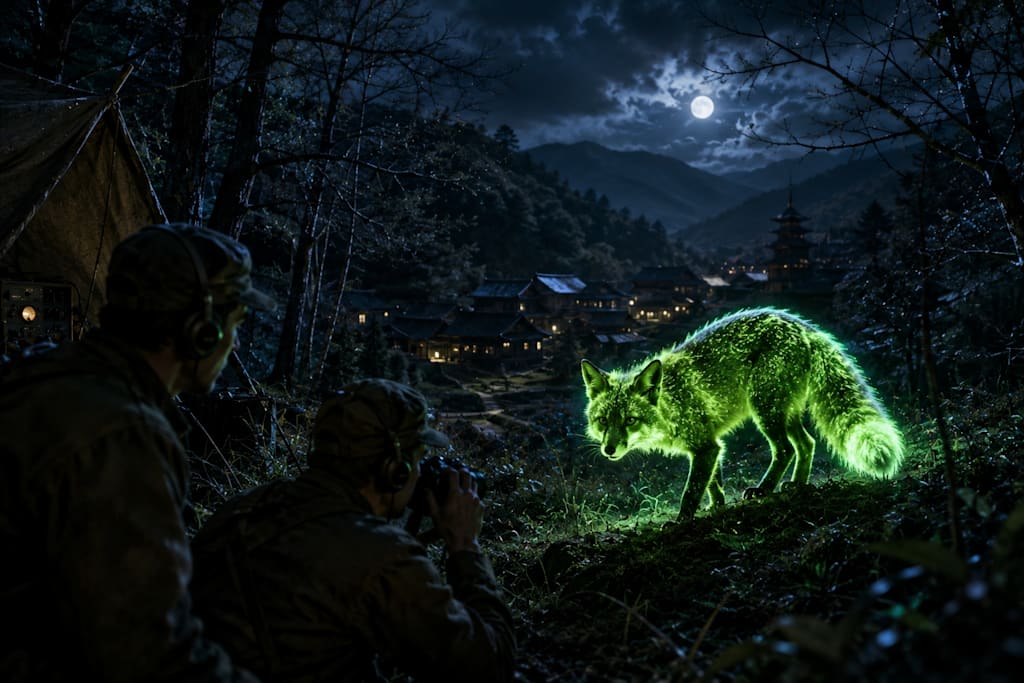
It was an age of enormous machines and monumental decisions. Yet hidden deep within the archives of America's wartime intelligence services lies a proposal so unusual that it almost sounds like satire. What if glowing foxes could help win the war? It wasn't a joke or the plot of a pulp novel. It was an actual psychological warfare proposal studied by the Office of Strategic Services... the organization that would eventually evolve into today's CIA. Known as Project Fantasia, it stands as one of the most imaginative and arguably strangest ideas ever considered by the American war effort.
To understand why anyone would contemplate releasing luminous foxes into enemy territory, we have to return to a world unlike our own. By the early 1940s, World War II had become a global struggle unlike anything humanity had ever experienced. Every major power was searching for an advantage: scientists developed radar, engineers refined jet aircraft, and cryptographers fought invisible battles with enemy codes. Intelligence agencies became laboratories of unconventional thinking. If an idea had even the slightest chance of disrupting an enemy's morale or decision-making, someone somewhere was willing to examine it.
The Office of Strategic Services, better known as the OSS, was no exception. Created in 1942 under the leadership of William J. Donovan, the OSS quickly became America's center for espionage, sabotage, and psychological warfare. Its agents parachuted behind enemy lines, organized resistance networks, gathered intelligence, and dreamed up operations that often sounded as though they belonged in adventure novels. Some of those ideas changed history. Others never left the drawing board. Project Fantasia belonged firmly in the second category.
The project began with an observation that psychologists and intelligence officers believed might be useful: every culture possesses folklore, ghost stories, legends, spirits, and creatures said to roam forests after dark. Military planners wondered whether those traditions could be exploited during wartime. Rather than attacking an enemy's soldiers directly, what if they attacked something less tangible, their confidence, expectations, or sense of reality?
The planners focused particular attention on Japanese folklore. For centuries, foxes, known as kitsune, had occupied a remarkable place in Japanese mythology. Depending upon the story, they could be clever tricksters, supernatural messengers, shape-shifting spirits, or mysterious beings capable of deceiving human observers. The OSS believed that these longstanding traditions might provide an opening for psychological warfare.
Their objective was not to convince people that folklore was literally true. Instead, they hoped to create moments of uncertainty, confusion, and unease, the kind of lingering doubt that could spread through communities already living under the tremendous stress of war. From that premise, the brainstorming became increasingly imaginative: researchers considered constructing enormous glowing figures designed to resemble legendary spirits, discussed eerie illuminated balloons drifting silently across the night sky, and proposed strange whistles, haunting sounds, and visual illusions intended to create the impression that supernatural forces were moving through the countryside. And then someone proposed the foxes: real foxes, captured alive, coated with luminous paint, and released under cover of darkness.
It is difficult to imagine the meeting where this proposal was first introduced. Yet within the culture of wartime experimentation, it apparently seemed worthy of investigation. The concept rested on a simple psychological principle: people are already inclined to fear what they cannot explain. Imagine living in a rural village during wartime: electric lights are scarce, news is limited, and rumors spread quickly. One evening, glowing animals suddenly emerge from nearby forests, silently moving across hillsides before disappearing into the darkness. The planners hoped such encounters would generate confusion that far exceeded the effort required to create them.
Remarkably, the project advanced beyond idle conversation. Officials began exploring practical questions: What type of luminous coating would remain visible throughout the night? Would the animals groom the paint away too quickly? Would the glow be bright enough to create the desired effect? Could foxes be transported and released without immediately fleeing in unpredictable directions? The very existence of such questions reminds us how seriously intelligence agencies evaluated even their most unconventional ideas.
At one stage, researchers tested luminous paint on animals to determine how well it adhered to fur. According to historical accounts, a raccoon at New York's Central Park Zoo became an unlikely participant in the experiment. The coating reportedly remained visible, and the concept, at least in that limited sense, appeared technically possible.
Unfortunately for Project Fantasia, technical possibility proved to be the least of its problems. Animals, after all, rarely cooperate with military planning. Foxes do not march in formation, follow tactical objectives, or haunt only strategically useful locations. Once released, they would simply do what foxes have always done: run wherever they pleased. Some might vanish into forests, others might cross rivers, and still others could head in precisely the opposite direction of the intended target. The military could illuminate them, but it could not command them.
There was another problem as well: many of the proposed luminous coatings relied upon radioactive compounds or chemicals that would never have been suitable for widespread use on living animals. Even by the standards of the 1940s, practical concerns quickly accumulated. As engineers, chemists, and planners examined the proposal in greater detail, its weaknesses became increasingly obvious. Project Fantasia gradually faded from consideration. The glowing foxes were never deployed. No Japanese villages awoke to discover spectral animals wandering their streets. No battlefield was won through supernatural illusion. The foxes remained exactly what they had always been, foxes.
Yet dismissing the project as nothing more than an amusing curiosity misses something important. Project Fantasia reveals how profoundly different wartime thinking can become. Modern readers often imagine military planning as strictly logical, governed by maps, mathematics, and engineering. Those elements certainly mattered, but so did psychology: fear, rumor, expectation. Military leaders understood that wars were fought not only with bullets and bombs but also with ideas. If convincing an enemy that ghosts walked the countryside could reduce morale or disrupt decision-making, someone believed it deserved investigation.
In that sense, Project Fantasia belonged to a much broader family of wartime deception. Throughout World War II, the Allies employed inflatable tanks, fake airfields, wooden aircraft, dummy radio traffic, carefully staged misinformation campaigns, and elaborate phantom armies to confuse Axis commanders. Compared with those operations, glowing foxes seem absurd, yet they emerged from the same underlying philosophy. Reality could be manipulated, perception could become a weapon, and sometimes the greatest victories came not from overwhelming force but from convincing an opponent to believe something that was never true.
Fortunately, someone eventually recognized that foxes made unreliable soldiers. Project Fantasia quietly disappeared into filing cabinets, overshadowed by more practical intelligence operations. For decades, few people even knew it had existed. Only later, as wartime archives were opened and historians sifted through OSS records, did the remarkable proposal reemerge. Readers encountering it today often react the same way: first comes disbelief, then laughter, then the realization that the story says something surprisingly profound about the era that produced it.
World War II demanded extraordinary creativity. Governments explored ideas ranging from the brilliant to the bizarre because the stakes were unimaginably high. Radar transformed modern warfare. Cryptography shortened the conflict. Medical advances saved countless lives. And somewhere, tucked between those genuine triumphs of science and engineering, sat a file describing glow-in-the-dark foxes.
History has a wonderful habit of humbling our expectations. We imagine the past as orderly and assume governments always pursued obvious solutions. Then a forgotten document surfaces, reminding us that real people, under immense pressure, facing impossible circumstances, sometimes reached for ideas that bordered on the fantastic. Perhaps that is why Project Fantasia deserves to be remembered: not because it succeeded, not because it changed the course of the war, but because it reminds us that history is written by human beings: curious, inventive, imperfect people willing to chase even the strangest possibilities if they believed those possibilities might help bring an unimaginably destructive conflict to an end.
The glowing foxes never haunted Japan. Instead, they haunt history itself. A quiet reminder that sometimes the most unbelievable stories are not myths at all, but simply the plans that never escaped the filing cabinet.
About the Creator
The Iron Lighthouse
Where folklore meets freeway. A guide to the strange heart of the American backroads...
Enjoyed the story? Support the Creator.
Subscribe for free to receive all their stories in your feed.
Comments
There are no comments for this story
Be the first to respond and start the conversation.