
The Day They Tried to Lift the Pentagon
Mind-bending Monday Edition

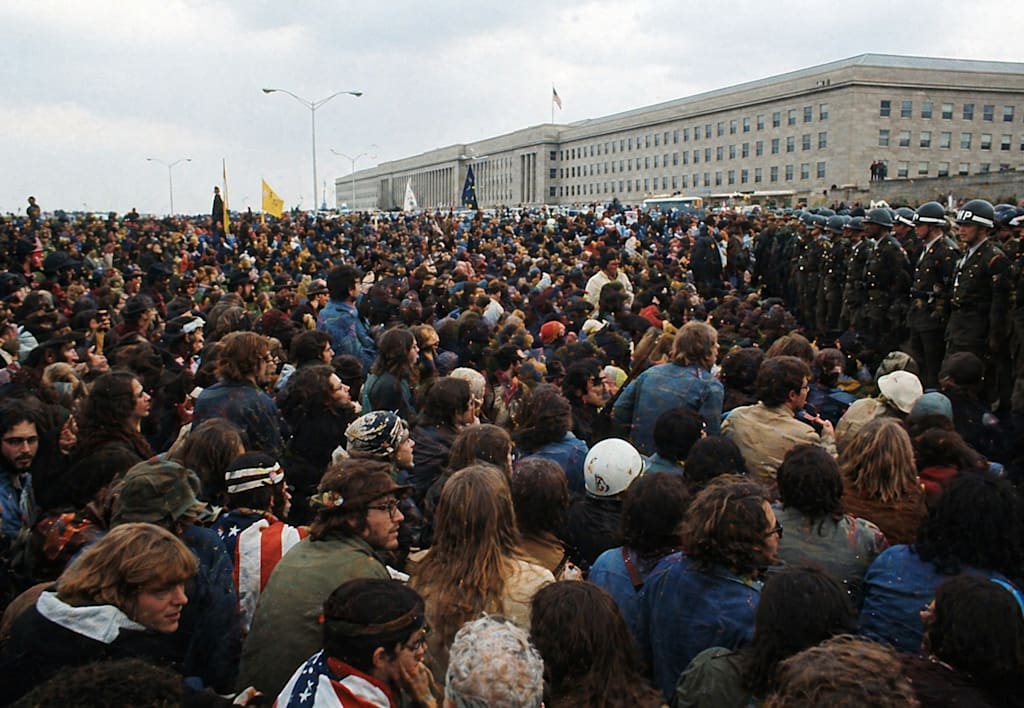
On an October day in 1967, the air outside The Pentagon felt charged with something that was difficult to define and even harder to contain. It wasn’t just anger, though there was plenty of that. It wasn’t just a protest, though that was certainly the reason thousands had gathered. It was something stranger, something more theatrical, more symbolic, more… improbable. Because among the chants and signs and restless movement of bodies pressing toward the seat of American military power, a plan had taken shape that sounded less like strategy and more like something pulled from a dream. They were going to lift the Pentagon...
Not metaphorically. Not rhetorically. Not as some poetic turn of phrase meant to inspire. They intended, at least in spirit, and perhaps in some corners quite literally, to raise the massive five-sided building hundreds of feet into the air using nothing more than collective will, chanting, and what some described as psychic energy. It was absurd. It was impossible. And yet, it happened... at least as an idea, as an event, as a moment that somehow slipped into the fabric of American history and refused to leave.
A War That Followed Them Home
To understand how something like this could happen, you have to step into the atmosphere of the late 1960s, a time when the Vietnam War had begun to fracture the American psyche in ways that were still unfolding. Images from overseas filtered into living rooms across the country. Grainy footage of jungle warfare, body counts, villages burning, and young men not returning. The distance between the war and the American public was shrinking, not geographically, but emotionally.
For many, especially younger Americans, the war felt less like a distant conflict and more like an unavoidable reality pressing in on all sides. Draft notices arrived. Conversations shifted. Questions that once seemed abstract became deeply personal. And with that shift came resistance.
Protests were not new, but they were growing, larger, louder, more urgent. And they were evolving. What had begun as traditional demonstrations was transforming into something more experimental, more expressive, more willing to blur the lines between activism and art.
Enter figures like Abbie Hoffman and Jerry Rubin, men who understood that in a media-driven age, attention was its own kind of currency. If you wanted to challenge power, you couldn’t just oppose it, you had to out-imagine it.
The Plan That Shouldn’t Have Been Taken Seriously
The idea to levitate the Pentagon was born of that mindset. A fusion of protest and performance designed to do what traditional demonstrations could not. It wasn’t about physics. It wasn’t about actually lifting thousands of tons of reinforced structure into the air. It was about creating a moment so surreal, so unexpected, that it would force people to look at what was happening differently. And in one of those details that feels almost too perfect to be true, the organizers actually sought a permit.
They proposed raising the Pentagon 300 feet into the sky.
The government, perhaps recognizing the absurdity but unwilling to fully dismiss it, reportedly negotiated the terms down to something more… manageable. A few inches, perhaps. A compromise between imagination and bureaucracy that somehow made the entire situation even more surreal. Because now, in a strange and official way, the possibility of levitation had been acknowledged, if only on paper.
Gathering at the Edges of Power
On October 21, 1967, thousands of protesters converged on Washington, D.C., eventually making their way to the Pentagon itself. They came with signs, with music, with flowers tucked into pockets and hair. Some came with a sense of purpose rooted in politics. Others came drawn by something less defined, a feeling that this moment, whatever it was, mattered. As the crowd grew, so did the tension.
Inside the Pentagon, decisions were being made about how to respond. Outside, the line between protest and confrontation began to blur. Soldiers stood watch, forming a human barrier between the building and the gathering mass. Young men in uniform, many not much older than the protesters themselves, were facing off against a movement that, in many ways, spoke directly to them. And then, somewhere within that gathering, the plan moved from idea to action.
The Attempt
Accounts vary, as they often do with moments that straddle the line between reality and legend, but the essence remains consistent. A group of protesters began to chant, to focus their attention on the massive structure before them. Hands were raised. Voices joined together in rhythm. Some closed their eyes. Others stared directly at the building as if willing it to respond. They were trying to lift it. Not with machines. Not with tools. But with belief.
Around them, the scene unfolded in layers. Some participants embraced the moment fully, committing to the act with sincerity. Others watched with a mix of amusement and curiosity, understanding the symbolic nature of what was happening. Journalists moved through the crowd, capturing images that would soon travel far beyond the edges of that day.
And the soldiers… The soldiers watched.
There is something almost cinematic in that image: disciplined lines of military personnel standing firm while, just beyond them, a group of citizens attempted to alter reality through collective will. Two visions of power facing each other, one grounded in force and structure, the other in imagination and defiance.
What Actually Happened
The Pentagon, as you might expect, did not rise into the air. It did not tremble, shift, or lift even the smallest measurable distance. The laws of physics remained intact, unmoved by chanting or intention. But to focus only on that is to miss the point entirely. Because something did happen. Something that doesn’t show up on a scale or in a measurement, but that nonetheless altered the landscape in which it occurred.
For a moment, the unthinkable had been attempted, not in secret, not in isolation, but in full view of the world. The idea that power could be confronted not just with opposition, but with absurdity, had been made visible. The Pentagon, a symbol of military authority, had been turned into the centerpiece of a performance that challenged its very gravity, not physically, but conceptually.
The Echo It Left Behind
In the years that followed, the attempt to levitate the Pentagon became part of the broader mythology of the 1960s, a story told and retold as an example of the era’s unique blend of seriousness and surrealism. It stood as a reminder that protest didn’t always follow predictable paths, that sometimes the most effective way to challenge something was to reframe it entirely. It also revealed something deeper about the people involved.
They understood, perhaps instinctively, that systems of power rely not just on force, but on perception. That authority is sustained not only by what it can do, but by what people believe it can do. And by choosing to engage with that perception in such an unconventional way, they introduced a kind of uncertainty into the equation. Not enough to topple a building. But enough to make people think.
The Lighthouse Reflection
There is a tendency, when looking back at moments like this, to reduce them to their most obvious elements. To laugh at the idea of people trying to lift a building with their minds. To dismiss it as a product of its time, a strange footnote in a decade full of them. But that misses something important.
Because beneath the surface of that absurdity was a very real impulse, the desire to challenge something that felt immovable. The need to confront a system that seemed too large, too entrenched, too powerful to be affected by ordinary means. And so they reached for something extraordinary.
Not because they believed it would work in a literal sense, but because it allowed them to express something that could not be contained within the usual boundaries of protest. It gave form to a feeling that words alone could not fully capture.
They didn’t lift the Pentagon, but for a moment, they lifted the idea that it could not be questioned. And sometimes, that is where change begins, not in the movement of stone, but in the shifting of perception.
Because once people begin to imagine that something can be different, even in the most unlikely way, the ground beneath it, no matter how solid it seems... begins, ever so slightly, to move.
About the Creator
The Iron Lighthouse
Where folklore meets freeway. A guide to the strange heart of the American backroads...
Enjoyed the story? Support the Creator.
Subscribe for free to receive all their stories in your feed.
Comments
There are no comments for this story
Be the first to respond and start the conversation.