
The Day It Rained Meat in Kentucky
Surreal Saturday Edition

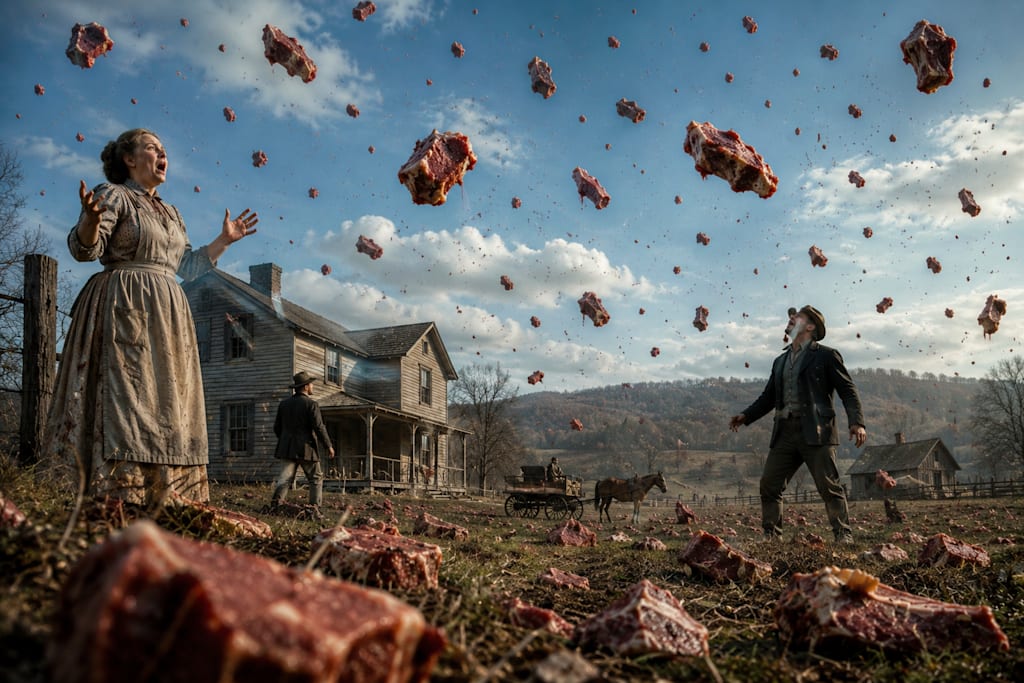
On a pleasant spring day in March of 1876, the residents of a small settlement in Bath County, Kentucky, witnessed something so bizarre that, nearly a century and a half later, historians and scientists are still talking about it. There were no dark storm clouds gathering overhead. No tornadoes churned on the horizon. No signs suggested that the day would become one of the strangest in American history. And then, without warning, meat began falling from the sky.
This is not folklore, nor is it an exaggerated campfire tale polished by generations of storytellers. On March 3, 1876, dozens of witnesses reported that chunks of fresh red flesh descended onto the farm of Allen and Nancy Crouch near Olympia Springs, Kentucky. Newspapers across the country picked up the story, scientists examined samples, and a mystery was born that has never been fully put to rest. It has come to be known simply as the Kentucky Meat Shower. A name that sounds like something invented by an eccentric novelist, yet by all accounts, it really happened.
The event occurred in the rolling hills of eastern Kentucky, where farming communities dotted the landscape and daily life moved at a steady, familiar pace. According to contemporary reports, Mrs. Crouch was outside making soap when she noticed pieces of material drifting down from above. At first glance, she may have thought it was ash or some unusual weather phenomenon. Instead, she found chunks of flesh scattered across the ground. Witnesses later described pieces ranging in size from small flakes to strips several inches long. Some accounts claimed that the meat covered an area roughly the size of a football field. One newspaper described the material as appearing fresh, red, and unmistakably animal in origin.
Witnesses later described pieces ranging in size from small flakes to strips several inches long. Some accounts claimed that the meat covered an area roughly the size of a football field. One newspaper described the material as fresh, red, and unmistakably of animal origin.
Naturally, confusion spread almost immediately. The late nineteenth century was an era fascinated by unexplained events. Americans read newspaper accounts of mysterious storms, comets, and scientific discoveries with great enthusiasm. But even by the standards of the day, meat falling from a clear sky presented a unique challenge. What exactly were people supposed to make of this? Speculation erupted. Some locals wondered whether the event had supernatural origins. Others suggested it might have been carried by unusual weather patterns. A few simply stared at the sky and admitted they had no explanation whatsoever.
Speculation erupted. Some locals wondered whether the event had supernatural origins. Others suggested it might have been carried by unusual weather patterns. A few simply stared at the sky and admitted they had no explanation whatsoever.
Then, in a wonderfully nineteenth-century twist, people did something that modern readers may find difficult to comprehend: they tasted it. Faced with chunks of unidentified flesh that had apparently descended from the heavens, several residents decided that the most sensible course of action was to sample the material in hopes of identifying it. The verdicts were mixed; some insisted that the substance resembled mutton, others thought it tasted like venison, still others proposed beef, horse meat, or even bear. Whatever the answer, the consensus was surprisingly straightforward: it was definitely meat. For historians, this detail has become one of the event's most enduring and amusing features. Long before DNA analysis, sophisticated laboratories, or modern forensic techniques, rural Americans often relied on direct experience to solve everyday problems. In 1876 Kentucky, apparently, that included tasting whatever happened to fall from the sky.
As news of the incident spread, curiosity quickly extended beyond Bath County. Scientists and physicians requested samples for examination. Newspapers from New York to California printed increasingly sensational accounts. Readers who had never heard of Olympia Springs suddenly found themselves captivated by a mystery unfolding hundreds of miles away. The scientific investigations produced results that only deepened the puzzle. One analysis concluded that the material contained muscle tissue, cartilage, and lung tissue from an animal. Another suggested that some of the samples resembled horse or infant tissue, though later researchers questioned those findings. Under the microscopes available at the time, the specimens appeared unmistakably organic. This was not dust, pollen, or some strange mineral deposit. Something biological had fallen onto a Kentucky farm. That realization left scientists with an obvious question: How?
Over the years, theories multiplied. Some observers suggested that powerful winds or whirlwinds had carried animal remains from elsewhere before depositing them over the Crouch property; others speculated about unusual atmospheric conditions. In an age when scientific understanding of weather and biology was still evolving, explanations ranged from the plausible to the wildly imaginative. For a time, one theory proposed that the substance was not meat at all, but rather a gelatinous bacterial growth known as Nostoc. An organism that sometimes appears suddenly after rainfall and had occasionally been mistaken for material that had fallen from the sky. Unfortunately for advocates of that explanation, the people who had actually handled, and tasted, the samples remained unconvinced. Nostoc, they insisted, did not taste like mutton.
As the decades passed, another explanation slowly gained favor among historians and scientists, and somehow, it managed to be even stranger than the mystery itself. The leading theory today involves vultures… specifically, a large flock of vultures flying over Bath County at precisely the wrong moment. To understand why this explanation has endured, one must first appreciate a little-known fact about vultures: they have an unusual defensive strategy. When threatened, startled, or suddenly needing to reduce their weight for flight, vultures are capable of regurgitating the contents of their stomachs. It is an efficient, if rather unpleasant, adaptation. By quickly emptying partially digested food, the birds become lighter and better able to escape danger… in other words, vultures occasionally vomit on purpose.
The theory goes something like this: at some point before passing over the Crouch farm, a large group of vultures had been feeding on the carcass of an animal. Something then startled the flock, perhaps a predator, a loud noise, or simply the movements of the birds themselves, triggering a mass regurgitation event. The result? Kentucky's most infamous rainstorm. As ridiculous as the explanation sounds, it possesses several strengths: it accounts for why the material appeared to be fresh animal tissue, explains why the pieces varied in size and composition, and most importantly, relies on documented animal behavior rather than supernatural forces.
Yet even the vulture hypothesis raises questions. Would an entire flock really regurgitate simultaneously? How large would such a flock need to be? Why did witnesses describe the sky as clear? And perhaps most importantly: what are the odds? Therein lies the enduring appeal of the Kentucky Meat Shower. Many mysteries disappear once science provides an explanation, but this one somehow became even more fascinating. The accepted solution, mass synchronized vulture vomiting, sounds so absurd that it circles back around to being extraordinary. It is difficult to imagine a more perfect collision between science and strangeness.
What makes the story particularly compelling is that it unfolded during a period of enormous change in American life. The United States of 1876 stood at the crossroads between frontier traditions and modern science. Telegraph lines crisscrossed the country, newspapers reached audiences on an unprecedented scale, and scientific institutions were becoming increasingly influential. Yet when confronted with meat falling from the heavens, Americans responded with a curious blend of skepticism, practicality, and wonder: they collected evidence, debated theories, consulted experts, and, for reasons that remain difficult to explain, they tasted it. That combination of curiosity and improvisation feels unmistakably American.
Today, the Kentucky Meat Shower occupies a peculiar place in history. It appears in books of oddities, lists of unexplained phenomena, and collections of forgotten Americana. Tourists occasionally visit Bath County hoping to stand where the event occurred, and historians continue to revisit newspaper archives in search of overlooked clues. But no definitive answer has emerged, perhaps none ever will. The truth may indeed involve vultures and an unfortunate coincidence of timing. Or perhaps some crucial piece of evidence disappeared long ago, carried off by weather, memory, and the passage of time. Whatever the explanation, the residents of Bath County experienced something few people in human history can claim: for a few bewildering minutes on an otherwise ordinary afternoon, they looked up into a clear Kentucky sky and watched meat rain down upon the earth.
The world is full of forgotten roads, abandoned towns, and lost inventions. And sometimes, just sometimes, it contains a story so improbable that even after nearly 150 years, we still find ourselves asking the same question those Kentuckians must have asked in 1876: "What on earth just happened?"
About the Creator
The Iron Lighthouse
Where folklore meets freeway. A guide to the strange heart of the American backroads...
Enjoyed the story? Support the Creator.
Subscribe for free to receive all their stories in your feed.
Comments
There are no comments for this story
Be the first to respond and start the conversation.