
The Bargain That Drew China Into the Korean War
Mao went to Moscow in 1949 to secure Soviet aid and recover Chinese rights in Manchuria. The treaty he won reshaped the new republic’s foreign policy, while Stalin’s decisions on Korea helped pull Beijing into a war it had hoped to avoid.
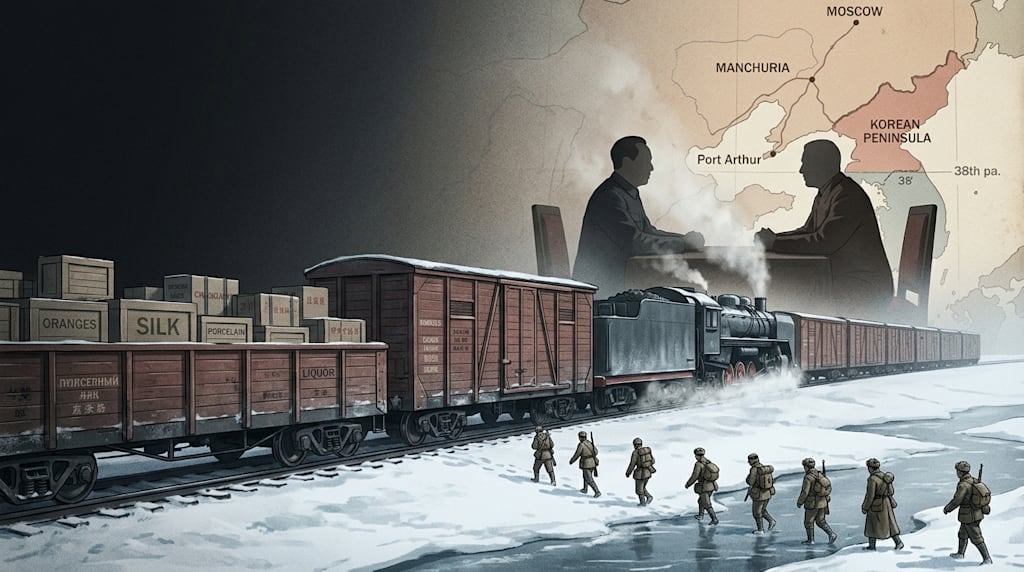
In the winter of 1949, a special train left Beijing for Moscow. Accounts of Mao Zedong’s visit describe a cargo of Chinese gifts for Joseph Stalin’s seventieth birthday: oranges from Jiangxi, scallions from Shandong, porcelain, silk, and liquor. The shipment was ceremonial. The journey was not.
Mao had two urgent tasks. He needed Soviet recognition, military assistance, loans, and technical help for a country exhausted by decades of war. He also wanted Moscow to surrender privileges it had secured in China’s northeast under an agreement with the Nationalist government in 1945.
Those aims pulled in opposite directions. The new People’s Republic needed the Soviet Union, but Mao did not intend to inherit the old government’s unequal arrangements with a different great power. The negotiations that followed shaped China’s alliance with Moscow. They also formed part of the setting in which the Korean War began.
1. A new government and an old problem
When the Chinese Communist Party declared the People’s Republic on October 1, 1949, it inherited a battered economy and a difficult diplomatic map. The civil war had left much of the country poor, inflation had eroded living standards, and the government needed to rebuild transport, energy, and industry. It had few sources of outside financing.
The CCP’s answer to the foreign-policy question was stated in 1949 as “leaning to one side”: the new state would align itself with the socialist bloc rather than try to balance Washington and Moscow. The choice reflected ideology, security concerns, and the practical need for Soviet support. It also reflected the Communist leadership’s hostility toward foreign privileges negotiated by the Nationalist government.
One target was the Sino-American Treaty of Friendship, Commerce and Navigation, signed by the Nationalist government and the United States in November 1946. The treaty gave citizens of each country broad rights to conduct business, pursue professions, own or lease property, and reside in the other country, subject to the treaty’s terms and local law.
Formally reciprocal provisions could still look unequal to Chinese Communists: American firms operated from a position of overwhelming industrial and financial strength, while Chinese businesses were trying to recover from years of war.
The treaty was not, by itself, the cause of China’s postwar economic crisis. The fiscal breakdown of the Nationalist government had many causes, including military expenditure, disrupted production, debt, and runaway inflation. But for the new leadership, the broader lesson was clear. Beijing did not want its foreign policy to preserve arrangements that it believed had compromised China’s sovereignty.
The awkward question was whether the same standard would apply to the Soviet Union.
2. What Stalin wanted to keep
The roots of the dispute lay in the final months of the Second World War. At the Yalta Conference in February 1945, the United States, Britain, and the Soviet Union discussed Soviet entry into the war against Japan. The arrangements gave Moscow strategic advantages in northeast Asia. After the Soviet Union entered the war against Japan in August, it negotiated a treaty with Chiang Kai-shek’s Nationalist government.
The Sino-Soviet Treaty of Friendship and Alliance, signed on August 14, 1945, and its related agreements gave the Soviet Union a major position in Manchuria. The two governments agreed to joint administration of the Chinese Changchun Railway. The Soviet Union gained the right to use Port Arthur as a naval base, while Dairen, now Dalian, had a special status shaped by the agreement. Mongolia’s separate status was also recognized through the diplomatic arrangements of the period.
These arrangements did not make the whole of northeast China Soviet territory. Chinese authorities remained responsible for Chinese territory. But Soviet control over railway rights and military access gave Moscow considerable strategic influence in a region central to China’s economy and security.
For Stalin, the agreement offered a buffer against future threats and access to an important Pacific position. For Mao, the same rights were a test of whether the Soviet Union would treat the new government as an equal ally or as a successor expected to accept the obligations made by its predecessor.
Mao arrived in Moscow on December 16, 1949. The first meetings did not settle the treaty question. Stalin argued that the 1945 arrangement was tied to the Allied settlement at Yalta and warned that changing it could reopen other wartime agreements. Mao’s position was different: China had not participated in the Yalta negotiations, and the Nationalist government’s signature could not settle the question of China’s rights indefinitely.
The negotiations stalled for weeks. The dispute was about more than the text of a treaty. Mao needed Soviet assistance, yet he also needed to establish that the new government could negotiate over territory, transport, and military bases without simply accepting Moscow’s demands.
A breakthrough came in early January. Zhou Enlai travelled to Moscow to lead the detailed negotiations, and the two governments eventually agreed on a new treaty. On February 14, 1950, they signed the Sino-Soviet Treaty of Friendship, Alliance and Mutual Assistance. Related agreements called for the transfer of the Chinese Changchun Railway to China by the end of 1952, set out the future of Soviet forces at Port Arthur, and provided a Soviet credit of $300 million over five years. The governments also formally ended the 1945 treaty arrangements and acknowledged Mongolia’s independence.
The credit mattered, but it was not a blank cheque. The treaty gave China a formal alliance and access to Soviet assistance while leaving important questions to be resolved through later agreements. A later exchange of notes extended Soviet use of Port Arthur; the withdrawal was completed by May 31, 1955.
Mao had secured a new legal framework for the relationship. He had not removed the underlying imbalance in power. That imbalance would soon be tested on the Korean Peninsula.
3. Korea enters the bargain
The Korean Peninsula had been divided into Soviet and American occupation zones after Japan’s surrender in 1945. The dividing line was the 38th parallel. By 1948, separate governments had emerged: the Democratic People’s Republic of Korea in the north, led by Kim Il Sung, and the Republic of Korea in the south, led by Syngman Rhee. Both claimed authority over the peninsula.
Kim had spent years in anti-Japanese guerrilla activity in Manchuria. A raid on Pochonbo in 1937 became a central episode in the official account of his resistance career and later helped establish his credentials as a national leader. After Japan’s defeat, Soviet authorities helped bring him back to Korea and supported his rise in the north. The political systems taking shape on both sides suppressed opponents, and the division hardened into an armed confrontation.
Kim repeatedly pressed Stalin for permission to reunify Korea by force. Stalin initially refused. He was concerned that a war might bring American forces into direct conflict with the Soviet Union. A divided Korea was unsatisfactory to Kim, but it left Moscow with a buffer and avoided a direct military test with Washington.
That position shifted in 1950. On January 30, Stalin sent a message indicating that he was prepared to help Kim, while stressing that the plan required extensive preparation and should not carry excessive risk. The archival message does not show an unconditional green light that day. The decision developed over the following months, as Kim continued to press his case and argued that North Korean forces could win quickly. By April, Stalin had agreed in principle, subject to Chinese approval.
Why did Stalin change his mind? Historians have offered more than one explanation. Documents from the Soviet archives show that his calculations about the United States and his relationship with Mao both mattered. One influential interpretation, advanced by historian Shen Zhihua, argues that Stalin saw the Korean question as a way to preserve Soviet influence over China at a time when Beijing was negotiating to recover Soviet-held privileges in the northeast. Other studies place greater weight on Stalin’s belief that the North could win before the United States intervened, and on his misreading of the risks.
The idea that Stalin deliberately set the war in motion solely to retain access to Port Arthur and Dairen is therefore too certain. The ports and the treaty dispute formed part of the strategic context, but the surviving evidence does not reduce Stalin’s decision to one motive or prove that he cared nothing about the war’s outcome.
4. The decision passed to Beijing
Kim travelled to Beijing in May 1950 and told Mao that Stalin had approved a military campaign. Mao was surprised and sought confirmation from Moscow through the Soviet ambassador. The surviving Soviet diplomatic cables record the request and Stalin’s reply. Stalin said the question had to be decided by the Korean and Chinese leaders together, and that the plan should be postponed if China objected.
This placed Mao in a difficult position. He was still pursuing other priorities, including plans concerning Taiwan, and a war on the Korean Peninsula would consume resources the new state badly needed. But China depended on the Soviet alliance for military equipment, credit, and industrial assistance. Openly rejecting Stalin after Moscow had approved Kim’s request would have risked damaging that relationship. Kim also presented the campaign as one that North Korea could win quickly, without requiring Chinese troops.
Mao did not receive a detailed operational plan that gave Beijing meaningful control over the timing of the invasion. The available evidence suggests that China was brought into the decision late, then asked to endorse an initiative already negotiated between Moscow and Pyongyang. That does not mean China had no agency. Mao ultimately approved the plan after checking Stalin’s position. It does mean that the new Chinese leadership had little room to shape the proposal on its own terms.
North Korean forces crossed the 38th parallel on June 25, 1950. The United Nations Security Council called for an end to the fighting and the withdrawal of North Korean forces in Resolution 82. It then recommended assistance to South Korea in Resolution 83. On July 7, Resolution 84 recommended that forces provided by UN member states be placed under a unified command led by the United States.
The Soviet representative was absent from the Council during this period because the Soviet Union was boycotting UN bodies over the refusal to give the Chinese seat to the People’s Republic of China instead of the Nationalist government. That absence meant Moscow did not use its veto to block the resolutions. The fact of the boycott is documented; the claim that the Soviet Union stayed away specifically to engineer the UN response is a separate interpretation and should not be presented as established fact.
The United States and other countries entered the conflict under the UN command. By the autumn, UN forces had pushed north after the landing at Incheon and were advancing toward the Chinese border. The prospect of hostile forces near the Yalu River turned China’s earlier diplomatic problem into a direct security crisis.
5. China chooses to intervene
By October 1950, Mao and his colleagues faced a decision with no easy answer. China had emerged from years of civil war with a weak air force, a small navy, limited supplies, and an economy that had barely begun to recover. The United States had far greater industrial capacity and air power. Chinese leaders had good reason to fear that intervention could expand the war and expose the new republic to devastating retaliation.
The debate inside the Chinese leadership was serious. Lin Biao, one of the commanders considered for the assignment, did not take command; Peng Dehuai was selected instead. Mao argued that allowing American-led forces to reach the Yalu would leave China vulnerable and could make economic recovery impossible. The dispatch of the US Seventh Fleet into the Taiwan Strait after the outbreak of war reinforced Beijing’s fear that the Korean conflict could widen into a broader confrontation with the United States.
Security was not the only consideration. Mao also had to reckon with the alliance he had just secured in Moscow. China’s refusal to assist North Korea could have weakened its standing with Stalin, while intervention would demonstrate that Beijing was prepared to bear the costs of the alliance. The decision was made under severe pressure, but it was still a decision by China’s own leadership, based on its assessment of the risks at the border and the consequences of standing aside.
Chinese People’s Volunteers began entering Korea in October 1950. Their intervention halted the UN advance into the north and forced a retreat southward. The front moved back and forth over the following months. The fighting became a costly war of attrition, and neither side achieved the complete military victory it had sought.
An armistice was signed on July 27, 1953. It stopped the fighting, but it did not produce a peace treaty or reunify Korea. The peninsula remained divided, with the border close to the line from which the war had begun.
6. What China gained, and what it paid
The war cost China heavily in lives, resources, and years of economic effort. Casualty estimates vary by source and by whether they include missing personnel, deaths from wounds, and other losses. Whatever the count, the human cost was enormous for a country that had only just emerged from civil war.
The war also changed the relationship between Beijing and Moscow. Mao later argued that Soviet confidence in China deepened during the Korean War. The alliance brought major assistance for industrial development, including Soviet equipment, designs, and technical expertise. The best-known part of that program became the “156 Projects,” a group of industrial ventures that formed a large part of China’s First Five-Year Plan. The program developed through a series of agreements in the 1950s, with projects concentrated in sectors such as power, machinery, coal, and steel. It should not be described as a single payment for China’s decision to enter the war, though the war and the alliance helped shape the political setting in which Soviet assistance expanded.
It is also important to distinguish that broader industrial cooperation from the $300 million credit in the February 1950 agreement. The credit was a specific treaty provision. Soviet assistance in the years that followed involved additional arrangements, equipment, expertise, and project agreements negotiated over time.
The other major outcome concerned China’s sovereignty in the northeast. Under the new agreements, the Chinese Changchun Railway was transferred to China by the end of 1952. Soviet forces remained at Port Arthur longer. In October 1954, the two governments agreed that the withdrawal of Soviet military units and the transfer of the naval-base facilities to Chinese control would be completed by May 31, 1955. The published agreement cited the changed regional situation after the Korean War and the restoration of peace in Indochina, as well as China’s increased defensive capacity.
That outcome matched a central goal of Mao’s Moscow trip: the new Chinese government would no longer accept the Soviet military position at Port Arthur as an indefinite inheritance from the Nationalist era. But the chain of events should not be made too neat. The record supports the conclusion that Stalin weighed the Korean War alongside his relationship with China; it does not conclusively establish that he approved the invasion simply to hold on to the ports regardless of the result.
The war also established a limit to American power on the Asian mainland. US and UN forces had not unified Korea under Seoul, and China had shown that it was willing to fight a major power near its border. Yet the war did not end China’s insecurity. The United States and China emerged as bitter enemies, Taiwan remained outside Beijing’s control, and the Korean Peninsula remained divided.
By May 31, 1955, Soviet troops had completed their withdrawal from Port Arthur. The harbour and its military facilities were under Chinese control again. The return of those rights fulfilled one of the diplomatic aims that had taken Mao to Moscow in 1949.
The path to that result ran through a war whose plans were first worked out by Stalin and Kim Il Sung, then presented to Mao for approval. China gained room to act as an independent power, but the proof of its independence came at a price paid on Korean soil.
About the Creator
Jin
Writer of reamstories
https://reamstories.com/jin
Enjoyed the story? Support the Creator.
Subscribe for free to receive all their stories in your feed. You could also become a paid subscriber, letting them know you appreciate their work.
Comments
There are no comments for this story
Be the first to respond and start the conversation.