Places
The Enigmatic Legend of El Dorado
The quest for El Dorado is regarded as one of the most intriguing legends associated with European exploration in the Americas. Translated as "The Golden One" in Spanish, El Dorado initially referred to a ceremonial figure within South American mythology rather than a specific city. As time progressed, this concept transformed into the legendary tale of a city or kingdom purportedly overflowing with gold, captivating the imaginations of explorers and adventurers for centuries.
By A História2 years ago in History
The Rise and Fall of Ancient Egypt: A Journey Through Time. Content Warning. AI-Generated.
It was Egypt, one of the world's oldest and most fabulous civilizations, along the banks of the Nile River that shone for thousands of years through the great pyramids to the very intricate mummification process. Ancient Egypt's history is rich and mysterious as a succession of mighty rulers shaped the culture, religion, and architectural wonders that remain famous even today. But like all great empires, Egypt's glory was eventually brought to an end. Here, we are going to tell you the story of Ancient Egypt, how they made mummies, the building of the pyramids, and the eventual collapse of the mighty kingdom that once was.
By Muhammad Naeem2 years ago in History
The Mystery of Oak Island: Unraveling the Enigma. AI-Generated.
Introduction: The Allure of Oak Island Do you know Oak Island? It is a small island located off the coast of Nova Scotia, Canada. It has emerged as one of the most famous places in the world for mystery enthusiasts and treasure hunters alike. The island is notorious for its legendary Money Pit, a deep shaft that has supposedly hidden treasure for centuries. Many people have long speculated about the treasure that was buried on Oak Island, and hundreds of expeditions have tried to uncover secrets. However, despite all these efforts, the truth about the mystery of Oak Island has remained elusive. So, what is going on with Oak Island and why does it capture the imagination of so many?
By soman Goswami2 years ago in History
Investigating the origins of civilization
Situated in the rich valley between the Tigris and Euphrates rivers, in present-day Iraq, Mesopotamia is recognized as one of the most important historical regions in human history. Commonly known as the "Cradle of Civilization," this area was inhabited by various groups who vigorously competed for its valuable resources and its strategic location linking Asia, Africa, and Europe. Among the ancient cultures that flourished in this region, the Sumerians are particularly notable for their groundbreaking contributions to state formation, cultural advancement, and technological progress. The designation "Sumerian" comes from the Akkadian term Shummer, which probably points to their geographical roots. In contrast, the Sumerians identified themselves as Hugozagh, meaning the "Black-Headed People." Their history traces back to prehistoric societies, including the Ubaid culture, which flourished near the Persian Gulf from the Neolithic era until the early Uruk period, approximately 4000 BCE. Although the exact origins of the Sumerians are still a topic of discussion, historians suggest they might have emerged from Central Asian populations or local Mesopotamian groups. The Sumerian civilization began to thrive around 4500 BCE and continued until approximately 1900 BCE. This era is typically categorized into six significant phases: the Ubaid Period, Uruk Period, Early Dynastic Period, Akkadian Empire, Gutian Interregnum, and the Third Dynasty of Ur. These phases were characterized by the emergence of city-states such as Uruk, Eridu, and Lagash, which became hubs of political authority, trade, and religious activities.
By A História2 years ago in History
St. Augustine, Florida: America’s Oldest City and a Living Chronicle of History
St. Augustine, Florida, holds a special place in the tapestry of American history. Founded on September 8, 1565, by the Spanish explorer Pedro Menéndez de Avilés, this city is the oldest continuously occupied European-established settlement in the United States. Its storied past is filled with exploration, cultural exchange, conflict, and reinvention, making it a fascinating destination for history enthusiasts and travelers alike. Nestled along the northeast coast of Florida, St. Augustine is more than just a historical landmark. It is a living city where the past blends seamlessly with the present, offering visitors the chance to walk through centuries of history while enjoying the charm and vibrancy of a modern coastal community. The Founding of St. Augustine Pedro Menéndez de Avilés arrived on the shores of Florida on September 8, 1565, during the feast day of St. Augustine, from whom the city takes its name. The Spanish explorer's mission was twofold: to establish a foothold in the New World and to challenge French settlements in the region. Within days of landing, Menéndez and his men founded St. Augustine, planting the Spanish flag firmly in Florida. For more than two centuries, St. Augustine served as the capital of Spanish Florida. It became a critical outpost in Spain’s colonial ambitions, offering a strategic location for protecting trade routes and expanding their influence in the Americas. The city's early years were marked by conflicts with Native American tribes, English raiders, and rival colonial powers, all of which shaped its unique identity. Shifting Control and British Rule In 1763, following the Seven Years' War, Spain ceded Florida to Great Britain in exchange for Havana, Cuba. During this period, St. Augustine became the capital of British East Florida. While under British control, the city experienced a transformation, with improvements made to its infrastructure and an influx of settlers. Despite these changes, British rule was short-lived. In 1783, following the conclusion of the American Revolutionary War, the Treaty of Paris returned Florida to Spanish control. St. Augustine once again became a Spanish city, although its future would soon take another dramatic turn. Becoming Part of the United States In 1821, Spain ceded Florida to the United States through the Adams-Onís Treaty. This marked the beginning of a new chapter for St. Augustine. The city transitioned from being a Spanish colonial outpost to an American territory, reflecting the broader westward expansion and nation-building efforts of the United States. Initially, St. Augustine served as the territorial capital of Florida. However, in 1824, the capital was moved to Tallahassee, a more central location within the state. Despite losing its political prominence, St. Augustine retained its historical significance and continued to grow as a cultural and economic hub. The Role of Henry Flagler and Tourism The late 19th century brought significant changes to St. Augustine, thanks to the vision and investment of Henry Flagler. A wealthy industrialist and co-founder of Standard Oil, Flagler recognized the potential of Florida’s mild winters to attract tourists from the northern United States. In the 1880s, Flagler began purchasing local rail lines and building luxurious hotels in St. Augustine, transforming the city into a winter retreat for affluent travelers. The grand Ponce de León Hotel, now part of Flagler College, is a lasting testament to his influence. Flagler’s efforts not only revitalized the city’s economy but also laid the foundation for Florida’s thriving tourism industry, which remains a vital part of the state’s identity. Preserving the Past Today, St. Augustine is a treasure trove of history. Its cobblestone streets, centuries-old buildings, and historic landmarks transport visitors back in time. The Castillo de San Marcos, a 17th-century Spanish fortress made of coquina stone, stands as a symbol of the city’s resilience and strategic importance. Visitors can also explore the Fountain of Youth Archaeological Park, believed to be the landing site of Ponce de León, and the St. Augustine Lighthouse and Maritime Museum, which offers panoramic views of the city. The city’s historic district is a charming blend of old and new, with boutique shops, art galleries, and restaurants housed in restored colonial-era buildings. Walking tours, reenactments, and festivals provide immersive experiences that bring St. Augustine’s history to life. A Living Chronicle of History St. Augustine’s enduring appeal lies in its ability to evolve while preserving its rich heritage. As the oldest city in the United States, it serves as a living chronicle of the nation’s history, from its colonial beginnings to its modern-day significance as a cultural and tourist destination. Whether you’re strolling along the historic streets, exploring ancient fortifications, or simply enjoying the coastal beauty of the city, St. Augustine offers a unique glimpse into the past. It is a reminder of the resilience and determination of the people who shaped its history and a testament to the enduring legacy of America’s oldest city. Conclusion St. Augustine’s story is one of exploration, conquest, adaptation, and growth. From its founding by Pedro Menéndez de Avilés in 1565 to its role as a modern cultural hub, the city has weathered centuries of change while maintaining its unique identity. For visitors and residents alike, St. Augustine is more than a historical site—it is a celebration of the diverse influences that have shaped the United States. Its enduring charm and significance make it a must-visit destination for anyone seeking to connect with the roots of American history.
By Deji Akomolafe2 years ago in History
Holborn Viaduct: A Victorian Marvel Then and Now
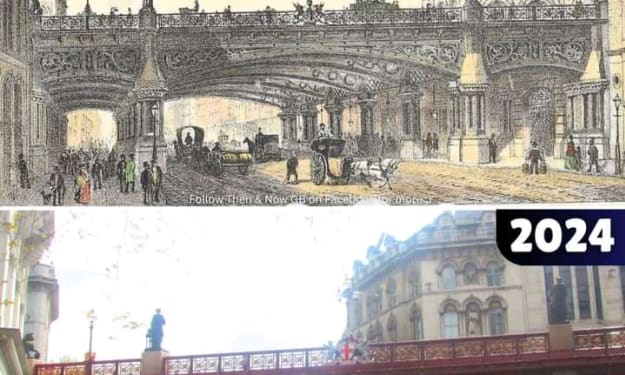
Holborn Viaduct, an iconic example of Victorian engineering and architectural ingenuity, stands as a testament to London’s industrial age. Completed in 1869, this bridge transformed the city’s infrastructure by connecting two bustling areas, Farringdon and Holborn, over the River Fleet. An antique print of the viaduct from 1894 showcases its grandeur during the late 19th century, a time when it was a symbol of progress and innovation. Comparing this historic image to the structure as it exists today reveals the enduring legacy of this remarkable feat of engineering and its significance in London’s evolution. The Creation of Holborn Viaduct Holborn Viaduct was conceived as part of a broader plan to modernize London's transport and infrastructure during the Victorian era. At the time, the rapid growth of the city created challenges for urban planning. The River Fleet, which had become heavily polluted and was more of a hazard than a benefit, needed to be covered, while the steep valley it formed disrupted traffic flow between central London and its suburbs. Designed by Sir William Haywood, Holborn Viaduct was built to address these challenges. The viaduct is not just a bridge but a raised roadway supported by a series of iron arches and adorned with striking ornamental details. Stretching 1,400 feet and reaching a height of approximately 80 feet above Farringdon Street, it provided a seamless connection for pedestrians and vehicles alike, bypassing the valley below. The construction of the viaduct was a massive undertaking, involving the demolition of existing buildings and the use of innovative techniques for the time. The final design incorporated both function and form, with pedestrian walkways, iron parapets, and grand staircases connecting the street level to the lower roads. At its official opening in 1869, Queen Victoria herself attended the inauguration, further cementing the viaduct’s importance in the eyes of the public. A Glimpse Into 1894 The antique print of Holborn Viaduct from 1894 offers a fascinating snapshot of its original Victorian splendor. The intricate ironwork of the arches and balustrades, the stately street lamps, and the elegant statues at its corners all reflect the era’s emphasis on combining utility with aesthetic beauty. The print captures a busy scene, with horse-drawn carriages and pedestrians making their way across the viaduct, embodying the vibrancy of late-19th-century London. During this time, Holborn Viaduct was more than just a piece of infrastructure—it was a symbol of modernity. It represented the Victorian ethos of progress, where advancements in engineering and technology were celebrated and integrated seamlessly into daily life. Holborn Viaduct Today Over 150 years later, Holborn Viaduct continues to serve as a vital part of London’s transport network. While its role has evolved with the city, the structure remains remarkably well-preserved. The ironwork, which was a hallmark of Victorian craftsmanship, has been meticulously maintained, and the four bronze statues representing Commerce, Agriculture, Science, and Fine Arts still stand at its corners, each a nod to the values that shaped the Victorian era. Modern vehicles have replaced horse-drawn carriages, and the surrounding skyline has changed dramatically, with towering skyscrapers and modern architecture dominating the area. Yet, the viaduct retains its historical charm, acting as a bridge between London’s past and present. In recent years, efforts to preserve and celebrate London’s Victorian heritage have brought renewed attention to structures like Holborn Viaduct. Restoration projects have ensured that its ornate features remain intact, and its significance as a piece of historical infrastructure is recognized by residents and visitors alike. Engineering and Architectural Significance Holborn Viaduct is more than just a practical bridge; it’s an enduring example of Victorian engineering. The use of cast iron and the emphasis on decorative elements reflect the design philosophy of the time, where beauty and functionality went hand in hand. The viaduct also demonstrates how engineering solutions were integrated into urban planning to solve real-world problems, such as improving traffic flow and covering unsanitary waterways. Its innovative design, which included dedicated pedestrian walkways, set a precedent for future urban infrastructure projects. The viaduct’s combination of utility and grandeur influenced other cities in Britain and abroad, serving as a model for urban development in the late 19th and early 20th centuries. A Living Connection to the Past Standing on Holborn Viaduct today, one can almost hear the echoes of 19th-century London—the clatter of horse hooves, the chatter of pedestrians, and the hum of a city on the brink of modernity. The viaduct’s ability to retain its historical essence while adapting to contemporary needs is a testament to its timeless design. For those with an appreciation for history, visiting Holborn Viaduct offers a unique opportunity to witness a piece of Victorian London that has endured the test of time. Comparing the 1894 print to the present day highlights the balance between preservation and progress that defines the city’s approach to its heritage. Conclusion Holborn Viaduct is not just a bridge; it’s a story of London’s transformation, a relic of Victorian ingenuity, and a functional piece of infrastructure that continues to serve its purpose. From the bustling scenes captured in the 1894 print to its current role in the heart of a modern metropolis, the viaduct bridges the gap between past and present. As we walk its length today, we are reminded of the vision and ambition of the engineers and architects who built it. Holborn Viaduct stands as a proud symbol of a bygone era, yet it remains as relevant as ever—a testament to the enduring legacy of Victorian innovation.
By Deji Akomolafe2 years ago in History
Unraveling the Secrets of Ancient Egypt
Welcome to the intriguing realm of Ancient Egypt, renowned as one of history's most iconic and thoroughly studied civilizations. Even with extensive research and numerous archaeological findings, Egypt remains a source of fascination for historians and enthusiasts. In this article, we will delve into the origins, societal structure, religious beliefs, and lasting legacy of this extraordinary civilization, examining the pivotal phases that contributed to its enduring impact on the world. The origins of Ancient Egypt can be traced back to approximately 5,500 BCE during the Predynastic Period. During this era, Northeast Africa was characterized by a verdant savanna, where various tribes thrived by taking advantage of the region's rich resources. As the climate shifted towards aridity, these groups began to migrate to the fertile Nile Valley, setting the stage for one of the most sophisticated agricultural societies of the ancient world.
By A História2 years ago in History
The Walker Family Cabin: A Window into Appalachian History
Nestled in the serene Great Smoky Mountains National Park in Tennessee, the Walker family cabin stands as a testament to the rugged determination and resilience of early Appalachian settlers. Built in the early 19th century, this modest log structure once sheltered 13 members of the Walker family and remains a poignant symbol of the lives lived in this remote and challenging environment. Today, it is preserved as part of the National Park’s historical collection, allowing visitors to step back in time and experience a slice of life as it was in the Smokies over 150 years ago. --- The Walker Family and Their Legacy The Walkers were among the many families who homesteaded in the Smoky Mountains long before the area became a protected national park. Settlers in the region relied on ingenuity, hard work, and a deep connection to the land to sustain their lives. The Walker family cabin, built entirely by hand from locally sourced timber, reflects the practicality and resourcefulness that defined Appalachian homesteaders. At its peak, the cabin was home to 13 family members—a remarkable feat given its small size. Despite the hardships of frontier life, the Walkers thrived in their mountain home, tending livestock, growing crops, and crafting essential tools and furniture. The cabin’s design, with its sturdy walls, simple furnishings, and functional layout, speaks to the resourceful spirit that enabled the Walkers to survive and prosper in the rugged wilderness. --- Life in the Cabin: A Simple, Rugged Existence Life in the Walker family cabin was far from easy. The Smoky Mountains, while breathtakingly beautiful, presented numerous challenges, including harsh winters, difficult terrain, and isolation from nearby communities. Settlers like the Walkers had to be self-reliant, producing or bartering for everything they needed. The cabin itself was constructed using the “saddle-notch” technique, in which logs are cut to fit snugly together without the use of nails. This method provided durability and insulation against the elements. Inside, the cabin featured a single room for cooking, eating, and sleeping. A simple stone fireplace served as the primary source of heat and was used for cooking meals. The Walkers’ lifestyle centered around subsistence farming and craftsmanship. They cultivated corn, beans, and other crops, raised livestock, and relied on hunting and fishing to supplement their diet. The tools and furniture found in the cabin today, many of which were crafted by the family, provide a glimpse into the resourcefulness required to live in such an isolated environment. --- The Walker Sisters: Guardians of Tradition The cabin remained a family home for over 150 years, with its last occupants being the Walker sisters, who lived there until 1966. These remarkable women became iconic figures in the Smoky Mountains, embodying the self-sufficient lifestyle of their ancestors even as the modern world encroached upon their way of life. In a famous 1960 black-and-white photograph, two of the Walker sisters are depicted standing outside their cabin, surrounded by the beauty of the Smokies. The image captures a moment in time when the traditions of the past were still alive, even as change loomed on the horizon. The sisters resisted the sale of their land to the federal government for the creation of the Great Smoky Mountains National Park, valuing their independence and heritage. Eventually, they reached an agreement that allowed them to live out their days in the cabin while the land around them became part of the park. Their story is one of resilience and dedication to preserving their family’s legacy. --- The Cabin Today: A Living Museum Today, the Walker family cabin is one of the most popular historical sites in the Great Smoky Mountains National Park. It has been carefully preserved, with much of its original structure, furniture, and tools still intact. Visitors to the cabin can explore its interior, which features displays of everyday items used by the Walker family, from cooking utensils to handmade furniture. The site also provides an opportunity to learn about the broader history of Appalachian settlers and their contributions to the cultural fabric of the region. Interpretive signs and guided tours offer insights into the challenges and triumphs of mountain life, connecting visitors to a way of life that has all but disappeared. Set against the stunning backdrop of the Smoky Mountains, the Walker cabin serves as a poignant reminder of the connection between people and the land. Its simple design and rustic charm stand in stark contrast to modern life, inviting visitors to reflect on the values of self-reliance, community, and harmony with nature. --- Preserving the Legacy of the Smokies The Walker family cabin is more than just a historical structure—it is a symbol of the enduring spirit of the people who shaped the Appalachian region. Its preservation as part of the Great Smoky Mountains National Park ensures that future generations can learn from and be inspired by the stories of early settlers like the Walkers. Visiting the cabin is an opportunity to step into the past and experience a simpler way of life, one defined by resilience, ingenuity, and an intimate relationship with nature. As you walk through the cabin’s weathered doors and gaze upon the breathtaking mountain views, it is easy to imagine the lives of the Walker family and the countless others who called the Smokies home. --- Conclusion: A Legacy of Resilience and Connection The Walker family cabin stands as a lasting tribute to the history and heritage of the Great Smoky Mountains. It reminds us of the strength and determination of the people who lived in harmony with this rugged land, crafting lives of purpose and meaning amidst the challenges of frontier life. Whether you are a history enthusiast, a lover of the outdoors, or simply curious about the stories of the past, a visit to the Walker family cabin is a journey worth taking. It is a chance to honor the legacy of the Walkers and to connect with the enduring spirit of the Smoky Mountains.
By Deji Akomolafe2 years ago in History
Big Band Street Dance, A Celebration
The Columbia Street Dance began in 1995 as a way to commemorate Columbia’s 50th anniversary of becoming a State Park. This event draws people from near and far. It marked the twenty eight anniversary of the Street Dance, as well as the 78th anniversary of Columbia becoming a state park this year.
By Michelle Renee Kidwell2 years ago in History
The First Automotive Accident in the World: Historical Incident in Transport Modes
The first known car accident occurred in 1771. Modern road safety and automobile engineering as we know it today has only one particular day to its past. And that was the steam-powered tractor designed by Nicolas-Joseph Cugnot, the first automobile, crashing on the streets of Paris. It is rather difficult to imagine an automobile accident in a time when cars such as we understand them did not exist. Actually, the steam contraption, invented by Cugnot was one of the crucial moments in modern history. And the accident, though minor, became an historical event.
By Abhay kumar chauhan2 years ago in History