Biographies
The Lost City of Atlantis – Truth, Myth, or a Hidden Civilization?
The Lost City of Atlantis – A Journey Beneath the Waves Atlantis. A name that sparks wonder and curiosity. Was it a real city? Or just a myth? The story begins in ancient Greece. The philosopher Plato was the first to talk about Atlantis. He described it as a powerful and wealthy city. A place full of beauty, gold, knowledge, and strength. But then, one day, it disappeared. In just one day and one night, Atlantis sank beneath the ocean. People were shocked. Was Plato telling the truth? Or was it just a story with a message? For centuries, explorers and scientists have searched for Atlantis. Some believe it was in the Mediterranean. Others say it was near Spain. Some even think it was in Antarctica. But no one has ever found solid proof. Many believe Atlantis is a warning. A symbol of what happens when power becomes pride. They say the people of Atlantis misused their knowledge and strength. And the gods punished them. The great city that once touched the sky was swallowed by the sea. Others believe it was just a story. Plato may have created it to teach a lesson. Still, even today, Atlantis captures the imagination of millions. Why? Because it's more than a city. It’s a dream. A hope that once, there was a civilization more advanced than us. Some modern scientists think Atlantis might have been real. Maybe it was destroyed by a natural disaster. An earthquake? A tsunami? But still, no clear evidence has been found. Books, documentaries, and movies have all explored the mystery of Atlantis. Each one with a different theory. But the main question remains: Where is Atlantis? And will we ever find it? Or will it always remain a secret under the waves? Atlantis teaches us something important: When power turns into pride, when knowledge is used in the wrong way, when wealth becomes everything— nothing lasts forever. It reminds us that human nature is always searching. We ask questions. We seek answers. We chase mysteries. That’s what makes us human. If one day Atlantis is found, maybe we will learn more about ourselves too. But if it is never found, its story will still inspire us. A silent city, sleeping under the waves. Waiting for someone to wake it up. --- Many people dream of Atlantis. They imagine tall towers under the sea. Crystal buildings. Golden roads. Mermaids swimming by. And strange, glowing plants no one has ever seen. Some say people in Atlantis had flying machines. Others say they had magic. They could talk with animals. Or control the weather. Could it be true? Maybe. Maybe not. But the mystery gives us hope. Hope that there is still something hidden on Earth. Something special. Something ancient. Some divers believe they saw parts of Atlantis. Strange shapes under the ocean. Walls. Steps. Even roads. But nothing has been proven. Still, they keep looking. Because sometimes, not finding something makes it even more exciting. Atlantis is also about questions. What makes a city great? Is it power? Is it money? Or is it kindness and wisdom? Maybe Atlantis had everything, but they lost their hearts. They forgot to care for each other. And so, they fell. Some people believe Atlantis will rise again. One day, someone will discover it. Maybe a young explorer. Maybe someone who loves the ocean. Maybe… you? If Atlantis is ever found, it will change history. We’ll learn about a forgotten time. A world we never knew. But even if we never find it, the story of Atlantis teaches us something important. Never stop wondering. Never stop exploring. And never let pride destroy what you build. Because the greatest cities are not the ones made of gold. They are the ones built with truth, peace, and love. So next time you hear the waves, close your eyes. And listen. Maybe, just maybe, Atlantis is calling you. -Legends never die. They live in our minds. In our dreams. And in the stories we share. Atlantis is more than a city. It’s an idea. A symbol of wonder. Of hope. And of warning. Some say the people of Atlantis were too proud. Too greedy. They had everything— But forgot the meaning of enough. Nature spoke. The sea rose. And the mighty city sank beneath the waves. But still, its light lives on. In books. In paintings. And in the hearts of those who believe. Children draw Atlantis in their notebooks. Artists paint it with colors of imagination. Writers write poems about it. And dreamers… They search for it. Because Atlantis isn’t just in the ocean. Maybe, it’s inside us. A place of peace. Of balance. Of beauty. So even if we never touch its stones, We can still carry its lesson. Be kind. Be wise. And never forget: The strongest cities… Are the ones we build with love. ۔
By Leya kirsan official about a year ago in History
Operation Black Buck: The RAF’s Longest Bomb Run
Operation Black Buck: The RAF’s Longest Bomb Run In April 1982, the world watched as a small cluster of windswept islands in the South Atlantic—the Falklands—ignited into war. Argentina had invaded. Britain responded. And in the opening days of this unlikely conflict, the Royal Air Force launched one of the most daring bombing missions in military history: Operation Black Buck.
By Wings of Time about a year ago in History
The Sky Kings of 1944: The Day the B-17s Pushed Back the Dark
The Sky Kings of 1944: The Day the B-17s Pushed Back the Dark The morning fog clung low over RAF Bassingbourn. It was February 20, 1944—a cold, grey Sunday. Rows of B-17 Flying Fortresses stood like silent giants, their olive-drab frames glistening under the damp chill. Crews moved with solemn urgency—checking flaps, loading bombs, reviewing mission briefings.
By Wings of Time about a year ago in History
Scientists Discover 78,000 Year Old Neanderthal Footprint That Tells a Story of Survival.
In a groundbreaking discovery that offers a rare glimpse into the lives of our ancient cousins, scientists have uncovered a 78,000-year-old Neanderthal footprint preserved in mudflats in northern Spain. This single footprint, remarkably intact after tens of thousands of years, tells a profound story of survival, resilience, and humanity in a harsh Ice Age environment.
By Tariq jamilabout a year ago in History
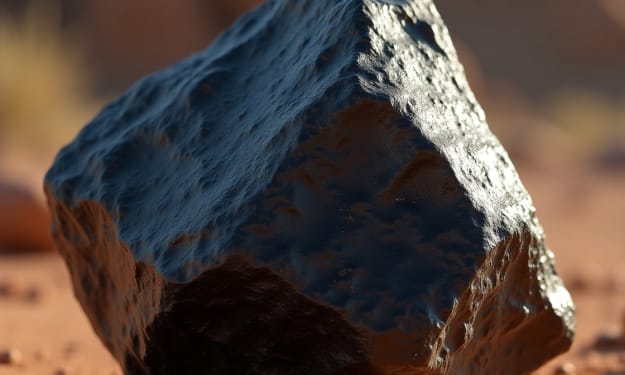
The largest Martian rock ever found on Earth,
In a landmark moment for space enthusiasts and collectors alike, a rare Martian meteorite known as NWA 16788 has been sold for a staggering $5.3 million at a recent Sotheby’s auction in New York, setting a new world record for the highest price ever paid for a Martian rock. Weighing 25 kilograms, NWA 16788 is the largest Martian rock ever found on Earth and a scientific marvel in its own right. Unearthed in Nigeria’s Sahara Desert in 2023, the meteorite is now being hailed as one of the most significant extraterrestrial finds of the 21st century. A Giant Among Space Rocks NWA 16788’s sheer size alone makes it a standout. It is 70% larger than any previously discovered Martian meteorite, placing it in a category of its own. Of the estimated 400 known Martian meteorites that have made their way to Earth, none approach the mass or preservation quality of this specimen. Most Martian meteorites are fragments, broken and scattered either during their descent through Earth’s atmosphere or upon impact. In contrast, NWA 16788 is remarkably intact. Scientists believe it was ejected from the surface of Mars millions of years ago, most likely as a result of a massive asteroid or comet collision that sent debris flying into space. Its journey from Mars to Earth, and its preservation in the Sahara’s arid conditions, makes it a geological time capsule offering insights into the Red Planet’s history. A Meteorite with a Story Named according to its classification — "NWA" standing for Northwest Africa — the rock was reportedly discovered by local meteorite hunters and verified by planetary scientists soon after. Its composition was analyzed using spectroscopy and isotopic analysis, confirming its Martian origin. Key indicators include the presence of certain gas isotopes trapped inside the rock, which match atmospheric readings taken by NASA’s rovers on Mars. Sotheby’s, the renowned auction house, described the meteorite as “a once-in-a-generation discovery.” Ahead of the sale, it was displayed in a climate-controlled glass case, drawing crowds of collectors, scientists, and curious onlookers. The final bid of $5.3 million shattered previous auction records for meteorites and planetary specimens. While the buyer’s identity remains anonymous, experts suggest the meteorite may end up in a private collection or museum, where it can be further studied and displayed. Scientific and Cultural Significance Beyond its size and monetary value, NWA 16788 represents a scientific treasure trove. Martian meteorites are incredibly rare, offering one of the few direct ways for scientists to study Mars without sending missions to the planet itself. These rocks allow researchers to analyze Mars’s geologic and atmospheric history, shedding light on everything from ancient volcanic activity to the possibility of past water — and even life. Some meteorites have been found to contain microscopic bubbles of Martian atmosphere, providing data that complements the findings of rovers like Perseverance and Curiosity. In the case of NWA 16788, its large mass increases the potential for multiple scientific analyses without damaging the integrity of the rock. "Having a sample this large gives researchers room to perform deeper investigations," says Dr. Lena Khatri, a planetary geologist at the University of Chicago. "This could improve our understanding of Martian mineralogy and the planet’s evolution." A Meteorite Market on the Rise The booming interest in space collectibles has driven up prices for meteorites and other extraterrestrial materials in recent years. Lunar samples, asteroid fragments, and now Martian rocks are being bought not just by museums and universities, but also by wealthy private collectors and investors. According to Sotheby’s, interest in the Martian meteorite was global, with bids coming in from multiple continents. The auction house’s specialists say that space rocks are increasingly seen as both scientific artifacts and cultural icons, symbolizing humanity’s enduring fascination with the cosmos. Final Thoughts As telescopes and rovers continue to explore Mars, and as space agencies prepare for eventual crewed missions to the Red Planet, pieces like NWA 16788 serve as tangible links between our world and Mars. The record-breaking sale not only marks a new chapter in meteorite collecting but also underscores the growing intersection of science, commerce, and space exploration. While the image accompanying the auction was AI-generated and provided only for reference, the rock itself is very real — a silent witness to a cosmic journey that began on another planet and ended with a multimillion-dollar bid in Manhattan.
By Israr khanabout a year ago in History
The Hearth of Habiganj
A Medieval Bengali Village Story In the heart of medieval Bengal, where the Meghna River curved like a silver thread through endless green, lay the village of Habiganj. It wasn’t a place of kings or conquests, but of muddy paths, straw roofs, and lives woven into the seasons’ rhythm. I’m Shyamal, a potter’s son, and this is my tale of a year in our village—our food, our struggles, our small joys. It’s no epic, but it’s ours, told as if we’re sitting by the fire, passing a clay plate of rice and stories.
By Shohel Ranaabout a year ago in History
Lost Voices of the Edwardians
Being obsessed with all things “Edwardian”, I couldn’t start reading this book fast enough. To read the actual ‘voices’ of children and adults who lived in the Edwardian Era just caught my attention. It was a real eye opener because these people lived in such different times, and although the Edwardian Era was the past moving into the modern, the lives and lifestyles of these ones was still a world away from the way we live today in 2025.
By Ruth Elizabeth Stiffabout a year ago in History
The Life Story of Elon Musk
Elon Musk, born on June 28, 1971, in Pretoria, South Africa, is a globally recognized entrepreneur, inventor, and industrial designer whose ambitions span from electric cars and clean energy to space exploration and artificial intelligence. His journey from a curious child in South Africa to one of the most influential figures in modern technology is marked by innovation, risk-taking, and relentless drive. Early Life and Education Elon was born to Maye Musk, a dietitian and model from Canada, and Errol Musk, a South African electromechanical engineer. Even as a young boy, Elon exhibited signs of deep intellectual curiosity. He was an avid reader, often losing himself in science fiction and technology books. By the age of 10, he had developed an interest in computers and taught himself programming. At 12, he sold the code for a simple video game called Blastar to a magazine. Despite his intelligence, Musk's school years were difficult. He was introverted and often bullied. At the age of 17, to avoid compulsory military service in apartheid-era South Africa and to pursue better opportunities, he moved to Canada. He attended Queen’s University in Ontario for two years before transferring to the University of Pennsylvania in the United States, where he earned degrees in both physics and economics. Early Ventures In 1995, Musk dropped out of a Ph.D. program at Stanford University after just two days, opting instead to dive into the world of internet startups. Alongside his brother Kimbal, he co-founded Zip2, a company that provided business directories and maps for newspapers. In 1999, Compaq acquired Zip2 for roughly $307 million. Elon received $22 million from the sale. He reinvested much of his earnings into his next venture, X.com, an online payment company. X.com later became PayPal after a merger and was eventually sold to eBay in 2002 for $1.5 billion in stock. Musk made about $180 million from this deal. SpaceX and the Dream of Space Fueled by a lifelong fascination with space, Musk founded Space Exploration Technologies Corp. (SpaceX) in 2002 with the ambitious goal of reducing space transportation costs and making Mars colonization possible. His early years at SpaceX were fraught with challenges. The company suffered three failed rocket launches between 2006 and 2008, nearly going bankrupt. However, in 2008, SpaceX successfully launched the Falcon 1 rocket into orbit, becoming the first privately funded company to do so. That same year, NASA awarded SpaceX a $1.6 billion contract to resupply the International Space Station. SpaceX has since achieved numerous milestones, including the first privately-developed spacecraft to dock with the ISS and the first reuse of an orbital rocket. In 2020, SpaceX became the first private company to send astronauts into space, marking a historic shift in the space industry. Tesla and the Electric Revolution In 2004, Musk joined the electric vehicle startup Tesla Motors (now Tesla, Inc.) as chairman, later becoming CEO and product architect. At the time, electric vehicles were widely seen as impractical and unprofitable. Musk, however, believed they could be the future of transportation. Tesla’s first car, the Roadster, debuted in 2008. It was followed by the Model S, Model X, Model 3, and Model Y, with each model making electric cars more mainstream and affordable. Under Musk’s leadership, Tesla not only became a leader in electric vehicles but also advanced battery technology and autonomous driving. Tesla's success has made Musk one of the wealthiest individuals in the world, with his net worth fluctuating in the hundreds of billions depending on Tesla's stock. Other Ventures and Innovations Musk’s interests extend well beyond cars and rockets. In 2006, he helped start SolarCity, a solar energy services company (later merged with Tesla). He also founded The Boring Company to develop underground transportation systems to combat urban congestion. In 2015, Musk co-founded OpenAI to promote friendly artificial intelligence. In 2016, he launched Neuralink, aiming to develop brain–computer interfaces that could help humans keep pace with AI. He has also proposed the Hyperloop, a futuristic transportation system involving high-speed pods traveling through vacuum tubes. Controversies and Public Persona Musk is known not just for his innovations but also for his controversial public statements, particularly on social media. He’s been involved in multiple legal disputes and regulatory battles, especially with the SEC over tweets affecting Tesla’s stock price. Despite these controversies, he maintains a large and loyal following, often admired for his candidness and willingness to take bold risks. Personal Life Musk has been married multiple times and has ten children. Despite his immense workload, he is known to work 80 to 100 hours a week. His work ethic, combined with his ambitious goals, has drawn comparisons to historical figures like Thomas Edison and Nikola Tesla. Legacy and Vision Elon Musk's life story is far from over. He continues to push the boundaries of what is possible, with ongoing projects aimed at colonizing Mars, solving traffic congestion, revolutionizing energy, and integrating AI with the human brain. What sets Musk apart is not just his success but his vision for humanity. His mission-driven approach—focusing on existential threats like climate change and interplanetary survival—makes him one of the most influential and polarizing figures of the 21st century.
By Israr khanabout a year ago in History
The Downfall of the Ottoman Empire: Causes and Consequences
The Ottoman Empire, once a vast and powerful dynasty spanning Europe, Asia, and Africa, existed for more than six centuries. At its height during the 16th and 17th centuries, it was one of the most formidable empires in history. However, by the early 20th century, it had disintegrated into political, economic, and military chaos, eventually collapsing after World War I. The fall of the Ottoman Empire was a gradual process, marked by both internal decay and external pressures. This article explores the key causes and consequences of the empire’s decline.
By Engr. Mansoor Ahmadabout a year ago in History
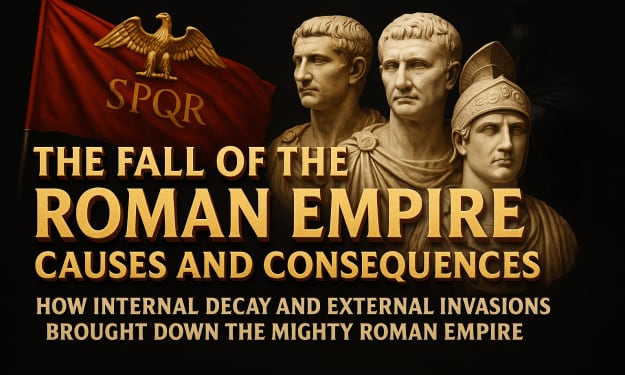
The Fall of the Roman Empire: Causes and Consequences
The Roman Empire, once the most powerful civilization in the ancient world, ultimately fell after centuries of domination across Europe, North Africa, and the Middle East. Its collapse is one of history's most significant turning points, signaling the end of classical antiquity and the beginning of the Middle Ages in Europe. Understanding the fall of the Roman Empire involves a complex combination of internal weaknesses and external pressures that eroded Rome’s ability to sustain itself. This article explores the key causes behind the downfall of the Roman Empire and the enduring consequences of its demise.
By Engr. Mansoor Ahmadabout a year ago in History