Biographies
Versace’s legacy is more than just daring dresses
London (CNN) -From bondage styles to safety pinned dresses, daring party frocks are widely considered to be the key protagonists of Gianni Versace’s sartorial legacy. But the late Italian fashion designer was also responsible for some of the most majestic silk shirts of the 1990s, and his close friend Elton John owned one in every print. “They’re just works of art,” shared the acclaimed singer-songwriter in a promotional video for auction house Christie’s last year, characterizing his deep affection for Versace’s patterns. “I never wore half of them, I just wanted to hang them. It was like an art installation with shirts, and it looked so beautiful.”
By Kristen Orkoshneliabout a year ago in History
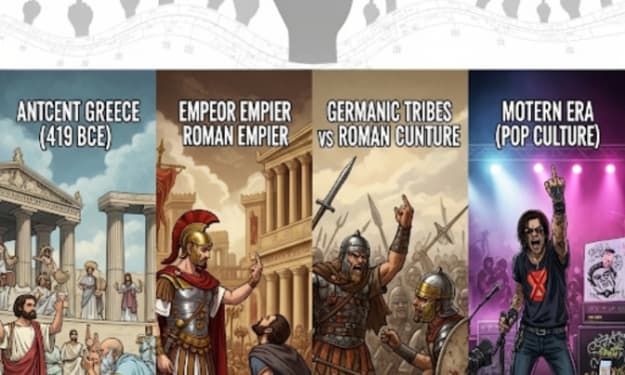
The Long History of the Middle Finger: From Ancient Insult to Global Gesture
The gesture of raising the middle finger—often considered vulgar or offensive in many cultures—has a surprisingly rich and ancient history that spans thousands of years. It is more than just a modern-day sign of frustration; it has deep roots in classical antiquity, plays, empires, and even battlefield provocations. From the Roman Empire to present-day protests, the middle finger has consistently served as a powerful, rebellious tool of communication. Origins in Ancient Greece The earliest recorded use of the middle finger as an offensive gesture dates back to ancient Greece, around 419 BCE. In Aristophanes’ famous comedic play The Clouds, a student mocks Socrates by raising his middle finger. This early use was not just comedic but carried a strong insult, symbolizing something highly inappropriate. In Greek culture, the gesture was symbolic and often interpreted as a visual representation of male genitalia. The extended middle finger was meant to resemble the penis, while the curled fingers on either side represented the testicles. This crude symbolism clearly implied that the person on the receiving end of the gesture was being emasculated or humiliated. The Romans and “Digitus Impudicus” When the Romans inherited and expanded upon Greek culture, they also adopted this vulgar hand gesture. In Latin, the middle finger was referred to as the "digitus impudicus", meaning “the impudent finger” or “the shameless finger.” It was seen as a crude and disrespectful way to insult someone—particularly in public settings. One of the most infamous figures connected to the gesture was the Roman Emperor Caligula. Known for his tyranny and eccentricities, Caligula reportedly forced members of his court and even the general public to kiss his middle finger as a deliberate act of humiliation. For Caligula, it was a way of asserting dominance and mocking those who opposed or questioned him. Meanwhile, Emperor Augustus, a much more conservative ruler, once exiled an actor from Rome for making the obscene gesture toward an audience during a performance. This suggests that even in a culture where gladiator battles and public executions were common, the middle finger was considered inappropriate and offensive enough to warrant exile. Germanic Tribes and Battlefield Insults The legacy of the digitus impudicus didn’t end with the fall of the Roman Empire. During various military campaigns, Germanic tribes—known for their fierce resistance to Roman occupation—used the gesture as a form of mockery and provocation. Roman soldiers would often encounter these taunts in the heat of battle. To the Germanic warriors, raising the middle finger was more than just an insult; it was a challenge to the masculine honor of the Roman soldiers. It mocked their authority, their pride, and their manhood, hitting them where it hurt the most—on a symbolic level. Medieval Silence and Modern Revival Surprisingly, during the Middle Ages, historical records on the middle finger gesture grow scarce. While vulgar language and hand signs undoubtedly existed, public decency laws and the influence of Christianity likely suppressed such expressions. It wasn’t until the modern era, particularly the 20th century, that the gesture began to resurface prominently in art, media, and pop culture. In the early 20th century, the gesture appeared in photographs of rebellious youth, political protests, and even wartime messages. By the 1960s and 70s, the middle finger had become a symbol of counterculture—used by musicians, actors, and civil rights protestors as a form of resistance.
By Ikram Ullahabout a year ago in History
Ise Jingu: The Sacred Heart of Japan — Myths, Miracles, and Hidden Blessings
🏯 A Shrine Older Than Time Tucked away in the serene forests of Ise City, Mie Prefecture, lies Ise Jingu (伊勢神宮)—Japan’s most sacred Shinto shrine. Known as the “Soul of Japan,” Ise is not a single shrine but a vast complex of over 125 smaller shrines, centered around two main ones:
By Takashi Nagayaabout a year ago in History
Mesopotamia: The Cradle of Civilization
Long before modern cities and high-speed internet, before the rise of Rome or the pyramids of Egypt, there was Mesopotamia. Located between the Tigris and Euphrates rivers in what is now Iraq and Syria, Kuwait, and parts of Turkey, Mesopotamia is often called the “cradle of civilization.”
By Echoes of Lifeabout a year ago in History
The Man Who Survived Two Atomic Bombs – And Lived to Warn the World
The summer of 1945 brought with it some of the darkest memories in human history. On August 6th, a single bomb reduced the vibrant city of Hiroshima to ashes. Three days later, Nagasaki suffered the same fate. Millions of lives were shattered, and history was left permanently scarred. But amidst this black chapter stood one man whose story became a powerful example of human strength and survival. This is the story of Tsutomu Yamaguchi — the man who survived both atomic bombings. --- Hiroshima: The First Apocalypse In early August 1945, Yamaguchi was working in Hiroshima as an engineer for Mitsubishi Heavy Industries. He was scheduled to return home to Nagasaki on August 6 — the same day the first atomic bomb was dropped. As he prepared to leave, a blinding flash tore through the sky. Within seconds, everything changed — fire, smoke, destruction. He was just 3 kilometers from the epicenter. Burned and injured, he miraculously survived. That night, he stayed in the ruins of a city that no longer existed. --- Nagasaki: Death Returns The next morning, wounded and exhausted, he somehow boarded a train and returned to Nagasaki. On the morning of August 9, while telling his supervisors about the horror of Hiroshima — another blinding flash filled the sky. The second atomic bomb had fallen — this time on his own city. Once again, he was near the epicenter. Once again, he survived. --- A Quiet Man with a Loud Message Yamaguchi had witnessed the unimaginable — burned bodies, crying survivors, and a kind of helplessness no words could describe. For years, he remained silent. But as time passed, he realized that surviving wasn’t just luck — it was a responsibility. He began to speak out — as a messenger of peace. His message was simple: > “No one should ever experience what I experienced.” “Peace is not optional — it is our only hope.” In 2009, Yamaguchi became the only person officially recognized by Japan as a survivor of both atomic bombings. --- What Did We Learn? Tsutomu Yamaguchi’s story isn’t just a memory — it’s a warning. In a world still chasing war and weapons, he reminds us that destruction is never far away if we lose our humanity. He faced death twice — and still chose life. He never spread hate, never sought revenge — only peace. --- Conclusion Yamaguchi’s life was not just a miracle — it was a light. When the world burned, he stood like a lantern — still glowing. His story teaches us not just to survive, but to live in a way that gives others hope In a world scorched by hatred, where silence often wins over truth, Tsutomu Yamaguchi chose to speak — not in anger, but in wisdom. He could have spent the rest of his days in the shadows of trauma, quietly mourning all that he lost. But instead, he stepped into the light, bearing the scars of two nuclear disasters not as marks of pain — but as symbols of purpose. Yamaguchi’s survival was more than just a miracle of biology — it was a moral calling. He lived not just to breathe, but to remind us that humanity cannot afford to repeat its greatest mistake. His voice, soft yet steady, echoed a truth that politicians often ignore, and that history books sometimes soften: > War does not end with victory. It ends with loss — for everyone. When the world heard “nuclear bomb,” they thought of power. But Yamaguchi saw orphans, burned skin, cries in the rubble, and cities turned into silent cemeteries. He became a bridge — between destruction and reflection, between memory and meaning. To live after death is rare. But to live for others after death has touched you — that is something divine. And that is exactly what he did. Even as time passed and the world moved on, he refused to let the horror become just another historical footnote. Through his words, interviews, and presence, he lit a candle in a dark world — and that candle still burns. His story doesn’t end with survival. It begins with it. Because in the end, the true victory is not in escaping death — It’s in choosing life, and using that life to heal, to warn, and to inspire. And that is why Tsutomu Yamaguchi lives on — not just in the pages of history but in every voice that dares to say:
By Asif nawazabout a year ago in History
WHEN PEACE WAS A CRIME:
Bound by Chains, Freed by Conviction: The Twin Souls of Bacha Khan and Nelson Mandela In the blood-soaked pages of colonial history, few names shimmer with the unbroken dignity of Khan Abdul Ghaffar Khan and Nelson Mandela, two giants of resistance who lived oceans apart but suffered under the same sky of oppression. One emerged from the rugged valleys of the North-West Frontier, the other from the gold-laden mines of South Africa yet both walked the same agonizing path: a path carved by prison bars, forged by pain, and lit only by the flickering torch of justice.
By Awais Ahmadabout a year ago in History
Echoes of Revelation
Long before skyscrapers pierced the skies of the Arabian Peninsula, before oil wells turned deserts into gold mines, Arabia was a land of vast deserts, scattered tribes, and ancient traditions. It was a place where power belonged to the strong, poetry to the eloquent, and truth was often lost in superstition. In this rugged land, where injustice roamed freely and the weak were voiceless, a light was destined to rise — a light that would echo through centuries and reach every corner of the earth.
By Adil Nawazabout a year ago in History
The Main Reason Behind the Israel-Iran Conflict
The conflict between Israel and Iran is one of the most dangerous tensions in the Middle East. It is not just about religion or politics—it’s a mix of historical distrust, security concerns, nuclear weapons, and regional influence. To understand why Israel and Iran are enemies today, we must look at real events, official statements, and international reports that clearly explain the reasons.
By Engr. Mansoor Ahmadabout a year ago in History