Biographies
The lost library of Alexandria . AI-Generated.
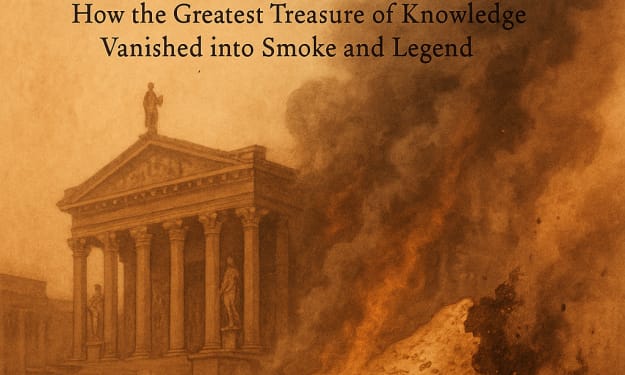
-- In the heart of ancient Egypt, where the sun kissed the sands and the Nile gave life to civilization, stood a marvel unlike any other — the Library of Alexandria. It wasn’t just a building filled with scrolls; it was a monument to human curiosity, a temple of thought, and perhaps the most ambitious effort ever made to collect all the world’s knowledge in one place. It began with a dream. Around 300 BCE, under the rule of Ptolemy I Soter, one of Alexander the Great’s generals, Egypt was not just a kingdom of pyramids and pharaohs, but of intellect and culture. Ptolemy envisioned a place where scholars from every land could gather and share their wisdom. His son, Ptolemy II, brought that dream to life by founding the Great Library as part of the larger research institution known as the Mouseion. The mission of the Library was bold and clear: to gather every book, every scroll, every piece of knowledge from every corner of the known world. Merchants and travelers arriving at the port of Alexandria were required to surrender any books they carried. These texts were copied — with the originals often kept in the library and the copies returned. It’s believed that the collection eventually grew to hold between 400,000 and 700,000 scrolls, containing works of literature, science, mathematics, astronomy, medicine, and philosophy. Some of the greatest minds of the ancient world studied or worked there. Euclid, the father of geometry, likely taught in Alexandria. Archimedes corresponded with scholars there. Hipparchus used the texts to calculate the distance to the moon. Eratosthenes, the chief librarian, calculated the circumference of the Earth with astonishing accuracy — over 2,000 years before satellites confirmed it. It was, quite literally, the brain of the ancient world. But as with all great things in history, the Library of Alexandria was fragile — not just in structure, but in fate. Its destruction is one of the most haunting mysteries of the ancient world, surrounded by legend, myth, and fragments of truth. There are multiple theories about how the library met its end, and most historians now believe it wasn’t a single catastrophic event, but a series of tragedies. The first major blow may have come during Julius Caesar’s civil war in 48 BCE. While pursuing Pompey, Caesar set fire to his ships in Alexandria’s harbor. The flames spread to parts of the city, and many believe the fire reached the library or nearby storehouses containing manuscripts. Caesar himself wrote that "forty thousand books" were lost — a tragic, if partial, loss of knowledge. Later, during the rise of Christianity in the Roman Empire, pagan temples and symbols of “old knowledge” were seen as threats. Some accounts suggest that in 391 CE, during the reign of Emperor Theodosius I, a Christian mob led by Bishop Theophilus may have destroyed what remained of the library as they ransacked pagan institutions. This time, it may have been more than books that burned — it was an ideological shift, a turning point where spiritual dogma began to replace scientific and philosophical inquiry. The final blow might have come in 642 CE, when the Muslim general Amr ibn al-As conquered Alexandria. According to some later sources — though debated by modern historians — Caliph Omar allegedly declared, “If the books agree with the Quran, we don’t need them. If they disagree, they are heresy.” And so, according to legend, the remaining books were used to fuel the city’s bathhouses for six months. Yet, there’s no definitive record of this. And perhaps that’s what makes the loss so haunting — we don’t even know how it was destroyed, only that it vanished. The loss of the Library of Alexandria was not just the burning of parchment. It was the disappearance of untold thousands of discoveries, poems, stories, philosophies, and theories — many of which may have never been written again. Works by Aristotle, Sophocles, and unknown geniuses of mathematics or medicine may have disappeared forever in those flames. Imagine if even a fraction of that knowledge had survived. What might the world look like today? Would humanity have entered the Renaissance centuries earlier? Would space travel have begun in the Middle Ages? Would diseases have been cured long before they ravaged millions? We will never know. But the story of the Library of Alexandria serves as a powerful reminder. Knowledge is powerful, but fragile. Ideas can change the world, but only if they are preserved, shared, and protected. In every fire that threatens books, in every regime that censors knowledge, echoes the tragedy of Alexandria. Today, in an age of digital archives and cloud backups, it’s tempting to believe that information is forever. But even now, data can be lost — to corruption, to war, to indifference. The lost library is not just a historical event; it is a warning. A warning that the greatest threat to knowledge is not fire or swords, but forgetting. Message to Reader: Preserve knowledge. Value learning. Question everything.
By Danyal Hashmiabout a year ago in History
Venture Capitalist Rajat Khare And His Journey Across Technology & Investments
A graduate of the highly advanced Indian Institute of Technology (IIT) Delhi, Rajat Khare is a venture capitalist and one of the prime movers of deep tech investment. His journey, stretching across India to Europe, exemplifies how an integrated strategy of capital, human development and technological vision can be combined in the building of global impact. Being the founder of Boundary Holding, a company headquartered in Luxembourg.
By Paula Stokesabout a year ago in History
Frozen in Fear: The 12-Year-Old Boy Who Survived a Blizzard Alone for 3 Days ❄️🧒🏻🏔️
On December 8, 2017, 12-year-old Artem Kuznetsov set out before dawn to cross a narrow mountain pass and deliver fresh bread 🍞 to his grandmother’s cabin. The frost sparkled ❄️ on every surface, and the snow was piled high from a storm earlier that week. He pulled his woolen cap over his ears, zipped up his jacket tight, and stepped out into what looked like a peaceful winter morning. He had done this journey many times before. The trail was narrow but clear, winding through pine forests 🌲 and across frozen streams. It usually took him less than an hour. He had no reason to believe this time would be any different. But halfway along the trail, things changed. The wind picked up sharply, blowing so hard it pushed him sideways. What had been gentle snowfall turned into a wall of ice 🌬️. The trees began to blur together. Within minutes, Artem realized he couldn’t see more than a few meters ahead. The footprints behind him were already vanishing. He considered turning back. But something stubborn inside him pushed forward. He thought of his grandmother, sick and alone, waiting for the bread he carried. He’d promised her 🤞. He had to keep going. Then he missed a turn. One wrong step in that blizzard, and the trail was gone. He turned in circles, calling out, hoping to hear someone respond—but all he heard was the wind screaming through the trees. He reached into his coat pocket to grab his phone 📱. The screen flickered and died in his gloved hand. The battery had frozen solid. Panic hit him in the chest like a punch 💔. He was alone. Truly alone. By late afternoon, it had grown dark. The storm hadn’t let up. Snow slapped his face. His fingers began to burn, then go numb 🥶. He knew if he stopped moving, he would freeze to death. But he couldn’t walk forever either. Eventually, he found a shallow dip beneath a fallen pine. He used branches and snow to form a rough shelter — barely enough to block the wind. He curled into a ball, hugging his knees, trying to conserve warmth. He had no food. No fire. Nothing but the coat on his back. That first night was endless. He didn’t sleep. Every noise made him jump. Wolves lived in those woods 🐾. He kept whispering to himself, just to hear something human. Back in his village, rescue teams had already begun searching. But with heavy snow and howling winds, they covered only a small area. Most feared the worst. The second day, Artem forced himself to move again. He drank melted snow cupped in his hands 💧. His face was swollen and raw. He wandered for hours with no sense of direction. Everything looked the same: white, gray, trees, and silence. His legs felt like they no longer belonged to him. That night, he didn’t build a shelter. He simply collapsed against a tree and let snow fall over him like a blanket. By the third morning, he felt hollow — like a ghost. But he kept going. Something inside him refused to quit. He thought of his grandmother again. Of her voice. Of warm soup 🍲. Of the way she smiled when he knocked at her door. He kept moving. That afternoon, a shepherd passing through the lower woods spotted small footprints in the snow. He followed them with suspicion and curiosity — until he saw something ahead: a thin boy, pale and shaking, barely upright. The man ran to him, removed his own coat, and wrapped it around Artem’s frozen frame. Artem’s lips were blue 💙. His eyes blinked slowly. But he was alive. Doctors later called it a miracle ✨. Artem suffered frostbite and exhaustion, but no lasting damage. He had survived three days in –22 °C weather with no food, no gear, and no way to call for help. When asked how he made it, Artem simply said, “I just wanted to see my grandma again.❤️
By Echoes by Imadabout a year ago in History
"When Fish Fell from the Sky: The Bizarre Rainstorm That Shocked a Town"
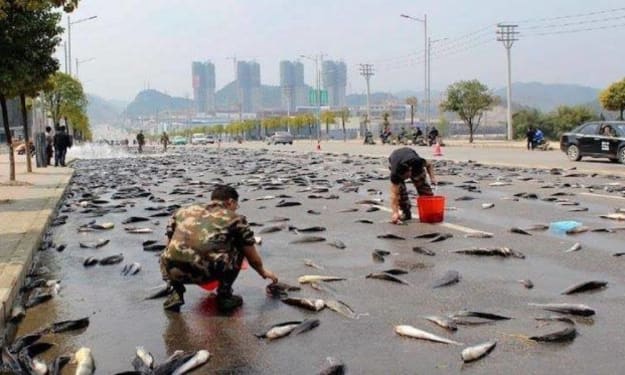
On a peaceful Tuesday afternoon, in a quiet coastal town in Honduras, something unimaginable happened. ☁️☀️ The sky, once clear and blue, suddenly darkened with strange clouds. People paused their daily routines, peeking out from their windows, puzzled by the sudden shift in weather. A cool breeze swept through the streets, carrying with it a strange scent — like the ocean, but stronger... and unfamiliar. 🌊 Children playing outside were the first to scream. But not out of fear — out of shock and awe. From the sky... fish began to fall. Tiny silver bodies rained down like droplets, bouncing off rooftops, landing in buckets, on cars, even on people’s heads. 🐟☔ Villagers rushed outside. Phones were pulled out, videos taken, prayers whispered. For a moment, it felt as if nature itself was performing a miracle — or sending a warning. Old María, the town’s storyteller, crossed herself and said, “It’s the Rain of Fish… it's real again.” The phenomenon, known locally as “Lluvia de Peces,” wasn’t new to them. But it had been decades since the last time it occurred with such intensity. Scientists, journalists, and curious travelers had once come to investigate. Many believed it was caused by waterspouts or tornadoes picking up fish from nearby rivers and dumping them over land. Others called it folklore. But when it happens in front of your eyes — it doesn’t feel like science. It feels like magic. ✨ Some villagers gathered the fish in baskets. Others stood in silence. Children ran through puddles filled with flapping fish, laughing and screaming. One young boy held up a fish and said, “The sky gave us dinner!” — his smile wide, eyes glowing with wonder. 🍽️😊 Local radio stations picked up the news. Within hours, the story was trending online. Scientists debated theories. Skeptics rolled their eyes. But the town knew what they had seen. They had touched the miracle. By nightfall, the town was quiet again. The fish were gone. But the memory remained, lingering in every conversation, in every whispered tale over dinner, in every gaze toward the clouds. And the next morning? Everyone looked up. Just in case... 🌧️🐟✨As the sun dipped below the horizon, casting golden light over the town, people still spoke of what they had witnessed. 🌅 The Rain of Fish was no longer just a tale told by grandmothers or written in dusty books — it had happened again, before their very eyes. The smell of salt and scales still lingered in the air. Kids carried buckets with leftover fish to show their friends. Some families even cooked the strange sky-gifted catch for dinner that night. 🐟🔥 Local elders sat on porches, recounting past times when the phenomenon occurred. They said it usually came after heavy storms, but today had been calm — that made it even more mysterious. Scientists arrived the next day. Drones flew above. Interviews were conducted. But none of their explanations could replace the feeling the people had — the mix of wonder, fear, and joy. One woman said, “I’ve lived here for 60 years. I’ve seen this only once before. When it happens, it feels like the earth is reminding us we’re not in control.” Children drew pictures of fish falling from the sky at school. Journalists camped out hoping it would happen again. But nature had made its point — and it was done. Some say it was a blessing. Others, a warning. But for the people of this little Honduran town, it was a moment they’d never forget. A living proof that not everything in the world can be explained. 🌍💫 And now, whenever clouds gather or the wind changes… they all stop, look up, and wonder — “Will the sky rain fish again?” 🐟🌧️And in that silence between the clouds and earth, hope waits — for another miracle to fall from the sky. 🌌🐟
By Leya kirsan official about a year ago in History
The Hidden Health Crisis That Took Hulk Hogan’s Life
Inside Hulk Hogan’s Sudden Death, His Secret Battle With Illness, and the Legacy He Left Behind The world lost more than a wrestler. It lost a pop culture giant whose final chapter was filled with quiet suffering and private strength.
By Lynn Myersabout a year ago in History
The Ophanim: Unraveling the Mystery of the Wheel Angels
The Ophanim: Unraveling the Mystery of the Wheel Angels When we picture an angel, we often envision a serene figure with magnificent wings, a gentle countenance, and a benevolent aura. But within the celestial hierarchy, there exists an order of angels whose appearance is far more abstract, powerful, and enigmatic. These are the Ophanim, the so-called "wheel angels," whose very form defies human understanding and whose purpose is tied to the most profound mystery of the divine throne.
By Sthephanieabout a year ago in History
A Journey into the Realm of the Malachim: Angels, Alphabet, and Ancient Mysticism
Angels have captivated human imagination for millennia, serving as divine messengers, guardians, and powerful celestial beings. Yet, within the vast tapestry of angelology, there are specific orders and concepts that remain shrouded in mystery. One such fascinating subject is the Malachim, a term that refers not only to a specific class of angels but also to a powerful and mystical alphabet. This guide will take you on a deep dive into the world of the Malachim, exploring their role in ancient texts, their place in angelic hierarchies, and the secrets of the unique script that bears their name.
By Sthephanieabout a year ago in History
The Man Who Wanted to Rule the World
The wind blew softly across the Austrian border town of Braunau am Inn, as if the sky itself had no idea what it had just delivered to Earth. On April 20, 1889, a boy was born in a small, ordinary house. His name would become one of the most infamous in human history: Adolf Hitler.
By Muhammad Riazabout a year ago in History
Famine Unfolding Across Gaza, Says Global Hunger Monitor
Global Hunger Monitor reports that famine is spreading throughout Gaza. According to a new report from the Integrated Food Security Phase Classification (IPC), a global organization that monitors hunger, a humanitarian crisis is engulfing Gaza as famine conditions spread throughout the territory. For hundreds of thousands of civilians, widespread malnutrition, hunger, and starvation are now a dire reality, according to the report, which warns that large segments of the population in Gaza are experiencing catastrophic levels of food insecurity. The IPC, which classifies food insecurity into five phases—ranging from minimal to famine—has placed much of Gaza in Phase 5: Catastrophe/Famine. Extreme hunger, acute malnutrition, and excessive mortality are all indicators of this phase. The situation, the IPC notes, is unprecedented in modern history in terms of speed, scale, and severity.
By GLOBAL NEWSabout a year ago in History