Biographies
Valentine’s Day A Not So Romantic Journey Going Back to Ancient Greece
Valentine’s Day A Not So Romantic Journey Going Back to Ancient Greece Valentine’s Day now a global celebration of love romance and affection is often associated with heart shaped chocolates flowers jewelry and grand romantic gestures. The history of this holiday is far darker and more complex than its modern commercialized version. While many trace its roots to ancient Rome and the pagan festival of Lupercalia some historians believe its origins go even further back to ancient Greece where the Arcadian Lykaia festival was held. This mysterious and archaic celebration along with its Roman counterpart played a crucial role in shaping what eventually became Valentine’s Day. The Arcadian Lykaia festival held in the lush green meadows of Arcadia in the Peloponnese was an ancient ritual dedicated to the god Pan. Pan the rustic deity of the wild nature and fertility was worshipped in natural settings rather than temples usually in caves and grottos. He was often depicted as a half goat half man figure playing his magical flute and seducing nymphs. According to mythology Arcadia was a land of divine beauty home to nymphs dryads and naiads who roamed its forests and streams. The festival which took place on the slopes of Mount Lykaion Wolf Mountain included secret sacrificial rituals and rites of passage that involved elements of both fertility and savagery.
By Adnan Rasheed2 years ago in History
Diwali: The Festival of Lights
*Diwali: Terse cultures and traditions, celebrates a multitude of festivals throughout the year. One of the most widely celebrated festivals in the country is *Diwali*, also known as the *Festival of Lights*. This festival, which holds deep religious significance, is observed by millions of people across India and around the world. Diwali marks the triumph of good over evil and light over darkness, and it is celebrated with much fanfare, joy, and devotion. *Origins and Mythological Significance* Diwali has ancient roots in Hindu mythology and is celebrated in honor of the return of Lord *Rama* to his kingdom, *Ayodhya*, after defeating the demon king *Ravana*. According to the epic *Ramayana*, Lord Rama, along with his wife *Sita* and brother *Lakshmana*, was exiled to the forest for fourteen years. During this time, Ravana abducted Sita, leading to a fierce battle in which Rama killed Ravana, symbolizing the victory of good over evil. To celebrate their return, the people of Ayodhya lit thousands of oil lamps, or *diyas*, to guide the way for Rama, Sita, and Lakshmana. The tradition of lighting lamps and bursting firecrackers continues to this day, symbolizing the victory of light over darkness and the destruction of evil. While Diwali is primarily a Hindu festival, it is also celebrated by other religious communities, including *Jains*, *Sikhs*, and *Buddhists*, with each group attributing different meanings to the festival. For Jains, Diwali marks the day when *Lord Mahavira*, the 24th Tirthankara, attained Nirvana. For Sikhs, Diwali commemorates the release of Guru Hargobind Ji from imprisonment. For Buddhists, particularly in the regions of *Ladakh*, Diwali marks the victory of the forces of light over darkness. *The Rituals and Preparations* Diwali preparations begin days before the actual festival. The entire household is thoroughly cleaned, with the belief that a clean home invites Goddess *Lakshmi*, the goddess of wealth, prosperity, and good fortune, into the house. People decorate their homes with *rangoli* (intricate patterns made of colored powders, flowers, or rice) and light countless *diyas* (small clay lamps) to ward off darkness and bring positivity into their lives. One of the key elements of Diwali is the worship of *Goddess Lakshmi*. On the night of Diwali, families gather to offer prayers, seeking her blessings for wealth, health, and happiness in the coming year. It is a time for family bonding, as relatives come together to share meals, exchange gifts, and celebrate the joyous occasion. Shopping is also an essential part of the Diwali preparations. People purchase new clothes, utensils, and gold as a way of symbolizing the renewal of life and fortune. Markets are adorned with colorful lights and decorations, and stalls are filled with sweets, gifts, and firecrackers. The festival creates a vibrant atmosphere throughout cities and villages, with streets bustling with excitement and energy. *Diwali in Different Parts of India* While the essence of Diwali remains the same across India, the way it is celebrated can vary from region to region. In the *north* of India, particularly in cities like Delhi and Uttar Pradesh, Diwali is marked by the lighting of lamps, firecrackers, and festive feasts. The streets are filled with the sounds of firecrackers, and families often hold grand celebrations at home. In the *south* of India, especially in Tamil Nadu and Kerala, Diwali celebrations are more subdued but equally significant. The day usually begins with an early morning ritual of taking an oil bath, followed by the worship of Lord Vishnu. People in southern India also prepare a variety of traditional sweets, such as *laddu* and *murukku*, and exchange gifts with family and friends. In *western India*, particularly in *Gujarat*, Diwali is celebrated with a unique touch. The festival coincides with the beginning of the Hindu New Year, and people clean and decorate their homes to welcome the new year. The five-day festival is filled with festivities, including the famous *Diwali Dhanteras* shopping spree and the vibrant *Gulal* (colored powder) celebrations. In *Maharashtra*, Diwali is celebrated with much grandeur. The *Narakasura* demon is believed to have been defeated by Lord Krishna on the day before Diwali, which is celebrated as *Naraka Chaturdashi*. On this day, people light lamps and engage in early morning rituals, followed by traditional feasts. *The Lights, The Sweets, and The Fireworks* One of the most striking features of Diwali is the *lighting of diyas*. The twinkling lights symbolize the triumph of good over evil, and they brighten every corner of Indian homes. The glow of the lamps fills the night sky, making it seem like the entire country is bathed in light. The atmosphere is vibrant, with homes and public places alike lit up by thousands of oil lamps, fairy lights, and candles. Another highlight of Diwali is the *sweets* that are prepared and shared among friends and family. Each region has its own specialty, but some of the most popular treats include *laddus*, *barfis*, *jalebis*, and *gulab jamun*. These sweets are offered to guests and exchanged as part of the festivities. The exchange of sweets is seen as a gesture of goodwill and is a way of strengthening relationships. *Fireworks* are also an integral part of the Diwali celebration. The night sky is filled with sparkling lights, loud bangs, and colorful explosions as people light *crackers* and *rockets*. The firecrackers symbolize the joy of the people living on earth, making the gods aware of their happiness. However, in recent years, there has been growing concern over the environmental impact of fireworks, with calls for more eco-friendly celebrations. *A Time for Unity and Celebration* Diwali is not just a religious event; it is a time for people of all ages and backgrounds to come together. It is a festival of joy, a celebration of life, and a reminder of the values of *unity*, *goodness*, and *generosity*. During Diwali, people forgive past grievances, strengthen bonds with family and friends, and make a fresh start. The lights that shine so brightly on Diwali are symbolic of the light that resides within each person—bringing hope, joy, and peace to the world. In conclusion, *Diwali* is more than just a festival—it is a reflection of the rich culture, traditions, and spirit of India. Whether in the bustling streets of Delhi, the quiet temples of Tamil Nadu, or the vibrant markets of Gujarat, Diwali unites people in celebration, bringing them closer to each other and to the divine. It reminds us that no matter the darkness we face in life, light will alw
By Israel morakinyo 2 years ago in History
Amenhotep IV
In the heart of ancient Egypt, where myth blended with daily life and tradition was as enduring as the Nile itself, one ruler dared to challenge the old order. Amenhotep IV—later known as Akhenaten—was a visionary pharaoh whose radical ideas and daring reforms reshaped not only the spiritual landscape of his nation but also its art, culture, and architecture.
By A História2 years ago in History
Who is an African Black Child: The Secrets Behind Successful Black Children That Change The World
Being an African-Black kid can be daunting at times. It means different things to many children. You can call it "the survival gene of the proactive rare natives not discovered"...Yes!
By Godsgift O. Amos2 years ago in History
A Love Beyond Time
February 13, 1798 My Dearest Cecilia, As I sit at my writing desk, the candle’s flame wavers, casting long, restless shadows upon the walls—shadows that mirror the tumult in my heart. My quill hesitates, hovering above this parchment, for how does one capture love so vast, so consuming, within mere words? How can ink and paper possibly convey the depth of devotion that I hold for you, the ache that grips my soul in your absence? I find myself tracing the edges of this letter, imagining your fingers brushing over these very words as you read them. Would that I could whisper them to you instead, letting the night carry my voice to your ears as the wind carries the scent of violets in spring. Oh, Cecilia, you have bewitched me utterly. Your laughter lingers in my mind like the sweetest melody, and your presence—though distant now—feels as vital to me as breath itself. Each day without you is an empty shell, a hollow moment that exists only to pass and bring me closer to the next time I may see you. I wake with your name upon my lips and fall asleep with the memory of your touch resting against my skin like the warmth of the sun after a long winter’s cold. The world before you was colorless, an existence dictated by duty and expectation, but you… you have painted my life in hues I never knew existed. I write to you now not only to profess my love but to lay bare the longing that consumes me, to share with you the heavy burden of my heart. My father speaks of responsibility, of duty, of the weight of our name and the legacy I am expected to uphold. He speaks of a match that would secure our family’s standing, a future that has been charted for me since birth. But he does not speak of love, nor of happiness, nor of the dreams that flutter like restless birds within my chest. I cannot—will not—resign myself to a life dictated by others when my heart has already chosen its path. My love, I have found within myself a courage I did not know I possessed, and I offer that courage to you now. If you will have me, if you will dare to walk this uncertain road with me, then let us break free from the chains of expectation. Let us cast aside these gilded cages and choose a life of our own making. I do not promise riches, nor ease, nor the comforts of a life secured by name and fortune. But I promise you my heart, my unwavering devotion, my every breath and every moment until the end of my days. I promise you laughter beneath the stars and whispered secrets in the hush of midnight. I promise you love that will stand unshaken against the storm, a love that will defy time itself. If your heart speaks as mine does, if your soul longs as mine longs, meet me at the old bridge by midnight two nights hence. There, beneath the watchful eye of the moon, let us make a vow that no force in this world may break. And if you do not come, if you choose the path laid before you by those who do not understand the fire in our hearts, I will not hold you to blame. I will carry your love with me always, a quiet ache that will never fade. But Cecilia, my heart tells me you will be there. Yours now and forever, Nick
By Shreyansh Singh2 years ago in History
The Fearless Charge of Genghis Khan
Genghis Khan’s War Strategy: The Genius Behind the Mongol Conquests Genghis Khan, the architect of the Mongol Empire, is advised one of history’s greatest aggressive strategists. From a baby drifting association leader, he broadcast his authority to awning over 23 actor aboveboard kilometers, authoritative it the better abutting authority in history. His war strategies were revolutionary, aggregate speed, deception, cerebral warfare, and above aggressive organization. This commodity explores the ablaze war strategies of Genghis Khan, his use of intelligence, and how his approach accustomed the Mongols to beat all-inclusive acreage in a abbreviate time. 1. Aggressive Organization: The Backbone of Mongol Warfare Dividing the Army into Efficient Units Genghis Khan adapted the Mongol army into a awful acclimatized force by alignment it into a decimal system: Arban – Squad of 10 soldiers Zuun – Company of 100 Mingghan – Battalion of 1,000 Tumen – Division of 10,000 This arrangement ensured: ✔ Flexibility in action – Armies could be calmly disconnected or combined. ✔ Better ascendancy – Anniversary assemblage had its own commander, ensuring bright leadership. ✔ Loyalty and accord – Soldiers were aggregate with men they trusted. Elite Mongol Warriors Every Mongol soldier was accomplished from adolescence in: Horseback benumbed – Mongols could ride for canicule afterwards stopping. Archery – They could shoot arrows while benumbed at abounding speed. Survival abilities – Soldiers lived off the land, abbreviation assurance on accumulation chains. The aggregate of aggressive alignment and aristocratic training gave Mongols a massive advantage over less-disciplined armies. 2. Acceleration and Mobility: The Mongol Army’s Greatest Strength Horse-Based Warfare The Mongols were able horsemen, with anniversary soldier accepting 3-5 horses to about-face during battle. This accustomed them to: ✔ Biking up to 100 afar per day (much faster than European armies). ✔ Advance apace and retreat afore the adversary could counterattack. ✔ Conduct abruptness attacks abysmal central adversary territory. Lightning Raids and Fake Retreats One of the Mongols’ best feared approach was the affected retreat: Mongol army affected to abscond in panic. The enemy, cerebration they had won, chased them. The Mongols again angry aback aback and ambushed their pursuers. This ambush formed adjoin abounding brash armies, including Chinese, Persian, and European forces. 3. Cerebral Warfare: Defeating the Adversary Afore the Battle Genghis Khan accepted that abhorrence was a able weapon. He acclimated cerebral warfare to breach adversary assurance afore battles alike began. Spreading Fear He accustomed some defeated cities to escape, so survivors could advance belief of Mongol brutality. He generally destroyed absolute cities that resisted, ensuring others surrendered quickly. His spies advance rumors of Mongol backbone to abate adversary morale. Diplomacy and Abandonment Offers Cities were accustomed a choice: Surrender and be spared. Resist and be annihilated. Many rulers chose surrender, acumen that abashed was futile. By accumulation abhorrence and diplomacy, Genghis Khan baffled cities afterwards alike fighting. 4. Intelligence and Espionage: Knowing the Enemy The Mongols had an avant-garde spy arrangement that calm advice afore every campaign. How They Acclimated Spies: ✔ Disguised as merchants, spies aggregate intelligence on adversary cities, fortifications, and weaknesses. ✔ Intercepted letters to agitate adversary communication. ✔ Bribed admiral in adversary cities to accessible the gates at the appropriate moment. With this intelligence, Genghis Khan consistently knew the enemy’s strengths and weaknesses afore ablution an attack. 5. Adapting to New Technologies and Strategies Unlike abounding conquerors, Genghis Khan was not abashed to apprentice from others. Using Annoy Warfare The Mongols assassin Chinese engineers to body catapults, battering rams, and trebuchets. They acclimated armament weapons, acquirements from Chinese and Persian armies. Cities with aerial walls were no best safe from Mongol attacks. Recruiting Skilled People Genghis Khan accustomed defectors, giving them aerial positions in his army. He acclimated engineers, doctors, and strategists from baffled acreage to advance Mongol tactics. By adopting adversary strengths, the Mongols remained unbeatable. 6. Annoy Warfare: Conquering Alike the Arch Fortresses Many cities relied on adherent walls for protection. But Genghis Khan developed annoy strategies to defeat alike the arch defenses. Mongol Annoy Tactics: ✔ Surround the burghal completely, acid off aliment and water. ✔ Use captured civilians as animal bouncer to abate burghal defenses. ✔ Launch ablaze arrows and armament bombs to actualize chaos. ✔ Divert rivers to flood adversary cities. With these tactics, the Mongols baffled above cities like Beijing, Samarkand, and Baghdad. 7. Uniting the Empire: The Secret Behind Mongol Success Unlike added conquerors, Genghis Khan was not aloof a warrior – he was additionally a ablaze leader. Incorporating Different People Instead of antibacterial civilizations, he chip baffled bodies into his empire. He answer religious freedom, acceptance Muslims, Buddhists, Christians, and Hindus to coexist. He called leaders based on merit, not aloof bloodline. Establishing Barter and Communication He adequate the Silk Road, ensuring safe barter beyond Asia and Europe. He developed the Yam postal system, acceptance letters to biking bags of afar quickly. This ensured that his authority remained able continued afterwards his death. Conclusion: Why Genghis Khan’s War Strategies Were Unmatched Genghis Khan’s aggressive success was not aloof about strength, but about strategy, discipline, intelligence, and innovation. ✔ Above alignment – A structured and acclimatized army. ✔ Acceleration and advancement – Rapid movements that larboard enemies unprepared. ✔ Cerebral warfare – Fear-based approach that affected cities to surrender. ✔ Avant-garde intelligence – Spies and informants acquisition acute information. ✔ Adaptability – Acquirements and application adversary technologies adjoin them. ✔ Annoy warfare ability – Breaking alike the arch burghal defenses. Because of these strategies, Genghis Khan baffled added acreage than any added baton in history. Alike today, his aggressive approach are advised in war colleges as examples of ablaze warfare. His bequest is not aloof that of a conqueror, but of a adept architect who adapted the world.
By Say the truth 2 years ago in History
The History of America
The History of America Pre-Colonial and Native American Era Before European setThe History of America Pre-Colonial and Native American Eratlers arrived on the shores of what is now the United States, the land was already home to millions of indigenous peoples. These Native American tribes had been living across the continent for thousands of years, developing intricate societies, languages, cultures, and technologies. The diversity among these groups was vast: in the Northeast, the Iroquois Confederacy brought together six distinct nations under a sophisticated political structure, while the Mississippian culture in the Southeast constructed grand earthen mounds and traded across large regions. In the Great Plains, nomadic tribes like the Sioux hunted buffalo, and in the Southwest, the Puebloans built impressive cliff dwellings. The Pacific Northwest was home to the Tlingit and Haida peoples, who built totem poles and lived off the bounty of the sea. These tribes had their own systems of governance, economies, and spiritual beliefs, each deeply connected to the land they inhabited.
By Banik Sojib2 years ago in History
Start of the History: Ancient China
Start of the History: Ancient China 1. Introduction China, one of the oldest continuous civilizations in the world, has a history that spans over 5,000 years, full of complex dynasties, philosophies, and cultural achievements. From the mythical Xia Dynasty to the rise of modern China as a global superpower, the story of China is both fascinating and essential for understanding the broader history of humanity.
By Banik Sojib2 years ago in History
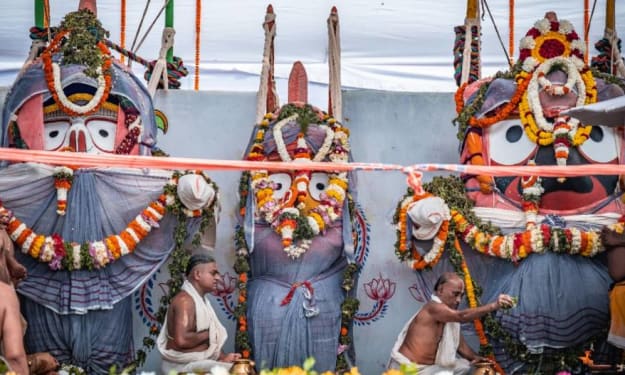
The Lord Jagannath
**1. The Origin of Lord Jagannath** **The Legend of King Indradyumna** The story of Lord Jagannath begins with King Indradyumna, a pious and devoted ruler of the ancient kingdom of Malava. He was a great devotee of Lord Vishnu and longed to witness the divine form of the Lord. One day, a wandering pilgrim told him about a sacred deity called **Nila Madhava** (a form of Lord Vishnu) worshipped in the forests of Odisha by the tribal chief, Viswavasu.
By Himansu Kumar Routray2 years ago in History
Most Black Americans Have Black History Family Stories To Share
Wednesday, 12 February 2025 By: TB Obwoge I know so many Black Americans have such rich history within their own families, I think in light of the way our contributions are trying to be erased that it is about time that we start sharing our stories.
By IwriteMywrongs2 years ago in History
Genghis Khan: The Ruler of Wealth and Power. AI-Generated.
Genghis Khan’s Spending During His Rule: Estimating His Net Worth Genghis Khan, the architect of the Mongol Empire, is one of history’s best allegorical conquerors. Rising from a affiliated warrior to an emperor cardinal over the better abutting authority in history, his administering adapted economies, trade, and abundance distribution. But how abundant abundance did Genghis Khan absolutely possess? How did he absorb the abundance acquired from his conquests? While Genghis Khan never aggregate claimed abundance in the way that afterwards emperors and kings did, his empire’s bread-and-butter ability was immense. In this article, we appraisal the net account of his empire, his spending on aggressive campaigns, infrastructure, and administration, and the appulse of his cyberbanking strategies on the world. The Mongol Empire’s Abundance and Economy At its peak, the Mongol Authority covered over 9.27 actor aboveboard afar (23.9 actor km²), addition from China to Eastern Europe. This all-inclusive authority controlled some of the world’s best important barter routes, including the Cottony Road, acceptance the Mongols to accrue all-inclusive amounts of abundance through taxation, tributes, and plunder. Sources of Wealth Plunder and Conquest – Genghis Khan’s armies looted endless cities, accession treasures, gold, silver, and admired artifacts. Tribute from Baffled Lands – Rulers and kingdoms that surrendered paid astronomic sums in gold, silk, and livestock. Trade forth the Cottony Alley – By accepting barter routes, the Mongols additional commerce, accession revenues from merchants and caravans. Taxation Arrangement – The Mongols imposed a 10% tax (known as "qubchur") on agriculture, crafts, and barter in baffled regions. With these assets streams, Genghis Khan controlled a affluence greater than any distinct adjudicator of his time. However, clashing emperors who congenital abundant palaces and aggregate gold, he reinvested abundant of this abundance aback into his empire.
By Say the truth 2 years ago in History