Biographies
Maharana Pratap
Early Life and Background (1540–1572) Maharana Pratap was born on May 9, 1540, in Kumbhalgarh, Rajasthan, to Maharana Udai Singh II and Maharani Jaiwanta Bai of the Sisodia Rajput clan. He was the eldest son and heir to the throne of Mewar, a kingdom in present-day Rajasthan. From an early age, Pratap displayed exceptional bravery, leadership, and a deep love for his homeland.
By Uday Kushwaha2 years ago in History
Letters to My Love🌹
The first letter arrived on a crisp autumn morning, tucked well among the folds of the every day newspaper. Elise, wrapping herself in a comfy shawl, picked it up with a curious frown. The envelope became simple—ivory white, together with her name written in fashionable cursive. There became no return address.
By RASHED KHAN2 years ago in History
A Love Across Time
In the coronary coronary heart of Paris, wherein the Seine River whispered secrets and techniques and strategies to the historical cobblestone streets, a more youthful female named Elara lived in a small attic rental. She changed into a historian, captivated with uncovering the mysteries of the beyond. Her modern task modified into a set of letters from the 18th century, observed within the dusty facts of a forgotten château. Among them emerge as a unusual letter, written in elegant cursive, that mentioned a love so profound it transcended time.
By RASHED KHAN2 years ago in History
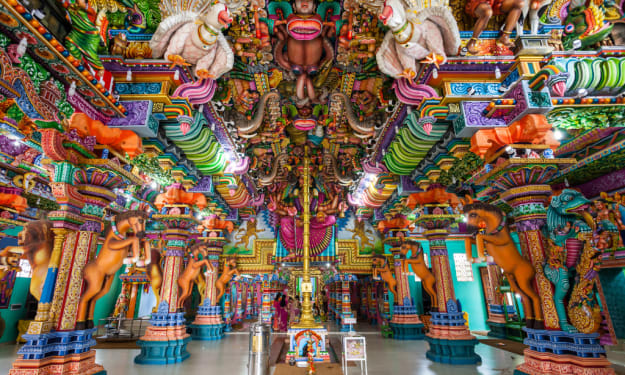
How Visiting Kamakshi Amman Temple Boosts Your Well-Being
Introduction: Beyond Worship—A Path to Holistic Well-Being Kamakshi Amman Temple, one of the most revered temples in Kanchipuram, Tamil Nadu, offers far more than a space for worship. The temple is a sanctuary where devotees experience not just spiritual nourishment but also significant physical and emotional benefits. The act of visiting this sacred place is not only about offering prayers to Sri Kamakshi Ambal but also about rejuvenating the body, mind, and spirit.
By Sri Kamakshi Ambal Temple2 years ago in History
Harry Potter (film series)The Harry Potter Film Series: A Magical Cinematic Journey
The Harry Potter Film Series: A Magical Cinematic Journey (film series) One of film history's most beloved and successful franchises is the Harry Potter film series. Adapted from J.K. The films brought the magical world of wizards, spells, and Hogwarts to life, based on J.K. Rowling's best-selling book series. Between 2001 and 2011, eight films in the Harry Potter (film series) were released. The franchise captivated audiences all over the world and made over $7.7 billion at the global box office. Origins and Progress When J.K. Rowling's Harry Potter and the Philosopher's Stone (also known as Sorcerer's Stone in the United States) debuted in 1997, it marked the beginning of the series' transformation from book to movie. The film rights were purchased by Warner Bros. in 1999, and the first movie was released in 2001. Harry Potter and the Sorcerer's Stone, directed by Chris Columbus, introduced audiences to the wizarding world by following 11-year-old Harry as he uncovers his magical heritage. The producers used mostly British actors to keep the show true. Daniel Radcliffe played Harry Potter, Emma Watson played Hermione Granger, and Rupert Grant played Ron Weasley. The core of the franchise was formed by these young actors and a stellar supporting cast that included Alan Rickman as Severus Snape, Maggie Smith as Minerva McGonagall, and Richard Harris as Albums Dumbledore. The Development of the Series As Rowling's books were adapted into movies, the films got darker and more mature as Harry and his friends faced more challenges. Chris Columbus, who directed the first two films, maintained a lighthearted, adventurous tone. Alfonso Charon, who directed Harry Potter and the Prisoner of Azkaban (2004), changed the visual and narrative tone of the series by adopting a darker, more artistic approach. The return of Voldemort (Ralph Fiennes) to power raised the stakes in Mike Newell's 2005 film Harry Potter and the Goblet of Fire. With Harry Potter and the Half-Blood Prince (2009) and Harry Potter and the Order of the Phoenix (2007), the series continued. David Yates directed both films, and he remained in charge for the series' final installments. To fully convey the epic conclusion, the final book, Harry Potter and the Deathly Hallows, was split into two films—Part 1 (2010) and Part 2 (2011). Harry Potter and the Deathly Hallows: Part 2 became the series' highest-grossing film, earning more than $1.3 billion worldwide. Harry Potter: The Wizarding World of Harry Potter and the Deathly Hallows 444 One of the most successful and well-liked franchises in film history is the Harry Potter film series. The magical world of magicians, magic, and Hogwarts has been awakened by the best-selling book series that inspired the J.K.-based film "The Films." Between 2001 and 2011, the Barry Potter (Film Series) franchise released eight films with global box office revenues of more than US$7.7 billion. The audience was captivated by the series. 444 History and Growth The journey of Harry Potter from When Rolling Harry Potter and the Philosopher's Stone, the American Wizard's title, became extremely popular in 1997, movies began. Warner & Company The rights to the movie were bought in 1999, and the first movie came out in 2001. When 11-year-old Harry discovered his magical heritage, the audience in Chris Columbus' Harry Potter and the Sorcerer's Stone was transported into a magical world. The producers cast mostly British actors, including Emma Watson as Elmina Granger, Daniel Radcliffe as Harry Potter, and Ron Weasley as Rupert Grant. With outstanding support, these young actors, such as Alan Rickman as Severus Snape, Maggie Smith as Minerva McGonagall, and Richard Harris as Albums Dumbledore, became the franchise's center. Series 444 The development of the all subsequent films based on Rowling's book became mature and dark, and Harry and his friends faced significant difficulties. The first two films by Chris Columbus remained light-hearted and adventurous. Alfonso Quarrions, who directed Harry Potter and the Prisoner of Azkaban (2004), introduced a dark, artistic approach that altered the visual and narrative tone of the series. 444 Voldemort, played by Ralph Fiennes, became a higher operation than the return to power, similar to what happened in Mike Newell and Harry Potter and the Mug From Fire (2005). Harry Potter and the Order of the Phoenix (2007) and Harry Potter and the Half Blood Prince (2009) marked the conclusion of the series.
By FZ Zeeshan2 years ago in History
The Evolution of Islam from Its Inception to 2025
Introduction Islam, one of the world's major religions, has a rich history that spans over fourteen centuries. Emerging in the 7th century CE in the Arabian Peninsula, it has expanded across various continents, cultures, and societies, adapting and evolving in response to diverse challenges and opportunities. This essay seeks to explore the evolution of Islam from its inception to the year 2025, examining significant historical events, cultural shifts, theological developments, and the current state of the Islamic faith.
By MOHAMMED NAZIM HOSSAIN2 years ago in History
A Love Letter Never Sent
Eleanor sighed, resting her head towards the again of her chair. Outside, the night stretched with out a result in sight, stars blinking in silent witness to her unstated emotions. She imagined him underneath the same sky, possibly studying a e-book by using the usage of the dim moderate of his lantern, or out of place in notion the manner he frequently modified into. Did he ever think of her? Would he ever apprehend how deeply she cared?
By RASHED KHAN2 years ago in History
The Last Goodbye
The rain drizzled gently, a tender whisper in opposition to the pavement. The town became wrapped in a misty haze, and the streetlights cast an eerie glow on the wet sidewalks. In the middle of it all, Eleanor stood by using the teach station, her fingers clenched across the cope with of her suitcase. The weight of the instant pressed down on her like an anchor.
By RASHED KHAN2 years ago in History
Idi Amin Dada: The Tyrant of Uganda
Idi Amin Dada remains one of the most notorious figures in modern African history. His name is synonymous with brutal dictatorship, human rights abuses, and a dramatic transformation of Uganda during the 1970s. This exploration delves into his early life, rise to power, reign as dictator, and the lasting impact of his rule on Uganda and the broader world.
By OWOYELE JEREMIAH2 years ago in History