Biographies
The Last Light: How Anne Frank’s Words Still Illuminate the World. AI-Generated.
AI-Assisted Content This article was created with the help of ChatGPT and then reviewed and edited by the author to ensure originality and compliance with Vocal Media's guidelines.
By Md Hasan Aliabout a year ago in History
Cleitarchus
The narrative of Alexander the Great has been recounted for centuries, yet few of his historians are as contentious and fascinating as Cleitarchus. Although his original writings have been lost to history, his impact endures through the works of later historians who drew upon his vivid, albeit occasionally embellished, accounts. Cleitarchus’ depiction of Alexander’s victories contributed to the legendary image of the Macedonian ruler, merging reality with dramatic expression. This essay examines Cleitarchus’ life, his role in shaping Alexander’s historiography, and the ongoing discussion regarding his credibility as a historical source.
By A Históriaabout a year ago in History
story of the butterfly
story of the butterfly Once a smart guy noticed a butterfly cocoon (egg) in his garden. He noticed that the butterfly turned into attempting difficult to pop out of its cocoon however couldn't. The newly born butterfly turned into attempting difficult and running difficult however couldn't get the relaxation of its frame out of the egg or cocoon from which it turned into born. At one point, it appeared that the butterfly may not be capable of pop out anymore, it stopped even after struggling. Seeing this scene, the person felt very sorry. He went and reduce the relaxation of the cocoon with a couple of scissors and were given the butterfly out. Does it look like the person did the butterfly a want, right? Actually, even though it appeared like a want before everything glance, the butterfly suffered the best loss for this guy. The butterfly turned into looking to pop out of the cocoon, the butterfly`s frame turned into on the brink of take at the demanding situations of the future. As its wings flapped, the God-given liquid withinside the cocoon turned into supporting its wings to grow to be stronger. But while this guy helped it to pop out with none effort, its wings remained immature. The butterfly ought to by no means fly nicely for the relaxation of its life, due to the fact its wings have been now no longer sturdy sufficient to fly. Lesson from the butterfly story: Life's issues or barriers make it certified and sturdy to stand the future. Shackled elephant When the boy promised his father to go to the circus. His father brought him to the circus. Before the circus began, the father showed his son the animals in front of various animal cages held outside the circus tent. When they saw, they came to the elephant. They saw that the elephant was not trapped in a cage, but was tied to his feet with thin chains that could break if he wanted. But what was surprising was that the elephants didn't try to do this. You see that the boy was very surprised and asked his father why. The father called out the elephant Mahout (who cared for the elephant) and asked why. The elephant Mahout replied - when these elephants were very small, we tied them with such thin chains. At that time, they broke and tried to fail many times. At this age, this chain was enough to maintain it. In this situation, when you grow up, you believe it is never possible to break this chain. Now they are much stronger than this chain, but they don't try to break them because they are tied to their beliefs. History Inspiration: The first step to success is to truly believe they will succeed. No matter how many obstacles try to stop them, they have to try to succeed. The habit of comparison is to be avoided A crow lived in a forest. He was very happy with his life. But one day he saw a swan.… … On this side of the river he breathed his last, and on that side I believe all happiness lies. Ah! How beautiful the swan is! The crow thought. Surely he is the happiest bird in the world. The crow told the swan about his thoughts. “Actually,” the swan replied, “I thought I was the happiest bird here, until I saw a peacock.… … Which has two colors on its body. So now I think that the peacock is the happiest bird in creation.” The crow then went to the peacock. The peacock told him, “I was very, very happy, until I saw the peacock.… … I have only two colors on my body, and how many colors are on the peacock’s body!” The crow then went to the zoo to meet the peacock. There he saw that hundreds of people had gathered to see the peacock. After everyone had left, the crow went to the peacock… … “Oh peacock, how beautiful you look! Thousands of people gather to see you every day. And me? People chase me away as soon as they see me. You must be the happiest bird in the world.” The peacock replied, “I also thought that I was probably the most beautiful and happiest bird on this planet. But because of this beauty, I have been kept in a cage. I have observed this zoo very carefully and realized that the crow is the only bird that is never kept in a cage. So for the past few days I have been thinking, Esh! If I were a crow, I could roam wherever I wanted.” Lesson from the story of avoiding the habit of comparison: unnecessarily comparing yourself to others only increases your misery.
By Foyzun Naharabout a year ago in History
Modern Science and Its Impact on the Future. Content Warning. AI-Generated.
Modern science is one of the most powerful tools shaping the world today. It helps us understand the universe, solve real-world problems, and improve the quality of human life. From medicine and technology to environmental solutions and space exploration, science is playing a key role in building a better future.
By Sadik rockerabout a year ago in History
Why Do They Fear Political Islam?
Start writing...Islam is not just a religious doctrine from the beginning - but a complete way of life. It offers people not only spiritual liberation, but also social justice, political leadership and a picture of a society without discrimination. When the Prophet (peace be upon him) called for religion in Mecca, it was not just a message of self-purification for a single individual - but a call for change at all levels of Arab society. Islam establishes a state, formulates laws, reforms society, and lays the foundation for an exceptional system of governance in the world. Therefore, Islam has never been just a 'religion of individual worship'.
By Abdul Barikabout a year ago in History
AI in Cybersecurity: A game changer or a double-edged sword?
Artificial intelligence has utterly transformed cybersecurity in diverse manners, both remarkable and multifold. Its skills—including scouring immense datasets, searching for anomalies and systematising retaliation—have propelled protective tactics to unprecedented heights.
By Abjol Hussain Laskarabout a year ago in History
Sultan Suleiman the Magnificent: Justice, Power, and Legacy
He ruled with knowledge, fought with honor, and left behind a golden age of tradition, law, and empire. His name nevertheless echoes through the halls of history as Kanuni — the Lawgiver. This is the story of Sultan Suleiman the Magnificent, the greatest Sultan of the Ottoman Empire.
By Md Ajmol Hossainabout a year ago in History
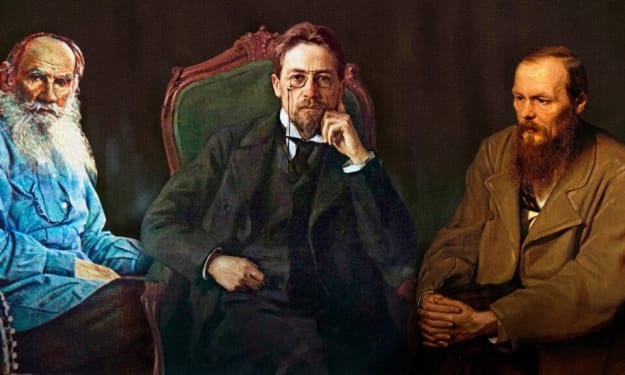
The top 5 great russian writers
Russian writers hold a special place in the world of literature. The influence of Russian literature extends beyond the realm of literary circles—it has impacted politics, economics, and society across the globe. Almost every writer and reader, big or small, holds Russian literature in high regard. There is hardly another example where the writers of a single country have had such a far-reaching influence. Russian literature reached its peak of richness in the 19th century. With a new language, fresh artistry, and modern ornamentation, it brought about a literary revolution that rippled beyond Russia and captivated the entire world. Even today, the world remains enchanted by the fragrance of the Golden Age of Russian literature. This Golden Age was glorified and enriched by several great writers. Today’s discussion is about five of them. Alexander Pushkin Alexander Sergeyevich Pushkin is often called the Shakespeare of Russian literature. The Golden Age of Russian literature began with Pushkin. Though he is regarded as the father of modern Russian poetry, he revived the entire landscape of Russian literature through his dramas, short stories, and novels. Born in 1799 and passing away in 1837, Pushkin was born into an aristocratic family in Tsarist Moscow. Despite his noble birth, he led a revolutionary and combative life. Although he is considered the father of Russian literature, he spent the first ten years of his life primarily speaking French. At just 15, he shocked everyone with his radically different poetry. His poems are largely romantic. Some of his famous works include Message of Europe, Ruslan and Ludmila, The Bronze Horseman, and Boris Godunov. His most beloved literary work is the verse novel Eugene Onegin, which took a lifetime to write. It is so complex that its English translation required two volumes for just 100 pages of the original. Pushkin was influenced by the liberal philosophies of Kant and Voltaire. He was a reformist and consistently wrote against monarchy. His revolutionary poetry frequently brought him into conflict with the authorities, resulting in years of exile. Pushkin was the first Russian writer whose works spread globally. Pushkin led a chaotic life—he was stubborn and short-tempered. He fought many duels. In one such duel by the Black River, he was shot. Two days later, the eccentric, debt-ridden Pushkin died at just 38. By then, he had already reshaped the map of Russian literature. Nikolai Gogol Pushkin’s friend Gogol was born ten years after Pushkin (in 1809) and died fifteen years later (in 1852), living a brief life of just 43 years. Gogol was born into a literary-minded family in Ukraine, then part of the Roman Empire. As a literary heir, he developed an early passion for poetry and drama. Gogol, like Pushkin, led a wild life. He self-published his first poetry book, and when no one bought a single copy, he burned all the remaining copies in a fit of rage. But he didn’t stop writing. He traveled extensively across the Soviet Union, Switzerland, Germany, Italy—even Palestine. He formed friendships with philosophers, writers, and spiritual figures throughout the Soviet region. He held multiple jobs, none of which satisfied him. Initially, Gogol wrote poetry and stories about Ukrainian village life. Over time, his writing style evolved. His friendship with Pushkin greatly enriched both their literary careers. Gogol’s works combined satire and realism, which distinguished him from others. It is believed he mocked Tsarism in his writings. His most famous works include the short story The Overcoat and the novel Dead Souls. It is largely due to Dead Souls that he is considered the pioneer of modern Russian novels. After Pushkin’s death in 1837, Gogol fell into despair and turned toward spirituality. He began to believe that the Devil was using him to write sinful material. As a result, he burned the second volume of Dead Souls. This act of destroying both his first and last books completed a symbolic cycle. After burning the final manuscript, Gogol became bedridden, stopped eating, and eventually died ten days later. Thus ended the life of one of modern Russian literature’s finest minds. Fyodor Dostoevsky The year was 1849. Under the Tsarist regime, a group of revolutionaries was taken before a firing squad for operating a secret progressive society. Just before execution, a last-minute order spared them. They were sent into exile. One of them, Fyodor Dostoevsky, was a novelist, short story writer, and philosopher—now one of the brightest names in world literature. Born in Moscow in 1821, Dostoevsky published his first novel Poor Folk at age 24, considered the first social novel in Russia. His four major novels are Crime and Punishment, The Idiot, The Demons, and The Brothers Karamazov. He became renowned for using the “stream of consciousness” technique, which was later popularized by James Joyce. His characters are complex and tormented, often exhausted and confused by moral dilemmas. Joyce described his novels as full of “violence.” Dostoevsky’s ideas and writing influenced countless writers and philosophers, including James Joyce, Albert Camus, Franz Kafka, Friedrich Nietzsche, Samuel Beckett, and even Albert Einstein. He suffered from epilepsy throughout his life and had a severe gambling addiction. A statue of him still stands at a casino in Germany. He lost his savings and even borrowed money meant for his ill wife's treatment, signing contracts under pressure to pay his debts. Despite this, he continued gambling. His first wife, with whom he had a rocky relationship, died of tuberculosis. Later, he fell in love with his 25-years-younger stenographer Anna and married her. Anna helped stabilize his life. Two months before his death in 1881 at age 59, Dostoevsky completed The Brothers Karamazov, which he dedicated to his beloved wife Anna. Leo Tolstoy Since 1901, the Nobel Prize has been awarded in literature, but the biggest controversy remains the committee’s failure to honor Leo Tolstoy. He died in 1910, and even by then, he was considered the greatest name in world literature. His novels War and Peace and Anna Karenina consistently rank at the top of the greatest literary works of all time. War and Peace took five years to write and spans over a thousand pages with more than 600 characters. It tells the story of Napoleon Bonaparte’s invasion of Russia and the rise and fall of aristocratic families. Anna Karenina, written over three years, explores Russian society and a complex romantic relationship. These two novels alone define Tolstoy’s literary legacy, although he also wrote Resurrection, an autobiography, and many timeless short stories. Born into an aristocratic family in 1828, Tolstoy lost both parents at a young age. He was exceptionally intelligent and hardworking. According to Maxim Gorky, Tolstoy was “a world unto himself.” He taught himself Latin, English, Arabic, Italian, and Hebrew—learning new languages just to read books in their original form. Early in life, Tolstoy was unsure whether to pursue literature, but under the influence of his friend and fellow writer Ivan Turgenev, he began writing. His first book Childhood was followed by two more autobiographical volumes. Most people write autobiographies later in life, but Tolstoy began his literary journey with one, as his life was already filled with remarkable events. After a failed stint managing his estate, he traveled across Europe and even fought in the Crimean War. These experiences enriched Tolstoy’s writing. His work extended beyond novels—his short stories are also invaluable. He was a philosopher, too. His teachings on nonviolence influenced Mahatma Gandhi. In his final years, Tolstoy turned toward spirituality, giving away nearly all his wealth. At age 82, he left home in poverty and died of pneumonia at a small train station in Russia—one of the brightest stars of world literature. Anton Chekhov Continuing the tradition of iconic Russian writers, Anton Chekhov also lived a short life—only 44 years. Born in 1860 and passing in 1904, Chekhov was the son of a serf-turned-merchant father and a Ukrainian mother. He grew up in a harsh family environment. In his words, “I have my mother’s heart and my father’s talent.” Chekhov was a doctor by profession, although he earned very little from it. He traveled across Russia, Ukraine, and even to prisoner camps in Japan, offering free medical help, building hospitals, and treating those suffering during a cholera outbreak. During this time, he wrote several letters considered among his finest works. He began writing to support his family financially after suddenly becoming the primary breadwinner. He submitted pieces to newspapers and gradually realized writing was his true calling. Even in his short life, his works gained immense recognition, both during and after his lifetime. He is regarded as one of the world’s greatest short story writers. His plays rank among the most frequently performed in history. His best-known plays include Three Sisters, The Seagull, and The Cherry Orchard. Though initially slow to gain popularity, his fame grew steadily. His most famous short stories include The Lady with the Dog, The Chameleon, The Black Monk, The Steppe, and A Dreary Story. His stories were often more blunt than traditional tales. Like Dostoevsky, Chekhov also gained fame for his use of stream of consciousness. Afraid of marriage, Chekhov married just three years before his death. He and his wife lived in separate cities. His death was also peculiar. After long suffering from tuberculosis, he one day sat up in bed and said in German—despite barely knowing the language—“I am dying.” He smiled, took a glass of champagne, drank it in one sip, and passed away in 1904. Thus ended the life of one of the greatest short story writers and playwrights in world literature.
By Riham Rahman about a year ago in History