
She Survived Titanic, Britannic and Olympic: The True Story of Woman Who Ocean Could Not Bury
When people talk about the disaster of Titanic, most of them imagine a Hollywood movie, iceberg, and tragic fates of hundreds of passengers. But there is one real human story that is even more unbelievable than any film script. It is a story of a quiet ship stewardess named Violet Jessop.
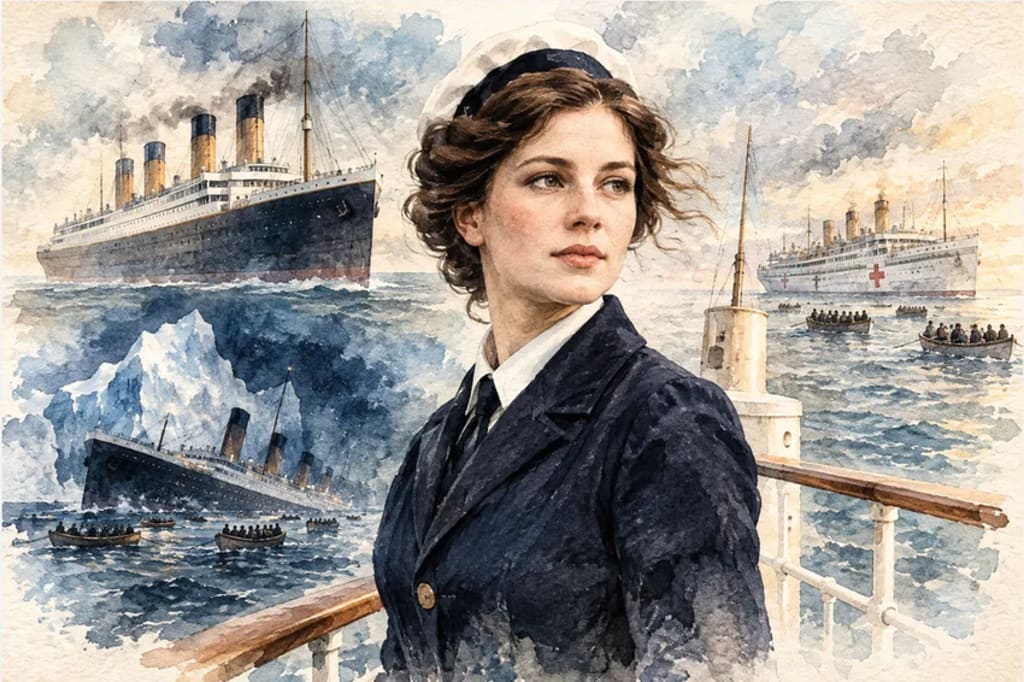
This woman did not find herself in the freezing waters of Atlantic Ocean only once. During her life, she served on all three gigantic sister ships of the White Star Line company — on Olympic, Titanic, and Britannic. And what is most fascinating? She survived a heavy crash or sinking of every single one of them. In the history of sea travel, she gained a completely unique, even if a bit scary, status of the most resilient woman in the world.
The first warning on board of Olympic
Violet was born in Argentina to Irish emigrants and her life was full of fights for survival since childhood, when she miraculously overcame a severe tuberculosis. When her father died, the family stopped moving and settled in Great Britain. To feed her siblings, Violet decided to follow the footsteps of her mother and started to work as a stewardess on ocean liners. It was an extremely hard work, which meant long hours on feet and constant care about rich passengers in the first class.
In 1911, she stepped on board of then the largest civil ship of the world — RMS Olympic. The ship was presented like a technological miracle and a peak of safety. But right during one of the first voyages in a strait near the British coast, a brutal collision happened with a war cruiser HMS Hawke. The impact was so strong that Olympic had a completely destroyed side and the hull started to fill with water. Violet was standing under the deck at that time, but thanks to the great work of the captain and crew, the ship managed to stay on the water and sail into port. For the young stewardess, it was the first warning sign that the sea can destroy even the biggest human work. But she did not let herself be scared.
The night when Titanic went down
Less than a year later, in April 1912, the White Star Line company finished its new pride — Titanic. It was even more luxury, bigger, and according to contemporary newspapers, completely unsinkable. Violet was transferred to it as an elite stewardess for the first class. The voyage went in a complete peace until the fateful night from 14th to 15th April.
When Titanic hit the iceberg, Violet was just lying in her cabin. Like an experienced member of the crew, she immediately understood that the situation is critical. She got an order to go up on the deck and show to frightened foreigners who did not understand English how to correctly put on life jackets and where to go. She had to keep absolute calm herself, so a panic would not break out in the luxury spaces. Finally, one of the officers literally pushed her into lifeboat number 16. Right before lowering the boat into the dark water, someone put a small, forgotten baby into her arms. Violet pressed the baby to her body all night in the freezing cold, until they were rescued in the morning by the ship Carpathia. On the land, she then gave the child to a crying mother who was desperately searching for it.
The third disaster in a minefield
One would think that after such an experience, Violet would never step on any ship again. But the First World War came and Violet volunteered as a nurse for the Red Cross. In 1916, the fate brought her on board of the third sister ship, which was rebuilt into a floating hospital — HMHS Britannic.
In the Aegean Sea, near the Greek shores, Britannic hit an underwater mine. The explosion was huge and the ship started to sink much faster than Titanic. Violet this time did not have luck for a calm retreat in a boat. When the ship was going down by its bow, the giant propellers on the stern were still turning above the water and started to suck and crush the lifeboats that were lowered too early. Violet saw that a certain death is coming, so she jumped from the boat directly into the water. The current sucked her under the surface, where she hit her head terribly against the ship’s keel. Yet, she managed to surface, catch some debris, and survive. A few years later, a doctor during a normal examination found out that she survived then with a broken skull bone, without even knowing about it.
A life without fear
The story of Violet Jessop does not end with a tragedy, but with an unbelievable peace. After the war ended, she returned to her original profession of a stewardess and spent another more than thirty years on the sea. She sailed around the world, survived other smaller storms, and went to retirement only in 1950. She died peacefully in her cottage in the English countryside in 1971 at the age of 83.
When historians today look at the black-and-white photographs of this smiling woman in the Red Cross uniform, they see in her a symbol of human resilience. Violet Jessop was not a famous celebrity or a captain, but an ordinary working woman who managed to look three times into the eyes of the biggest naval disasters of modern history — and every time she walked away as a winner.
P.S. I am very sorry for my imperfect English, I am still learning it! Thank you all for your understanding and I hope you liked this unbelievable history story anyway.
About the Creator
Enjoyed the story? Support the Creator.
Subscribe for free to receive all their stories in your feed.
Comments
There are no comments for this story
Be the first to respond and start the conversation.