
Reconstructing Aristotle's Protrepticus: 99% of Ancient Greek Literature Lost
"The foundation of all wisdom is self-awareness.

Aristotle is a well-known Greek philosopher. His statements are as well-known as passages from a collection of famous quotes. His views are proclaimed in innumerable graduation speeches:
"The foundation of all wisdom is self-awareness.
"You become more aware of your ignorance as you gain more knowledge."The ability to consider an idea without accepting it is a sign of a well-educated mind.We are responsible for our own happiness.What we consistently do defines who we are. Therefore, excellence is a habit rather than an act.
The sum of its pieces is not as great as the whole.
Remarkably, no one can be absolutely sure that a quote from Aristotle is accurate. Aristotle is not alone in his predicament. It is impossible to analyse the full scope of ancient Greek literature. According to historians, between 90 and 99 percent of Greek literature has been lost due to improper preservation methods, weather exposure, war-related fires, or just being thrown away.
One of Aristotle's early writings, Protrepticus (Exhortation to Philosophy), written while he was a member of Plato's Academy, has been lost in its entirety, according to philosophers Dr. Doug Hutchinson of the University of Toronto and Dr. Monte Johnson of the University of California-San Diego. However, it has survived thanks to reconstructions made by contemporary historians using quotes from late antiquity.
Why Did Aristotle Write a Protreptic? What Is a Protreptic?
Protreptikos is Greek for "an exhortation" or "a turning toward." These pieces aim to convince people to adopt a particular lifestyle. The text was intended for a wider audience than technical philosophical treatises. It served as a defence of intellectual inquiry as much as an invitation. Because of this, the Protrepticus can function as a specific introduction to Aristotle's worldview before readers come across his more specialised writings.
Iamblichus's Contribution to Aristotle's Preservation
To encourage students to study philosophy, Iamblichus, a Syrian Neoplatonist philosopher from the third century AD, penned his own adaptation of Protrepticus. His historical compilation of lengthy, unattributed passages from intellectual masterpieces is his most well-known creation today. Iamblichus became an inadvertent preservationist by assembling passages from older authors like building bricks, even though he assembled his work to honour Pythagorean philosophy.
In order to preserve Aristotle's early ideas, which were intended for a broad audience rather than those in Plato's Academy, Iamblichus employed lengthy portions from Aristotle's lost Protrepticus.
Additionally, ten pages of text by a sophist from the fifth century BC that Iamblichus refers to as the Anonymous Iamblichi are included, along with passages and explanations of Plato's theories. Luckily, Iamblichus is most useful in saving a lot of Aristotle's ideas.
Iamblichus was able to immediately incorporate significant portions of Aristotle into his own philosophical collection, according to Johnson and Hutchinson. According to this perspective, Iamblichus is no longer a commentator but rather a conduit allowing other authors to access Aristotle's lost writings.
The Impact of Aristotle's Protrepticus on Early Christianity and Cicero
Quotations from later writers have also been used to recreate the Hortensius, a lost book by the Roman philosopher Cicero. Cicero and early Church fathers like Saint Augustine of Hippo drew influence from Aristotle and his interpretations of Plato's teachings. Cicero's writings, such as the Hortensius, aim to convince readers that leading a philosophical life is the best course of action.
Thus, the combined legacies of Plato and Aristotle serve as the foundation for the ideas of Cicero and numerous other philosophers. Reconstructions by scholars show how early philosophers influenced those who modified their theories for a more contemporary era.
Professors Johnson and Hutchinson's research demonstrates the numerous links that can be found when a deleted text is reconstructed. Aristotle's early ideas demonstrate this renowned philosopher's approachable and convincing side.
The Protrepticus portrays Aristotle as a supporter of introspection, intellectual curiosity, and the lifetime pursuit of knowledge rather than arcane logic or metaphysics. The lecturers continue to gain understanding of Aristotle's development as a philosophical thinker through meticulous research and analysis of papyrus pieces that have survived for over two millennia.
Why It's Still Important to Reconstruct Aristotle's Lost Protrepticus
Of the roughly 150–200 works credited to Aristotle in antiquity, only 31 treatises remain today. According to Johnson, rebuilding the Protrepticus fills in a significant gap in intellectual history. A compelling old question is raised by the transmission and preservation of classical texts:
Why should people seek wisdom? According to the reconstructed Protrepticus, Aristotle's response was straightforward but profound: philosophy is the activity that enables people to reach their greatest potential, not just one of many.
Using Papyri fragments of the Protrepticus, Johnson and Hutchinson produce a work that faithfully captures Aristotle's most well-known thesis: even those who come to reject the extraordinary worth of philosophy must nevertheless use philosophical reasoning to support their claims.
Therefore, the pursuit of this intellectual culture is inevitable regardless of one's acceptance or rejection of philosophy. The real basis for Aristotle's exhortations to seek wisdom is this dilemma.
Socrates, Plato, and Aristotle: The Foundation of Western Philosophy
Aristotle was influenced by Socrates through Plato and the Academy, even though he was born fifteen years after Socrates' death and could never have studied under him personally. The Pursuit of Rational Inquiry, one of Socrates' most important intellectual legacies, was designed to argue that the pursuit of truth is humanity's greatest resource.
The second elevates ethics as a top priority. This worry was passed down from Socrates to Aristotle, who incorporated it into his own writings. In contrast to his teacher Socrates, Plato would have rejected relativism in favour of Objective Truth.
It is evident that human reason is capable of discovering universal principles. Additionally, Plato imparted to his pupils the idea that reality has a purpose and an underlying order. Plato's final argument, which had a direct impact on Aristotle, is that a philosopher must always pursue wisdom.
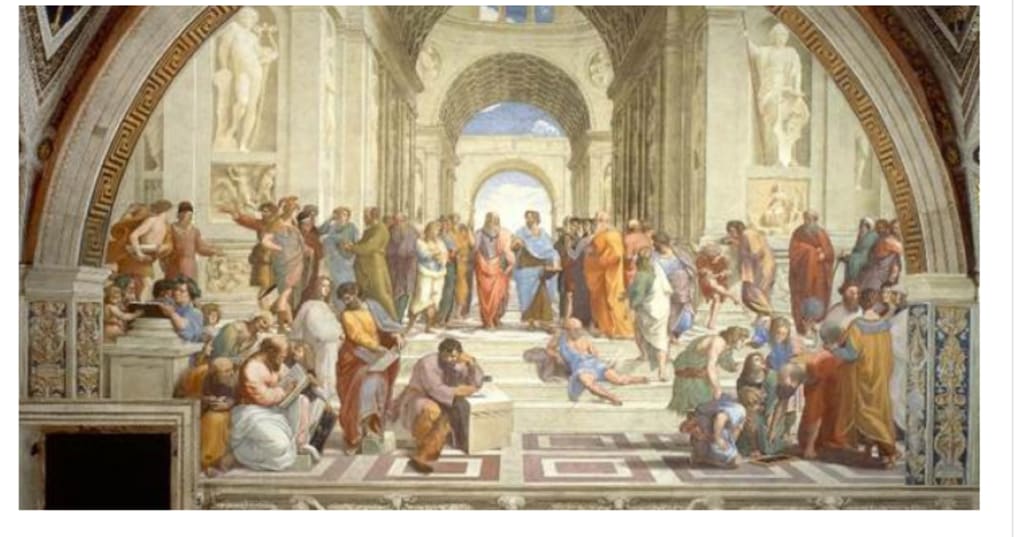
Aristotle was fascinated by what could be seen in the world around us, whereas Plato was always interested in what may be found beyond our physical level.The finest mathematicians, philosophers, and scientists of classical antiquity are shown in Raphael's fresco, The School of Athens, which was created for Pope Julius II in the early 16th century AD. These figures include Plato, Aristotle, Pythangoras, Euclid, Zoaster,
and Ptolemy, who all had different goals and lived in various times, the mural illustrates the philosophical stances. Aristotle gestures horizontally toward the visible world, while Plato points upward toward ultimate reality.
What Remained of Aristotle's 200 Lost Works: The Corpus Aristotelicum
The Corpus Aristotelicum, which was eventually assembled and edited hundreds of years after Aristotle's death by Andronicus of Rhodes in the middle of the first century BC, is the name given to these amazing accomplishments that are still in existence.
It's astounding how wide it is. Aristotle's extant works address nearly every facet of knowledge, including language, the arts, ethics, politics, and law, even if his contributions to logic and the establishment of zoology as a field are still his most well-known accomplishments.
Aristotle also distinguished and clarified many fields of knowledge, such as mathematics and metaphysics, whose main goal was to discover truth apart from politics and ethics. Aristotle considered himself to be part of a lengthy heritage of thought. When addressing a certain discipline, he compiled all earlier contributions to the field and focused on the issues that these earlier works had failed to address.
In actuality, Aristotle was essentially an empiricist. He enjoyed gathering and analysing information about the physical world as it had existed and was visible to him. Though its consequences are still up for debate, Aristotle formulated theories regarding the appropriate application of reason.
How Byzantine and Baghdadi Libraries Preserved Aristotle's Writings
Unfortunately, conflict, political unrest, a lack of infrastructure, and a lack of funding all contributed to the destruction of numerous ancient artefacts, particularly fragile papers. War and devastation were valued more highly than cultural preservation in an unstable environment.
Previously accessible works were lost throughout the vast Roman Empire, which stretched from Egypt in the east to Britain in the west. Fortunately, generations of scribes continued to copy and preserve Aristotle's writings.
Following the fall of the Western Roman Empire, Aristotle's writings could only be discovered in the vast libraries of Constantinople, which became the new center of Christian imperial authority in the East, or in distant locations like Baghdad, where the Abbasid dynasty had established a new governmental system.
Both Christians and Jews, who frequently had protected legal status under the Abbasids but were nevertheless subject to unique taxes and legal distinctions, were welcomed into this magnificent city. The philosophical texts that had been mainly neglected or deteriorated in Western Europe had a huge revival in this specific setting.
The majority of Aristotle's known works were translated into Arabic between 750 and 900 AD by the academics of Baghdad's renowned "House of Wisdom." He was very useful as a translator since he looked at problems from various perspectives and made sure that many topics were not only accepted but also suitable for discussion.
The scholar Ibn Rushd's translations helped spread Aristotle's teachings throughout Western Europe. He was originally from the Islamic city of Cordoba and was also known as Averroes. Orthodox theologians were worried by Averroes' claim that philosophical reasoning did not conflict with religious truth in his defence of the compatibility of philosophy and religion.
His followers in the Christian West faced criticism for adhering to his writings. For later scholars, his ability to offer extensive, in-depth commentary, succinct summaries, and lengthy discussions on each of Aristotle's works was invaluable.
About the Creator
Enjoyed the story? Support the Creator.
Subscribe for free to receive all their stories in your feed.
Comments
There are no comments for this story
Be the first to respond and start the conversation.