
Napoleon Was Not Short
And the Lie That Fooled the Entire World..
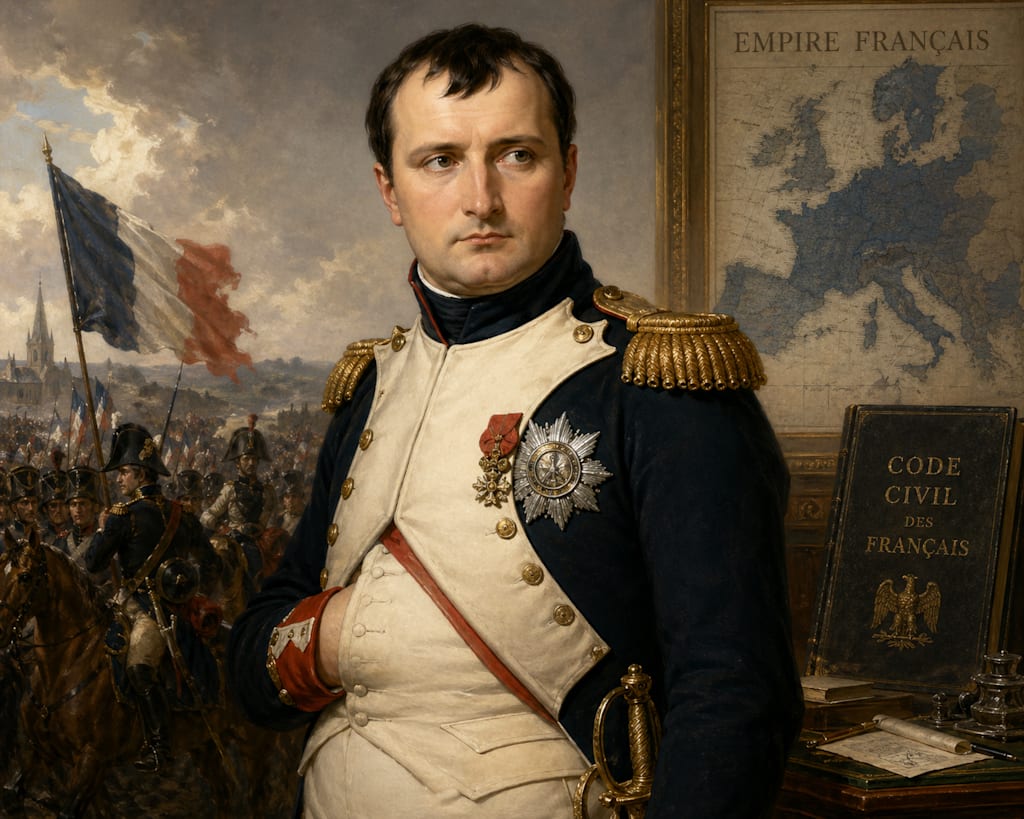
There is a joke the world has been laughing at for over two hundred years.
It goes something like this: Napoleon Bonaparte, one of the most brilliant military minds in human history, Emperor of France, conqueror of Europe — was a tiny, furious little man with a God complex and something to prove.
There is only one problem with that joke.
It is entirely, demonstrably false.
And the fact that the world still believes it is one of the greatest propaganda victories in modern history — pulled off not by Napoleon's enemies on the battlefield, where they rarely beat him, but in the pages of a satirical magazine by a cartoonist with a pen and an agenda.
Napoleon Bonaparte was born in 1769 in Corsica, and by every credible historical record, he stood approximately 5 feet 6 or 7 inches tall — which was, by the standards of late 18th century France, average to slightly above average for a man of his era. His own doctor recorded his height at 5 feet 6.5 inches in French units at the time of his death. Modern historians and medical analysts who have examined those records consistently place him in the normal height range for his period.
So where did the myth come from?
Two places, and they fed each other perfectly.
The first was a simple confusion of measurement. The French Pouce — the unit used to record Napoleon's height — was slightly longer than the British inch. When British sources translated his recorded height without accounting for this difference, Napoleon came out shorter on paper than he actually was. A clerical conversion error became a biographical fact, repeated and amplified until it took on a life of its own.
The second — and far more deliberate — source was James Gillray, a British caricaturist working in London at the height of the Napoleonic Wars. Gillray produced a series of political cartoons depicting Napoleon as a tiny, raging figure — childlike in stature, monstrous in ambition. The image was striking, memorable, and served a clear political purpose: to make the man threatening Britain's entire geopolitical order look ridiculous rather than terrifying.
It worked beyond anyone's expectations.
The British were, it should be said, genuinely afraid of Napoleon. And they had reason to be. By the early 1800s, he had reorganized the French legal system through the Napoleonic Code — a framework still influencing laws in countries from France to Louisiana to Quebec today. He had restructured his nation's education system, its banking infrastructure, and its military doctrine. On the battlefield, he was operating on a level that his contemporaries openly struggled to counter. The Coalition forces that eventually defeated him required five separate attempts spanning over a decade.
You do not need five coalitions and a decade to defeat a small, temperamental man with delusions of grandeur.
You need them to defeat a strategic genius who kept winning.
Napoleon's own nickname among his troops was "le petit caporal" — the little corporal. But this was a term of affection, not physical description. It referred to his habit of mingling with ordinary soldiers, eating with them, knowing their names. It was the kind of nickname given to a leader soldiers loved, not mocked. His personal guard, meanwhile, were famously among the tallest men in the French army — which may have contributed visually to the impression of him being smaller by comparison.
He was surrounded by giants by design. That is not the behavior of a man with an inferiority complex. That is the behavior of a man who understood optics.
He was exiled twice — first to Elba, from which he escaped after ten months and returned to power in an episode so audacious it reads like fiction, and then finally to Saint Helena, a remote island in the South Atlantic from which there was no returning. He died there in 1821. He was 51.
The cause of death is still debated. Stomach cancer, according to official records. Arsenic poisoning, according to tests conducted on his hair samples in the 20th century. Even in death, nothing about Napoleon is simple.
What he left behind is undeniable in scale. The Napoleonic Code. The restructured map of Europe. The concept of meritocracy in military promotion — the idea that a soldier could rise through skill rather than birthright, which Napoleon himself had done. Museums. Universities. The Legion of Honour, still awarded in France today.
The man reshaped a continent.
And the world remembers him as short.
That is not history. That is what happens when your enemies are better at cartoons than you are at politics.
About the Creator
Enjoyed the story? Support the Creator.
Subscribe for free to receive all their stories in your feed.
Comments
There are no comments for this story
Be the first to respond and start the conversation.