
Greek Fire Was Real. The Wonder Weapon Was Not.
What the sources prove about Byzantium’s liquid fire, what historians suspect, and what is pure legend

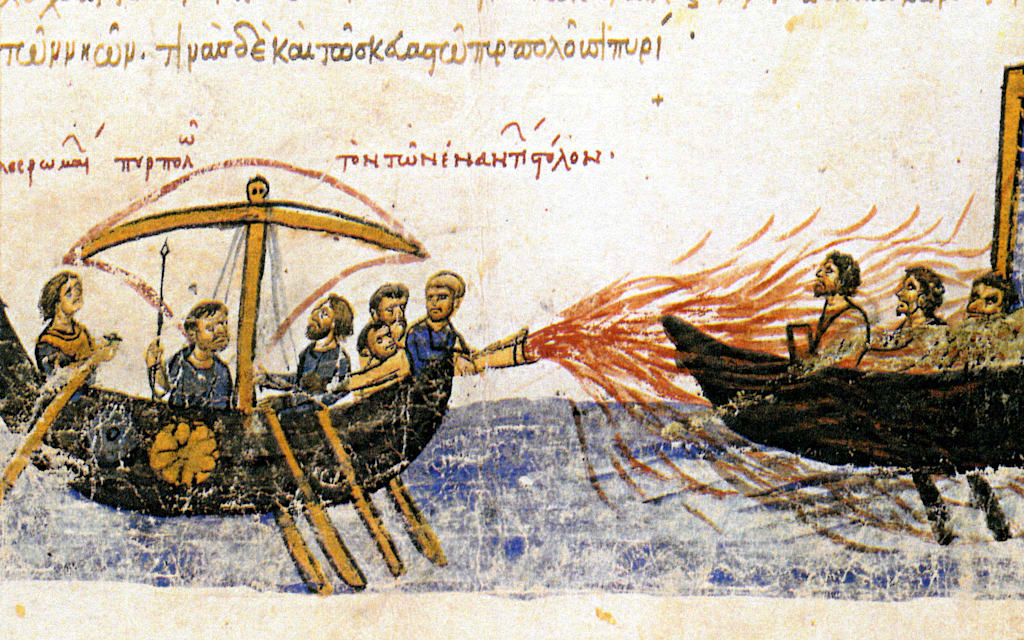
The Seljuk sultan Kilij Arslan II was welcomed as a guest of Emperor Manuel I Komnenos in Constantinople in 1162. He was treated to great banquets and horse races. In line with tradition, Manuel arranged to “set alight some boats and skiffs with liquid fire,” as described by the historian John Kinnamos. Fourteen years later Kilij Arslan would defeat Manuel at Myriokephalon.
In 1171, nine years later, this weapon was actually needed. After Manuel had every Venetian in the empire arrested, a group of them managed to flee Constantinople on a large ship. They were overtaken by the imperial navy in the area of the Dardanelles. But, according to Kinnamos, as they were well versed in Roman ways, they had covered the vessel with cloths soaked in vinegar. The fire failed to hit the ship, or hit the cloths and landed in the water. The Venetians made it back safely.
In this case the weapon was not effective against even one ship. The incident shows the limits of the so-called Greek fire. There are very few areas of Byzantine history which have as much myth as fact. This essay will separate facts, logical deductions from historians, and myths.
The Evidence: What They Called It
The term “Greek fire” is very important. The Byzantines did not refer to the weapon by that name. Instead, they used terms such as liquid fire (hygron pyr), sea fire (thalassion pyr), prepared fire (skeuaston pyr), or Roman fire, as Theophanes once stated. Also, in the tenth century a manual called it sticky fire (kollytikon). In common language it was known as lampron, the brilliant fire. Also, it was referred to as “Median fire” by Leo the Deacon, most likely due to the link the Greeks made between naphtha and Media in Persia. The term “Greek fire” (ignis graecus) is used almost entirely by Western writers. Liudprand of Cremona used it to describe the Byzantine weapon in his account of 941. As the historian John Haldon has pointed out, many Western sources use the term “Greek fire” to describe any incendiary device, usually pots of flaming pitch or oil. John Pryor and Elizabeth Jeffreys have noted in their study of the Byzantine navy that this has caused confusion.
The idea of incendiary devices dates back to ancient times. Thucydides relates that the Boeotians at Delion in 424 BC employed a device made of a tube attached to wheels. This had a cauldron at the end filled with burning charcoal, sulfur, and pitch. It also had large bellows at the other end, and it was used to set fire to a partially wooden wall. In the sixth century Prokopios reported that pots of sulfur, bitumen, and naphtha (Medea’s oil to the Greeks) were lit and flung onto battering rams. The new element of Greek fire in the seventh century was the liquid fire projected from a tube mounted on warships.
The Evidence: Where It Came From
Traditionally there was just one inventor. Theophanes the Confessor records that in 671/672 Emperor Constantine IV, having been warned of a great Arab fleet, built large biremes with cauldrons of fire and dromons (typical Byzantine war galleys) with siphons. He also states: “At that time Kallinikos, an architect from Helioupolis in Syria, took refuge with the Romans and manufactured a naval fire with which he kindled the ships of the Arabs and burnt them with their crews.” Heliopolis is Baalbek in modern-day Lebanon. Architekton meant master builder or engineer to the Greeks.
Other sources disagree with this and each other. Constantine VII in the tenth century mentions that Kallinikos manufactured “the liquid fire which is projected through the tubes” and that the Romans used this to destroy the Arab fleet at Cyzicus. In the Syriac tradition, as recorded by Michael the Syrian, the new fire was first deployed against an Arab fleet attacking a coastal town in Lycia. However, the future patriarch Nikephoros, who probably wrote in the 780s, does not mention Kallinikos or fire at all. Instead, he records that the Arab fleet was weakened by years of fighting and destroyed by a storm off Syllaion in Pamphylia. Theophanes wrote nearly one hundred and fifty years after the events, and his dating of this period is confused. Also, in his entries the siphons were added to the ships before Kallinikos arrived.
Upon investigation of the lengthy siege in the 670s, Cyril Mango and Roger Scott, the translators of Theophanes, realized that there was no siege, just a series of engagements. Marek Jankowiak has since argued that the actual Arab siege in this generation was in the late 660s. What we do know is that by the 670s the imperial fleet had a new fire weapon using siphons. Later Byzantines linked it to an engineer from Syria fleeing to the empire. J. R. Partington noted that Constantine VII’s wording indicates that the novelty was how it was fired. He has even proposed that it was done by Constantinople’s own craftsmen.
The Evidence: Five Centuries of Fire
The best evidence comes from the Arab siege of 717–718. Theophanes reports that Leo III sent fire-bearing ships to attack an Arab squadron. Some were cast, burning, onto the sea walls, and the enemy “cowered with fear after experiencing the efficacious action of the liquid fire.” The next spring two new Arab fleets avoided the straits, as Nikephoros explains, “for fear of being injured by the artificial fire of the Romans.” When their Egyptian crews deserted, Leo’s fire-bearing ships sank them.
It was soon turned against fellow Byzantines. In 727 rebels from Hellas and the Cyclades “had their ships burnt with artificial fire.” In 743 the usurper Artabasdos dispatched fire-bearing ships to attack the loyal fleet of the Kibyrrhaiots, but his ships were simply driven off. During the revolt of Thomas the Slav in 821–823, the imperial fleet burned rebel ships at anchor. This is illustrated in the Madrid manuscript of the chronicler John Skylitzes, copied in Norman Sicily around 1160. It contains the most famous picture of the weapon: a galley shooting a jet of fire from its bow.
Against the Arabs of Crete, it was deployed many times. In the early 870s, Admiral Niketas Ooryphas burned twenty Cretan ships near Kardia. At Euripos in the 880s the defenders waited for favorable winds and set fire to many ships of an Arab fleet. Yet the expedition to Crete in 949 ended in disaster. Leo the Deacon recounts that the island was only captured in 961 by Nikephoros Phokas, whose fleet also contained fire-bearing ships.
The most famous uses were against the Rus. Liudprand, whose stepfather was in Constantinople as an envoy, relates that in 941 Romanos I fitted fifteen old galleys with fire throwers “not only at the bows but at the stern and both sides as well,” and that God calmed the sea, “for otherwise the Greeks would have had difficulty in hurling their fire.” The Rus jumped overboard to avoid being burned. Their chronicle says that the Greeks had “the lightning from heaven.” In 942 Byzantine ships sent to King Hugh of Italy burned the fleet of the Saracens of Fraxinetum in Provence. Leo the Deacon writes that in 971 the Rus prince Svyatoslav, cornered at Dorostolon on the Danube, made it a condition of peace that the Romans would not attack his retreating ships with fire, “for they were terribly afraid of Median fire, which can reduce even stones to ashes.”
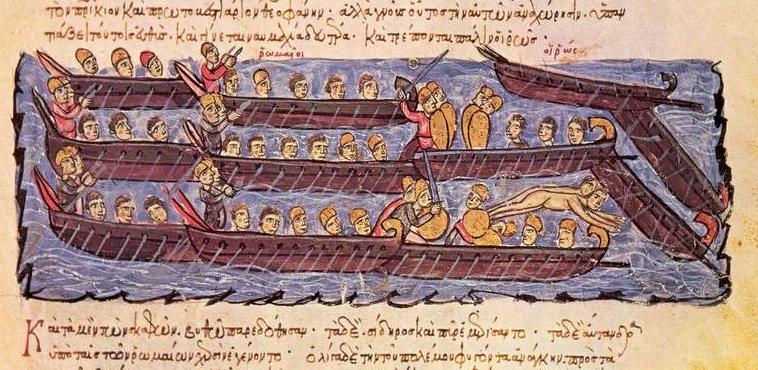
In 1043 the Rus struck again. Michael Psellos, who was observing from the emperor’s side, recalls that when the fire was hurled, “the Russians, being unable to see now, threw themselves into the water,” although much was done by a sudden gale.
The Komnenoi still employed the weapon. Anna Komnene recounts that around 1099 Alexios I had his ships fitted with gilded lion heads which looked like they were vomiting fire. He defeated a Pisan squadron off Rhodes. In 1107–1108 the defenders of Dyrrachion directed the weapon against Bohemond’s siege tower. Niketas Choniates adds that in 1147 fire-bearing ships were prepared for fighting the Normans of Sicily.
One of the last definite mentions is in 1187. After defeating the rebel Alexios Branas, Isaac II allowed the citizens and foreigners to punish villages along the Sea of Marmara that had supported him. Choniates reports that liquid fire contained in tightly sealed vessels was hurled at their houses, and whatever it touched it consumed. The weapon was now being turned against Byzantine villages.
By 1203 it was no longer used. According to Choniates, Alexios III could only repair “the rotting and worm-eaten small skiffs, barely twenty in number,” as discussed in my essay on 1204. The Venetians had covered their galleys “with ox hides to make them impervious to fire.” But no sources mention the weapon being used against them. The Byzantines reverted to old-fashioned fireships. In April 1204 the crusaders threw what Robert of Clari calls Greek fire at the towers of Constantinople.
The Evidence: Manuals, Inventories, and Pictures
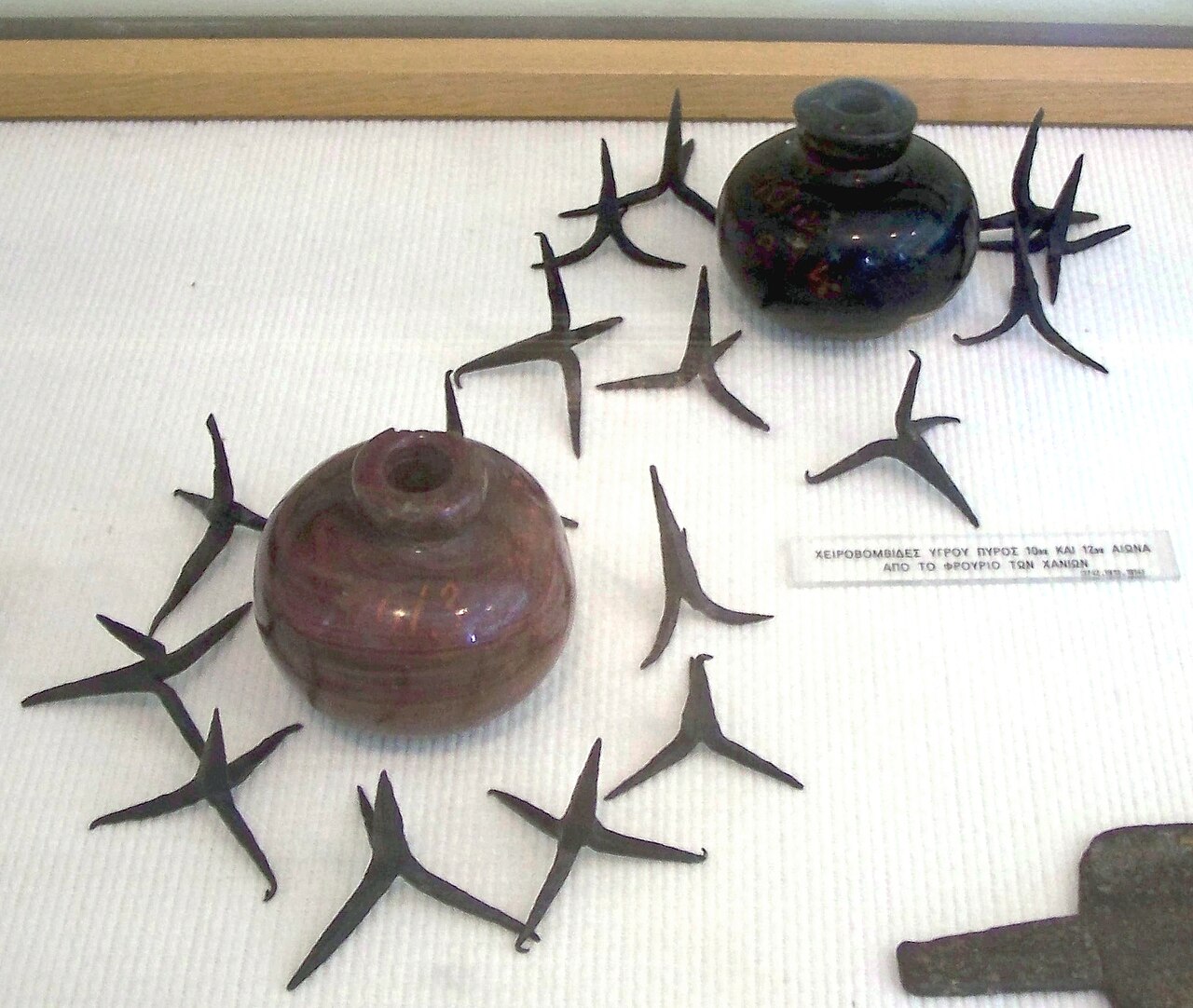
The most detailed technical evidence comes from Leo VI’s military manual, the Taktika, compiled around 900. Every dromon should have a siphon at the bow. It should be bound round with bronze as usual, and the processed fire should be hurled at the enemy. Above the siphon should be a fortified platform of planks for marines. One of the oarsmen at the bow was the siphonator. The fire was discharged with a thunderous noise and smoke. Leo also recommends that jars of processed fire be thrown at enemy ships. He also lists caltrops wrapped in tow to be set alight, cranes to pour fire onto ships alongside, and small hand siphons behind iron shields. He claims the hand siphons were “recently invented by our Majesty.” The inventories of the expedition to Crete in 949 mention three siphons per dromon. Two hundred Byzantine pounds of tin were given to a metalworker named Michael to solder them.
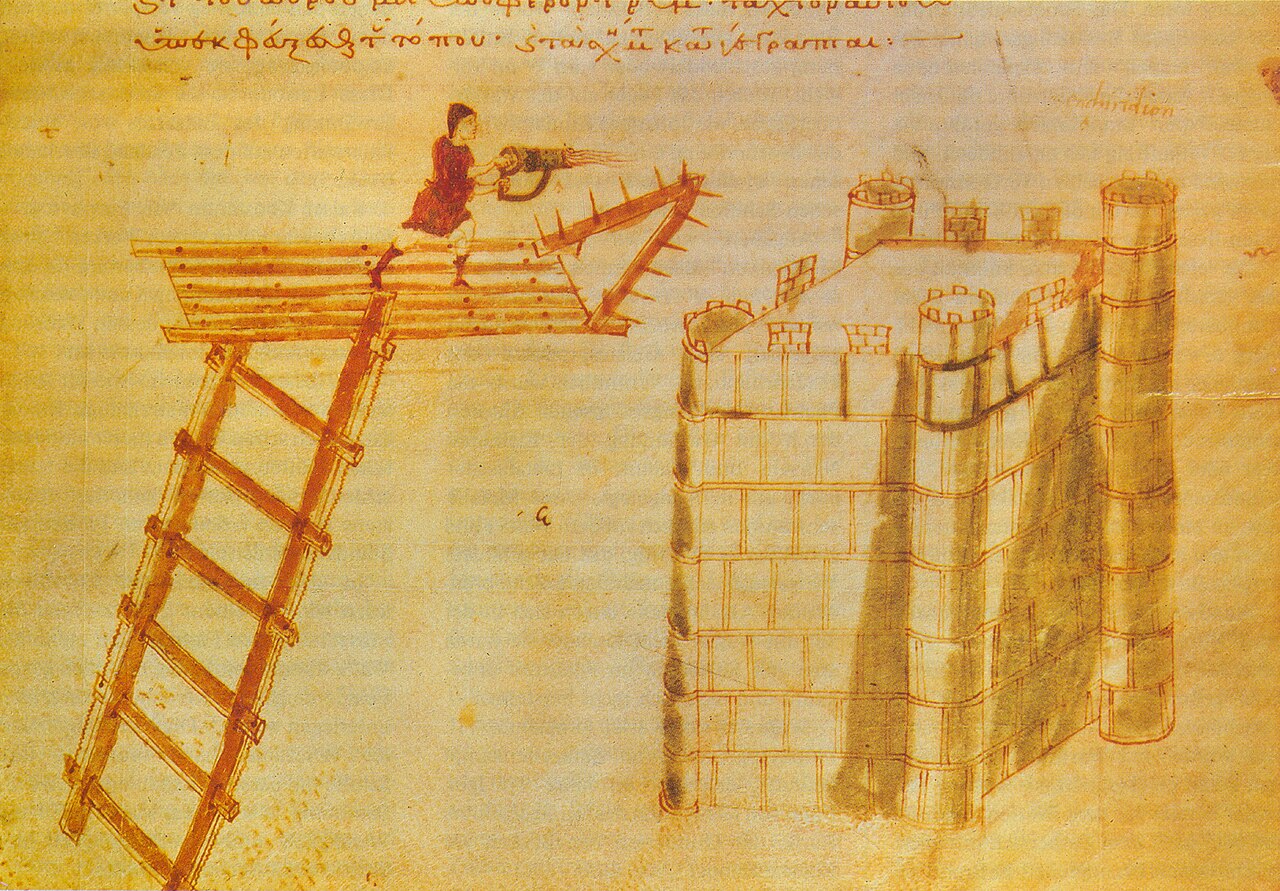
The manuals also show that it was not just employed at sea. Leo VI proposes the use of fire throwers against siege towers. A tenth-century siege manual describes the preparation of pine torches, tow, pitch, and hand siphons. The military manual attributed to Nikephoros Phokas, written shortly after 963, specifies that field armies should use swivel projectors of brilliant fire and hand siphons. An eleventh-century Vatican manuscript of a siege manual depicts a soldier on a flying bridge with a handheld flamethrower aiming at the top of a wall. In practice, Skylitzes reports that the defenders of Nicaea used it to burn the siege engines of the rebel Bardas Skleros in the late 970s.
The Evidence: Who Else Had It?
The Byzantines claimed to have a monopoly on this weapon. In a way they did. When the Bulgarians took Debeltos in 812 under Khan Krum, they found “36 brass siphons and a considerable quantity of the liquid fire that is projected from them.” There is no evidence they ever used them. In 827 an Arab fleet captured a Byzantine fire ship off Pantelleria. An anonymous Arabic translation of Leo VI’s naval chapter mentions the fire tubes were termed sifuna. According to Pryor and Jeffreys, the translator had no idea how they worked.
The Arabs had their own incendiaries and experts known as naffatun. An account of the sack of Thessaloniki in 904, attributed to John Kaminiates, speaks of attackers blowing fire through siphons from bridges slung from their masts. Haldon believes it was likely, and Pryor and Jeffreys think it was probable, that the Arabs eventually had a projector. However, concrete evidence for the siphons is “extremely elusive.” What we do know is that Muslim armies wielded naphtha very effectively. Baha al-Din, the biographer of Saladin, described how in 1190 at Acre a young metal founder from Damascus torched three crusader siege towers with pots of boiled naphtha.
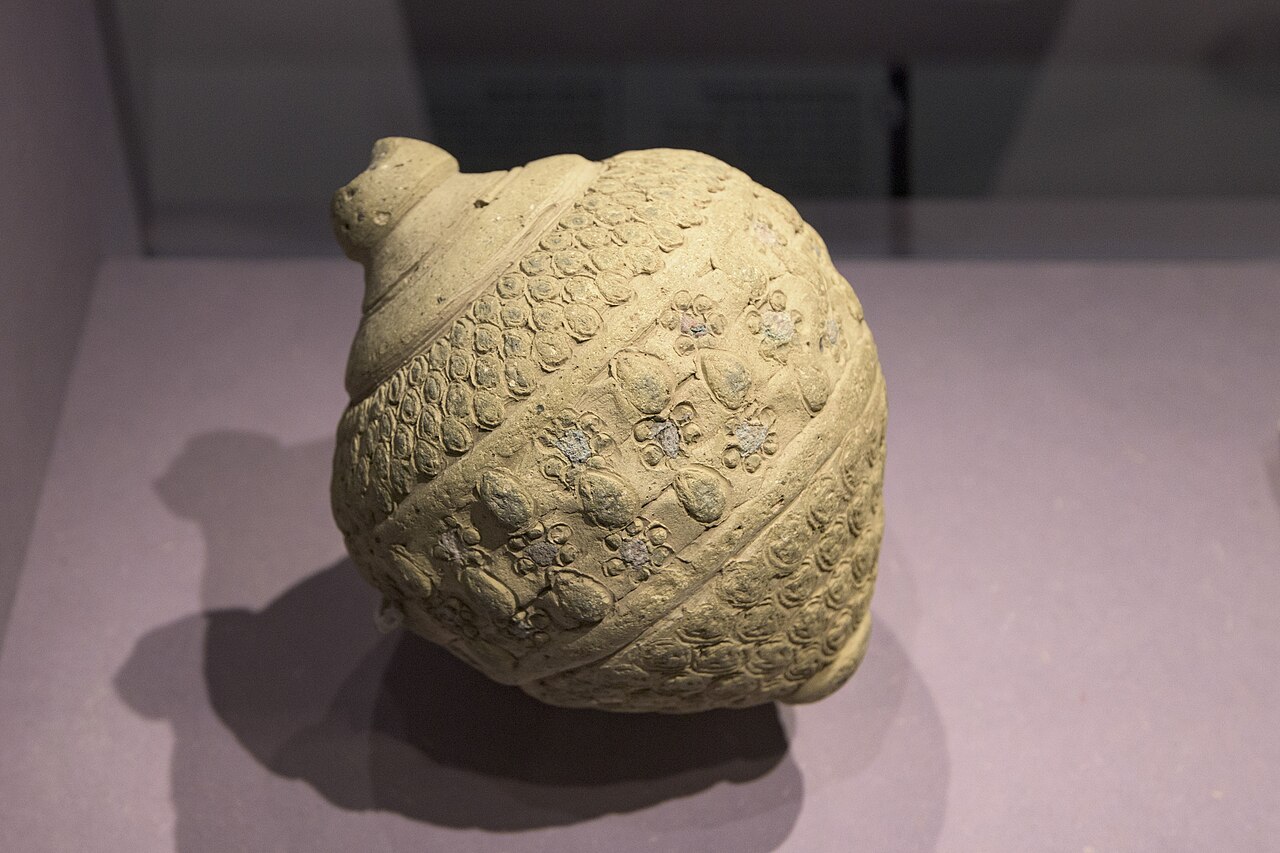
Something similar happened at the other end of Asia. In Partington’s summary, Chinese sources assert that around 917 the ruler of the southeast kingdom centered on Hangzhou sent a “furious fiery oil” to Abaoji, the Khitan ruler. A Chinese military manual from 1044 mentions a tank of the oil with a pump to force it through a tube. The oil, according to these sources, came from Arabia. Partington thought knowledge or rumor of the Byzantine siphons might have traveled east. Haldon suggests the Arabs may have taken the weapon to China.
The Hypotheses: What Was in It?
No Byzantine text preserves the formula. Therefore, all is guesswork. The older scholars, from the French chemist Marcellin Berthelot to the Greek chemist Konstantinos Zenghelis in the 1930s, suspected that it contained saltpeter or an explosive. Others supposed it contained quicklime or calcium phosphide, both of which react with water. Haldon has found “not a shred of evidence” of any explosive devices in the West before gunpowder. Bert Hall, in the 1999 reprint of Partington’s history, believes the case against quicklime and phosphide is irrefutable. The case for saltpeter is still open.
The only thing left is petroleum. Constantine VII records in the De Administrando Imperio that there were wells of naphtha in Tamatarcha on the Taman peninsula and in Zichia on the northeast coast of the Black Sea, whose oils were “not of the same colour, some of them being red, some yellow, and some blackish.” There were also wells in Derzene and Tziliapert farther east. Most were outside the empire, and the oil still oozes up as very light crude oil. We do not know how it was processed. Haldon and Maurice Byrne suggested it was heated crude oil. Partington proposes it was distilled petroleum with resins. Pryor and Jeffreys think it was a light distillate like kerosene. Haldon admits that there is no mention in the sources.
The Hypotheses: How Did It Work?
The Greek word siphon means a tube but also a pump. The Roman world had excellent bronze force pumps. For example, Hero of Alexandria mentions a double-cylinder fire engine. Pryor and Jeffreys argue that what Kallinikos did was “to adapt the idea of the force pump” to processed petroleum. Theodoros Korres, a Greek Byzantinist, disagrees. He contends it was mostly clay pots of fire launched from a catapult. Haldon counters that two or three siphons per ship, protected by a deck, do not make sense as catapults.
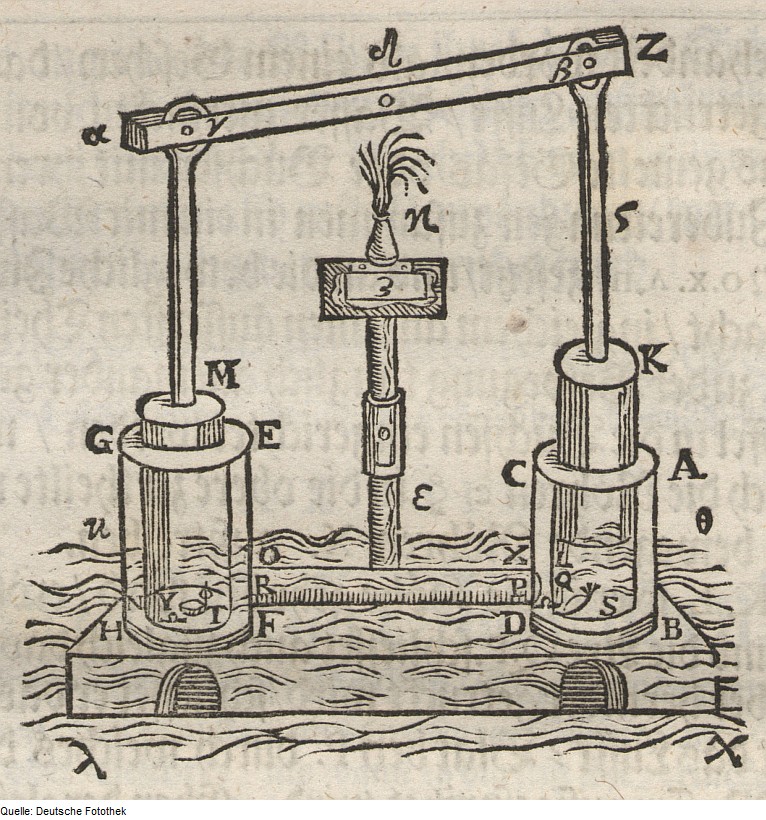
In 2002 Haldon, along with Andrew Lacey and Colin Hewes, tested the theory for a television documentary. A heated pressure tank was very unstable. However, a double-cylinder bronze pump based on Hero’s design worked. The crude oil mixed with pine resin was heated to around sixty degrees Celsius and set alight with a small torch under the nozzle. It shot out in a roaring, smoky jet. It could hit targets up to fifteen meters away. In Malta it destroyed a boat ten to fifteen meters away. It took three men to operate the pump. The jet tended to arc downward. This, Pryor and Jeffreys suggest, may have been why Anna Komnene remarks that the Pisans were afraid of the fire that went “often downwards or laterally.”
This proves that this type of weapon was possible, but we do not know if this is how the Byzantines used it. It is disputed whether the oil was heated on board. Pryor and Jeffreys point out that the only direct evidence comes from two dubious Western texts. We do not know how the jet was set alight. Also, the hand siphon is puzzling to Haldon.
The Verdict: How Effective Was It?
Overall, Pryor and Jeffreys conclude, Greek fire was never a “ship-killing weapon,” and no tactics were ever developed around it. It needed calm weather and favorable winds. The bow of a dromon would only be about one and a half meters above calm water. A moderate breeze could cause waves of nearly one meter. Therefore, in any real sea conditions it would have been just as dangerous to the ship as to the enemy. It had a range of about fifteen meters, judging by Haldon’s machine.
It was also a short-range weapon. Anna admits that the admiral Landulph fired first off Rhodes, but he missed with his fire. The fire-bearing ships of Artabasdos were simply driven off. Even when it was effective, it rarely decided the outcome of a battle on its own. Theophanes himself reports that in 717–718 there were a hundred days of snow, starvation, and disease in the Arab camp. Also, they were set upon by Bulgarians, and reportedly twenty-two thousand Arabs were killed. At Dyrrachion the fire could only reach the top of Bohemond’s tower. The defenders had to pile up flammable items and oil to burn it down.
Still, it may have been a psychological weapon. Fleets would change course to avoid it. The Rus remembered it for generations. Haldon, who has proven with his replica that it worked, is unsure if it “radically affected the general evolution of the Byzantine state and its neighbours.” It won battles but did not save an empire on its own.
The Hypotheses: Why Did It Disappear?
Haldon states that there are no further explicit references to Greek fire after the 1180s, and so it appears that by 1204 it could no longer be deployed on imperial warships. Similarly, Pryor and Jeffreys conclude: “At Constantinople in 1203 the Byzantine galleys were not equipped with Greek Fire.” Why was this?
Fuel
Haldon argues that Greek fire required a regular supply of crude oil, which could no longer be obtained after the later twelfth century; this was due to the areas it came from becoming inaccessible to imperial authorities. Pryor and Jeffreys are unconvinced. Most of the wells listed by Constantine VII were outside the empire at the time, and when the Mongols invaded and stimulated trade in these areas, the supply does not appear to have returned.
Warships
The siphon was carried on warships, which had disappeared during the reign of the Angeloi. The great fleet built by the first three Komnenian emperors had declined, and by 1203 there was no way to effectively fight off the Venetian fleet. A weapon requiring skilled men to operate, regular maintenance of pumps, and an active arsenal could not survive. Haldon observes that the oil could no longer be secured “as the imperial fleet declined in numbers and efficacy.”
Secrecy
No Byzantine sources describe the process of making Greek fire. Constantine VII stresses that it must only be prepared in the capital. If the knowledge was only held in the arsenal, then it could easily be lost with it. This is an assumption but fits in with the evidence. This implies that the secrecy which protected Greek fire for five hundred years also caused it to be vulnerable.
Lack of Effectiveness
During the twelfth and thirteenth centuries incendiaries were common across the Muslim and Latin worlds. Therefore, a short-range fire thrower requiring still water would have been less of an advantage.
The Legends
All of the following are untrue or unproven.
Given to Constantine the Great by an Angel. Constantine VII explains to his son that he should tell foreign leaders exactly this, “as they have often made demands of us also,” and that once a governor was bribed to give some away but was struck by fire from heaven. This is not a description of how secretive it was, but it shows that foreigners wanted to obtain it and that it was a state monopoly. It tells us nothing about how it was made.
Only One Family Knew the Secret. Only George Kedrenos, over four centuries after Kallinikos, claims that the Lampros family (the descendants of Kallinikos) still produced the fuel. This idea that an obscure family had the secret for six centuries is not believable to Pryor and Jeffreys.
Made by One Refugee to Save Constantinople. The origin story of Greek fire is late and conflicting. It never actually saved the city on its own.
Fire Could Not Be Put Out and Water Made It Worse. Water failed as the liquid would float. But many sources agree that it could be put out using sand, strong vinegar, or old urine. Hides soaked in vinegar were also resistant. There was a whole chapter in a tenth-century manual on “how the fire that is called wet can be put out.” Skylitzes notes that at Vidin around 1002 the Bulgarians put out the fire. The idea that it could burn stone and iron is an exaggeration by the crusaders.
Gunpowder or Ignited by Water. There is no evidence to support either. Quicklime is listed by Leo VI as a separate weapon.
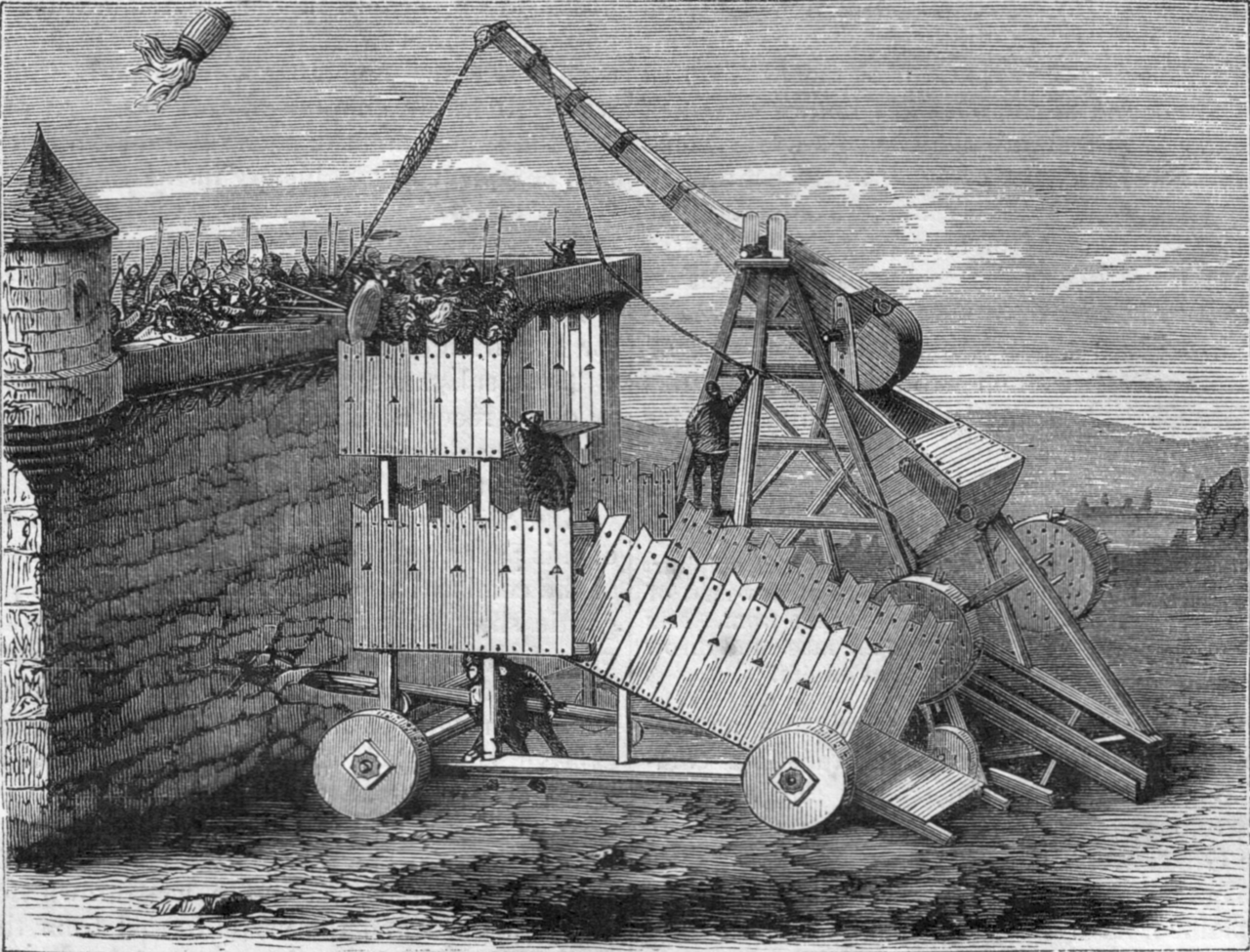
All Greek Fires Mentioned in the Chronicles Were Byzantine. Most were not. The Greek fire seen by the French chronicler Jean de Joinville was hurled by the Egyptians onto Louis IX’s crusaders in 1249–1250. It was launched in pots from a siege engine. Although it appeared to be “a dragon flying through the air,” it was not the liquid fire. Geoffrey Malaterra imagined that the Venetians blew it “from hidden passages of tubes beneath the waves” in 1081. This shows that he did not understand what it was.
The Recipe Is Known. Anna Komnene’s recipe involved blowing pine resin and sulfur through reeds. This was a handheld weapon used against sappers in tunnels. The liquid fire was treated separately. Pryor and Jeffreys judge that the Latin Book of Fires of Mark the Greek is also not very useful. The clay pots found at Baalbek and Hama were never proven to have been used for Greek fire, as noted by Partington.
Used to Defend Constantinople in 1453. Partington believed this was the case, relying mainly on the longer chronicle once attributed to George Sphrantzes. As the historian Marios Philippides has shown, this was a later embellishment written by Makarios Melissenos, who was “a notorious forger of Palaeologan chrysobulls,” and it was composed over a century after the fall. No reliable sources show the weapon being used after the 1180s.
Cannot Be Replicated by Modern Science. Haldon has constructed a replica using materials available in Byzantium. The exact recipe, though, is unknown.
Real Fire, Imagined Weapon
Greek fire did exist. It is supported by more evidence than many legends. The evidence includes an emperor’s handbook, naval lists, captured siphons, the testimony of friends and enemies, and a working replica. However, the wonder weapon of popular history did not exist. This was created by Western writers who referred to all incendiaries as Greek, modern authors who love a mystery, and the Byzantines who told their neighbors it was given to Constantine by an angel. Haldon explains that Greek fire offers us an insight into medieval warfare technology and “medieval and modern myth-making.”
Byzantium did not survive because of the liquid fire. It had liquid fire because it had a fleet, an arsenal, and oil. Once the fleet was gone, so was the liquid fire.
If you enjoyed this essay and want to support independent writing about Byzantium, please share this essay with others who might enjoy it too.
Sources and Further Reading
Primary sources
Anna Komnene. The Alexiad of the Princess Anna Comnena. Translated by Elizabeth A. S. Dawes. London: Kegan Paul, Trench, Trubner, 1928.
Choniates, Niketas. O City of Byzantium: Annals of Niketas Choniates. Translated by Harry J. Magoulias. Detroit: Wayne State University Press, 1984.
Constantine Porphyrogenitus. De Administrando Imperio. Greek text edited by Gy. Moravcsik. English translation by R. J. H. Jenkins. New rev. ed. Washington, DC: Dumbarton Oaks Center for Byzantine Studies, 1967.
Joinville, Jean de. “Chronicle of the Crusade of St. Lewis.” In Memoirs of the Crusades, by Villehardouin and de Joinville, translated by Frank T. Marzials. London: J. M. Dent, 1908.
Kinnamos, John. Deeds of John and Manuel Comnenus. Translated by Charles M. Brand. New York: Columbia University Press, 1976.
Leo the Deacon. The History of Leo the Deacon: Byzantine Military Expansion in the Tenth Century. Translated by Alice-Mary Talbot and Denis F. Sullivan. Washington, DC: Dumbarton Oaks, 2005.
Leo VI. Naumachika Leontos Basileos. Greek text and English translation in Pryor and Jeffreys, The Age of the ΔΡΟΜΩΝ, Appendix Two.
Liudprand of Cremona. The Works of Liudprand of Cremona. Translated by F. A. Wright. London: George Routledge & Sons, 1930.
Nikephoros, Patriarch of Constantinople. Short History. Edited and translated by Cyril Mango. Washington, DC: Dumbarton Oaks, 1990.
Psellos, Michael. Fourteen Byzantine Rulers: The Chronographia of Michael Psellus. Translated by E. R. A. Sewter. Harmondsworth: Penguin, 1966.
Robert of Clari. The Conquest of Constantinople. Translated by Edgar Holmes McNeal. New York: Columbia University Press, 1936.
The Russian Primary Chronicle: Laurentian Text. Translated and edited by Samuel Hazzard Cross and Olgerd P. Sherbowitz-Wetzor. Cambridge, MA: Mediaeval Academy of America, 1953.
Skylitzes, John. A Synopsis of Byzantine History, 811–1057. Translated by John Wortley. Cambridge: Cambridge University Press, 2010.
Theophanes Confessor. The Chronicle of Theophanes Confessor: Byzantine and Near Eastern History, AD 284–813. Translated by Cyril Mango and Roger Scott. Oxford: Clarendon Press, 1997.
Modern studies
Haldon, John. “‘Greek Fire’ Revisited: Recent and Current Research.” With contributions by Andrew Lacey and Colin Hewes. In Byzantine Style, Religion and Civilization: In Honour of Sir Steven Runciman, edited by Elizabeth Jeffreys, 290–325. Cambridge: Cambridge University Press, 2006.
Haldon, John, and Maurice Byrne. “A Possible Solution to the Problem of Greek Fire.” Byzantinische Zeitschrift 70 (1977): 91–99.
Jankowiak, Marek. “The First Arab Siege of Constantinople.” Travaux et Mémoires 17 (2013): 237–320.
Korres, Theodoros K. Ὑγρόν πῦρ: Ἕνα ὅπλο τῆς βυζαντινῆς ναυτικῆς τακτικῆς. 2nd ed. Thessaloniki: Vanias, 1989.
Partington, J. R. A History of Greek Fire and Gunpowder. 1960. Reprint, with an introduction by Bert S. Hall, Baltimore: Johns Hopkins University Press, 1999.
Philippides, Marios. “The Fall of Constantinople: Bishop Leonard and the Greek Accounts.” Greek, Roman and Byzantine Studies 22 (1981): 287–300.
Pryor, John H., and Elizabeth M. Jeffreys. The Age of the ΔΡΟΜΩΝ: The Byzantine Navy ca. 500–1204. Leiden: Brill, 2006.
Zenghelis, C. “Le feu grégeois et les armes à feu des Byzantins.” Byzantion 7 (1932): 265–286.
Thucydides, Prokopios, Michael the Syrian, Hero of Alexandria, John Kaminiates, Geoffrey Malaterra, George Kedrenos, Baha al-Din, Mark the Greek, the Chinese texts, and the tenth-century military manuals are cited as reported in the works of Haldon, Partington, and Pryor and Jeffreys listed above.
Image Credits
Featured image: Madrid Skylitzes, Biblioteca Nacional de España, Vitr. 26-2, fol. 34v, twelfth century. Public domain, via Wikimedia Commons.
The Rus attack of 941: Madrid Skylitzes, Biblioteca Nacional de España, Vitr. 26-2, fol. 130, twelfth century. Public domain, via Wikimedia Commons.
Grenades and caltrops from Chania: National Historical Museum, Athens. Photo by Badseed, CC BY-SA 3.0, via Wikimedia Commons.
Hand siphon on a flying bridge: Siege manual attributed to Heron of Byzantium, Vatican Library, MS Vat. gr. 1605, eleventh century. Public domain, via Wikimedia Commons.
Fire bomb from Iran: National Museum of Iran. Photo by Hnapel, CC0, via Wikimedia Commons.
Hero of Alexandria’s fire engine: Woodcut from Heronis Alexandrini Buch von Lufft- und Wasser-Künsten (Bamberg, 1688). Public domain, Deutsche Fotothek via Wikimedia Commons.
Catapult hurling Greek fire: Harper’s New Monthly Magazine, June 1869. Public domain, via Wikimedia Commons.
About the Creator
S. Kallistos
Greek author of novels set in Byzantine Constantinople (The Keyholder, The Unforgotten). Here I write about Byzantium’s emperors, battles, heresies, and forgotten lives. More in my free newsletter, Byzantium Retold.
Enjoyed the story? Support the Creator.
Subscribe for free to receive all their stories in your feed.
Comments
There are no comments for this story
Be the first to respond and start the conversation.