
Basil II Never Called Himself the Bulgar-Slayer
Kleidion, 1014: the battle that killed a tsar without touching him

How I make this: written in Greek and translated into English by me, with AI assistance (Claude, by Anthropic) for editing, fact-checking, and maps.
In the summer of 1014, the Byzantine Emperor Basil II vanquished the Bulgarian army of Tsar Samuel in one afternoon and broke the back of the forty-year war between them. Yet he became famous less for his victory than for its aftermath.
Basil had reached the age of fifty-six that year and had ruled the empire in his own right for thirty-eight years, since he was eighteen. Now the time had come to fight the battle against his old enemy that would later earn him the sobriquet “Bulgar-Slayer.”
1. Three centuries of war
To truly comprehend what happened at Kleidion, you have to look back more than three centuries.
Khan Asparuh was the ruler who led the Bulgars across the Danube around 680 to settle permanently in Byzantine territory. A year later, the Byzantines admitted for the first time that they were unable to push them out of their dominion, when Emperor Constantine IV signed a treaty recognizing their settlement in former Byzantine provinces. This was the starting point for more than three centuries in which the Byzantine Empire and the Bulgar khanate (later tsardom) fought, intermarried, traded, and struggled to convert and subdue one another.
Decades of brutal wars and indescribable atrocities followed. In 811, Khan Krum ambushed the Byzantine Emperor Nikephoros I in a mountain pass similar to Kleidion, and after killing him he had his skull lined with silver and used it as a drinking cup. In 864, Khan Boris was baptized as Boris-Michael by clergy sent from Constantinople, taking the emperor’s own name. But his conversion did not bring an end to the wars. Instead, it turned them into a deeper and more serious dispute about who was the true heir of Christian Rome in the East.
The dispute reached its peak under Tsar Symeon the Great (893–927). In 913, he marched on Constantinople and extracted from the Patriarch a ceremony he considered his coronation, later styling himself Emperor of the Bulgarians and Romans. Under his leadership, Bulgaria expanded from the Adriatic to the Black Sea. But his successors failed to preserve its power and territory, and in the aftermath of the Rus’ invasion of 968–971, the Byzantine Emperor John Tzimiskes captured the Bulgarian capital, Preslav, and annexed the eastern part of the country. It seemed the Bulgarian state had come to its end.
It was not. In the western highlands, four brothers known as the Cometopuli, the sons of a provincial governor named Nicholas, began to resist. The youngest, Samuel, would outlive the other three (he had one of them, Aron, put to death) and rebuild the kingdom. He was fighting the Byzantines long before he became tsar in 997.
2. The long duel
Tsar Samuel and Emperor Basil II would spend most of their lives at war with each other. Samuel was most probably the older of the two, although his year of birth is unknown.
In August 986, at their first major encounter, the Byzantine emperor suffered a devastating defeat. As Basil’s army was returning from an unsuccessful twenty-day siege of Serdica, modern Sofia, Samuel ambushed and destroyed it in the pass known as Trajan’s Gate. The historian Leo the Deacon, who was present, escaped death at the very last minute. The Armenian chronicler Stephen of Taron claims that Basil himself escaped only because his Armenian infantry closed ranks around him and led him away by another mountain route. He was twenty-eight, and for the rest of his life he would keep alive the memory of his defeat.
For much of the next fifteen years, civil wars and the Fatimid threat in the east kept Basil from concentrating on Bulgaria, and Samuel exploited the time to recover lost territories and to raid as far south as Corinth. But in 1000 Basil returned and began to grind his enemy down with a methodical hatred unusual even for that age. He besieged and captured Bulgarian fortresses one by one, recovered the old Bulgarian capitals in the east, then the cities of Vidin on the Danube and Skopje, and constantly cultivated turncoats among the Bulgarian elite. An exceptional success of this strategy came in 1005, when the governor of Dyrrachium handed the port over to him. The chronicler John Skylitzes says Basil invaded Bulgaria every year, although the historian Paul Stephenson has argued that his campaigning was more sporadic than that. By 1014, Samuel’s realm was restricted to the mountains of Macedonia and Albania. Basil was in his fifties while Samuel was older, and their long duel was reaching its end.
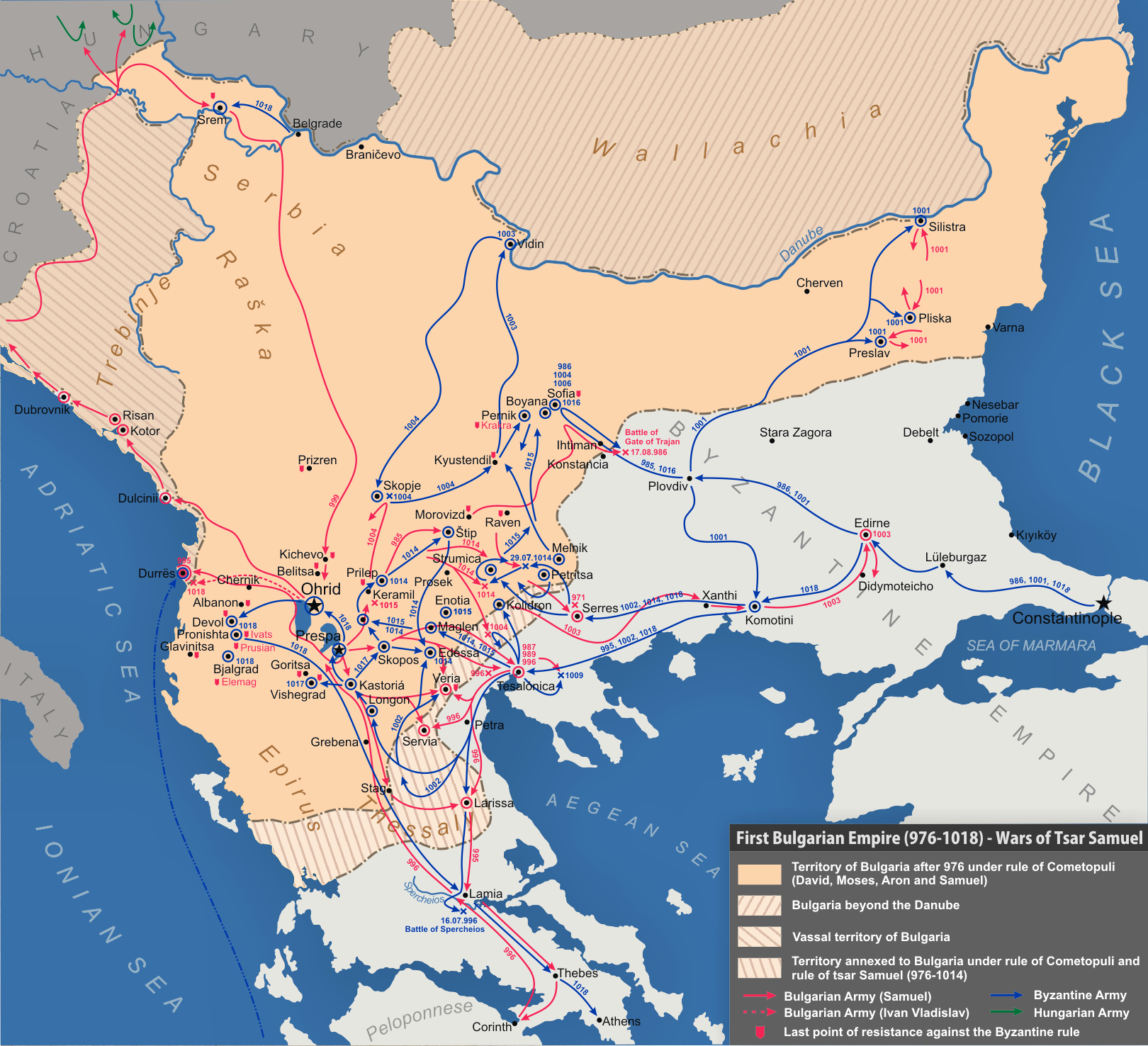
3. Kleidion
By the summer of 1014, Samuel had been on the defensive for years, and the old tsar decided to let geography help him, since he was well aware that his army could no longer hold out alone. He chose to make his stand against Basil in the valley between the mountains of Belasitsa and Ograzhden, in what is now the border region of Bulgaria, North Macedonia, and Greece; the valley was narrow, wooded, and easy to fortify. The Byzantine name for the pass was Kleidion, which means “the key” in Greek, and the nearby village of Klyuch, whose name means “key” in Bulgarian, still carries it. Whoever controlled the pass dominated the road from the Struma valley west to Strumica and the Bulgarian heartland beyond. Samuel fortified it with a thick wooden wall, ditches, and earthworks, garrisoned it heavily, and waited for the Byzantine army.
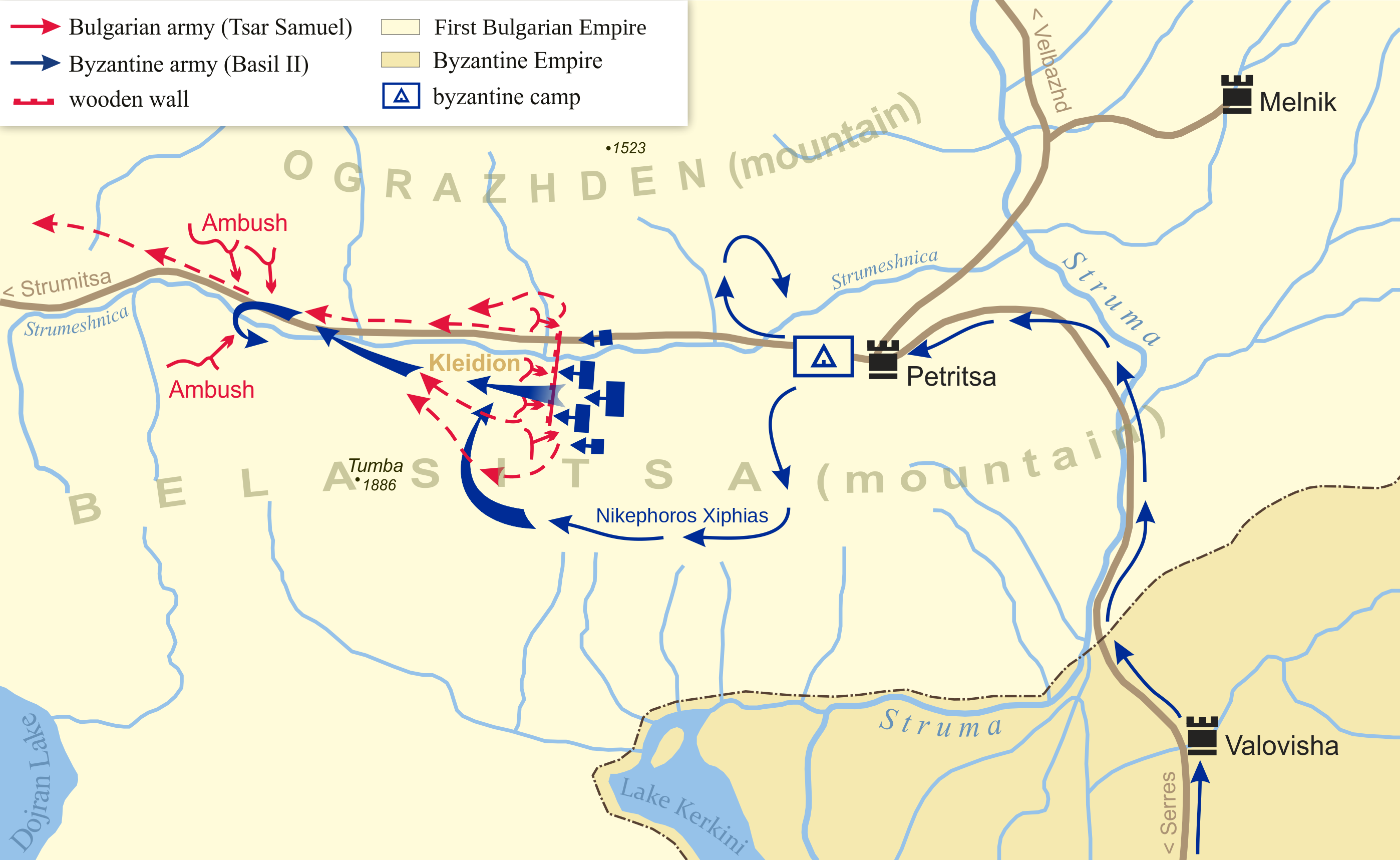
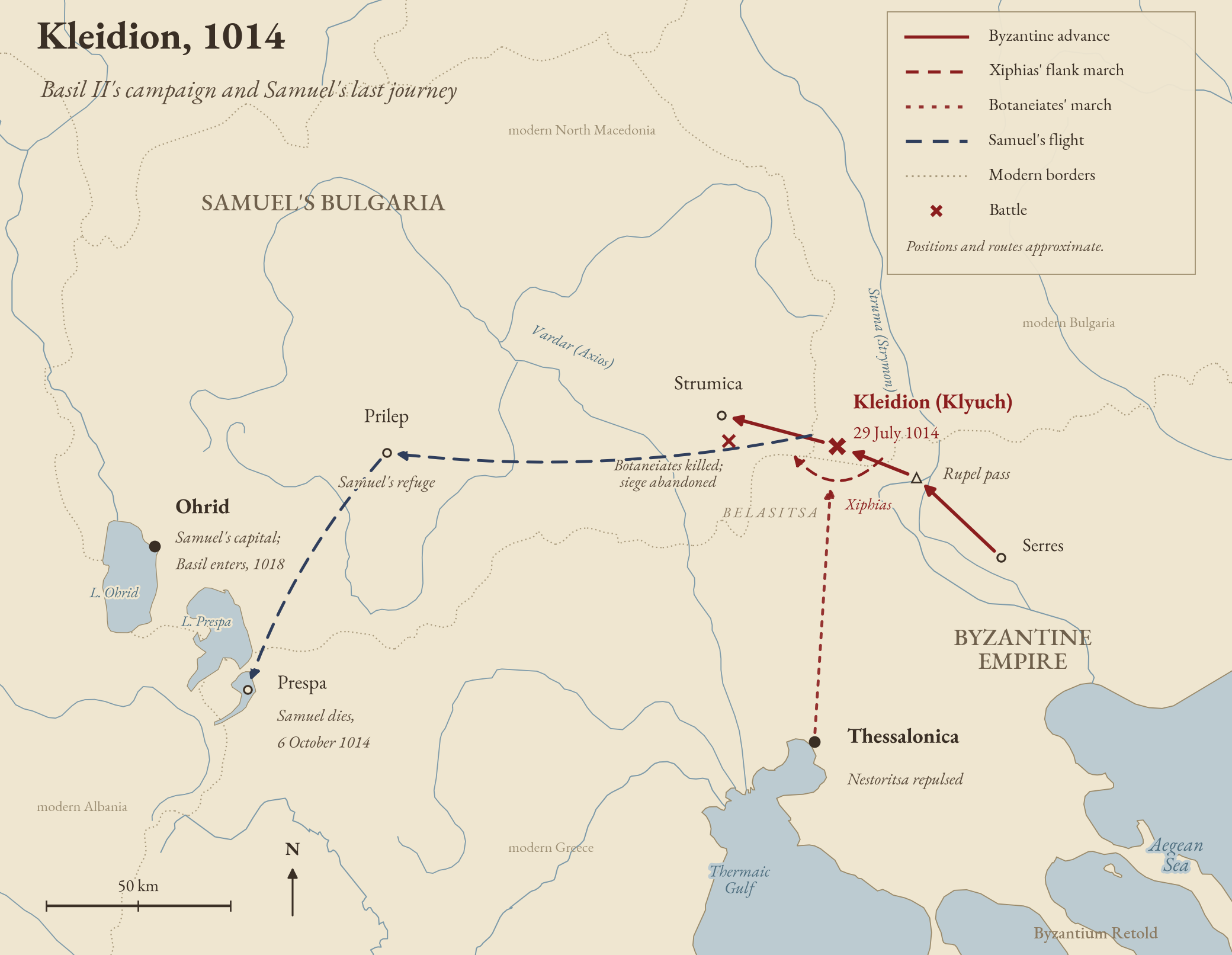
Samuel’s strategy was simple and logical. A frontal assault on a fortified pass was suicide, and the first Byzantine attacks on the wall confirmed it, since they were repulsed and forced to withdraw with heavy losses. Samuel attempted to draw the emperor away by sending his general Nestoritsa south to attack Thessalonica, but the city’s governor, Theophylact Botaneiates, defeated the Bulgarian force outside the city walls and marched north to join Basil. Still, the wooden wall held. Basil was ready to give up and turn back when one of his generals, Nikephoros Xiphias, the governor of Philippopolis, informed him that there was a path over Mount Belasitsa. He proposed to lead a detachment to climb it, descend behind the Bulgarian lines, and attack from the rear.
Basil approved the plan. On July 29, while the main Byzantine force kept up its assault on the wall, Xiphias’s infantry detachment appeared on the slopes behind the Bulgarians and charged down on them through the trees. The defenders were taken by surprise and abandoned their towers to face the new threat, and Basil’s army managed to break through the wall. Trapped between the valley and the mountain, the Bulgarian army collapsed, and Samuel himself escaped capture only at the last moment. It was his son, Gabriel Radomir, who fought his way to him, put him on his own horse, and carried him off the battlefield to the safety of the fortress of Prilep. His army was shattered; thousands of Bulgarians were killed and thousands more were captured.
But the war was not over yet. As Basil moved on Strumica, he sent Theophylact Botaneiates to clear the Bulgarian defenses on the road south. Gabriel Radomir at first allowed him to proceed, then ambushed his column in a narrow valley; Botaneiates was killed, reportedly speared by Gabriel himself. Basil was forced to abandon the siege of Strumica and withdraw.
Then came the moment that created the legend.
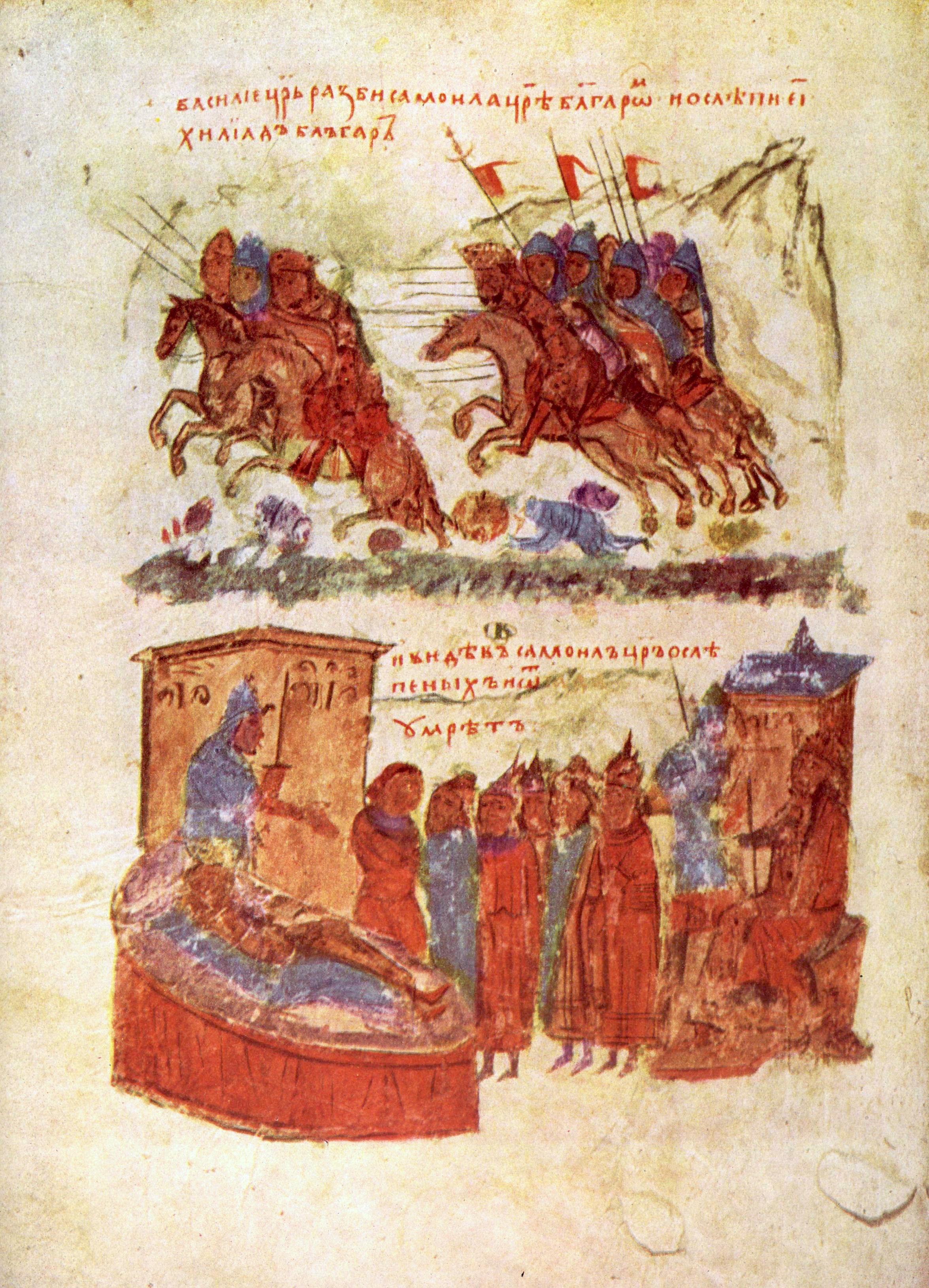
According to John Skylitzes, who recounted the aftermath of the battle about seventy years later, Basil ordered the blinding of some fifteen thousand Bulgarian prisoners and sent them home in groups of a hundred, each group led by a man who was left deliberately with one eye. Kekaumenos gives fourteen thousand, and even a caption in the Vatican copy of the fourteenth-century Bulgarian translation of the chronicle of Constantine Manasses repeats the figure of fifteen thousand. Modern historians generally think the real number was smaller. The blinding is likely to have followed Botaneiates’ death, and many historians see it partly as retribution. Blinding was also the penalty for rebels in Byzantium, and rebels were exactly what the Bulgarians were in Basil’s eyes.
The blinded men reached Samuel in early October, at his residence on Lake Prespa. Skylitzes claims that the old tsar, seeing his army return in that state, fainted and fell to the ground, and died two days later, on October 6, 1014. Modern writers usually believe that Samuel suffered a heart attack or a stroke. Whatever it was, his war had come to an end more than a hundred miles from the field where it had been lost. He had spent nearly forty years rebuilding a kingdom from the Macedonian highlands and died knowing that a single afternoon had undone his work.
4. What followed
The Bulgarian state did not survive long after Samuel’s death. His son Gabriel Radomir succeeded him and continued the fight, but within a year he was murdered by his cousin John Vladislav, whose life Gabriel had once saved and who now led the war against the empire. But John Vladislav was killed in 1018 while besieging the coastal fortress of Dyrrachium, and with his death the resistance collapsed. Basil entered Ohrid triumphantly the same year and accepted the submission of the widowed tsaritsa Maria, the archbishop David, and the surviving Bulgarian nobility. He annexed the Bulgarian state, and on his way home he made a stop in Athens to express his gratitude to the Virgin in the Parthenon, which was then a church. He was now sixty himself and had spent thirty-two years on this war.
Constantinople now ruled the Balkans from the Danube to the Peloponnese, for the first time since the seventh century. New themes such as Bulgaria, Sirmium, and Paristrion extended the imperial administration to the Danube, and the Serbs and Croats acknowledged the emperor’s supremacy. Basil imposed unusually mild terms on the conquered. The Archbishopric of Ohrid remained autonomous while the Bulgarians continued to pay taxes in kind, in grain and livestock, rather than in coin. He understood what his successors did not: that a conquered nation punished too harshly will rebel. He was proved right when Byzantine ministers demanded coin in the 1030s and Bulgaria rebelled under Peter Delyan in 1040. His legacy was an empire larger than any since the seventh century, a treasury that Psellos estimates at two hundred thousand talents, and an army his successors would let decline in the decades before the defeat at Manzikert. An independent Bulgarian state would be restored in 1185, under the brothers Peter and Asen. The memory of Kleidion did not fade. For the Bulgarians, 1014 became what 1453 would later become for the Greeks: a wound that named generations.
5. The man and the name
Basil II is considered a strange figure even by Byzantine standards. He never married and fathered no heir. According to Psellos, who was born toward the end of his reign and sketched his portrait a generation later, he dressed simply, without ornament, spoke bluntly and curtly, and had little use for men of letters. He died on December 15, 1025, at the age of sixty-seven, eleven years after Kleidion, while preparing an expedition to recover Sicily from the Arabs. He had ruled in his own right for forty-nine years, longer than any other Byzantine emperor.
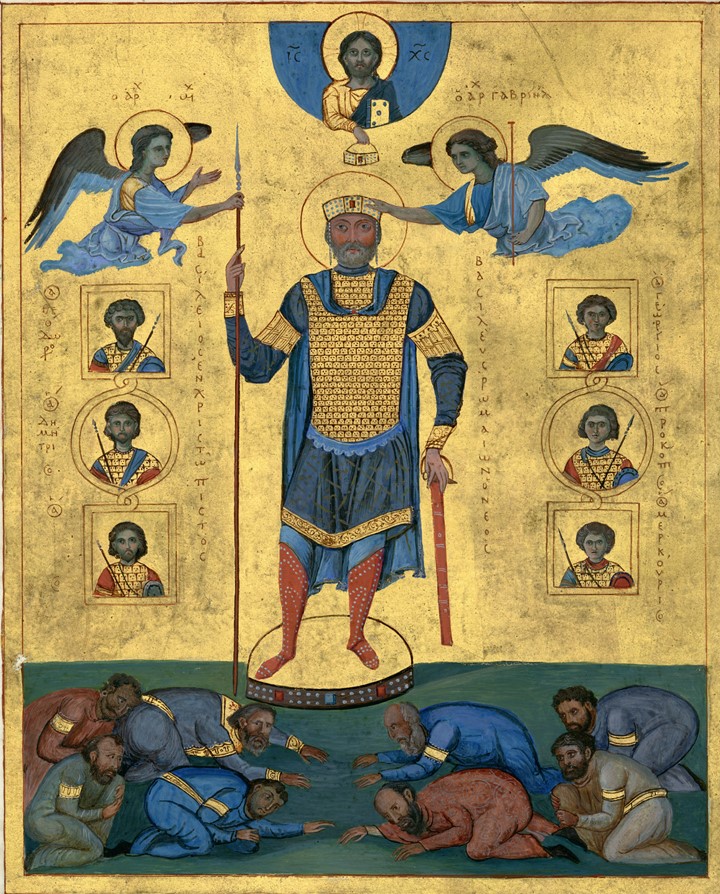
On his deathbed, he asked his brother Constantine VIII to bury him in the church of St John the Evangelist at the Hebdomon, the old parade ground outside the walls of Constantinople where his triumph over the Bulgarians had begun, instead of the imperial mausoleum at the Holy Apostles. His tomb inscription, written in his voice and attributed in a fourteenth-century manuscript to Psellos, declared that from the day God made him emperor no one had seen his spear lie idle, since he had kept watch all his life, guarding the children of New Rome. It was the closest he came to a self-portrait. More than two centuries later, Michael VIII Palaiologos had his remains moved to a monastery at Selymbria.
His famous epithet — Boulgaroktonos in Greek, the Bulgar-Slayer — was never used in his lifetime. As the historian Paul Stephenson has shown, it appears only about a century and a half later, in the military culture of the Komnenian court, and above all after the Bulgarian revolt of 1185, when an emperor facing a new Bulgarian rebellion needed a Bulgar-Slayer to invoke. Stephenson has also questioned how far the image of a long, relentless war of attrition matches what Basil actually did. The legend grew after his death and over his grave; the man himself made no effort to wear the name. Basil had won his war, but what he could not silence was the column of blinded men, walking forever on the road to Prespa: an image that the Bulgarians have never quite stopped seeing.
I publish a new essay on Byzantine history every two weeks in my free newsletter, Byzantium Retold.
Sources and Further Reading
Primary sources
Kekaumenos. Consilia et Narrationes. Greek text, English translation, and commentary by Charlotte Roueché. Sharing Ancient Wisdoms (SAWS) edition, 2013. https://www.ancientwisdoms.ac.uk/library/kekaumenos-consilia-et-narrationes/.
Leo the Deacon. The History of Leo the Deacon: Byzantine Military Expansion in the Tenth Century. Translated by Alice-Mary Talbot and Denis F. Sullivan. Washington, DC: Dumbarton Oaks, 2005.
Manasses, Constantine. The Chronicle of Constantine Manasses. Translated by Linda Yuretich. Translated Texts for Byzantinists 6. Liverpool: Liverpool University Press, 2018.
Psellus, Michael. Fourteen Byzantine Rulers: The Chronographia of Michael Psellus. Translated by E. R. A. Sewter. Harmondsworth: Penguin, 1966.
Skylitzes, John. A Synopsis of Byzantine History, 811–1057. Translated by John Wortley. Cambridge: Cambridge University Press, 2010.
Step‘anos Tarōnec‘i. The Universal History of Step‘anos Tarōnec‘i. Translated by Tim Greenwood. Oxford: Oxford University Press, 2017.
Theophanes Confessor. The Chronicle of Theophanes Confessor. Translated by Cyril Mango and Roger Scott. Oxford: Clarendon Press, 1997.
Yaḥyā ibn Saʿīd al-Anṭākī. Histoire de Yahya-ibn-Sa’ïd d’Antioche. Edited and translated by Ignace Kratchkovsky and Alexander Vasiliev. Patrologia Orientalis 23, no. 3 (1932). Continued by Ignace Kratchkovsky, Françoise Micheau, and Gérard Troupeau. Patrologia Orientalis 47, no. 4 (1997).
Modern studies
Curta, Florin. Southeastern Europe in the Middle Ages, 500–1250. Cambridge: Cambridge University Press, 2006.
Fine, John V. A., Jr. The Early Medieval Balkans: A Critical Survey from the Sixth to the Late Twelfth Century. Ann Arbor: University of Michigan Press, 1983.
Holmes, Catherine. Basil II and the Governance of Empire (976–1025). Oxford: Oxford University Press, 2005.
Kaldellis, Anthony. The Christian Parthenon: Classicism and Pilgrimage in Byzantine Athens. Cambridge: Cambridge University Press, 2009.
Kaldellis, Anthony. Streams of Gold, Rivers of Blood: The Rise and Fall of Byzantium, 955 A.D. to the First Crusade. New York: Oxford University Press, 2017.
Runciman, Steven. A History of the First Bulgarian Empire. London: G. Bell and Sons, 1930.
Stephenson, Paul. Byzantium’s Balkan Frontier: A Political Study of the Northern Balkans, 900–1204. Cambridge: Cambridge University Press, 2000.
Stephenson, Paul. The Legend of Basil the Bulgar-Slayer. Cambridge: Cambridge University Press, 2003.
Treadgold, Warren. A History of the Byzantine State and Society. Stanford, CA: Stanford University Press, 1997.
Image credits
Header image: Belasitsa, the mountain crossed by Xiphias's men, seen from its ridge on the Greek–Bulgarian border; the pass of Kleidion lies in the valley at its northern foot. Photo: Nikolaos Fantsoudis, CC BY-SA 4.0 (creativecommons.org/licenses/by-sa/4.0), via Wikimedia Commons; cropped.
Map of Samuel's Bulgaria: Kandi, CC BY-SA 3.0 (creativecommons.org/licenses/by-sa/3.0), via Wikimedia Commons; date corrected.
About the Creator
S. Kallistos
S. Kallistos is the pen name of a Greek author whose work explores the intersections of history, power, and human connection. He is the author of The Keyholder — A Novel of Byzantine Constantinople (Amazon, 2026).
Enjoyed the story? Support the Creator.
Subscribe for free to receive all their stories in your feed.
Comments
There are no comments for this story
Be the first to respond and start the conversation.