
A historian discovers a secret Helvetian army functioning within the Roman Empire.
A Locally Funded and Managed Military

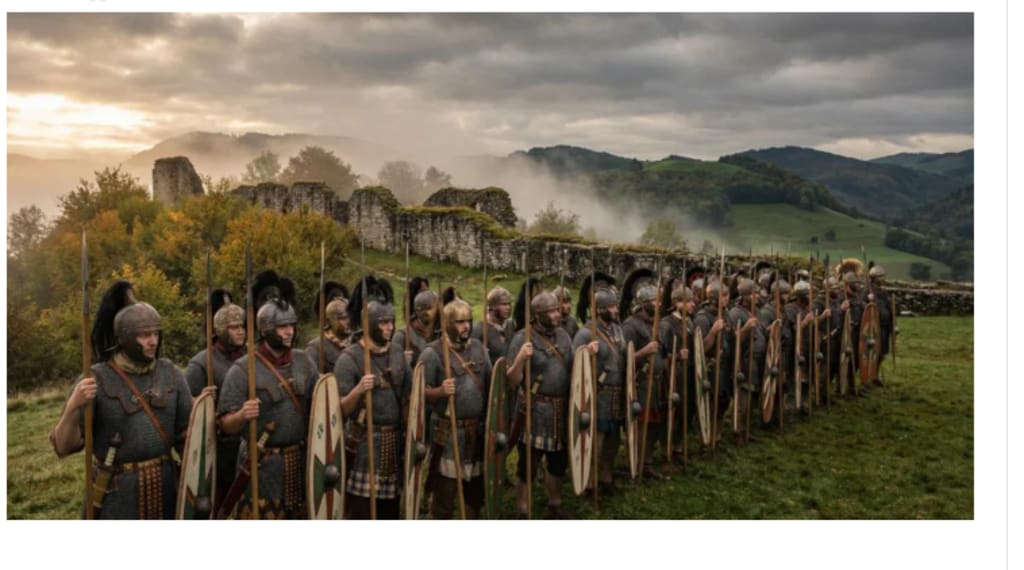
According to a recent research by historian John Ma of Columbia University, there was indications of a covert army functioning inside the Roman Empire in the first century AD. The study, which was published in the Journal of Roman Studies, casts doubt on the conventional wisdom that the Roman Empire totally absorbed and ruled over every society it subjugated.
Rather, although being legally under Roman administration, the Helvetians, a Celtic tribe in modern-day Switzerland, managed to retain a startling level of autonomy, including the capacity to recruit, equip, and finance their own armed forces.
The results imply that imperial control was much more negotiable and adaptable than previously believed. As a "state within an empire," the Helvetians maintained their administrative authority and cultural identity long after they were allegedly subjugated.
The example provides a case study demonstrating that imperial rule was not always a one-way deal, as reported by Popular Mechanics. The approach may be imitated by countless other villages around the empire.
The Empire's Helvetian State
Originally from the Swiss Plateau, the Helvetians were a strong Celtic confederation. During the Gallic Wars in 58 BC, they famously engaged in combat with Julius Caesar, which is said to have signalled the end of their independence. But according to Ma's research, the Helvetians were more than just Rome's subservient subjects well into the first century AD. They functioned as a civitas, a type of Roman administrative unit that, in this instance, retained important state-like functions.
The study found that the Helvetian civitas retained administrative authority over their realm, handled taxes, and oversaw local governance. The most amazing thing is that they kept organising and funding their own armed forces. This was an acknowledged, independent group operating inside the larger imperial framework rather than a rebel group.
Ma said that the "capacity of Gallic civitates in the first century C.E. to operate as state-like entities shaped the practice and the experience of [the] empire." These administrative divisions in Gaul were frequently founded on the lands of pre-existing Celtic tribes, and they actively participated in funding, outfitting, and defending their own armies and forts.
A Locally Funded and Managed Military
The military itself provides one of the strongest arguments in favour of this autonomy. Rome did not directly manage the Helvetian army, despite the fact that they progressively adopted Roman clothing and weapons. They defended small forts and areas on their own terms, providing their own equipment and compensation.
The Roman historian Tacitus, who documented a battle in 69 AD, is a key source that bolsters this theory. According to Tacitus, Roman soldiers tried to take funds meant for a Helvetian-paid garrison defending a nearby fort. Rather than depending on the Roman imperial treasury, this occurrence demonstrates that the Helvetians had local control over their military budget and administrative matters. When it came to their own garrison, the representation suggested that Helvetians, not Roman commanders, were in charge.
This textual evidence is further supported by archaeological excavations. A 1948 excavation in Switzerland revealed a burial filled with currency, weapons, and military hardware. The idea of a self-funded, locally controlled armed force is reinforced by the existence of localised coinage, which strongly suggests it was used to pay soldiers, mercenaries, or tribute.
Ma contends that the location in present-day Switzerland was a fully autonomous political town that ruled itself throughout the first century AD rather than a remote Roman garrison manned by auxiliary troops.
Roman Influence and Cultural Identity
The development of the Helvetian military also sheds light on how regional cultures interacted with Roman influence without necessarily losing their individuality. The Helvetian warriors eventually adopted Roman-style swords, belts, and other gear, giving them a more Roman appearance. Ma contends that this change in style does not imply that they have given up their independence or completely absorbed into Roman society.
Rather, the Helvetians were probably intentionally maintaining their own political systems while modernising their military technology. They kept the power to make their own decisions while adopting the Roman troops' useful equipment.
The local elites made the decisive decisions about military organization and finance, despite the Romans projecting their power. In order to comprehend the larger dynamics of Roman provincial control, Ma's research highlights that the Helvetians maintained a separate political identity while becoming increasingly Roman-looking.
Roman Imperialism A Reevaluation
The conventional interpretation of Roman imperialism, which frequently portrays Rome as conquering, supplanting regional systems, and enforcing complete, centralised rule, is challenged by this nuanced perspective of the Helvetian civitas.
The Helvetians serve as an example of how imperial rule may be negotiated and adaptable, depending more on shared authority and integration with local powers than on total dominance. It's possible that the Romans were much more practical than the notion of an all-consuming empire implies.
The Helvetians' capacity to preserve their Celtic identity and independence raises the possibility that other Gallic communities may have benefited from comparable agreements. Rather than being a monolith that eliminated all local government, the Roman Empire may have operated more as a network of semi-independent entities working with the central government.
In addition to changing our perception of the Helvetians, this discovery prompts a more thorough examination of how ancient rulers preserved their enormous lands—through collaboration as much as invasion.
About the Creator
Enjoyed the story? Support the Creator.
Subscribe for free to receive all their stories in your feed.
Comments
There are no comments for this story
Be the first to respond and start the conversation.