
5 Mysteries of Ravana After Ramayana: His Body, Sita, Mandodari and Forgotten Sons
From the legend of Ravana’s preserved body in a Sri Lankan cave to mysterious stories about Sita, Mandodari and his powerful sons, here are the fascinating beliefs that continue to intrigue Ramayana readers.

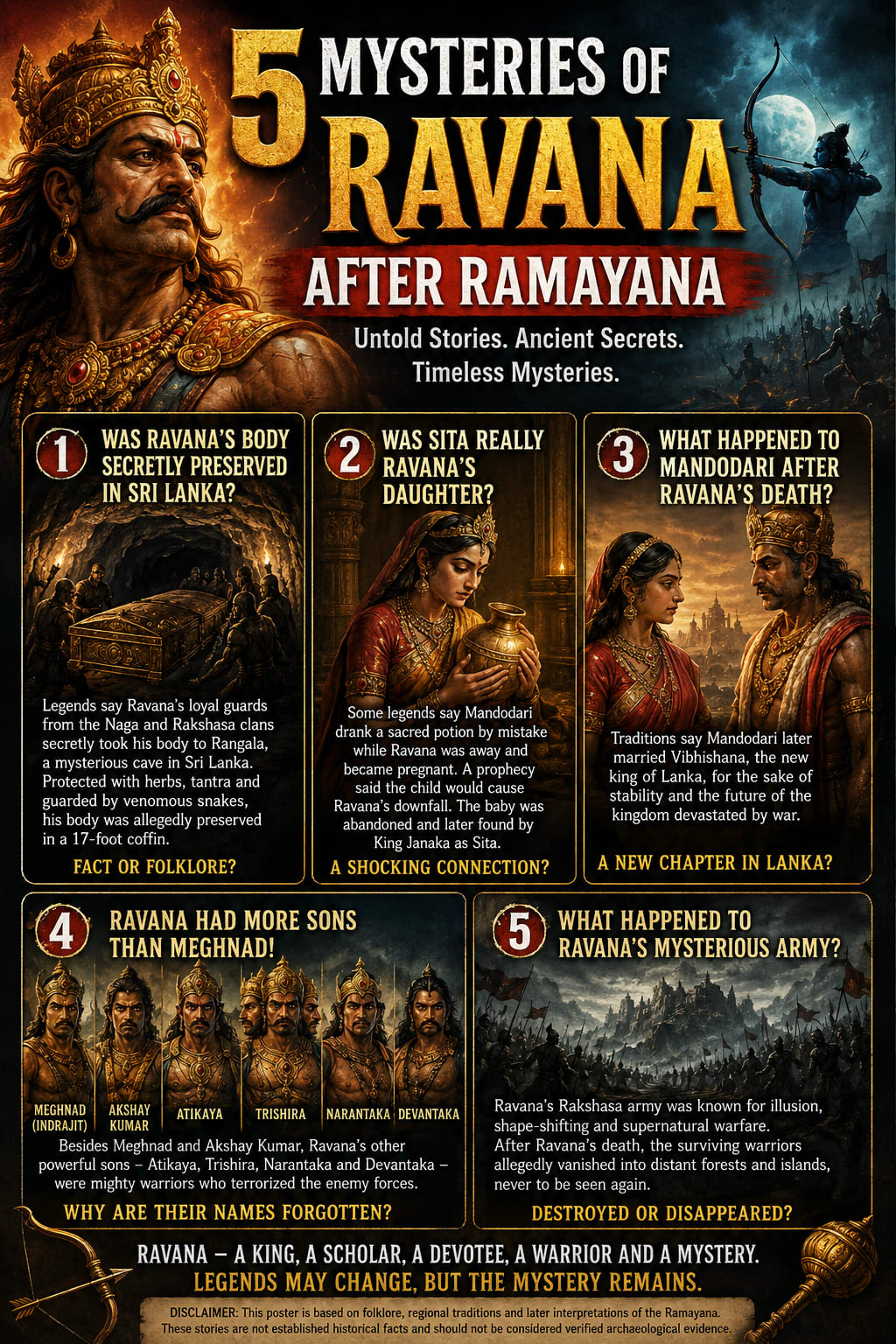
The battle of Lanka ended with the death of Ravana, one of the most powerful and complex characters associated with the Ramayana. According to the traditional narrative, Vibhishana performed the final rites of his elder brother after Lord Rama reminded him that hostility ends with death.
But for many people, Ravana’s death is not where the mystery ends.
Over the centuries, several regional traditions and folk legends have developed around Ravana. Some claim that his body was secretly preserved in Sri Lanka. Others tell an unusual story connecting Sita’s birth with Ravana and Mandodari. There are also lesser-known tales about Ravana’s sons and questions about what happened to his enormous army after the fall of Lanka.
It is important to remember that many of these stories are folk traditions and later beliefs rather than events described in the Valmiki Ramayana.
Was Ravana’s Body Secretly Preserved in Sri Lanka?
One of the most fascinating legends claims that Ravana’s loyal followers did not allow his body to be completely destroyed after his death.
According to this tradition, a group of Ravana’s trusted guards—including warriors associated in folklore with the Naga and Rakshasa clans—secretly removed his body and carried it deep into the mountainous forests of Sri Lanka.
The story connects the body with a remote area known as Rangala, where Ravana was supposedly placed inside a mysterious cave.
Some versions of the legend claim that people knowledgeable in herbs, medicine and tantra prepared a special herbal substance to protect the body from decomposition.
The body was then allegedly placed inside a huge coffin measuring around 17 feet in length and hidden deep inside the cave.
Even more mysterious are stories claiming that poisonous snakes continue to protect the location.
However, there is an important distinction to make: there is no established historical or archaeological evidence proving that Ravana’s preserved body exists in such a cave.
The story survives mainly as a fascinating piece of Sri Lankan folklore associated with Ravana.
Was Sita Really Ravana’s Daughter?
Another controversial Ramayana-related mystery concerns the birth of Mata Sita.
In the widely known Ramayana tradition, Sita is regarded as Bhumija, the daughter of the Earth, who was discovered by King Janaka while he was ploughing a field.
However, some alternative traditions tell a very different story.
According to one such legend, Ravana once collected the sacred blood of powerful sages and stored it inside a golden vessel. Before leaving on another campaign, he supposedly warned Mandodari not to touch it.
The legend says that Mandodari, suffering emotionally because of Ravana’s prolonged absence, mistakenly believed that the substance inside the vessel could end her life and drank it.
Instead, she became pregnant.
Astrologers allegedly predicted that the child would one day become responsible for the destruction of Ravana and Lanka.
Frightened by the prophecy, Mandodari supposedly travelled away from Lanka and abandoned the unborn child, which was eventually buried in the earth.
Years later, King Janaka discovered a divine baby while preparing land for a yajna.
That child, according to this alternative legend, was Sita.
This story creates a dramatic connection between Sita and Ravana, suggesting that the very person whose abduction eventually caused Ravana’s downfall may have had an unexpected connection to his own family.
But this should not be confused with the mainstream account. The Valmiki Ramayana presents Sita as the daughter discovered and raised by King Janaka, and the Ravana-daughter story belongs to alternative traditions and folklore.
What Happened to Mandodari After Ravana’s Death?
Mandodari is one of the most interesting yet often overlooked figures in Ravana’s story.
Throughout the conflict, she is commonly portrayed as intelligent and far more cautious than her husband. She repeatedly tried to persuade Ravana to return Sita and avoid a disastrous war with Rama.
Ravana ignored her warnings.
By the end of the war, Mandodari had lost her husband, members of her family and much of the kingdom she had once known.
So what happened to her afterward?
Some later traditions claim that Mandodari eventually married Vibhishana, who became the ruler of Lanka after Ravana’s death.
According to these accounts, the marriage was connected less with romance and more with maintaining political stability in a kingdom devastated by war.
Mandodari understood Lanka, its people and its royal administration. Vibhishana represented a new era of rule. Their union, according to these traditions, helped provide continuity while Lanka recovered from destruction.
This story, however, also comes from later traditions and should not automatically be treated as a central event of the Valmiki Ramayana.
Ravana Had More Sons Than Meghnad
When Ravana’s sons are discussed, two names usually receive most of the attention: Meghnad, also known as Indrajit, and Akshay Kumar.
But traditions associated with the Ramayana also mention other powerful sons of Ravana.
Among the best known are Atikaya, Trishira, Narantaka and Devantaka.
Trishira is remembered as a terrifying three-headed warrior who fought fiercely during the Lanka war before being killed by Hanuman.
Narantaka was known for his speed and destructive attacks against the Vanara army. His battle eventually brought him face-to-face with Angada, the son of Bali.
Devantaka was portrayed as an immensely powerful warrior who fought with a heavy mace. His strength caused chaos among the Vanara forces before Hanuman defeated him.
Atikaya was perhaps the most formidable among these lesser-discussed sons.
He was described as a gigantic warrior protected by extraordinary armour. During the war, Lakshmana eventually confronted him, and according to the narrative tradition, a divine weapon was required to defeat him.
These warriors demonstrate just how large and powerful Ravana’s family and military structure were supposed to have been.
What Happened to Ravana’s Mysterious Army?
Ravana’s power did not depend entirely on his personal strength.
His enormous Rakshasa army was another important reason Lanka was considered so difficult to conquer.
These warriors are frequently associated in later storytelling with illusion, shape-shifting and supernatural warfare. Enemies could supposedly be confused by warriors changing form, appearing in multiple places or creating deceptive scenes on the battlefield.
During the war with Rama’s forces, however, Lanka gradually lost its greatest commanders.
Kumbhakarna fell.
Indrajit was killed.
Ravana’s sons and other major warriors were defeated.
Finally, Ravana himself died.
Some legends claim that the remaining warriors who refused to accept Vibhishana’s rule eventually abandoned Lanka and disappeared into distant forests, islands and unexplored regions.
With time, the once-feared army disappeared from history and survived mainly in legends.
There is no verified historical evidence showing that a secret surviving army of Ravana continued to exist after the events described in the epic tradition.
Why Ravana’s Mysteries Still Fascinate People
Ravana remains fascinating because he is not remembered simply as a powerful king defeated by Rama.
He is associated with extraordinary knowledge, devotion, ambition, warfare, pride and ultimately a catastrophic failure caused by his own decisions.
That complexity has allowed countless regional stories to develop around him.
The alleged preserved body of Ravana, the alternative story of Sita’s birth, Mandodari’s life after the war, Ravana’s forgotten sons and the disappearance of his army all add new layers to the legends surrounding Lanka.
Some originate from religious traditions, others from regional folklore, and some have been expanded through generations of storytelling.
Separating scriptural tradition, folklore and historical evidence is therefore important when exploring these mysteries.
Whether these legends are taken literally or simply enjoyed as part of South Asia’s enormous storytelling tradition, one thing is certain: thousands of years after the story of Rama and Ravana entered cultural memory, the mysteries surrounding the king of Lanka continue to fascinate readers.
Disclaimer: This article discusses stories found in folklore, regional traditions and later interpretations of the Ramayana. Several claims mentioned here are not established historical facts and should not be treated as verified archaeological discoveries.
Seo Tags
Ravana mysteries, Ravana body in Sri Lanka, Ravana dead body cave, was Sita Ravana daughter, Mandodari after Ravana death, Ravana sons names, Ravana army, Ramayana mysteries, Ravana secrets.
About the Creator
parwinder singh
🎬 Movie & Entertainment Writer sharing reviews, ending explanations, story breakdowns, plot twists and hidden details from Bollywood, Hollywood, South Indian cinema, Korean dramas and OTT releases.
Enjoyed the story? Support the Creator.
Subscribe for free to receive all their stories in your feed.
Comments
There are no comments for this story
Be the first to respond and start the conversation.