literature
Geek literature from the New York Times or the recesses of online. Our favorite stories showcase geeks.
Melville's Humanity
The Sad Case of Bartleby The short story, “Bartleby, The Scrivener” by Herman Melville is incredibly sad when examining the character Bartleby, yet the story has a deeper impact when examining the narrator, as one of the characters. What struck me as most profound was his declaration: “Nothing so aggravates an earnest person as a passive resistance,” a response to Bartleby’s continued refusal to comply (Melville 1166). Bartleby, who seems to be industrious in the beginning transitions towards a slow decline with his verbal refusal: “I would prefer not to,” which happens to turn into an automatic response throughout the rest of the novel (Melville 1164). Just like the characters in this short story, I found myself inclined to use this phrase when my daughter made mention that I needed to do something. She was not amused.
By Rebecca A Hyde Gonzales4 years ago in Geeks
The Allegory
That which represents both itself and something else is allegorical. The relationship between what is perceived as truth and what is real is often weaved so intricately that we are unable to distinguish between the two. What's interesting about allegories is the thread of truth found within the tale that often draws on historical, political, or cultural context. The reader or the observer has to really examine what is presented and determine what is true versus what is real. On the surface, it appears that truth and reality are at opposite ends. Rather, the differences help us to understand meaning beyond actual representations, a glimpse, perhaps, into the metaphysical and spiritual. Moby-Dick by Herman Melville expands Melville’s earlier travel narratives by incorporating spiritual and political allegory. What appears to be internal conflict can best be described as an effort to unravel the truth from reality. This paper examines the complex tapestry of Melville’s novel and how it is manifested in the character Ishmael and in the exploration of “whiteness” introduced in Chapter 42: “The Whiteness of the Whale.”
By Rebecca A Hyde Gonzales4 years ago in Geeks
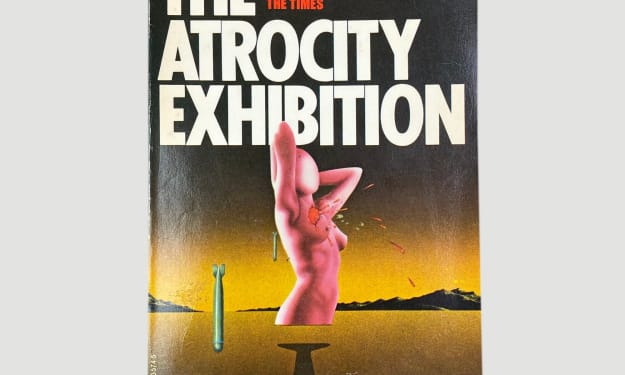
Book Review: "The Atrocity Exhibition" by JG Ballard
It's been a while since I've read some JG Ballard. From what I remember, I have always had a polarising experience with his books. The first book I ever read by JG Ballard was Empire of the Sun, which, as many of you, was introduced to me by the film starring the then-child Christian Bale. I was a teenager back then and it would be a couple of years until I would read another Ballard novel, this time lent to me by a friend who thought that I 'had to read this!' - it was Cocaine Nights and I was eighteen. A balancing act of dystopia and dark secrets seemed to be a big deal to Ballard when I followed that by reading High Rise, which is pretty much about the same thing. Crash when I was twenty was something I read in between university novels. With its sexualisation of car crashes, it freaked me out enough not to pick up another Ballard until now. It's been almost seven years. And imagine it, the first Ballard I picked up since then had to be The Atrocity Exhibition.
By Annie Kapur4 years ago in Geeks
April '22 Reads
I read six books in April, which, for most people, is a lot. More than some people read in a year. More than some people have read in years. And to be honest, I hadn’t read that much since high school, since before college – where I majored in English – took over, since before life took over. I was reading so much that there wasn’t time to write about each book I read. Or rather, I didn’t make time to write about each book.
By Victoria Brown4 years ago in Geeks
Book Review: "Seek My Face" by John Updike
When I started reading John Updike novels, I was in my teens. I read the Rabbit Series and then, into my twenties, I kind of gave him up purely because I did not want to ruin the magic that was the Rabbit Series, thinking that nothing else he wrote would live up to that. However, as of recent, I have been rekindled with the works of John Updike for a very strange reason: he was near Anne Tyler in the library and they ran out of her novels so I went for something that looked somewhere in the ballpark. I had heard of Updike before and I had read some of his stuff before too - so I was sure as I waited for more Anne Tyler that I would be entertained. One of those books was called Seek My Face.
By Annie Kapur4 years ago in Geeks
Petre and the Wolfsbane
Aconite. Monkshood. Wolfsbane, if by any other name. Friend to none but witches, warlocks, and herbwives, whom are merely sickly-sweet matronly witches in guise. The kind that would candy belladonna shoots, and jam belladonna berries, sell them as treats to ignorant passerbys, numb to the deception, fooled for the chance to help an old woman with shaky hands and a twisted spine.
By Sean Prater4 years ago in Geeks
Game Of Thrones, Days Without End, Fugitive Pieces
Book reviews A series of fantasy novels by American author George R. R. Martin, "A Game of Thrones is a Song of Ice and Fire's First Novel." The novel was first published on August 1, 1996. It won the Locus Award in 1997 and was nominated for both the Nebula Award and the Fantasy Award.
By Mehedi Hasan Shawon4 years ago in Geeks
Cold Comfort Farm & The Prestige & Saturday Night and Sunday Morning Book Summary
Book reviews "Cold Comfort Farm" is a comic novel by English writer Stella Gibbons. It was first published in 1932. In contemporary rural life, romance and sometimes destructive stories emerge from writers like Mary Webb. Gibbons' Cold Comfort Firm alludes specifically to several novels as a parody of the "Loam and Lovechild" genre.
By Mehedi Hasan Shawon4 years ago in Geeks
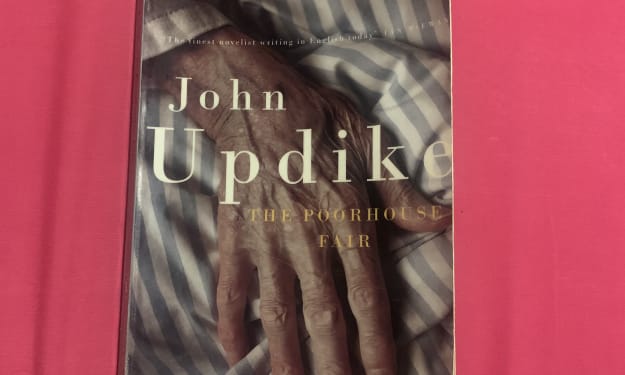
Book Review: "The Poorhouse Fair" by John Updike
I'm still on the whole John Updike phase of my relationship with realism and honestly, I think this is one of the weirdest ones I have encountered yet. Spanning less than 130 pages, Updike's first novel The Poorhouse Fair is a difficult read to many people. First published in 1959, it often goes overlooked in Updike's collection purely because of its nature for 'going on a bit'. The random amblings of age and nature throughout the book have made it an irritable read for the 21st century reader. But I am not going to lie to you when I say that I actually really enjoyed it. Not as much as his other novels no, and certainly not as much as his shorter works either - but I still thought it was pretty good as a book. I happen to quite enjoy nothing happening in my novels and more dialogue, description, encounter. It really brings out the entire world you are going to exist in for a brief period of time.
By Annie Kapur4 years ago in Geeks
More Bad Book Reviews
I have previously shared through Vocal my experiences as a book reviewer and most recently, being challenged about what I have written in response to my reading of ARCs: book reviews written by me. I read a lot and share on many book oriented websites so my views are widespread. That doesn't mean that they are widely read but they are widely distributed.
By Rachel Deeming4 years ago in Geeks