space
Space: The Final Frontier. Exploring space developments and theorizing about how humans fit into the universe.
Life is Hard, But At Least There’s Wi-Fi. AI-Generated.
Let’s be honest—life is complicated. One minute, you’re a kid whose biggest problem is running out of cookies. The next, you’re an adult, and suddenly, everything costs money. Even breathing feels like it comes with hidden fees.
By Pure Crown2 years ago in Futurism
THE FUTURE OF SPACE TRAVEL
Introduction: A New Home in Space? Have you ever gazed at the night sky and wondered if humanity could one day live on another planet? For centuries, space has fascinated scientists and dreamers alike. Today, with rapid advancements in space technology, the idea of living on Mars is no longer just science fiction—it is a serious possibility. But how would that work? What challenges must we overcome? Let's explore the exciting future of space travel and what it would take to turn Mars into a second home for humanity. --- Why Mars? Mars, often called the "Red Planet" due to its rusty-colored surface, is one of our solar system's most studied planets. But why is it the best candidate for human settlement? Scientists believe Mars is the most suitable planet for colonization because it has some similarities to Earth. Here’s why: Seasons Similar to Earth – Mars has a tilt similar to Earth, meaning it experiences seasons, though they last much longer. Frozen Water – There is evidence of frozen water beneath the surface, which could be converted into drinking water or even fuel for rockets. A Day Close to Earth’s – A Martian day, or "sol," is about 24 hours and 37 minutes, making it easier for humans to adjust compared to other planets. Even with these similarities, Mars is still an extreme and dangerous environment. Before we can call it home, many challenges must be addressed. --- Challenges of Living on Mars Living on Mars presents several obstacles that scientists and engineers must overcome. Let’s take a closer look at the biggest challenges: 1. Lack of Oxygen Earth’s atmosphere is rich in oxygen, but Mars has almost none. Instead, it is mostly carbon dioxide, which humans cannot breathe. Scientists are working on developing oxygen-producing machines, such as MOXIE (Mars Oxygen In-Situ Resource Utilization Experiment), a device that can convert carbon dioxide into oxygen. 2. Harsh Temperatures Mars is incredibly cold, with temperatures that can plummet to -81°F (-63°C), much colder than Antarctica. Humans will need heated shelters and specially designed space suits to withstand the freezing conditions. 3. No Natural Food or Water Sources Unlike Earth, Mars has no grocery stores, rivers, or farmland. Scientists are researching ways to grow food in Martian soil and extract water from underground ice deposits. Hydroponic and aeroponic farming techniques could be the key to growing fresh produce in space. 4. Long and Dangerous Journey Traveling to Mars is no easy feat. With current technology, it takes about 7-9 months to reach Mars. Astronauts will have to carry enough supplies for the journey and prepare for potential emergencies without immediate help from Earth. --- How Are We Preparing for Mars? Despite these challenges, space agencies and private companies are actively working on solutions to make Mars colonization a reality. Here’s how: 1. Advanced Rockets and Spacecraft Companies like SpaceX, founded by Elon Musk, are developing powerful rockets like Starship, designed to carry people and cargo to Mars. This reusable spacecraft could revolutionize space travel by making interplanetary journeys more affordable and efficient. 2. Simulating Mars on Earth Scientists are testing Mars-like conditions in extreme locations on Earth, such as deserts and icy regions. These simulations help researchers understand what it takes for humans to survive in Mars’ harsh environment. 3. Rovers and Drones Exploring Mars NASA's robotic explorers, like Perseverance and Curiosity, have been studying Mars for years. These rovers analyze soil samples, test for past life, and help scientists determine the best places for future human settlements. --- The Future: Will You Live on Mars One Day? The idea of living on Mars might seem like a fantasy today, but scientists predict that within the next 50 to 100 years, the first human colonies could be established. Imagine a future where Martian cities have homes, schools, and even sporting events! Children might grow up on Mars, exploring red deserts and gazing at Earth as a distant blue dot in the sky. However, before we take this giant leap, extensive research and testing are needed to ensure human safety and survival. Governments and private companies are investing billions into space exploration, and every small step brings us closer to making Mars a reality for future generations. Would you like to be among the first humans to step foot on Mars? The future of space travel is unfolding before us, and one day, Mars may no longer be just another planet—it could be our second home.
By SHADOW-WRITES2 years ago in Futurism
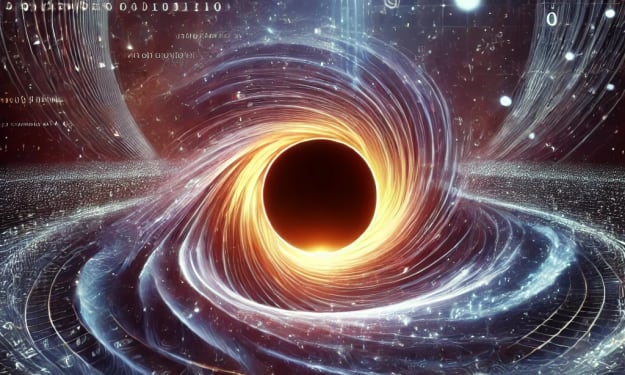
Scientists Find Evidence That Our Entire Universe Might Be Inside a Black Hole
Are We Living Inside a Black Hole? Scientists Find Evidence That Could Change Everything For centuries, humanity has sought to understand the true nature of our universe. From the ancient philosophers who gazed at the night sky to the modern physicists unlocking the secrets of quantum mechanics, we have continuously pushed the boundaries of our knowledge. But what if everything we thought we knew about the universe was wrong? What if our entire cosmos—galaxies, stars, planets, and even time itself—is actually inside a black hole?
By JONATAN DAVID VEGA2 years ago in Futurism
Scientists Develop a Helmet to Talk to Extraterrestrials
The Future of Alien Communication: Scientists Develop a Helmet to Talk to Extraterrestrials For centuries, humanity has gazed at the stars, wondering if we are alone in the universe. We have sent out radio signals, built massive telescopes, and even launched probes carrying messages in the hopes that an intelligent extraterrestrial civilization might receive and understand them.
By JONATAN DAVID VEGA2 years ago in Futurism
Hidden Structures Beneath the Pyramids of Egypt,Vast underground city
The Discovery That Could Change History: Hidden Structures Beneath the Pyramids of Egypt For centuries, historians and archaeologists have debated the true purpose of the pyramids of Egypt. Were they merely grandiose tombs for pharaohs, or did they serve a much greater function? A groundbreaking new discovery could provide answers that challenge our understanding of ancient civilizations. Using advanced radar technology, Italian researcher Corrado Malanga and Scottish scientist Filippo Biondi have uncovered a network of hidden structures beneath the Pyramid of Khafre in Giza. Their findings suggest that the pyramids might not be simple burial sites but part of an ancient and sophisticated architectural system whose purpose remains a mystery.
By JONATAN DAVID VEGA2 years ago in Futurism
"The Final Dreamer"
"The Final Dreamer" Humanity had advanced to the pinnacle of technological development by 2147. On the horizon, cities shone like steel-and-glass beacons, and humans had endless free time while machines performed the most routine duties. from the human mind was anything from idle. The distinction between reality and virtuality started to become more hazy with the introduction of NeuralSync, a device that made it possible for a person's consciousness to directly interact with a huge digital network.
By Rajoan Islam2 years ago in Futurism
The Future of Transportation:
Imagine a world where your daily commute is a swift flight over traffic-clogged streets or a rapid journey through low-pressure tubes at speeds rivaling jetliners. This isn't the stuff of science fiction; it's the emerging reality of transportation, with hyperloops and flying cars poised to revolutionize how we move.
By Pure Crown2 years ago in Futurism
The James Webb telescope captured images of the farthest planet in the solar system,Neptune, where seven of its 14 moons can be seen.
Neptune, discovered in 1846, is thirty times farther from the Sun than Earth and orbits in one of the darkest parts of the solar system.
By JONATAN DAVID VEGA2 years ago in Futurism
Space X Astronauts Sunita Williams and Barry Wilmore Return to Earth After Nine Months in Space
Sunita Williams and Barry Wilmore Return to Earth After Nine Months in Space A Mission Extended Beyond Expectations NASA astronauts Barry "Butch" Wilmore and Sunita "Suni" Williams have safely returned to Earth after spending 286 days aboard the International Space Station (ISS). Originally planned as a short mission, their stay was unexpectedly extended due to technical issues with the Boeing Starliner spacecraft, preventing their timely return.
By JONATAN DAVID VEGA2 years ago in Futurism