artificial intelligence
The future of artificial intelligence.
GM Cuts 600 IT Roles as AI Productivity Gains Outpace Headcount Needs
Read Time 6 minutes Tags AI Automation GM Layoffs IT Workforce Productivity Enterprise AI Labor Market DETROIT An ominous email about an oddly timed 15 minute virtual meeting A scripted message from human resources And an abrupt end to that meeting as well as their job That is how General Motors employees who were laid off Monday by the Detroit automaker described their jobs being terminated to CNBC No appreciation or empathy No questions Nothing said a data analyst who worked for more than a decade at the automaker The layoffs affect about 500 to 600 employees largely in information technology roles in Austin Texas and Warren Michigan according to a person at GM familiar with the layoffs who asked not to be named in order to speak about details that had not been made public The layoffs came as the automaker reevaluates its workforce needs and cuts costs amid uncertain market conditions The two laid off workers who asked not to be named for fear of repercussions or impacts to potential future jobs said their units had gone through recent restructurings and that they were being encouraged to use artificial intelligence more in their work They are going to push AI for everyday work and everything else said a veteran programmer and data scientist for the company I have seen it firsthand It can make you much more productive as a programmer It can really help you get more work done but AI is not going to do you any good if you do not know the business Automakers like many major companies are using AI to help workers make their jobs more efficient but the emerging technology also has led to layoffs Companies such as Amazon Meta Oracle and Block have announced rounds of job cuts with some emphasizing AI role in automating work and boosting productivity with lower head counts GM declined to discuss the role AI played in its most recent layoffs or give additional details of reasoning for the job cuts outside of a statement Monday GM is transforming its Information Technology organization to better position the company for the future As part of that work we have made the difficult decision to eliminate certain roles globally We are grateful for the contributions of the employees affected and are committed to supporting them through this transition The person at GM familiar with the layoffs told CNBC that AI played a role in the decision as it continues to hire people with such skill sets but it was not the only reason for the terminations Technical and labor market analysis One Substitution over augmentation GM case shows the shift from AI as productivity multiplier to AI as headcount reducer Employees reported being encouraged to use AI more in their work then laid off when output per head rose The veteran programmer noted AI can make you much more productive as a programmer but domain knowledge remains a bottleneck This matches enterprise patterns where coding assistants reduce time spent on boilerplate but business context still requires human judgment The layoffs hit roles where AI can automate 40 to 60 percent of tasks with minimal supervision Two Hiring for AI specialization continues Despite Monday cuts GM is still hiring IT workers The company as of Tuesday had roughly 80 open IT positions that include jobs working in AI motorsports and autonomous vehicles according to the Detroit automaker careers website This is the classic barbell pattern Reduce generalist IT roles increase specialized AI ML and data roles The net headcount may fall but technical capability shifts toward model deployment inference optimization and data pipelines That is substitution not just automation Three Severance structure signals transition planning An overview of the GM Severance Program sent to affected employees and viewed by CNBC offered severance of two months for those who had one to four years of experience That scales up and employees with eight years of experience get four months of severance At the top of the scale GM is offering six months of severance for employees who had worked at the company for 12 or more years Lump sum payments toward health care between 2000 and 6000 also will be provided Any unused vacation or sick time was forfeited unless such actions violated state laws GM also offered services through mental health care company Lyra for navigating job loss and career coaching and future job assistance through outplacement services company LHH Four Broader enterprise signal GM is not isolated Amazon Meta Oracle and Block have announced rounds of job cuts with some emphasizing AI role in automating work and boosting productivity with lower head counts The pattern is consistent across sectors with large IT footprints IT roles with repetitive logic data processing and report generation are most exposed Roles requiring systems integration regulatory knowledge and cross functional coordination remain resilient for now Five Market and investor reaction GM stock rose 115 percent on the news Markets are pricing the cuts as margin improvement not demand weakness The broader market also hits new highs as companies ramp up AI spending Investors reward lower headcount when accompanied by AI driven productivity metrics The risk is that over automation creates technical debt and single points of failure if domain knowledge exits faster than AI can capture it What to watch First whether GM backfills laid off roles with contractors or offshore teams Second whether AI tools used by remaining staff can maintain system reliability without the original builders Third whether severed employees move to suppliers or competitors carrying institutional knowledge The transition from AI augmentation to AI substitution is now measurable in headcount numbers For IT professionals the signal is clear Build skills in AI orchestration data engineering and model operations not just scripting and maintenance For executives the risk is losing tacit knowledge that AI cannot replicate The GM cuts show that AI can cut costs but cannot yet replace business context How is your org balancing AI productivity gains with headcount planning Share your approach in the comments
By Behind the Tech5 months ago in Futurism
Kevin O Leary Labels Trump The AI President as Markets Hit New Highs on Productivity Gains
Read Time 6 minutes Tags AI Policy Trump Kevin O Leary US China AI Economy Productivity Job Displacement Kevin O Leary believes President Donald Trump legacy will be tied to the boom of Artificial Intelligence The Shark Tank star 71 explained in a recently resurfaced interview with Fox Business from February that the outcome of AI is still unknown Wild card here You do not know the outcome of AI yet Does it displace so many jobs that becomes a midterm election issue Or is the productivity so spectacular on margin and productivity enhancement in the S and P 500 the market keeps going up hitting new highs He declared that Trump will be the AI president It all came on his watch The nascent first term simmering through the former President Joe Biden years boom it hits and now everybody is wondering what the outcome is gonna be job loss or productivity enhancement If he wins on the productivity enhancement for the first time ever maybe technology saves the midterms he said at the time Since O Leary comments AI has continued to have a massive impact on the US economy According to Yahoo Finance the technology marked the leading reason for job cuts in March accounting for 15341 layoffs or roughly 25 percent of total job loss However the outlet reports that markets continue to hit new highs as companies ramp up AI spending In a more recent appearance on Fox Business the mogul doubled down on his assertion that AI would be an asset for Trump 79 and his administration in future elections AI has already put itself in all 11 sectors of our economy to be something very powerful as a tool to enhance the economy through productivity and margin enhancement O Leary told Fox Business on Thursday April 30 That is why the markets are hitting new highs even while we have all this conflict around the world Technical and economic analysis One Productivity versus displacement trade off O Leary frames the political outcome around a single variable net productivity gain If AI driven automation increases output per worker enough to lift S and P 500 margins and wages in remaining roles then job loss becomes a secondary issue for voters If displacement concentrates in specific sectors and geographies then AI becomes a midterm liability The data from March supports both narratives AI led layoffs hit 15341 jobs while equity markets set new highs The divergence suggests capital markets are pricing in long term efficiency gains while labor markets feel short term disruption Two Policy window and timing The nascent first term O Leary references was 2017 to 2021 where US AI policy was largely hands off The Biden years saw export controls and NIST frameworks but limited executive action Trump return has shifted toward mandatory safety evals and compute reporting as discussed in the upcoming Beijing summit with Xi Jinping If executive action lands before midterms and markets hold then the AI president label gains traction If regulation lags or causes a market correction then the label weakens Three China military AI race as forcing function O Leary warned of a military arms race between the US and China over the effective implementation of artificial intelligence when it comes to national security This reframes AI from economic tool to strategic asset In that frame the president who secures compute advantage secures deterrence The Trump administration is expected to discuss AI safety and security risks with Xi this week The move from laissez faire to bilateral deconfliction channels mirrors Cold War logic If successful it reduces tail risk and supports market stability If failed it raises risk premium and validates China decoupling narrative Four Market structure implications AI has already put itself in all 11 sectors of our economy O Leary is correct on adoption breadth The value accrual is concentrated in compute cloud hyperscalers data and model providers This creates a K shaped market where software and hardware firms hit new highs while legacy sectors face margin compression and headcount reduction Investors are rewarding capital expenditure on AI infrastructure even amid geopolitical conflict The signal is that productivity enhancement is real enough to offset macro risk for now What to watch First execution of Trump executive action on AI safety If it mandates incident reporting and red teaming without stifling model release then productivity narrative holds Second China response on domestic chip and model stack DeepSeek Huawei inference shift shows decoupling is real If China closes training gap then US advantage narrows Third labor market data in AI exposed roles If displacement spreads beyond IT and customer support into finance legal and operations then political backlash accelerates For enterprise leaders the takeaway is direct price AI as both cost center and strategic asset Map exposure to job categories most at risk Build redeployment plans that capture productivity gains internally Do not assume market highs equal political stability The AI president narrative depends on whether productivity gains reach voters before job loss reaches polling stations Do you think AI will be a net job creator or destroyer in your sector Share your view in the comments
By Behind the Tech5 months ago in Futurism
WHAT WE KNOW ABOUT UNIVERSE
Astronomy is the scientific study of the universe and everything that exists within it, including stars, planets, galaxies, gas, dust, and other celestial bodies. It is one of the oldest sciences, helping humanity understand the mysteries of space and the laws that govern the cosmos. Astronomers observe celestial objects and develop theories about the origin, structure, and future of the universe. The universe is often defined as the totality of all matter, energy, space, and time that exists around us.
By Ibrahim Shah 5 months ago in Futurism
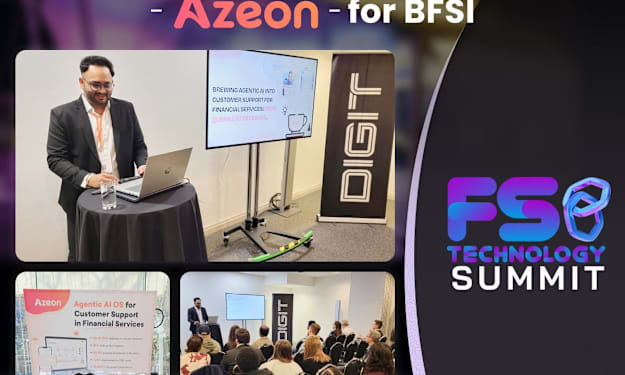
Azeon Exhibits at DigitFS 2026, Showcasing Production-Ready AI Support Agent for Financial Services
There's a specific moment that signals when an industry has moved past the hype phase of a new technology. It's not when the keynotes get longer or the exhibitor floor gets busier. It's when the questions change.
By Pritesh Patel5 months ago in Futurism
In NASA data, AI discovered more than 100 secret exoplanets; hundreds more might be out there.
NASA's TESS spacecraft has confirmed almost 700 exoplanets in just seven years of operation. That seems like a lot. However, the majority of signals identified as promising have never been fully processed, despite the telescope monitoring more than two million stars. There are actual planets hidden in that backlog, sitting there in the data but never verified. More than 100 of them were recently discovered and verified by a research team.
By Francis Dami5 months ago in Futurism
Crowdfunding Market Is Redefining How Ideas, Startups, and Social Causes Get Funded. AI-Generated.
Crowdfunding Market Is Growing Rapidly Worldwide The global crowdfunding market is witnessing strong growth as digital fundraising becomes an increasingly popular alternative to traditional financing methods. According to Renub Research, the crowdfunding market is expected to grow from US$ 19.32 billion in 2025 to US$ 45.37 billion by 2034, registering a CAGR of 9.95% from 2026 to 2034. The expansion is being driven by rising internet penetration, widespread adoption of online payment systems, growing startup culture, and increasing participation from individual investors across the globe.
By Aman Ahirwar5 months ago in Futurism
Neowiz AI Creator Listing Exposes Generative AI Normalization in AAA Production
Read Time 6 minutes Tags Generative AI Game Development Neowiz Lies of P AI Ethics Production Pipelines Lies of P was a banger and so for a while now everyone has been waiting on word of its already confirmed sequel However that is not necessarily why developer Neowiz is currently making headlines across the web Instead the Korean studio is getting flak for a newly discovered job listing which specifically asks for an AI creator or AI artist depending on how literal you want the translation to be As you can probably imagine the role title alone has been enough to attract criticism but what is actually expected of this employee Well the description goes into a bit of detail and unfortunately for Neowiz the clear push for generative AI that is using AI to make assets based on the existing work of others is only going to attract even more negativity There is an obvious mention of using generative AI to produce textures and create assets while also using popular models like Stable Diffusion and Midjourney to craft concept drafts for both characters and environments What is more the role is tasked with training unique AI models to help shape the project visual identity Basically the job is all about getting the most out of AI in pretty much every applicable field Again this listing is already being heavily scrutinised across sites like Reddit but the reality here is that these kinds of positions are steadily becoming the norm The bottom line is that if a company believes that it can utilise AI to increase productivity streamline workflow and ultimately make more money then it is going to make the call For most onlookers the issue often boils down to how AI is actually being used We have seen plenty of examples of AI generated assets being present in shipped games and that is usually enough to warrant a backlash But then utilising AI tools to help streamline a project development is generally viewed with much less cynicism Meanwhile others would simply argue that anything AI related is a slippery slope Technical breakdown of the role and implications One Scope of generative deployment The job post lists three core functions First use generative AI to produce textures and create assets Second use Stable Diffusion and Midjourney to craft concept drafts for characters and environments Third train unique AI models to help shape the project visual identity This is not a prompt engineer support role This is a production artist role where diffusion models replace DCC tools for first pass work The phrase create assets signals intent to ship model output not just reference boards The mandate to train unique AI models implies fine tuning on studio owned data or scraping for style transfer which raises provenance and copyright risk Two Pipeline integration versus replacement In traditional AAA pipelines concept artists produce key art that informs 3D modelers who build meshes then texture artists paint maps and shaders The Neowiz listing collapses concept and texture into a single AI first pass loop Stable Diffusion can generate orthographic character sheets normal maps and tileable textures in seconds Midjourney excels at mood boards and environment keys Fine tuning on Lies of P art would let the studio maintain visual continuity while increasing throughput The cost lever is clear Fewer junior texture artists more senior oversight on curation and cleanup But quality variance from diffusion models means art direction must enforce strict consistency or the sequel risks looking like patchwork Three Legal and ethical surface area The listing does not specify training data policy If the unique AI models are trained on Lies of P internal concept art then the studio controls rights and the risk is low If training includes third party art without license then the studio inherits infringement exposure Western audiences on Reddit have flagged this as the core issue Eastern markets have less cultural backlash which explains why Korean studios are more transparent about these roles The backlash gradient is geographic but the legal risk is global once the game ships on PS5 and Steam in US and EU jurisdictions Four Production economics and labor dynamics Studios adopt AI when the ROI is positive A texture that takes a human artist four hours can be prompted in four minutes with cleanup in thirty The cost delta is an order of magnitude That saves budget or lets the same headcount ship more content Lies of P sold four million copies with DLC That is success but not Activision scale For a mid tier studio like Neowiz generative AI is a force multiplier to compete with larger teams The trade off is reputation Some players will refuse to buy a game made with generative AI Others do not care if the final product is good The market will segment Five Industry precedent and trajectory This is not isolated Ubisoft uses Ghostwriter for NPC barks Square Enix tested AI for Foamstars assets Activision disclosed AI in Call of Duty cosmetics Sony said AI is not a replacement for artists or creators but the platform holder cannot dictate partner pipelines The Neowiz post is notable because it is public and specific It signals that Korean AAA is moving from quiet experimentation to formal hiring That normalizes the role of AI creator across the industry Expect more listings with requirements for ComfyUI LoRA training ControlNet pipelines and in house dataset management What to watch First disclosure standards Will Sony or Steam require labeling of generative AI content in store pages Second tooling maturity ControlNet and IPAdapter reduce randomness and improve production control If Neowiz ships assets with consistent topology and PBR compliance then the technical argument against AI weakens Third community response If Lies of P 2 reviews well despite AI pipeline then other studios will accelerate adoption If backlash impacts sales then studios will hide AI use or limit it to preproduction For developers evaluate AI on output quality legal safety and pipeline fit For players decide if process purity matters more than final experience The Neowiz listing is a data point in a larger trend Generative AI is moving from novelty to department It will not replace art direction but it will replace some brush strokes Do you care if textures and concepts are AI assisted Share your technical tolerance in the comments
By Behind the Tech5 months ago in Futurism
US China AI Control Divergence Drives Trump Xi Summit Agenda on Model Safety
Read Time 6 minutes Tags AI Governance China US Policy AI Safety Trump Xi Agentic AI Public Trust In the US China tech race Beijing has underscored AI control from the start the US seems only now to be taking it seriously US President Donald Trump and Chinese President Xi Jinping will likely discuss AI at a summit in Beijing this week There is a striking difference in how eager the public in China and the US are for AI adoption This report is from this week CNBC The China Connection newsletter The big story A robotic voice warned me and others at a Hangzhou street intersection that a scooter driver did not have a helmet on even though I saw the rider wearing one Regardless the city and others are ploughing ahead in testing robot police officers The national cybersecurity regulator on Friday published guidelines for ensuring safe use of agentic AI It is a reminder that in the US China tech race Beijing has underscored AI control from the start the US seems only now to be taking it seriously As comparisons to the Cold War nuclear threat grow hopes are rising that Trump and Xi will talk about AI cooperation in Beijing this week Given concerns about the latest AI models we are willing to explore channels of deconfliction senior US officials told reporters in a briefing ahead of the planned summit The stakes are rising sharply US based Anthropic rolled out cyber focused Mythos to select clients in the last few weeks a model Chinese state media has noted for its unprecedented capabilities in cyberattacks Meanwhile the latest version of China open sourced DeepSeek model has weaned itself further off US chips Technical and policy analysis One Regulatory asymmetry defines negotiation baselines China national cybersecurity regulator published guidelines for ensuring safe use of agentic AI before broad enterprise deployment Agentic systems can plan execute multi step tasks and call external tools which raises control risk Beijing approach is top down compliance first The US has relied on voluntary commitments and NIST frameworks until now Trump is expected to unveil executive action on AI safety as soon as Monday That marks a pivot from laissez faire to mandated guardrails The summit will test whether the US can adopt enforceable rules without ceding model leadership Two Public adoption gap creates different risk profiles In the US a backlash over defense tech supplier Palantir manifesto last month reinforced fears about the dark side of AI Teachers warn about the impact of AI on literacy There is more concern about the technology in the US than in many parts of the world 50 percent of Americans are wary of it versus an average of 33 percent in other G7 countries according to Pew surveys In China fear of being displaced by AI has motivated people and businesses to adopt the tech more quickly while courts are ruling in favor of human workers After initially taking months to greenlight local ChatGPT alternatives Beijing has come around to encouraging adoption while issuing guidance on AI use in schools This divergence matters for safety talks A risk averse US public demands slower rollout and stronger safeguards A pro adoption Chinese public enables faster data collection and real world testing of agentic systems like robot police officers in Hangzhou That gives Beijing more operational telemetry on failure modes which is leverage in any safety dialogue Three Model capability and hardware decoupling are linked The latest version of China open sourced DeepSeek model has weaned itself further off US chips DeepSeek said its new model can use Huawei chips for inference while still training on Nvidia The US Anthropic Mythos model shows unprecedented capabilities in cyberattacks If China and the US get involved in an AI arms race then it is bad not just for both countries but for all humanity said Hai Zhao a director of international political studies at the Chinese Academy of Social Sciences The technical bridge is dual use control Both sides have frontier models that can automate vulnerability discovery Both sides are building domestic chip stacks to reduce supply chain risk The summit could produce channels of deconfliction similar to nuclear hotlines That requires shared definitions of red lines telemetry exchange for incidents and verification of model capabilities Four Education and research pipelines reinforce the split Hangzhou Zhejiang University and Shanghai Jiao Tong University surpassed Harvard to take the top spots in a ranking of universities by scientific performance Many of China high tech startups including DeepSeek have their roots in Zhejiang University The school alumni association has released a list of 10 companies such as quantum computing player Logistics Bits which it says could be the next DeepSeek Beijing mandate to achieve an AI penetration rate of over 70 percent in key industries by next year accelerates deployment In the US AI feels more behind the scenes said Hunter Roskom a student from the University of Wisconsin Madison at Zhejiang University In China it is integrated into daily life What to watch First scope of Trump executive action Will it mandate incident reporting for models above a certain compute threshold Will it require model cards with safety evals for agentic systems Second verification mechanism for AI cooperation A global treaty to regulate the use of AI in the military was proposed by Chinese scholars Cold War arms control relied on inspection This era may need cryptographic proofs of training data and continuous monitoring APIs Third enterprise impact If US and China align on safety baselines then multinationals can unify compliance If they diverge then firms must maintain two AI stacks with different guardrails and audit trails For risk and engineering leaders map your exposure now Classify models by autonomy level agentic versus chat Document chip dependencies for training and inference Prepare for jurisdiction specific safety logs and red team disclosures The Trump Xi summit is not just diplomacy It is the first draft of international AI control protocols What safety controls should be non negotiable for agentic AI Share your technical requirements in the comments
By Behind the Tech5 months ago in Futurism
DeepSeek Huawei Inference Shift Signals China AI Stack Decoupling from Nvidia
Read Time 6 minutes Tags AI Hardware DeepSeek Huawei Nvidia Export Controls China Semiconductors Chinese AI firm DeepSeek said for the first time that its new model had been optimized to run on chips made by Chinese tech giant Huawei This was a milestone in China long running effort to develop advanced technologies at home and reduce its reliance on Western innovation While most of the world leading AI systems still rely on semiconductors from US chip making giant Nvidia Chinese AI firms are increasingly turning to homegrown alternatives The timing of DeepSeek announcement before this week scheduled summit between President Trump and Xi Jinping gives Beijing fresh confidence entering trade talks that US export controls on Nvidia chips have not derailed China AI development Before last year meeting between the two leaders Mr Trump said he planned to discuss Nvidia most powerful AI chips with Mr Xi fueling speculation that the United States might ease restrictions on the technology But after years of Washington preventing Chinese companies from buying certain advanced technology products firms like DeepSeek and Moonshot AI are starting to design their AI systems around the constraints rather than waiting for them to disappear That includes exploring how their models can run on a broader range of processors beyond Nvidia US export controls are not freezing China AI development They are forcing China to build an alternative stack said Wei Sun a principal AI analyst at Counterpoint Research in Beijing Technical implications of the DeepSeek Huawei stack One Inference first decoupling DeepSeek said its latest model can use Huawei chips for inference the process that allows an AI system to respond more quickly and accurately to users Inference generally requires less computing power than training the demanding process of teaching a model how to function DeepSeek still relied on Nvidia chips to train its system according to two people in the semiconductor industry This split shows a pragmatic path Chinese labs train on smuggled or cloud hosted Nvidia GPUs then deploy on domestic accelerators for inference where volume and latency matter most Two Hardware model co design becomes strategic When DeepSeek announced its latest model Huawei said there had been close collaboration of chip and model technologies from both parties In technical papers DeepSeek outlined specific ways chip makers could modify their products to improve performance with its systems This is vertical integration at the instruction set level Chinese models are now specifying hardware features like memory layout sparsity support and operator fusion targets Huawei can then tape out silicon that fits those needs The result is tighter coupling between model architecture and domestic chips which reduces portability but increases performance per watt on sanctioned hardware Three Yield and power constraints drive system architecture Semiconductor Manufacturing International Corporation or SMIC the Chinese company making some Huawei chips has struggled to produce them at scale The chips it manufactures are more prone to defects and consume more power than those made by foreign rivals Huawei workaround has been to strap together large numbers of these weaker chips to achieve the computing power of more advanced processors That strategy demands new networking memory and cooling designs It shifts the engineering burden from transistor scaling to system integration and compiler optimization Chinese labs will invest heavily in distributed inference frameworks that can hide latency across clusters of lower yield chips Geopolitical and market impact One Bifurcated AI infrastructure Jensen Huang Nvidia chief executive has long warned that rigid export controls would push Chinese companies to accelerate efforts to build domestic alternatives which could lead to a bifurcated market Chinese AI systems running on Chinese chips while the West sticks with American hardware DeepSeek announcement is the first public proof point Enterprises that want to operate in China may need to qualify models on two stacks CUDA for global and CANN for Huawei That doubles validation cost and fragments MLOps tooling Two Policy feedback loop Commerce Secretary Howard Lutnick told a Senate Appropriations Committee last month that no H200s had actually gone to China and Nvidia said in regulatory filings this year that it had yet to generate any revenue from H200 sales there Ahead of this week summit in Beijing the fate of Nvidia chips in China is no clearer than it was at the last meeting Beijing may use DeepSeek progress to argue that controls are ineffective and ask for relief Washington may argue that the controls are working because they forced China into a slower less efficient path The technical reality is both are true China is behind on training but catching up on inference Three Compliance fracture for multinationals China deployed its blocking statute ordering Chinese firms to ignore US sanctions on five refineries accused of buying Iranian crude The same logic can apply to compute If a Chinese customer requires Huawei chips for data sovereignty and a US vendor can only support Nvidia then global firms face conflicting legal mandates Model weights telemetry data and chip origin will be audited together AI governance now includes export control jurisdiction mapping What to watch Next is whether Huawei can ship a competitive training chip this year as promised If DeepSeek or Moonshot can train a frontier class model entirely on domestic silicon then the decoupling is complete Until then expect a hybrid world Nvidia for training Huawei for inference with growing software abstraction layers to bridge them For CTOs and AI risk teams the action items are clear Benchmark your models on non Nvidia hardware Audit your supply chain for chip provenance Build policy engines that route workloads by jurisdiction The DeepSeek Huawei milestone does not end the chip war It moves it from the fab to the compiler Do you plan to support Huawei CANN in your inference stack Share your roadmap in the comments
By Behind the Tech5 months ago in Futurism
Trump Legacy Week War Trade and AI Safety Converge in Beijing Summit with Xi
Read Time 6 minutes Tags Geopolitics AI Safety Trump China Iran Semiconductors Executive Action Three generational forces will converge this week first in Washington then in Beijing in what could prove a hugely consequential stretch of Donald Trump presidency The coming days carry stakes measured in decades war and peace in the Middle East the trajectory of the US China relationship and the rules governing the AI revolution State of play Trump China summit was once seen as a de facto deadline for stabilizing the Iran war But with Air Force One set to land in Beijing on Wednesday evening the conflict remains unresolved On Sunday the US finally received Iran response to a one page memorandum aimed at ending the war and establishing a framework for nuclear negotiations Trump rejected the offer as unacceptable and accused Iran of playing games with the US leaving him days to recalibrate escalate or arrive in Beijing empty handed Zoom in Trump presidency has long been building toward this summit with Xi Jinping which White House spokeswoman Anna Kelly described as a trip of tremendous symbolic significance Beneath the pageantry sits the defining geopolitical question of the century whether the world two superpowers can manage their rivalry or are destined for economic rupture and military confrontation Trump is expected to bring a roster of CEOs to Beijing as he pursues investment pledges and business deals aimed at easing tensions in an increasingly fraught economic relationship The intrigue Washington and Beijing have escalated a quiet sanctions war over Iran in the weeks leading up to the summit turning the Middle East conflict into another front in their widening geopolitical rivalry The Trump administration on Friday sanctioned three Chinese satellite firms for providing imagery that enabled Iranian strikes on US forces part of a broader US push to choke off Chinese support for Tehran Beijing has refused to bend Earlier this month China deployed its blocking statute for the first time ordering Chinese firms to ignore US sanctions on five refineries accused of buying Iranian crude Between the lines Trump has long believed his personal relationship with Xi is stronger and more pragmatic than many China hawks in Washington understand Critics in both parties fear Trump appetite for grand bargains and personal diplomacy could undermine US support for Taiwan which Xi is determined to bring under Beijing control as soon as 2027 Taiwan looms over the summit as both a military tinderbox and the heart of the semiconductor industry that is powering the AI economy Zoom out Trump and Xi are expected to discuss AI for the first time amid mounting alarm over the enormous cyber risks posed by frontier models like Anthropic Mythos While details remain fluid Trump is expected to unveil executive action on AI safety as soon as Monday The White House evolving posture marks a pivot from its earlier laissez faire approach to AI driven by fears that the technology is advancing faster than governments can control it Technical and strategic implications One AI safety is now a national security primitive The fact that Mythos capable of discovering thousands of zero day vulnerabilities is explicitly cited in summit prep shows that capability thresholds have crossed into strategic risk Frontier models are being treated as dual use systems equivalent to nuclear materials in Cold War frameworks The move to explore formal lines of communication on AI safety and security risks echoes the logic that drove nuclear hotlines and arms control talks This is deconfliction infrastructure for model risk Two Semiconductor supply chain and model control are converging Taiwan centrality is no longer only about chips for consumer electronics It is about who controls fabrication for the next generation of training clusters and inference hardware If Beijing timeline for Taiwan is 2027 then the window for US led AI governance norms is narrow Any executive action on AI safety must be viewed through fab access export control and onshore compute capacity The CEO delegation to Beijing likely includes hyperscalers and chip firms negotiating that triangle Three Sanctions enforcement is now compute aware US sanctions on Chinese satellite firms for enabling Iranian strikes show that intelligence supply chains are part of kinetic conflict China blocking statute response means Chinese entities are legally required to ignore US secondary sanctions That creates compliance fracture for global firms running AI workloads across both jurisdictions Data localization model weights and satellite imagery are now the same battlefield The new variable is AI mediated targeting and autonomous vulnerability discovery What to watch A senior US official said Trump and Xi will explore whether to open formal lines of communication on AI safety The prospect of AI coordination is striking given that the Trump administration just accused China backed actors of systematically siphoning knowledge from America leading AI companies This mirrors the paradox of Cold War arms control You negotiate with the adversary you fear most because the failure mode is mutual The bottom line War trade and technology will converge this week into a singular test of Trump legacy The outcome could shape the global balance of power long after today partisan battles fade from memory For AI leaders the signal is clear Expect executive action on safety mandatory incident reporting and potential model registration If a hotline model emerges then cross border eval sharing and capability caps become plausible The frontier is no longer just technical It is diplomatic What governance mechanisms should exist between rival AI superpowers Share your framework in the comments
By Behind the Tech5 months ago in Futurism
I Work in Hollywood Everyone Who Used to Make TV Is Now Secretly Training AI
Read Time 6 minutes Tags Hollywood AI Training Labor Screenwriters Gig Work Artificial Intelligence My name on the platform is ri611 Or h924092b12ee797f depending on who is paying me That line opens a piece in The Big Story and it captures a new reality in Hollywood Everyone who used to make TV is now secretly training AI For screenwriters and job seekers all over AI gig work is the new waiting tables In eight months one writer completed 20 of these soul crushing contracts for five different platforms It is bad The article is exclusive to subscribers but the headline and summary reveal a shift that is not being talked about publicly Creative workers are not just losing jobs to AI They are being hired to build the models that will replace them The work is anonymous low paid and hidden behind usernames like ri611 The platforms do not want you to know that your next favorite show might be outlined by a model trained on the unused scripts of writers who can no longer get staffed This is the other side of the AI labor story we covered last week with worker surveillance and bossware That piece showed how AI becomes a boss for warehouse staff drivers and service workers This piece shows how AI turns creatives into ghost trainers The divide is not just between those who use AI and those managed by it The divide is also between those who know they are training AI and those who do not The work is described as soul crushing Contracts are short pay is per task and the content is often absurd You might rewrite the same scene 50 times with tiny variations to teach a model tone You might label emotional beats in a script you will never get credit for You might generate dialogue for characters you will never own The platforms call it data annotation or human feedback The writers call it waiting tables for robots The economic pressure is clear Hollywood has slowed TV orders are down and studios are cautious after the 2023 strikes and the 2025 contract fights Many mid level writers who once staffed network shows or streaming rooms are now freelancing for AI labs The work pays rent but it does not build a career There are no credits no residuals no community It is piecework and it is invisible This has three major implications for the future of entertainment and labor First it accelerates the quality problem If the people who understand story structure pacing and subtext are spending their days generating training data then fewer of them are writing original shows The next wave of AI generated scripts will be built on the fatigue of the last wave of human writers The model learns from people who are burned out underpaid and anonymous That is not a recipe for depth or originality Second it creates a legal and ethical gray zone Were these writers told their work would train a replacement Did their contracts include model rights Are they employees or contractors If AI companies are using Hollywood talent to improve commercial models without clear consent or credit then we are looking at a new kind of labor dispute The 2023 writers strike fought for guardrails on AI The 2026 reality is that many writers are inside the machine feeding it because they have bills to pay Third it shows how fast the gig economy absorbs white collar work Waiting tables was the classic survival job for actors and writers in Los Angeles Now the survival job is tagging data at midnight for a platform that calls you h924092b12ee797f The skills are different but the precarity is the same No health insurance no union no path to promotion Just tasks in a queue This trend connects to a broader pattern across tech Data centers could emit more greenhouse gases than entire nations Meta may lay off hundreds of workers training its AI while also planning to capture keystrokes and mouse movements from employees OpenAI is beefing up image generation while facing a lawsuit over its founding structure The infrastructure of AI is built on hidden labor from data center emissions to clickwork to Hollywood writers rebranding as ri611 The question for the industry is not only can AI write a show The question is should we be quiet about who is teaching it to write and under what conditions If the answer is no then the next contract fight will not be about AI in the writers room It will be about writers in the AI training room demanding to be seen For readers who care about the future of story this is the new front line The credits you do not see are the ones training the models you will see next What do you think Should AI training be credited labor Should writers have a right to refuse Share your thoughts in the comments
By Behind the Tech5 months ago in Futurism