
My Teacher Posted an Abalone Video. I Still Have to See Him Twice a Week.
A viral Threads clip, a school gender equity investigation, and the uncomfortable truth about power in the classroom.
When “Don’t Play with Your Food” Is No Longer a Joke: The Taichung High School Teacher Abalone Video Controversy, and the Discomfort No One Can Say Out Loud
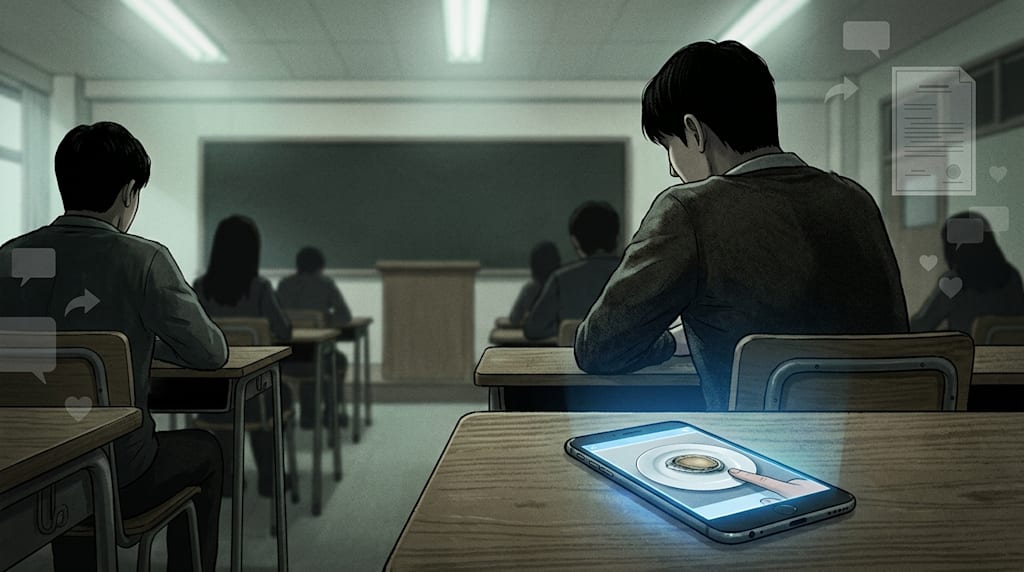
In September 2026, a male teacher at a high school in Taichung posted a video to Threads. He extends his index finger and repeatedly touches an abalone on a plate. The background music is the classic love song “Special Love for Special You.” Text on the screen reads, “Don’t play with your food.”
A student screenshotted the video and shared it. That student wrote: “I want to cry. Why is this kind of person my teacher?” and “I have to see this teacher twice a week.”
Comments piled up under the post. “So disgusting, really so disgusting,” one person wrote. Another said, “As a man, seeing this kind of behavior makes me want to throw up. Is he sick? I can’t believe it’s 2026 and someone still thinks this is funny.” Some people emailed the video to the school’s personnel office, student affairs office, and gender equity committee.
A school director commented under the related post: “Our school has immediately completed the required reporting. The matter will subsequently be handled in accordance with legal procedures.” The original poster replied, “Thank you, director.”
The video is only part of the problem
The issue is who is doing it: a student’s teacher.
If a random internet user, an influencer, or a passerby had uploaded this video to a personal account, the controversy might not have been as intense. Between a teacher and a student, there is a clear power imbalance. The student has to see this teacher twice a week. They sit in his classroom. He grades their work. When a student sees a teacher doing something that makes them uncomfortable on social media, and then realizes they still have to sit in the same classroom the next day, that feeling cannot be solved by “just don’t look.”
The student’s “I want to cry” comes from realizing there is no easy way out.
Why the symbols trigger associations
A finger repeatedly touching an abalone. A love song, “Special Love for Special You.” The text “Don’t play with your food.” For some viewers, this combination is no longer a simple cooking video or a joke.
In Chinese internet slang, “abalone” is often used as a euphemism for female genitalia. Combined with the finger motion and the romantic song, the video carries a strong sexual implication for many viewers.
In most legal systems and campus gender equity regulations, the determination of sexual harassment does not depend only on the actor’s subjective intent. It also takes into account the recipient’s feelings and the context. “I was just joking” does not absolve someone of responsibility. This is especially true when the person is a teacher. The standard should be higher, not lower.
A teacher's social media boundaries
Some may ask whether teachers, as human beings, can post on their personal social media.
Of course they can. But the line between “private” and “public” has long been blurred in the age of social media. If the account is public, students can follow it, screenshot it, and share it. It is no longer a purely private space. Even if the account is set to private, once someone screenshots and shares the content, the impact still enters the campus.
Teachers are expected to uphold a higher level of professional ethics. Teachers have influence over students’ development. That influence is why the expectation exists. A gesture, a song choice, a joke can be interpreted, imitated, or turned into a campus meme. When a teacher puts sexually suggestive content online and students see it and feel uncomfortable, this is no longer a matter of “personal freedom of speech.”
After the school reports, the procedure begins
The school has said it “immediately completed the required reporting” and that the matter will be handled according to legal procedures. The case may enter an investigation by the school’s Gender Equity Education Committee.
If the investigation determines that the teacher’s behavior constitutes sexual harassment, possible administrative penalties include a reprimand, a demerit, or dismissal, suspension, or non-renewal of contract. If the case involves Taiwan’s Gender Equity Education Act or Sexual Harassment Prevention Act, fines may also apply.
Before the investigation concludes, online public shaming, doxxing, and verbal abuse may not give students a safer campus. The gender equity committee should investigate according to law, give both sides an opportunity to be heard, and ensure that during the investigation, students are not forced to face an uncomfortable teaching situation.
What the public reaction reveals
After the incident came to light, two voices emerged online.
One side argues that the teacher’s behavior was inappropriate and carried sexual implications, and that the student’s distress is understandable. The other side argues that it was just touching an abalone and adding a song, and asks whether netizens are overinterpreting. Some worry that if any subjective association can constitute sexual harassment, teachers will be walking on eggshells.
This debate touches on a core difficulty in gender equity education: whether feelings or intent should carry more weight.
In traditional thinking, people often say, “He didn’t mean it that way” or “You’re overthinking.” In gender equity thinking, the focus is on whether the recipient felt subjected to unwelcome sexually suggestive words or behavior, and whether there is a power disparity between the parties. The teacher-student relationship is a classic example of power imbalance. Even if the teacher thought it was “just for fun,” the student’s feelings and the campus impact cannot be ignored.
The educational question
The incident raises a question that goes beyond whether the teacher meant it sexually. It asks how we teach children to understand their bodies, respect boundaries, and use social media in the digital age.
Gender equity education is not only about preventing sexual assault or sexual harassment. It also teaches everyone that your freedom cannot be built on someone else’s discomfort, and that your joke cannot cross someone else’s boundary.
For teachers, the incident also raises a question of ethics. A teacher’s professionalism is not only about teaching a good class. It is also about maintaining boundaries with students. Especially in middle and high school, when students are in a critical period of developing gender identity and body awareness, a teacher’s every word and action can become a model for understanding “what is normal” and “what is respect.”
A teacher who cannot distinguish between a joke and harassment cannot teach students respect.
Tomorrow, the student still has to see him twice
The incident is still under investigation. The school says it will handle it according to legal procedures. The gender equity committee may meet, conduct interviews, and issue a decision. All of this is necessary.
For that student, tomorrow they still have to see him twice. The day after tomorrow, too. Next week, too.
The video can be deleted, the account closed, and the report completed. The discomfort a student feels while sitting in the classroom, looking at the teacher on the podium, will not disappear because of a news report or a school statement.
The video, the public anger, and the school’s procedures will pass. The student still has to see him twice tomorrow.
About the Creator
Jin
Writer of reamstories
https://reamstories.com/jin
Enjoyed the story? Support the Creator.
Subscribe for free to receive all their stories in your feed. You could also become a paid subscriber, letting them know you appreciate their work.
Comments
There are no comments for this story
Be the first to respond and start the conversation.