Microfiction
Bjërks
“Not a fan. No. I first heard her when she was in the Sugarcubes, and I thought that it was kind of cute, but her voice just put me off. Not a fan. I mean there were some fun songs from them at the time. I liked ‘Birthday’ and ‘Delicious Demon’, and there was that last one I heard before I they broke up. I was in school and my boyfriend loved it when we danced at a club to it. And then she went solo. Not a fan… And then she started doing all that dance music. My boyfriend brought home ‘Debut’ and I did not think it was her until I heard that ‘Venus as a Boy’ thing and…he said that he wanted to see other people. And then she put out that video of her dancing in the street. So fake. Not a fan at all. Yeah, I know she had that swan dress and that people thought she was really cool and edgy, but I was just bored. And no, I ain’t going to the show she’s got at that gallery. Still not a fan…
By Kendall Defoe 3 years ago in Fiction
Glistenade Days
I awoke before dawn, as was my habit. Rising slowly, I shuffled to the window and drew back the curtains. The world outside was dark and still. Stars twinkled faintly in the night sky. A sliver of moon cast a pale glow over the silent street below.
By Anne Pedersen3 years ago in Fiction
A Cry for Help
Paul, I spotted your poster stapled to a tree and feel I must respond. You and I share a bond that most people will never understand. You have lost your favorite black T-shirt, and I have lost my pants. They are not just any pair of pants. My pants are made from the best corduroy money can buy. They give off a rubbing sound when I walk. This vip-vip sound makes me the center of attention wherever I go. People stop and scan the area in search of this unique sound. I can see a look of recognition form across their faces as I pass by them. Oh, that’s where the sound is coming from, is what they’re thinking.
By Mark Gagnon3 years ago in Fiction
Paracusia
This story is part of the Vocal + Assist on Facebook Unreliable Narrator Challenge. You can learn more about it here: I think there is a killer in my building. I never go out alone, anymore. Not with everything that’s happening. With all that’s happening, my fear is high all the way out and all the way home, but the chatter keeps up and keeps me going.
By Hannah Moore3 years ago in Fiction
Ethereal Light
Once upon a time, in a far-off land, there was a magical forest. It was a place where animals spoke and trees glowed with an ethereal light. In the heart of the forest lived a kind and gentle princess named Elara, who loved to roam the woods and make friends with all the creatures who lived there.
By Feathermoon 3 years ago in Fiction
Simulationalism
There are a group of people for whom the simulation hypothesis is no longer a hypothesis. They believe with their entire beings, their whole hearts and minds, that we are indeed simulated beings living in a simulated world. In the mid to late 1980s, some of them, how many it is impossible to say, banded together to found a church, the Church of Simulationalism also known as the Simulationist Church. Through the process of simulational submersion (also known as transsubsimulationtiation or just transsubsimulation for short), in a sop to the Catholic doctrine of transubstantiation, they come to know of our “real” position in this universe as simulated beings living in a simulated world. The Simulationalists have borrowed heavily from Catholic tradition for their “faith” as you will learn if you read more on the topic. This “religion” was founded on a set of 18 core principles, their foundational maxims or Simulationist’s Creed, which are published in full here. Below I present only the first three maxims of the creed.
By Everyday Junglist3 years ago in Fiction
Computomorphism
The tendency to use analogy to computers and computing to explain and simplify complex biological systems and phenomenon is a recently acquired tendency of human psychology and is seen most often in pop culture writing about technology and neuroscience. The application of computomorphism in neuroscience gave rise to the compulogical fallacy. In their classic work, The Philosophical Foundations of Neuroscience, M.R. Bennet and P.M.S. Hacker gave the name mereological fallacy to the logical disorder plaguing much neuroscientific thought at the time. Then, and still to this day, neuroscientists commonly assigned various cognitive attributes to the brain that can only logically be attributed to a whole human being. Examples include things like having memories, desiring things, seeing, tasting, judging, evaluating, etc. Their intent was to show the logical contradictions that arise as a result of this erroneous view of cognition.
By Everyday Junglist3 years ago in Fiction
Lighten Up
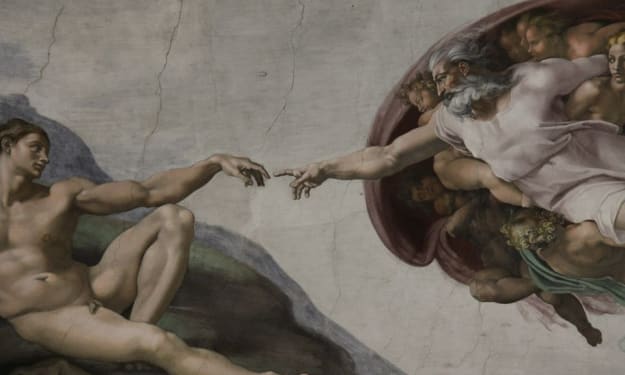
Michelangelo experienced an epiphany while lying on his back, staring at a blank section of the Sistine Chapel. This place is possitively humorless. All day long, I’m subjected to the droning of Gregorian chants. Nobody ever laughs or even smiles. The priests, monks, and nuns dress in lackluster clothes that purposely hide any suggestion of their human form. It must be the most depressing place on the planet.
By Mark Gagnon3 years ago in Fiction