
Why Mars Will Never Be Our Mid-Autumn Moon
The moon shows up every year. Mars shows up when it feels like it, walks backward, and makes us wait 780 days.
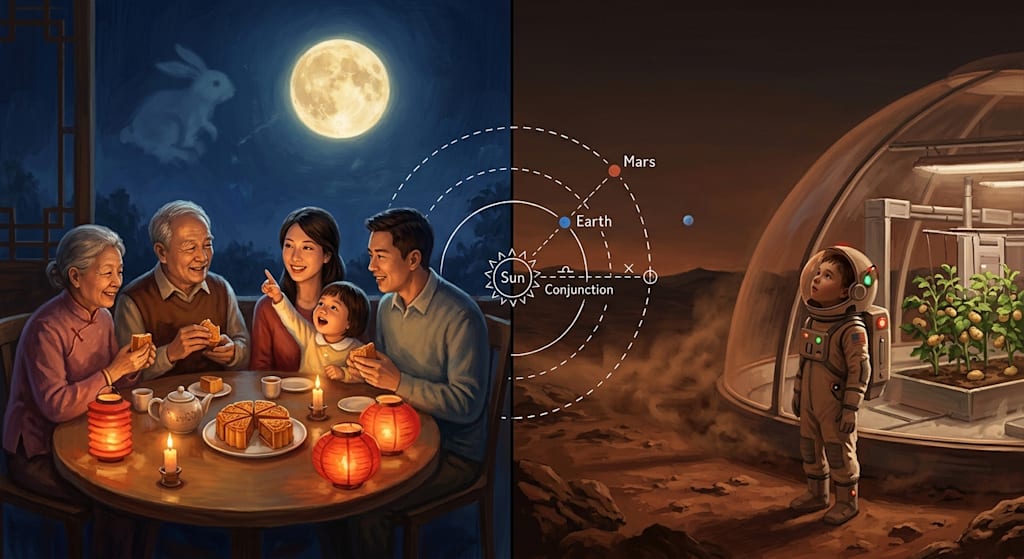
The moon shows up every year. Mars shows up when it feels like it, walks backward, and makes us wait 780 days.
On Mid-Autumn night, the moon rises. The mooncake on the table is cut into eight pieces. The old man says, Look, there is a rabbit in the moon. The child looks for a long time and says, No. The old man says, There is. You will see it when you grow up.
That is tradition. It does not depend on being right about astronomy. It depends on being visible every year.
Mars cannot do that.
I. Mars Will Not Cooperate
Earth takes about 365 days to circle the Sun. Mars takes about 687. They move at different speeds on different orbits, so the distance between them keeps changing. At their farthest, Earth and Mars are about 400 million kilometers apart. At their closest, about 55 million kilometers. Their synodic period is about 780 days, or about 26 months, before Earth catches up with Mars once.
That day is called opposition. The Sun, Earth, and Mars roughly line up, with Earth in the middle. Mars is brightest then, with an apparent magnitude reaching about -2.94. It hangs red in the sky and does not twinkle. The ancients saw a ball of fire and called it Yinghuo.
Opposition does not happen every year. It comes about once every two years and two months. A favorable opposition is rarer, about once every 15 to 17 years. At solar conjunction, Mars moves behind the Sun. Its apparent magnitude drops to about 1.8. It sits in the same direction as the Sun, and even a telescope struggles to find it.
You cannot decree, “Look at Mars every year on the 15th day of the eighth lunar month.” On that day next year, Mars may be below the horizon, behind the Sun, or just a dim star.
Worse, Mars does not stay in one place.
Venus and Mercury are inside Earth’s orbit. They appear only near the horizon at dawn or dusk. Jupiter and Saturn are far away and move slowly, so they circle the sky in long, steady loops. Mars is caught in between. It is outside Earth’s orbit, but it is the closest to Earth, and its orbit is longer. From Earth, Mars wanders. Around opposition, as Earth overtakes it, Mars seems to stop, slide backward, stop again, then move forward.
Ancient astrologers treated that backward slide as viral material. In the Kaiyuan Zhanjing, “Yinghuo” appears again and again. The emperor will die. The crown prince will die. Ministers will die. Generals will die. The state will fall into civil strife. Treacherous officials will take power. Drought will hit the fields. Wars will be lost. Mars wanders in the sky, and blame arrives from the human world.
When Yinghuo guards the Heart, it is a great ill omen.
For such a planet to become the Mid-Autumn moon is too much to ask. The moon is punctual, round, gentle. Mars is willful, retrograde, violent. The moon brings people together. Mars makes them take the blame.
II. After Landing, Festivals Grow Out of Survival
Suppose the 22nd century arrives and there are cities on Mars. A city might be called Zhurong, Ares, or New Dunhuang. People grow potatoes under domes, build homes in lava tubes, and close the windows when dust storms come. The Martian sky is dark orange. The Sun is a little smaller than it is on Earth, and at sunset the area around it turns blue. A Martian day lasts about 24 hours and 37 minutes, close to Earth’s. A Martian year lasts about 687 days.
By then, festivals will not start with “admiring Mars.” They will start with “commemorating survival.”
The date the first humans landed on Mars will become the creation day of Martian civilization. The day the first potato was grown on Mars will become the harvest festival. The day the first Martian baby was born will become the festival of new life. The first time a signal went from Mars to Earth, saying “We have arrived,” will become the communication festival.
Festivals begin as memory, not aesthetics. Humans first remember “we almost died.” Then they remember “we survived.” Only later do they learn to say, “Mars is beautiful tonight.”
III. Three Possible Martian Traditions
On Earth, a Mars Landing Anniversary. The date is fixed, once a year. It commemorates the first time humans set foot on Mars. Mars may not be visible that day. The activities might be spaceflight livestreams, technology exhibitions, school speeches, Mars-themed films, red cake. It is like a space day, not like Mid-Autumn. You can commemorate a past event without seeing the planet.
Astronomically, a Mars Opposition Festival. About once every 780 days. Grand celebrations for a favorable opposition, smaller ones for an ordinary opposition. Amateur astronomers set up telescopes. The media explains why Mars is brightest today. Businesses launch Yinghuo-red drinks. In livestreams, someone shouts, “Family, tonight Mars is at opposition!” This is like meteor showers, eclipses, supermoons. It is an event-driven carnival, not an annual folk custom.
On Mars, an Earth-Gazing Festival. This one comes closest to the feeling of Mid-Autumn.
Seen from Mars, Earth is an inner planet, like Venus seen from Earth. It is not as large and round as the moon. It is a small blue-white point of light. It appears only near the horizon at dawn and dusk. It waxes and wanes. Its maximum elongation is no more than about 40 degrees. It is bright, but small. It will not light up the Martian night, but it will light up the longing for home.
If Mars colonists establish an Earth-Gazing Festival, it will not be once a year. It too will be limited by the synodic period, about once every 780 days. Because it is rare, it may be more solemn. On that day, Martian children ask, “Why do we look at that blue dot?” The old people say, “Because we came from there. All your ancestors, all myths, all wars and poems, all Mid-Autumn and Spring Festivals, are on that blue dot.”
In that moment, what looks like Mid-Autumn is not Earth people looking at Mars. It is Martians looking at Earth.
IV. Why It Is Ultimately Not Mid-Autumn
Mid-Autumn is a festival of agricultural civilization. The Mars festival is a festival of spacefaring civilization.
Mid-Autumn depends on the lunar calendar, the autumn harvest, and reunion. Its sky is stable. The moon arrives as promised every year. Its society is settled. Families live in the same place and look up to see the same moon. Its emotion is “Though a thousand miles apart, we share the same moon.” However far apart, people share the same sky.
The Mars festival depends on planetary orbits, launch windows, and communication delays. The signal delay between Earth and Mars is about three minutes at the shortest and about twenty-two minutes at the longest. If you say “I miss you” on Mars, the person on Earth may hear it twenty-two minutes later. This distance is longer than a thousand miles. It is a distance even light must travel for a while. It does not suit gentle, synchronized looking up. It suits a one-way longing.
The Mid-Autumn moon is near. Mars is far.
The Mid-Autumn moon is round. Mars is small.
The Mid-Autumn moon comes every year. Mars comes once every two years or more.
The Mid-Autumn moon belongs to everyone. Mars belongs first to astronauts, astronomers, and science fiction fans.
To force Mars into a viewing on the 15th day of the eighth lunar month every year would only be awkward. On that day, Mars may be below the horizon, behind the Sun, or merely a dim star. Tradition needs repetition. Mars does not provide annual repetition. It provides a longer rhythm: a wait of about 780 days, a favorable opposition every 15 to 17 years, and a cycle of about 151 years before it returns to a similar position in the sky.
This rhythm is slower, stranger, and harder to plan around than Mid-Autumn.
V. The Martian Child Asks About the Blue Dot
If one day humans really live on Mars, the most moving scene may not be Earth people looking at Mars. It may be Martians looking at Earth.
A Martian child stands under the dome and asks, “What is that blue dot?”
The adult says, “That is Earth.”
The child asks, “Why do we look at it tonight?”
The adult says, “Because today is the Earth-Gazing Festival. Everyone born on Mars must remember that our story began there.”
At that time, there will be no Chang’e, no Jade Rabbit, no osmanthus tree in the Martian sky. But there may be another set of myths: the first landers, the first greenhouse, the first dust storm, the first Martian wedding, the first person born on Mars. Festivals will grow out of these memories. They will not imitate Mid-Autumn, but they will have their own reunion.
People on Earth may, on some night, look at Mars through a telescope. What they see is a red point of light, probes, future cities, children far away. They will not say, “Mars is so round.” They will say, “There are people there.”
This is how tradition works. It is not the planet itself. It is the shared memory that humans give to it. Mid-Autumn turned the moon into a homeland. The future may turn Mars into another homeland. Earth people looking at Mars are looking toward the future. Martians looking at Earth are looking back at the past.
So, if one day we successfully land on Mars, “looking at Mars” will not become a traditional custom like looking at the moon on Mid-Autumn. It will not be once a year, not visible to everyone, not gentle and full. But it will enter human civilization in another way: as the carnival of the opposition festival, the pride of the landing anniversary, the longing of the Martian Earth-Gazing Festival.
After asking about the blue dot, the Martian child goes back to eating potatoes. Outside the window, the dust is light. The blue dot slowly sinks. The adult turns off the last dome light. Tomorrow there are still potatoes to plant.
About the Creator
Jin
Writer of reamstories
https://reamstories.com/jin
Enjoyed the story? Support the Creator.
Subscribe for free to receive all their stories in your feed. You could also become a paid subscriber, letting them know you appreciate their work.
Comments
There are no comments for this story
Be the first to respond and start the conversation.