
The Last Pot of Zhijiang Duck
My apprentice threw her apron on the cutting board and walked out. Two months later, a foam box arrived with a note: “Shifu, taste it.”
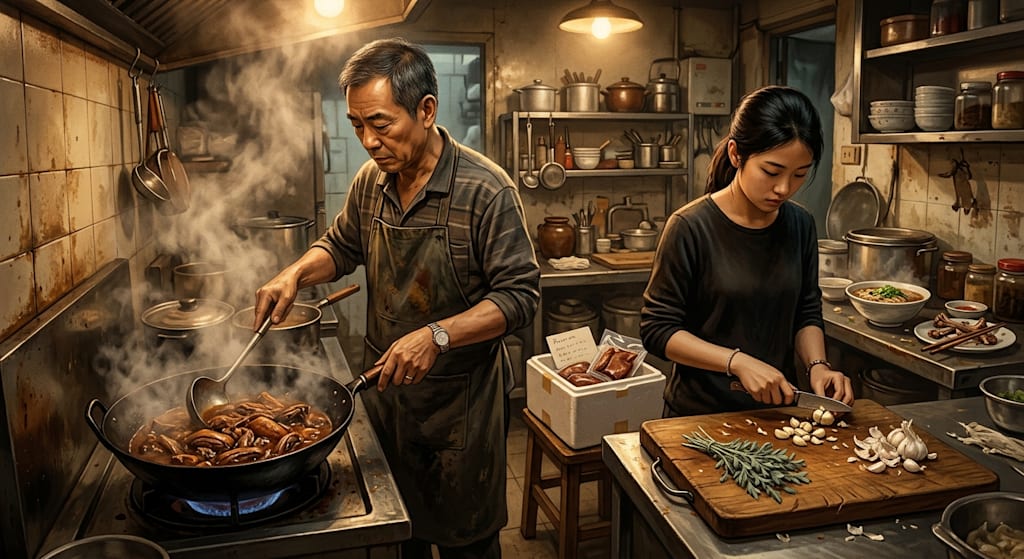
The duck stall at the back of the market belonged to a man named Yang. The ducks ranged on the slope behind his house. During the years I had my shop, I got there before seven every morning. Master Yang never had to ask. His knife was already sharpened.
My apprentice was Master Yang’s niece, Amei. On her first trip to the market with me, she squatted in front of the duck cage and looked for a long while. “This one’s legs are too thick,” she said. “That one’s feathers are dull.” I picked one out. She reached over, lifted its wing, looked at the down underneath, and said this one would do. Master Yang laughed and said Amei had been recognizing ducks since she was little. She had a better eye than me.
Amei was the one who taught me to recognize zhicao. At the market entrance there was an old woman with a basket lined with a damp cloth. On it lay a bunch of grayish-green grass with long, slender leaves. It smelled slightly bitter. Amei said this was zhicao, the herb for cooking duck. I picked it up and smelled it. She said, “Pinch a leaf and smell your fingers.” I pinched one. A cool, pungent smell stayed on my fingertip, like mint but not quite. After we bought the duck that day, she told me all the way back: zhicao can’t go in too early, or the fragrance escapes. It can’t go in too late either, or it won’t suppress the duck’s gameiness. I asked who taught her. She said her mother cooked duck, and she learned by squatting by the stove and watching.
Back at the shop, Amei peeled garlic and I cut ginger. She peeled fast. A pinch and a twist with her fingernails, and the skin came off. A little pile of clean white cloves built up on the cutting board. I cut the ginger into thick slices. She said, “Shifu, you’re cutting them too thick.” I said thick ginger holds up to braising. She didn’t say anything else and pushed the garlic over to my hand.
For the first month, I only let her watch the fire. When the duck went into the pot to render over low heat, I had her turn it with the spatula. She turned it too fast. I said slow down, let the skin stay against the pan a little longer. She slowed down, then after a while sped up again. I said, “Listen to the sound. When the moisture is sizzling, don’t move it. Wait until the sound deepens, then turn it.” She tilted her ear toward the pot and nodded.
The first afternoon I let her cook alone was after the market closed. She followed the steps I had taught her: sear the duck parts first, put the duck meat and pork belly into the pot to render, add soy sauce and rice wine for color, then the ginger, garlic, chili, and zhicao. After twenty minutes of braising, she lifted the lid to look. There was still a lot of liquid, so she turned up the heat. I was nearby doing the accounts. I smelled something burning and looked up. She had already taken the pot off the heat. A layer of duck pieces at the bottom had blackened skin. She stood there, fingers pinching the corner of her apron.
I didn’t say anything. I used chopsticks to pick out the unblackened pieces and put them on a plate. Then I scraped the black ones into my own bowl. She watched me. I picked up a black piece and bit into it. The skin was bitter. The meat inside was still tender. I said, “The heat was too high. Next time call me two minutes before you reduce the sauce.” She grunted and took the bowl to wash. That night I ate that bowl of blackened duck. She sat across from me peeling garlic for the next day. When she finished a plate, she said, “Shifu, I’ll come earlier tomorrow.”
The second time, she cooked behind my back. I had a fever and was lying in the back room. I heard the pot and spatula clattering outside and didn’t get up. After a while she carried a bowl in. The duck pieces were cut unevenly. The broth was dark. I tasted a piece. Salty. She stood by the bed watching me. I ladled a spoonful of broth over rice and ate half a bowl. I said, “Too much salt. Put in half a spoon less tomorrow.” She took the bowl and said, “Oh.” At the door she turned back. “Shifu, what do you want to eat tonight?” I said, “Whatever you cook, I’ll eat.”
After that, when she cooked duck, I stood beside her and watched without interfering. Before she added the zhicao, she would pause and look at me. I said, “Smell it.” She grabbed a handful of zhicao, brought it to her nose, and said it was ready. I said, “Then put it in.”
In the busiest days before the holiday, we cooked more than ten pots a day. Amei worked the wok. I prepped. By the third pot, she said, “Shifu, someday I’ll open my own shop and sell Zhijiang duck too.” I said, “First learn to hold this pot of mine steady.” She laughed and said she had it steady. That night after work, she sat by the stove peeling garlic. She opened her mouth. “Shifu, why don’t you…” A customer at the door called, “Boss, add a duck leg.” I got up to answer. When I came back, she was already peeling the next head of garlic and didn’t ask again.
The shop closed because the landlord took the space back, not because business was bad. The day I put up the transfer notice, Amei came and reached out to tear it down. I put up another. She tore it down again. I said, “Amei.” She said, “Shifu, I’ll take it.” I said, “What you cook still isn’t Zhijiang duck.” She stood there, apron still tied. She wiped her hands twice on the apron, untied it, threw it on the cutting board, and left. The garlic was half peeled. White cloves scattered by the cutting board.
I cooked the last pot alone. I smashed the garlic with the knife. The skin flew to the floor. I bought a bunch of zhicao, couldn’t use it all, put it in the fridge, and half of it rotted two days later. When the duck was rendered and it was time to add the zhicao, I paused. I remembered Amei bringing it to her nose. I put it in anyway. I cooked it and ate it myself. The taste hadn’t changed. It was just that the kitchen was too empty. The spatula against the pot sounded loud.
Amei later opened a small shop in the next county. The sign said Zhijiang Duck. No word the first month. The second month, a foam box arrived. Inside was a vacuum bag of cooked duck and a note: “Shifu, taste it.” I heated it up and sat by the stove to eat. The duck meat was firm. The skin was just right. The zhicao fragrance was there. Only it had been added a little early, so the fragrance was a bit scattered. After I finished, I called her. She picked up and said, “Shifu.” I said, “The zhicao went in too early. Next time add it in the last ten minutes.” She paused for two seconds and said she’d remember.
I hung up and put the leftover duck bones into a bowl. The next morning, I used that bowl of duck broth to cook a bowl of noodles.
About the Creator
Jin
Writer of reamstories
https://reamstories.com/jin
Enjoyed the story? Support the Creator.
Subscribe for free to receive all their stories in your feed. You could also become a paid subscriber, letting them know you appreciate their work.
Comments
There are no comments for this story
Be the first to respond and start the conversation.