
The Bag of Dried Mushrooms I Keep for Pork Belly
It looks like kindling and smells like old wood. Then warm water changes everything.
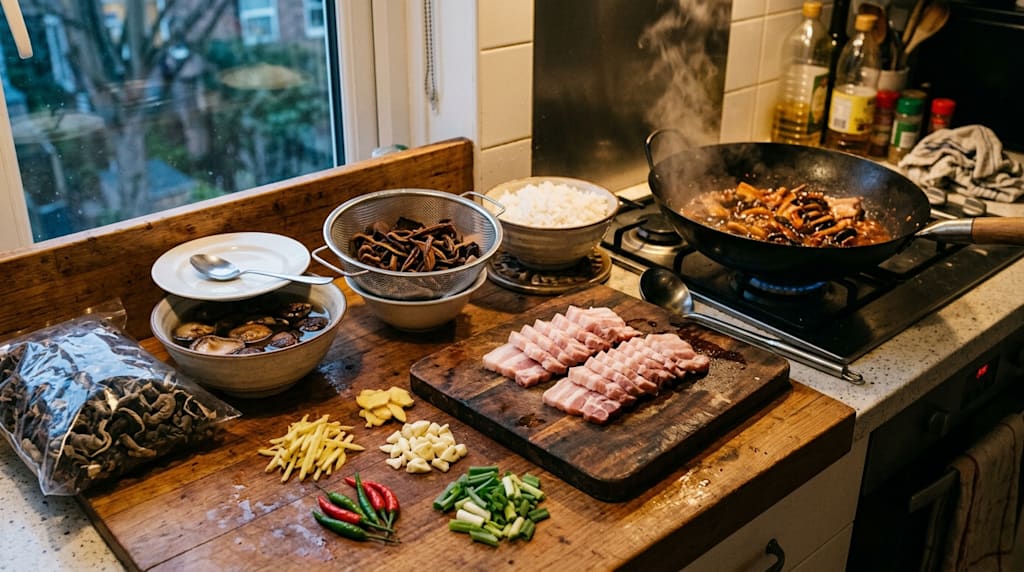
When dried tea tree mushrooms sit in a plastic bag, they don’t look like much. The slender stems are curled up, dark brown, almost black, and if you grab a handful they rustle dryly, like kindling. Every time I dig the bag out of the cupboard, I bring it close and sniff it first. There isn’t much of a smell. Just a faint, stuffy odor, like old wood. But once warm water goes in, things change.
The water should cover the mushrooms. I put a heavier bowl on top to keep them all submerged. Soaking time depends on my mood. Half an hour is fine, an hour is fine too, and if I remember halfway through, I turn them over. The dried mushrooms slowly soften in the water. Their color shifts from dark brown to light brown, the stems plump up, and a layer of fine grit floats to the surface. The smell changes too. The mushroom scent rises out of the water. It isn’t sharp, and you can’t miss it. For a while there is a faint mushroom fragrance in the kitchen.
After soaking comes the troublesome part. The root ends, the ones with bits of wood stuck to them, have to be pinched off. That’s the foot the mushroom grew on the wood. Hard, impossible to chew. After the roots are off, I put the mushrooms in a basin, sprinkle in a little flour or salt, and rub them. Sand and wood dust hide in the folds of dried mushrooms. Rinsing alone won’t get them clean. You have to rub them handful by handful. Rub, wring them dry, change the water, rub again, wring again. I usually wash them three times. The first water is cloudy, the second less so, and by the third it’s basically clear. The washed mushrooms drain in a colander, stems crowded together like a pile of small things that have just had a bath.
Pork belly is another matter. I blanch it first. Cold water in the pot, a few slices of ginger, two sections of scallion, a spoonful of cooking wine. Bring it to a boil, and a grey-white foam rises to the surface. Skim it off, boil for another two or three minutes, then take the meat out. The pork shrinks a little in the hot water, its surface turns white, and it feels a bit firmer than raw meat. Let it cool until it’s no longer too hot to touch, then slice it. Even slices, not one thick and one thin.
Some people find blanching a nuisance. They’d rather slice the pork and put it straight into the pan to render, which keeps more of the meat’s flavor. I don’t argue. I blanch because once I bought pork with a heavy gamey smell, and the whole dish came out wrong. Since then it’s become a habit. Blanching also makes the meat easier to slice. Raw meat is soft and floppy, and the knife slips. After blanching it firms up, and your fingers can press it steady.
While prepping, I usually smash the ginger and garlic together and chop them fine, julienne the green and red chilies, and cut the scallion into sections. I don’t always have chilies. Whatever chili is at home gets used. Bell peppers, screw peppers, dried chilies, all have been tried. Once there was only half a sweet pepper left in the fridge. I sliced it and threw it in. It looked good, and it tasted fine.
Heat the pot, pour in oil. Not too much. The pork belly will render its own. When the oil is hot, add the pork slices and spread them out. Don’t rush to flip them. Wait until the side touching the pot is slightly golden, then turn them. Sprinkle in a little salt. The salt gives the meat a base flavor and keeps the oil from splattering. Oil quiets down when it meets salt. Throw in a few Sichuan peppercorns and shreds of ginger. Once the fragrance rises, keep rendering until the edges of the pork curl, the fat turns translucent, and there’s clearly an extra layer of oil in the pan. That’s the dry-fragrant stage.
Now add the chopped garlic and a small spoonful of doubanjiang. The garlic sizzles, the bean paste breaks apart, the oil turns red, and the fragrance lifts out of the pan. Add the drained tea tree mushrooms and stir-fry. They make a fine crackling sound as they go in. The stems roll through the oil, and their light brown color gets coated with the sauce. Stir-fry for two or three minutes, until the stems are soft but still springy, then add a small splash of water. Not much. Just enough to leave a layer at the bottom of the pan. One spoonful of light soy sauce, one spoonful of oyster sauce. Mix, cover, and simmer.
Keep the heat low while it simmers, letting the liquid bubble gently. In those two or three minutes, the tea tree mushrooms absorb flavor. Their fibers are like tiny tubes, drawing in the meat fragrance, the sauce, the oil. When the lid comes off, most of the liquid has reduced, and the mushrooms are darker. Pick one up and bite. The outside is slick with sauce, the inside is crisp, and after a couple of chews it turns chewy.
Add a small spoonful of chicken bouillon and the scallion sections. Toss twice and turn off the heat. The scallion shouldn’t cook long. Just until its raw edge is gone, leaving a slight pungency behind.
Plate it. The green and red chili strands are scattered among the mushrooms and pork, and the scallion is bright green. The pork is dry-fragrant. The fat isn’t greasy, and the lean part isn’t dry. When you bite a tea tree mushroom, there’s first a crisp sound, then your teeth feel the resistance of the stem. Chew, and the resistance gives way, and the umami and sauce come out together. It’s best with rice. The sauce seeps into the grains. One bowl goes down, and the second is already filled.
In winter, if there are garlic sprouts, cut a handful and throw them in. The pungency of the sprouts and the mushroom scent meet and become stronger than scallion alone. If there are no sprouts, use scallion. If there’s no scallion, leave it out. It’s still fine. The recipe is almost identical to pork belly with deer-antler mushrooms. Change the mushroom and you get another texture. Deer-antler mushrooms are thicker and more meaty when bitten. Tea tree mushrooms are thinner, and their crisp-chewy quality is more obvious. I like both. If I had to rank them, deer-antler mushrooms come first, tea tree mushrooms second. Second place doesn’t mean bad. First place is just too strong.
If the soaked tea tree mushrooms aren’t all used, drain them and keep them in the fridge. Eat them within two or three days. But in my experience, there’s rarely any left. A bag of dried tea tree mushrooms looks like a lot, but once soaked and stir-fried, it makes one plate. Put it on the table, and chopsticks come and go. Soon the bottom of the plate holds only a little sauce and a few Sichuan peppercorns.
No one eats the Sichuan peppercorns in the end, but without them when the pork is rendering, the dish isn’t right. Without those few peppercorns, the whole plate’s fragrance is one layer thinner. Home cooking works that way sometimes. Some ingredients are there to make everything else taste better. Nobody eats them in the end.
About the Creator
Jin
Writer of reamstories
https://reamstories.com/jin
Enjoyed the story? Support the Creator.
Subscribe for free to receive all their stories in your feed. You could also become a paid subscriber, letting them know you appreciate their work.
Comments
There are no comments for this story
Be the first to respond and start the conversation.