
The $20 Frozen Noodle That Isn’t Instant
Sam’s Club beef noodles sit between the noodle shop, the takeout app, and the freezer. That gap explains the price.
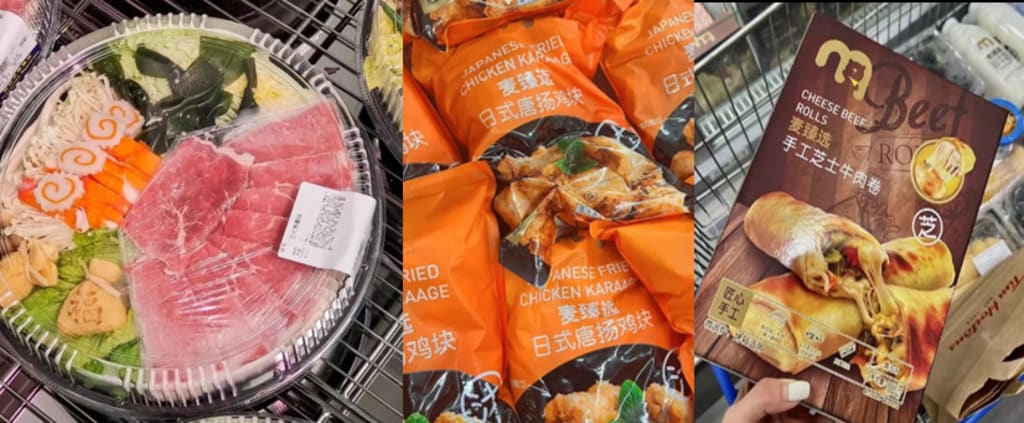
The noodle shop math
Twenty yuan buys a bowl of beef noodles at a noodle shop. The meat comes as four or five thin slices. The soup is hot, the noodles are freshly boiled, and someone else washes the bowl. You sit down, eat, stand up, and leave. The money pays for “ready now,” and it also pays for the table, the chair, and the server who carries the bowl over.
For the same twenty yuan, you can buy a box of Sam’s Club “instant noodles” from a supermarket freezer. The package shows big chunks of beef. Inside are three bags: noodle cake, meat pack, seasoning. You need a pot. You need to turn on the stove. You need to wait for the water to boil, cook the noodles, heat the meat, and put it in a bowl. After eating, you wash the pot.
If you compare only the amount of meat, the noodle shop version does not necessarily win. Braised beef at a branded deli works out to eighty to one hundred yuan per jin. Loose beef at a wet market runs fifty to sixty. Sixty grams of meat costs eight to ten yuan. The noodle cake and seasoning cost three to five. Total: eleven to fifteen. Sam’s sells it for around twenty. The extra covers cold-chain shipping, packaging, and the convenience of not going downstairs to buy braised meat.
The math does not stop there.
Eight actions versus two
Instant noodles work because hot water is enough. On a train, in an office, by a dorm bed: tear open, add water, wait three minutes. This Sam’s product needs a stove. It needs you to stand in the kitchen, watch the water boil, put the noodles in, wait, fish them out, heat the meat, and put it in a bowl. After eating, there is a layer of oil on the pot wall. You have to wash it.
Eight actions for one bowl. Instant noodles take two: tear, add water.
So the product sits in an awkward position. Call it convenient, and you still have to wash the pot. Call it inconvenient, and it is still much simpler than washing vegetables and cutting meat. It is neither the noodle shop’s “sit down and eat” nor instant noodles’ “anytime, anywhere.” It is closer to a frozen prepared staple in an instant-noodle wrapper. It sells the certainty of keeping food at home and heating it up when you want it.
Who needs that certainty? Single people, for one. Washing the pot is itself a threshold. Cooking for one is hard: cook too much and you eat it for three meals; cook too little and it is not worth turning on the stove. For families, it is one more option at the table, not a necessity. The product targets people who do not want to cook and also do not want to order takeout every meal.
Takeout is also prepared food
With a budget of twenty yuan, why not order takeout?
Because takeout may also be prepared food. The kung pao chicken in a takeout box and the prepared meal pack in a supermarket freezer now have ingredient lists whose first five items look more and more alike. Chain restaurants use central kitchens. Takeout stalls use meal packs. Mall restaurants use semi-finished dishes. They moved the step of washing and cutting vegetables from the back kitchen to the factory long ago. Consumers think they are eating out, but they may be paying rent, packaging, and delivery fees for a heated prepared meal.
Since prepared food is already in the system, the home freezer becomes the cheaper version. Homes have refrigerators. Cold-chain delivery reaches county towns. Buy some, keep it at home, heat it when you want it. For the same prepared meal, heating it yourself often costs less than half of ordering takeout. You save the platform delivery fee, the restaurant rent, and the labor premium.
The tradeoff is the pot.
The trend follows daily life
Many people object to prepared food. They point to high salt and oil, additives, texture that does not match freshly made food, and prices that do not feel cheap. Those concerns have a real basis. For prepared food to enter the refrigerator, it cannot rely only on convenience. It also needs transparent labeling, stable quality, reasonable prices, and passable taste. Otherwise it moves the helplessness of restaurants back home.
Trends, however, do not depend on attitudes. They depend on the structure of daily life. Many young people do not know how to cook. Middle-aged people may not have the time. Plenty of older people do not know how to cook either. If no one cooks, they eat out or order takeout. To cut costs, ensure speed, and stabilize flavor, takeout has long been prepared at many stages. This is not a secret. It is industry common sense.
People who cannot cook will sooner or later face the question “what do I eat?” So will people who can cook but are too lazy to. Single people face it more often. Cooking for one is hard: too much is waste, too little is not worth it. Prepared food fills that gap.
What America shows and does not
American data often gets used as an argument. Sixty-seven percent of consumers regularly buy frozen or prepared foods, and more than half consider it a healthy choice. Those numbers need care. “Frozen or prepared foods” is a broad category. Frozen vegetables, frozen pizza, and frozen entrees all count. Perception and nutritional conclusions are also two different things.
One phenomenon is worth a look. In American supermarkets, the frozen section is often larger than the fresh section. Frozen vegetables and frozen pizza take up a whole row. Fresh spinach sits in a corner. This does not mean Americans love prepared food more. The fresh-food supply chain requires rapid turnover, and labor and cold-chain costs are higher. Industrial assembly lines push the cost of prepared food very low. Highly mechanized agriculture sends many products first into food processing. After years of development, consumer acceptance of frozen food rose. Some of that acceptance is active choice. Some is the choice of having no choice after fresh food becomes too expensive.
China will not simply copy this path. China has cheap takeout, wet markets crowded at seven in the morning, fresh-food e-commerce with half-hour delivery, and a density of delivery riders under office buildings. Chinese consumers care about wok hei and fresh stir-frying. Prepared food in China will more likely penetrate in layers than replace everything. Single young people in first-tier cities, dual-income households, and young people who cannot cook may stock frozen staples and semi-finished products. Families with children will be more cautious and mix prepared food with fresh cooking. Older people will split. Some want convenience. Some insist on buying vegetables and cooking. Prepared food will enter the refrigerator, but it will not drive the wet market out.
Back to the bowl
Twenty yuan at a noodle shop buys “ready now” and “no dishes to wash.” Twenty yuan for a box of Sam’s frozen noodles buys “food at home” and “no need to go out.” Twenty yuan for takeout buys “delivered to your hand” and “no pot to wash.” Three twenty-yuan notes buy three different things.
Whether Sam’s product is expensive depends on the comparison. Against a noodle shop, it is not expensive. Against instant noodles, it is a little more. Against takeout, it may be cheaper and more controllable. Against cooking yourself, it buys time and convenience.
Its position is probably a household frozen prepared noodle, not instant noodles. It sells the certainty of food at home. That certainty has value and a cost. The cost is washing the pot, taking up one slot in the freezer, and accepting that this meal was heated up, not made.
Prepared food enters the refrigerator because many lives no longer have much room for freshly made meals. We can demand that it be more transparent, healthier, and better tasting. It is hard to deny that prepared food is finding its place between people who cannot cook, people who have no time to cook, and people who are too lazy to cook.
Sam’s “instant noodles” are one slice of that place. The product is not that convenient, and it is not that cheap. It happens to stand in the blank space between noodle shops, instant noodles, and takeout. In that blank space stand many people who open the refrigerator, look at the freezer, and do not want to go out or wash a pot.
They wash the pot anyway.
About the Creator
Jin
Writer of reamstories
https://reamstories.com/jin
Enjoyed the story? Support the Creator.
Subscribe for free to receive all their stories in your feed. You could also become a paid subscriber, letting them know you appreciate their work.
Comments
There are no comments for this story
Be the first to respond and start the conversation.