
I Learned the Hard Way That Every Hunger Isn't A Need For Food
Here is a true story of a painful experience that happened to me as a teenager.


There was a time in my teenage years when I was always hungry — or at least, that’s what I believed. I would eat, get up from the table, and still feel that familiar ache. My aunt eventually grew tired of hearing me say the words “I’m hungry.”
- To her, it sounded like a habit I needed to break.
- To me, it was simply the only language I had for a need I didn’t yet understand.
One day, my aunt decided to teach me a lesson. She served me a "plate of disgusting food" thinking it would break my habit of saying, "I'm hungry."
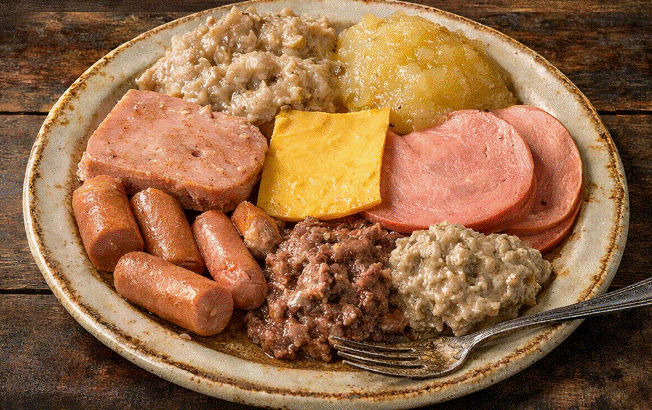
She placed a plate in front of me filled with foods that didn’t belong together — a mixture of foods that weren’t meant to be eaten at once, especially not in the same meal. Potted meat. Spam. Vienna sausages. Cheese. Oatmeal. Bologna. Applesauce. And a few other items that looked like they had been gathered not from a kitchen, but from a dumpster.
Everything was piled together, touching, leaning, and sliding. It was a plate of punishment disguised as a plate of food.
I sat at the table for hours. I stared at the plate. I cried just looking at the food. I swallowed around the lump in my throat and the knot in my stomach. And eventually, I had finished eating every bite. Not because I wanted to, but because I was a child with no power and no voice — and because I wanted the ordeal to end.
Even though I still endured hunger pangs, I never again said in my aunt's hearing that I was hungry because I didn't want another plate of her so called "breaking the hungry habit food."
The Truth
But here’s the truth I didn’t have the words for back then. I wasn’t hungry for food. I was hungry for love. I was hungry for respect. I was hungry for kindness. I was hungry to be seen, understood, and cared for.
The plate my aunt made me eat didn’t cure my hunger. It silenced it.
Now, as a grown woman looking back, I understand that my stomach wasn’t the empty place. My heart was. I was longing for gentleness, for safety, for someone to ask why I felt the way I did instead of trying to force it out of me. The hole within me had nothing to do with food at all.
I Rewrite My Menu
I no longer have to eat what I don't enjoy. In fact, I have noticed that at the end of my meals, I automatically leave a spoonful of soup, one French fry, a fork full of collard greens, a crouton, or something on my plate. It is never planned, but I refuse to force myself to eat the last morsel. It is left on my plate as symbolic of my being healed of what happened to me when I couldn't help myself
Today, I am no longer afraid to say I’m hungry. Because now I know what I’m truly hungry for — and I am equipped to come up with my own menu.
My Hunger Had Nothing To Do With Food
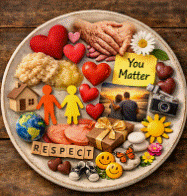
There was a time when my hunger was misunderstood — a hunger mistaken for appetite instead of ache. Years later, I’ve learned to fill my plate differently. Now, it holds compassion instead of criticism, kindness instead of control, joy instead of judgment. Each symbol — a heart, a hand, a smile, a note that says "You Matter" — reminds me that true nourishment begins in my soul.

I Forgave My Aunt
I realized that my aunt did not do what she did to hurt me. She did the best she could to help me. Years later, I sat by her bed while she was dying of cancer. I held her hand and did not say, "I am hungry." I looked into her weak eyes and said three different words: "I forgive you." She was too sick to respond with words. Instead, she squeezed my hand.
After leaving the hospital room, I went into the hospital cafeteria and ordered from the menu exactly what I wanted to eat. I was thankful those items my aunt served me so many year ago were not on the menu.
About the Creator
Margaret Minnicks
Margaret Minnicks has a bachelor's degree in English. She is an ordained minister with two master's degrees in theology and Christian education. Thanks for reading and sending TIPS her way.
Enjoyed the story? Support the Creator.
Subscribe for free to receive all their stories in your feed. You could also become a paid subscriber, letting them know you appreciate their work.
Comments
There are no comments for this story
Be the first to respond and start the conversation.