
I Have to Watch a Commercial Before I Can Enter My Own Home
A Beijing apartment complex turned the front door into an ad slot. Skip the five-second spot? That costs extra.
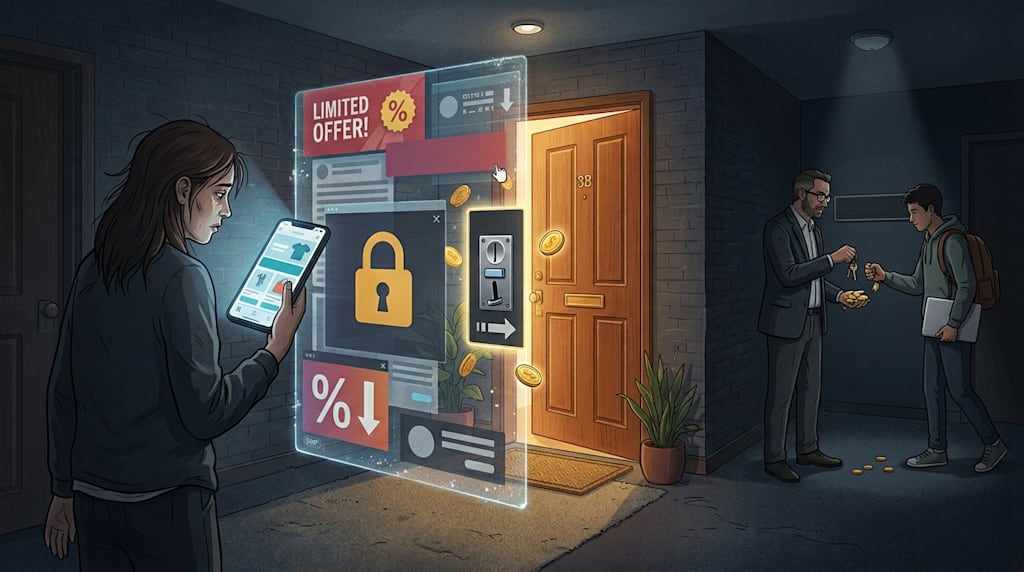
Beijing, Chaoyang District. Ms. Li stands outside her building. She opens the Daguanjia app. A shopping ad fills the screen. “Twist to download or jump to a third-party app.” She doesn’t twist. She hunts for Skip. Tiny gray text, lower right. She taps. Misses. The shopping app opens. She switches back. Taps again. Two seconds. The door opens.
Ten seconds from pocket to hallway. Seven of them spent on an ad and closing it.
She could use facial recognition instead. She doesn’t. “It’s not sensitive. If I change my outfit, or it’s dark, it won’t recognize me. The app always works. I just have to watch an ad.”
Other residents say the same. The complex offers two ways in: face scan or app. Both run through Daguanjia. Most people upload a photo and use face scan. Anyone using Bluetooth through the app pays with attention.
A reporter tested it. Opening Daguanjia shows a five-second splash ad. It links to shopping platforms. The center icon says “Twist to download or jump.” The Skip button is small, gray, buried. Tap slightly off, touch the wrong part of the screen, tilt the phone, and you’re gone.
After entering the app, residents give ID number and name. Property management approves them. Once approved, they can open any unit door in the complex.
“Who shops right before going home?” Ms. Li said. “It wastes time.” The complex never asked residents about the system. She suspects a deal: the operator provides the access system for free and makes money from ads. Whether residents must consent, and where the ad money goes, has no clear answer.
You can pay to make it stop. Daguanjia sells a “Pure Version” membership. One yuan a month. 2.8 for three months. 8.8 a year. It blocks splash ads, door-opening ads, and homepage banners. Mini-programs still show splash ads.
Other apps do this too. Qinlin Daojia charges. Xiaowei Open Door makes you do tasks. The tasks are ads. Watch long enough, get a month without ads.
The Measures for the Administration of Internet Advertising say pop-up ads must have a clear close button and close in one click. No fake close buttons. No hard-to-find close buttons. No ads that only close after a timer.
Zhao Zhanling, a lawyer at Beijing Jiawei Law Firm, told Southern Metropolis Daily: “The Skip button is extremely sensitive and hard to close. It provides a closing method that isn’t effective or immediate. That’s edge ball. That’s exploiting loopholes.” He said there is no mandatory national standard for splash ad trigger sensitivity. If it bothers residents, report it to market regulators.
Zhao also said: if the complex offers both face scan and app, it’s not a violation. Unless the property contract says otherwise, property management can generally choose the access system.
Lin Feiran, a lawyer at Beijing Jingdu Law Firm, said splash ads aren’t illegal by themselves. The problem is when they hide service rules, strip users of informed expectations, violate their real intent, and infringe on consumer rights: the right to know what service you’re getting, the right to choose, the right to refuse forced transactions.
Consumer Rights Protection Law, Article 9: Consumers can choose goods or services, choose service methods, and decide whether to accept any service. Article 10: Consumers have the right to fair trade and to refuse forced transactions.
Civil Code, Article 282: Income from using owners’ common areas, after reasonable costs, belongs to the owners.
Property Management Regulations, Article 54: Operating common parts or facilities requires consent from relevant owners, the owners’ assembly, and the property service company. Procedures must be followed. Income should mainly go to special maintenance funds.
The ad money from the door app comes from residents walking in and out. Where does it go? Most complexes don’t say.
Why do these jumps keep happening? Money. A senior internet ad insider told Southern Metropolis Daily: advertisers pay by click and jump. Every tap is cash. Forced jumps also collect device model, location, and personal profile. That data gets packaged and sold. Higher profit.
So platforms keep testing the edge. Maximize the chance a user touches an ad.
The fine? Advertising violations can cost 5,000 to 30,000 yuan. Compared with ongoing ad revenue, that’s small.
Regulators have acted. The Ministry of Industry and Information Technology has run special campaigns against apps that infringe user rights. More than 50 batches of notices. “Random jumps from information windows” is a target. In June 2023, the ministry met with internet platforms and smart terminal companies. It told them to manage app information windows and stop illegal ones.
Technical standards exist. In July 2023, the National Technical Committee for Network Security Standardization issued a practice guide for shake ads. It suggests acceleration of at least 15 m/s², rotation of at least 35°, and operation time of at least 3 seconds.
But these are practice guides, not mandatory national standards.
Qiao Basheng, a distinguished professor at Zhejiang Normal University, told other media: To cure random jumps, regulators, platforms, industries, and users need to work together. Regulators should refine enforcement, clarify responsibility for third-party ad SDKs, increase spot checks, raise fines, and link violations to app store listings and credit ratings. Reverse the imbalance where violating costs less than profiting.
The hard part is not the law. The hard part is people.
Everyone knows the model is unreasonable. Everyone knows owners are the real masters. Everyone knows owners have legal grounds. But protecting those rights is still hard. Rights on paper.
In an owners’ group chat, a few people complain. They ask property management to fix things. Most people stay silent. They watch. “Less trouble.” If the few win, everyone enjoys it. If they lose, no one cares. Hide behind the screen.
The Civil Code gives owners the right to hire and fire property service companies. That right is not decided by a few active owners.
Article 278: To hire or dismiss a property service company, owners representing at least two-thirds of the exclusive area and two-thirds of the number of owners must vote. Then owners representing more than half of the area and more than half of the number of voters must agree.
Suppose 120 households. 12,000 square meters. At least 80 households, with at least 8,000 square meters, must vote. At least 40 households, with at least 4,000 square meters, must agree.
It looks like one-third. In practice, getting that one-third to agree is hard.
What can owners do?
Complain. Market regulators: 12315. App ad violations, consumer rights. Industry and information technology: 12300. App random jumps, forced ads. Housing and urban-rural development: property management changed the access system without consent, misappropriated common revenue.
Keep evidence. Screen record the ad. Screenshot the accidental jump. Save messages with property management. Say which app, what ad, and how you triggered it.
Shenzhen communities have used collective complaints. Regulators intervened. Talks. Rectification.
Demand information. Demand the property management publish the contract with the app operator, ad revenue accounts, and the decision process for the access system. In writing, demand they stop ads in the door app and provide a convenient way in without ads. Bring back physical cards. Or make face scan work.
Form an owners’ committee. It represents all owners. It can call a vote. Decide the access system. Hire or fire the property company. This is the root fix.
Sue. If complaints and talks fail, owners can sue the property company or app operator. Claim infringement of the right to know and common ownership. Demand stop, return ad revenue, and pay damages. If the property company’s decision was illegal, ask the court to revoke it.
Go public. Media pressure.
Technology should help. It should not block your door. Access control can be smart. It should not sell ads before it lets you in. It can connect. It should not connect to ads. It can upgrade. It should not exceed its authority.
Property management serves. It does not manage owners. It does not profit from them. Owners are the masters.
The road home should be clean. It should have dignity. No five-second ad. No twist-to-jump. No pay-to-skip.
The law does not protect people who sleep on their rights. Owners’ rights cannot live only in legal codes. They must live in complaints, votes, and collective action.
Access control can be smart. The road home must be free.
About the Creator
Jin
Writer of reamstories
https://reamstories.com/jin
Enjoyed the story? Support the Creator.
Subscribe for free to receive all their stories in your feed. You could also become a paid subscriber, letting them know you appreciate their work.
Comments
There are no comments for this story
Be the first to respond and start the conversation.