
Eggs First: My Mother’s Fifteen-Second Rule for Chive and Egg
She never gave me a recipe. She gave me an order.
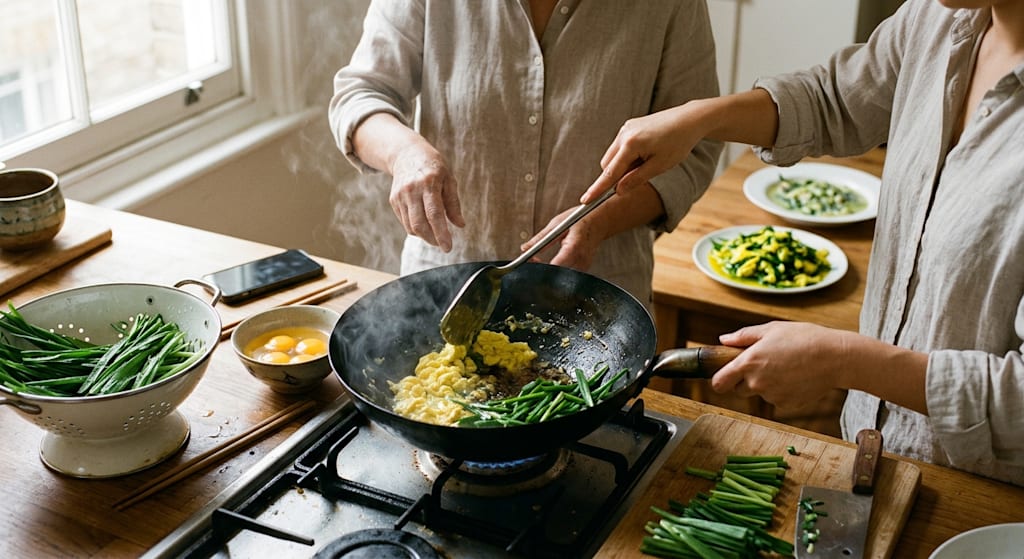
The wok has to be hot enough to smoke before the oil goes in. The oil slides around the bottom, hisses, and then the beaten eggs go in. Don’t rush to stir. Wait until the edges set, then push the spatula from the edge toward the center, pushing the eggs into large curds. Take them out when they are eight-tenths done. Tilt the spatula to lift them so you don’t carry the oil out with them. Leave a little oil in the wok for the chives. The chives are already cut, stems and leaves separate, washed and shaken dry. Tip them in. A loud hiss. The wok breath rushes up. Ten seconds or so, the leaves collapse, the color turns from dark to bright. Put the eggs back, flip twice, turn off the heat, plate it.
That is my whole order for chive and egg. Eggs first, chives after. The eggs stay tender, the chives stay crisp, and both are still at their best.
I learned this dish from my mother. She stood on the left side of the stove, I stood on the right. She cooked it once while I watched. I cooked it once while she watched. The first time, I put the chives into the wok first. She didn’t say anything. When I scrambled to pour in the egg and scraped out a plate of mush, she said, try it the other way around. The second time I fried the eggs first. When I took them out, she said, eight-tenths is enough, don’t overcook them. The third time she said, count fifteen after the chives go in, then put the eggs back. I counted. Fifteen, exactly.
I tried it the other way once. Chives first. The chives gave off water as soon as they hit the heat, and the wok filled with a layer of green liquid. When the egg went in, it couldn’t hold together. It scattered into the liquid. I scooped it up with the spatula, and the egg was not egg, the chives were not chives. A plate of mush. We finished it in the end, but while we ate it I knew the order had been wrong. Once the order is wrong, both things are wronged.
Some people take the easy way and put everything in at once. Pour in the egg, scatter the chives on top, stir blindly with the spatula. It’s not inedible. The egg is a little older, the chives a little softer. At home nobody complains. But don’t do it for guests. A plate of chive and egg with clear yellow and green, and a plate of soft, watery mush, are not the same thing on the table.
When the chives come home, pick them over first. Snap off the old roots, pick out the yellow leaves. After washing, shake them dry. Going into the wok wet is asking for water. I usually put the chives in a colander, carry them to the balcony, and shake them a few times. Then I shake them again. Water hidden between the leaves falls and hits the back of my hand, cold. When cutting, keep stems and leaves separate. The stems are thick and need ten seconds or so first. The leaves are thin and only need to go back with the eggs at the end. A lot of people get water from their chives, and it isn’t only a matter of heat. From the moment they go in dripping wet, you are already working against yourself.
Beat the eggs, add a pinch of salt. Some people add water, some add wine. My family adds neither. My mother said if you add water you get watery eggs. Press them and water comes out. She never added water. The eggs were beaten, and when you lifted the chopsticks, a yellow line dripped down into the bowl with a dull sound. Three eggs to one bunch of chives. Too many eggs and they press down the chives. Too few chives and they can’t wrap the eggs. You learn the ratio after two times at the wok. A recipe gives you a rough idea. The measure is in your hands, in your eyes, in the last failure and the next adjustment.
The wok has to smoke before the oil goes in. Too little oil and things stick. Too much and it’s greasy. Once the egg is in, don’t rush to stir. Wait for the edges to set, then push the spatula from the edge toward the center. Frying eggs is not scrambling eggs. You can’t just stab at it from the start. The more you rush, the more the egg breaks. Wait a little, and it will set into curds on its own.
The heat has to be fierce. The moment the chives hit the wok, the sound is loud, a sharp hiss, and the wok breath comes up. Ten seconds or so is enough. When the leaves collapse and the color turns from dark to bright, stop. Ten more seconds and they turn yellow, and once yellow they turn bitter.
Once I answered a phone call. The chives stayed in the wok half a minute longer. I brought the plate to the table. My brother took a bite, chewed twice, and said, this plate is yellow. We finished that plate too, but while we ate, nobody reached for it a second time. My brother finished one bowl of rice, went to get another, and didn’t stop by that plate on the way. In the kitchen, ten seconds can decide whether a dish is right.
At the end, put the eggs back, flip twice, let the egg curds take on the chive juice. Turn off the heat, plate it. Wash the wok while it’s hot. Once it cools, the egg crust won’t scrape off. Hot wok, cold water, a sizzle. The smell of chives and egg is still in the kitchen, and you can already carry the plate out.
After washing the wok, wiping the stove, and hanging the spatula back on its hook, I picked up a small piece of egg that had fallen on the stove while I was plating and ate it. The salt was just right. Tomorrow I’ll fry it again. Eggs first.
About the Creator
Jin
Writer of reamstories
https://reamstories.com/jin
Enjoyed the story? Support the Creator.
Subscribe for free to receive all their stories in your feed. You could also become a paid subscriber, letting them know you appreciate their work.
Comments
There are no comments for this story
Be the first to respond and start the conversation.