
A Boat Doesn’t Find Itself
He walked away from Wall Street with $7,200, a busted stomach, and a stranger who handed him a broom. Seven months later, his hands finally knew what to do.
Ethan Cross was on his third double espresso when his right eyelid started twitching. He had been staring at the numbers jumping on the trading terminal for eleven hours. The box of antacids beside his keyboard had one last foil tab left. At 2:47 a.m., in the restroom, he threw up the only thing in his stomach, black coffee, and looked at the face in the mirror. Thirty-two, dark circles under his eyes, the corners of his mouth turned down in a permanent downturn, like a short position on himself that he had never covered.
He didn’t go home that night. He sat in his office chair until daylight, deleted six news apps and ten social media apps from his phone, and unsubscribed from three financial morning briefings. Before the market opened at eight, he placed his security badge on his supervisor’s keyboard and walked out of the building. The woman who sold croissants at the entrance took one look at him, handed him a paper bag, and slipped in an extra pat of butter without a word.
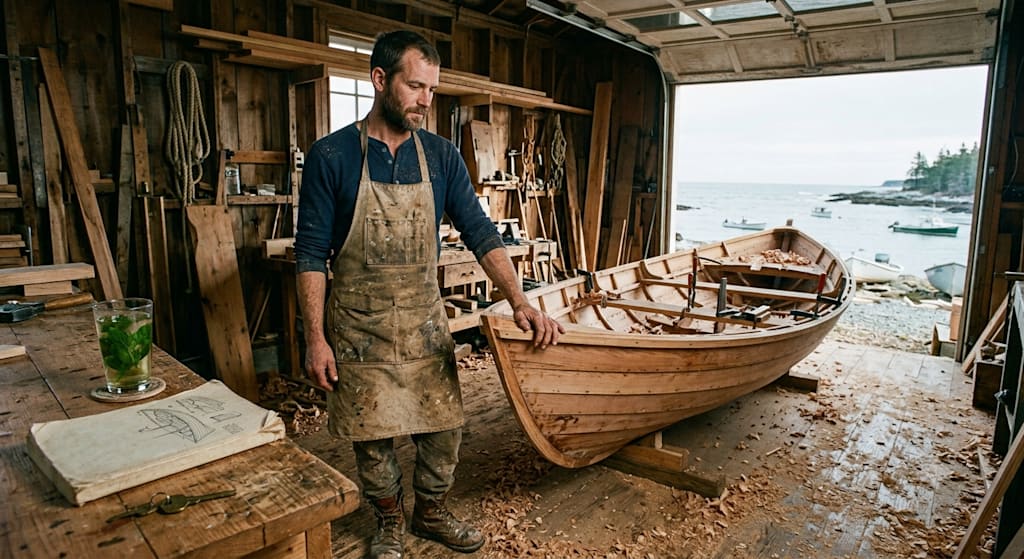
He went to a small town on the coast of Maine called Brooksville. Not to “heal,” not to “find himself.” He had only $7,200 left in his pocket, was a month behind on rent, and had cut up his debit card before leaving Manhattan. The first person he met there was a man named Mick, sixty-three years old, who had been building wooden boats for forty years and whose palms were rough as sandpaper. Mick looked him over and said, “Those hands of yours have never even held a hammer.” Then he tossed him a broom and had him sweep wood shavings for three days.
That first month, Ethan stood in the boatshed ten hours a day. He woke at five in the morning and did a hundred bodyweight squats and a set of pull-ups using a beam overhead. He did it not because anyone taught him, but because he had discovered that if he didn’t move, his shoulders and lower back would ache so badly by three in the afternoon that he couldn’t hold a chisel steady. Mick never said, “You should exercise.” Mick only once, when he saw Ethan’s knees crack as he squatted down, tossed him an old yoga mat and said, “Damp rises. Don’t let your joints sit straight on the concrete.”
His diet changed slowly. There was no microwave in the boatshed, and the nearest fast-food place was a forty-minute drive away. Mick ate cold roast chicken legs, boiled broccoli, and a large cup of mint tea gone cold for lunch. At first Ethan could barely choke it down; later, hungry enough, he copied him, shredding the chicken into raw baby spinach with olive oil and lemon juice. A month in, he no longer crashed in the afternoons. The puffiness around his cheeks receded, and his cuffs felt a finger’s width looser. He hadn’t “decided to eat healthy”; it was just that if he didn’t eat this way, his hand would shake on the plane in the afternoon, and Mick’s hand never shook.
In his fourth month, he finished the first boat rib he could assemble entirely on his own. The white oak bend had been steamed in the box; when he pulled on his gloves and pressed it into the jig, the wood fiber let out a long, low creak, like something alive exhaling. In that moment he noticed that his breath was synced with the force in his hands, and that his mind held nothing of yesterday’s positions or tomorrow’s bills, only the wood and his hands. He locked the bend into its notch, straightened up, and wiped the sweat and sawdust off his forehead. Mick stood five paces away, drinking his mint tea. He glanced over once and said, “That one’ll do.”
Ethan did not lie awake that night. He lay on the cot in the boatshed loft, caught the smell of pine resin and rust, heard the tide slapping against the pilings, and remembered that the last time he had fallen asleep thinking about nothing at all, he was probably fourteen. It was the first time he had lost consciousness before eleven o’clock without alcohol or melatonin.
In his seventh month, his first skiff went into the water. It wasn’t one of Mick’s orders; it was a two-person rowboat he had pieced together from offcuts and a few weekends, the bow off true by maybe two degrees, the paint uneven in thickness. He pushed the boat into the shallow cove, water rising past his knees, the October Maine sea stabbing his calves numb. He climbed in, picked up the oars, and rowed past the breakwater. There were choppy waves, a northeast wind. He kept his center of gravity low. The angle of the blade entering the water was one Mick had corrected by whacking him across the calf with a broken oar. His calf had stayed black and blue for two full weeks, but he had memorized that angle for life.
Out past the third set of swells, he realized the corners of his mouth were curved upward. Not a smile, just the natural resting curve of relaxation. The last time he had made that expression, he’d had to practice it deliberately in front of a mirror. He stopped rowing and let the boat drift. Two northern gannets passed overhead, their feathers nearly translucent in the white light.
When he got back to shore, Mick had already finished for the day. The boatshed door was left ajar, all the tools wiped clean and hung by size. On the workbench sat a glass of cold mint tea, and beside it, a key, the key to the boatshed door. Ethan stood in the doorway and drank the tea. Sweat ran down his temples, salty. He washed the glass, turned it upside down on the drying rack, closed the door, locked it, and walked back up to the loft with the key pressed into his palm.
That night he woke suddenly at four in the morning, not startled, just awake, his mind clear as if rinsed in ice water. He lay still and listened. His heartbeat was steady. His stomach didn’t hurt. His shoulders weren’t rigid. He remembered four in the morning in Manhattan, usually staring at screens or jolted out of a nightmare with damp palms. Now he opened his hand. The palm was dry. Only the fresh callus between thumb and forefinger rasped against the sheet.
He turned over, and a thought surfaced: next week he’d correct the bow angle on that skiff, using the new western red cedar that had just come in. He found the idea interesting. Not because it would make money—he planned to give that boat to the town library’s summer camp. He was interested because the thought of how the wood would meet the water’s drag curve sent a mild electric current through his chest.
He had made it to thirty-six. He could still row. He could lift a sixty-pound piece of white oak. He could read an old manual on boat construction in an hour and remember the keel angles. He could sleep six hours straight without pills or alcohol. His savings were under four thousand dollars. He had only a debit card in his wallet. But his last stomach spasm had been three months ago. His last bout of unexplained heart palpitations had been last winter.
People in town called him “that young guy who builds boats,” not “that guy from New York.” He had liked the latter. He liked the former more.
Just before Christmas, he got a text from a former colleague named Allison, asking if he had “found himself” up in Maine. Ethan didn’t reply. He put the phone on the workbench and kept sanding the hull with 180-grit sandpaper. The fine wood dust rose and drifted slowly through the slanted afternoon light. He thought the question was like asking a boat, “Have you found yourself at sea?” A boat doesn’t find itself. A boat just doesn’t sink, and keeps moving in one direction.
He switched the sandpaper to his left hand and flexed his right wrist. Outside the window, it had started to snow. The flakes hit the seawater and disappeared instantly. He went back to work.
The story ended there. He had not become a legend, nor had he grasped any grand truth. His stomach simply didn’t hurt anymore. There were calluses on his palms. Tomorrow he would fix a bow angle on a boat, and he would probably get it done before dark.
About the Creator
Jin
Writer of reamstories
https://reamstories.com/jin
Enjoyed the story? Support the Creator.
Subscribe for free to receive all their stories in your feed. You could also become a paid subscriber, letting them know you appreciate their work.
Comments
There are no comments for this story
Be the first to respond and start the conversation.