parents
The boundless love a parent has for their child is matched only by their capacity to embarrass them.
Manifestations of Abandonment
I have always been a curator of stray pets. From the wee age of six, I kept bringing home every abandoned, lonely creature I found. Call it a compassionate heart, a love for animals, too, maybe. I think it was a symptom of what abandonment does to a person. You rescue what you identify with because you can’t stand for anything to feel as you have. So I brought home lonely creatures in need of love. Maybe I was rescuing myself from loneliness and despair.
By Alexandra Grant3 months ago in Families
How to Convince My Parent to Move to Assisted Living
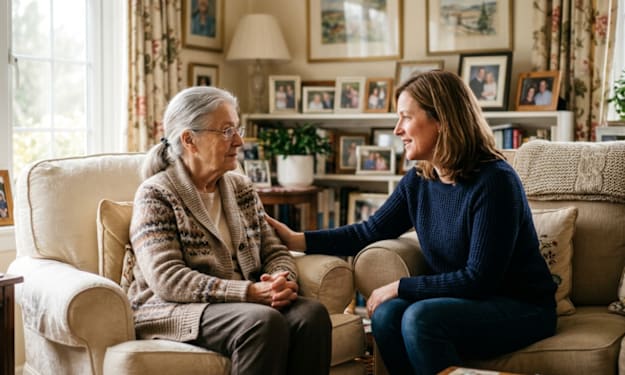
One of the most emotional things that can happen during life is to watch a parent grow older. There is a time when it becomes worrisome to children to know of a parent's safety, health or ability to take care of himself. Assisted living offers support and social activities, as well as peace of mind, but it's not always an easy decision to get a parent to accept.
By Shelia Bailey3 months ago in Families
Manifestations of Abandonment
I am a product of abandonment. Not my choice, but it is what it is. I am a product of several things, not at all nice to discuss, yet I am still kicking. I am not sure what people’s intentions are when they do something, but I am guessing selfishness is at the root of it all. I was abandoned. Correction, my sister and I were abandoned by our mother when I was around two years old.
By Alexandra Grant3 months ago in Families
Carlton Jama Adams on the Everyday Practices That Strengthen Family Relationships. AI-Generated.
Carlton Jama Adams is a licensed clinical psychologist and psychology professor specializing in healthy parenting. Throughout his work, he has emphasized the importance of nurturing strong family relationships through consistent engagement and meaningful interaction. While many people associate family closeness with major milestones and special occasions, lasting emotional bonds are often built through everyday experiences. Small moments of connection, repeated over time, can help family members develop trust, improve communication, and create a greater sense of belonging.
By Carlton Adams3 months ago in Families
The Genius Ways My Father Motivated His Children to Help Him in the Garden
Gardens and children need the same things, patience, love, and someone who will never give up on them — Nicolette Sowder My Father had the skill of making things seem like a game and have fun with us. In the Autumn, after he had finished the Autumn clearing of cutting down the dead flowers and plants, he would say — “alright you lot, if you build a bonfire, I’ll buy you some fireworks as a treat. There’s no need to go anywhere else, there’s plenty of branches, and stalks, around the garden. The bonfire will go really well if you put rake up lots of leaves and put them on as well”.
By Pamella Richards3 months ago in Families
Financial Independence
Financial independence empowers both men and women to take control of their lives. It creates opportunities, reduces stress, and builds confidence. Moreover, it allows individuals to make choices without relying on others for financial support.
By Dark Insight3 months ago in Families
What Families Should Know About Memory Care in Brookings
It can be one of the more emotional experiences in a family when a loved one is having memory problems. Some medical conditions like Alzheimer's and other dementias can cause difficulties for the person and others around them. Once memory loss occurs, many families start looking around for other help that can offer safety, comfort, and specialized care. Memory care in Brookings can make a significant impact in these situations.
By Patrica Overton3 months ago in Families
The last gift from my father . AI-Generated.
The Last Gift From My Father I still remember the heavy, suffocating silence of that morning. It wasn’t the peaceful kind of quiet. It was the kind that presses down on your chest until it's hard to breathe. My father had been gone for three days, and the house already felt hollow—like the heart of it had been ripped out and could never be replaced. People came and went in a blur. They offered soft words, patted my shoulder, and left quietly. But once the door clicked shut for the last time, I was left entirely alone with a mind full of memories I didn't know how to carry. My dad wasn’t just my father; he was my anchor, my guide, and honestly, my best friend. By the fourth day, the quiet was driving me crazy. I decided to clean his room. I don’t even know why. Maybe I just needed to breathe the same air he did one last time, or maybe I just needed to keep my hands busy so my mind would stop spinning. His room still smelled exactly like him—a mix of old books and his favorite cologne. Everything was perfectly in place, just the way he liked it. His shoes were lined up neatly, his shirts folded without a single wrinkle. It felt entirely wrong knowing he would never walk through that door again. While going through his closet, my hand brushed against something hidden beneath a stack of sweaters. It was a small, worn wooden box. It wasn’t locked, just tucked away carefully, as if he wanted it found, but only by someone looking closely. My fingers shook as I lifted the lid. Inside lay a folded piece of paper and an old wristwatch. The watch was scratched but well-loved, the kind of piece you can tell has a history. I had never seen him wear it. I slowly unfolded the paper, and the moment I saw his sharp, familiar handwriting, a knot formed tightly in my throat. The letter started simply: “My dear child,” I had to stop. My eyes flooded with tears, blurring the ink, but I forced myself to blink them away and keep reading. He wrote about life. He admitted to mistakes he’d made and talked about how hard he had tried to build a better future for me. He apologized for the times he had been too strict or too quiet. He explained that he was just terrified of the world, and wanted to make sure I was tough enough to handle it when he was gone. Then, he wrote the words that made my hands completely lose their grip. He told me the wristwatch belonged to his own father—my grandfather. It had been passed down through our family, and now it belonged to me. He wrote that time is the only truly priceless thing a person has, and that I shouldn't waste a single second of mine on bitterness, anger, or regrets. At the very bottom of the page, there was one last sentence: “If you are reading this, I am no longer there to hold your hand, but please know I am proud of you every single day.” The dam broke. The letter slipped from my fingers onto the floor as I finally let go. For the first time since he died, I didn't just cry because I missed him—I cried for all the things I never got to say. I wished I had told him I loved him more. I wished I hadn't been so busy with stupid, unimportant things and had just sat down to talk with him more often. I would have given anything just to hear his voice call my name one more time. I picked up the watch and squeezed it in my fist. It felt warm, almost as if it was holding onto the heat of his skin. I didn't sleep at all that night. I just sat on the edge of his bed in the dark, replaying every lesson he ever taught me about being honest, patient, and kind. As the weeks passed, something shifted inside me. The ache of his absence didn't go away, but it changed. It stopped feeling like just a tragic loss and started feeling like a responsibility. His words became my map. His watch became a daily reminder on my wrist that my time here matters. Now, whenever life gets overwhelming or I have to make a hard choice, I look down at that ticking face and remember his letter. It doesn't make me cry anymore. It gives me a spine. Sometimes, the greatest thing a father leaves you isn't something you can lock away in a box. It’s the strength he built into you while he was still here.
By Hafiz afridi3 months ago in Families
The Day I Realized What My Mother Had Given Up for Me. AI-Generated.
When I was a child, I thought my mother was simply doing what all mothers do. She woke up before everyone else, prepared meals, reminded me to complete my homework, and somehow managed to solve every problem that appeared in our lives. To me, it all seemed normal. At that age, I never stopped to wonder how difficult life might have been for her. Children rarely notice sacrifice. They notice the things they receive, not the things someone else gives up. Looking back now, I realize that many of the opportunities I enjoyed existed because my mother quietly placed my needs ahead of her own. She never announced her sacrifices or asked for recognition. She simply kept moving forward, one day at a time. Growing Up Without Understanding As a teenager, I often believed life revolved around my own problems. If I wanted something and couldn't have it immediately, I became frustrated. If my friends had something newer or better, I complained. My mother usually listened without arguing. What I didn't understand was that she carried worries I never saw. There were bills to pay, responsibilities to manage, and countless decisions to make. Yet she tried her best to protect me from those burdens. Whenever I asked how things were going, her answer was always the same. "Everything is fine." Years later, I learned that everything was not always fine. She simply didn't want me to carry worries that belonged to her. While I focused on school, friends, and my own goals, she was quietly making sacrifices to keep our lives stable. The Small Things That Meant Everything When people think about sacrifice, they often imagine dramatic moments. In reality, sacrifice usually appears in small, ordinary ways. It is the parent who works an extra shift. It is the meal skipped so someone else can eat. It is the dream postponed because a family needs support. My mother's sacrifices were hidden inside everyday life. She wore the same coat for years while making sure I had what I needed for school. She spent money on books and supplies instead of buying things for herself. She gave her time, energy, and attention without expecting anything in return. At the time, I thought these things were normal. Now I understand how extraordinary they were. The Moment Everything Changed As I grew older and became responsible for my own life, I started to see the world differently. For the first time, I experienced financial pressure, long workdays, and the challenge of balancing responsibilities. Suddenly, many memories from my childhood looked different. I remembered how tired my mother often seemed after work. I remembered the times she said she wasn't hungry and encouraged me to finish the last portion of food. I remembered how she always found a solution even when circumstances were difficult. The older I became, the more I understood. And with that understanding came gratitude. I realized that many of the things I had taken for granted were actually the result of her determination, patience, and love. A Different Kind of Strength The strongest people are not always the loudest. Sometimes strength looks like patience. Sometimes strength looks like showing up every day even when you're exhausted. Sometimes strength looks like carrying responsibilities without complaining. My mother taught me that strength is not measured by physical power or public recognition. It is measured by commitment, resilience, and love. She faced challenges that I didn't fully appreciate until adulthood. Yet she continued moving forward because she believed her family mattered more than her personal comfort. That kind of strength deserves recognition. Lessons That Stay Forever The greatest gift my mother gave me was not financial support or material possessions. It was her example. She taught me the value of hard work. She taught me the importance of kindness. She taught me that real love is often demonstrated through actions rather than words. Those lessons continue to influence my decisions today. Whenever I face a difficult situation, I think about her determination and persistence. Whenever I feel tempted to quit, I remember how many obstacles she overcame without giving up. Her example became part of who I am. A Mother's Silent Legacy My mother's sacrifices may never appear in history books. There will never be awards celebrating the countless small decisions she made for the benefit of her family. Yet her influence is visible in every success I achieve and every lesson I carry forward. Her legacy is not built from fame or recognition. It is built from love, consistency, and quiet determination. The older I get, the more I understand that some of the most important contributions in life happen behind the scenes. They are not announced to the world. They are simply given. And that is what makes them so powerful. A mother's silent sacrifice often goes unnoticed when it is happening. But years later, when we finally understand everything she gave up, we realize that her love shaped our lives in ways we may never fully measure. The greatest tribute we can offer is not just gratitude, but appreciation while we still have the chance to say it.
By Golden Smith 3 months ago in Families
The Genius Ways My Father Motivated His Children to Help Him in the Garden
Gardens and children need the same things, patience, love, and someone who will never give up on them — Nicolette Sowder My Father had the skill of making things seem like a game and have fun with us. In the Autumn, after he had finished the Autumn clearing of cutting down the dead vegetation, he would say — “alright you lot, if you build a bonfire, I’ll buy you some fireworks as a treat. There’s no need to go anywhere else, there’s plenty of branches, and stalks, around the garden. The bonfire will go really well if you rake up lots of leaves and put them on as well”.
By Pamella Richards3 months ago in Families
He Was Mine
On June 3rd, 2025, my father, Hugh Stewart, died. Dementia. I have written various pieces, including two challenge-winning poems about our complicated relationship. While it is true and fair that he was not an easy man to love, rather than taking further opportunities to discuss his failings, I wanted to commemorate the first anniversary of his death by celebrating him a little.
By Paul Stewart3 months ago in Families