
The Number That Ate the Child: What We Actually Measure When We Measure “Giftedness”
A former test designer on the hidden surveillance inside elite schools — and the bicycle mechanic who escaped it.
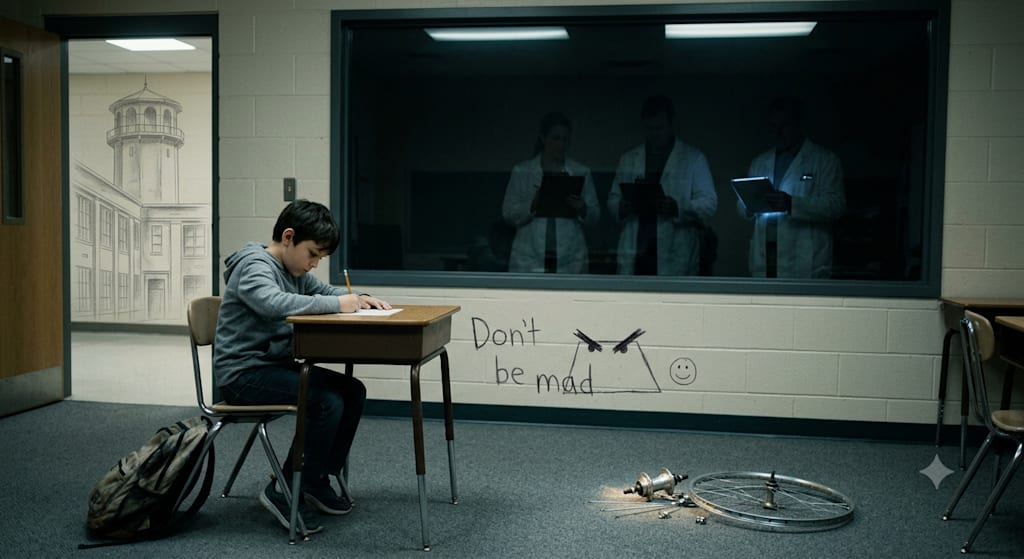
The first time I sensed something was off about “identifying giftedness” was while designing a set of figural reasoning items for a gifted‑child screening. The task asked children to pick, from six options, “the most creative combination of shapes.” We had defined creativity for scoring purposes as the degree to which an option broke the implied symmetry of the item stem while maintaining a sense of visual balance. One child chose the answer we had keyed as the most creative. In the post‑test interview, I asked him why. He said, “Because it looks like my mom’s eyebrows when she’s angry.”
My colleagues around the table laughed. Then someone marked a perfect score in the “creative thinking” column of the rating form. The column went from zero to five.
In that moment, the child had certainly revealed a singular associative capacity. But once we translated his sentence into a number and used that number to help decide what kind of classroom he would sit in for the next ten years, what curriculum he would receive, what expectations would be pressed upon him, we were no longer doing “identification.” We were doing a finer‑grained act of sorting. We didn’t call him a poor student. We called him a “highly creative individual.” The label had changed. The labeling had not.
Beijing No. 8 Middle School is one of the very few public schools in China with legal permission to skim the brightest young children from a wide catchment area. I contributed to the development of their psychological tests and later tracked students who came through the program. Internally, the program runs a complete assessment apparatus: cognitive batteries, emotional regulation scales, behavioral observation logs, ongoing developmental files. In their first week, students fill out a “Self‑Directed Learning Disposition Inventory.” One item reads: “When I encounter a difficult problem I cannot solve right away, I will: A. Keep trying until I solve it; B. Seek help; C. Put it aside for now and wait for inspiration; D. Feel frustrated and give up.” The correct answer is A. A child who chooses C gets flagged with the note “metacognitive strategies require guidance.”
This is not a lone item. Every single entry in the assessment system sends children the same message: your curiosity, your hesitation, your giving up, the shape of your mother’s eyebrows, all of these things can be measured, all of them ought to be optimized, and all of them will ultimately be used to judge whether you fit the predetermined track of “gifted development.”
A fourteen‑year‑old once said something to me during a mid‑semester interview. He had been in the program for three years by then, his metrics near the top. He said, “I know my creativity score dropped last week because I’ve been drawing lately instead of doing the extra math problems. But isn’t drawing a kind of innovation?” He paused, then added, “Whatever. I’ll finish the math first next time, and then I’ll draw.”
There was no anger. He was recalibrating his strategy. In that moment, I thought of the prison Foucault describes in Discipline and Punish, the kind where no guard needs to strike you with a baton; you simply know you may be watched at any time, and so you move by yourself to the spot you are supposed to occupy. The difference is that the watchtower in a prison is physical. The watchtower inside a thirteen‑year‑old’s head is built brick by brick out of sentences like “your spatial reasoning ability is in the top fifth percentile” and “your creative thinking score is below that of your peers.”
The system’s most intractable feature is that every time it applies pressure, it does so under the banner of “for your own good.” It isn’t called discipline. It’s called an “individualized development plan.”
For a while, I believed this problem could be solved by refining the assessment tools. Use fewer cold numerical scales and more descriptive evaluations. Attend not just to cognitive dimensions but also to indicators of emotional and social development. Look not only at final products but also at the attempts and iterations along the way. Spoken aloud, these ideas win plenty of nodding heads at education conferences.
But later I witnessed something with my own eyes. An education researcher who had worked with the No. 8 program tried to replace the traditional quantitative scoring with a more “humanistic” growth portfolio. Instead of scores, the portfolio recorded the questions a child had posed over the semester, descriptions of the paths they took to solve problems, shifts in the roles they played during collaboration. Three years later, the portfolio itself had become a new basis for scoring. When elite high schools ran their self‑enrollment admissions, they asked children to submit a “curated growth portfolio,” complete with a “problem‑awareness score” and a “cross‑disciplinary integration competency level.”
The moment intrinsic motivation can be graded, it stops being intrinsic. The moment a growth mindset must be assessed, it degenerates into just another competition of fixed mindsets, only this time the race is to see who can look more like a “growth mindset person.”
This is not a moral failing of any individual. It is the instinctive response of an education system once a society anchors the value of a human being to “identifiable output.” Feed it the goal of “cultivating innovative talent to serve modernization,” and it will disassemble “innovation” into manageable KPIs. Expecting it to keep a small de‑metricized plot of land is like expecting a river to erode only the left bank.
The No. 8 model is often discussed as the template for gifted education in China. Judged by performance metrics, it is successful: large numbers of its graduates enter top universities, publish papers in international journals, and become the youngest name in whatever room they walk into. But if you look along a different dimension, at the students who passed through the program but eventually “veered off track,” you see another set of silent data.
I know one of them. In secondary school he was classified as “mathematically gifted,” put on an accelerated track, and ended up studying theoretical physics at university. At twenty‑eight, he quit research and went back to his hometown to open a bicycle repair shop. The last time we met, he told me: “Those tests said I had high spatial reasoning. They didn’t say I like the feeling of grease on my hands when I fix things.”
He pointed to a half‑dismantled road bike at the door. “See this derailleur? When you adjust it, you have to listen. If the sound is wrong, it’s wrong, no matter what the specs say. That’s something a psych test can’t measure.”
I asked him what had stayed with him most from all that testing. He thought for a moment. “I still dream about that rating scale sometimes. I dream I picked the wrong answer again, and someone tells me my potential needs to be reassessed.”
There have been hopes of rolling out the No. 8 model across the country, but the idea contains its own logical knot. A program that relies heavily on high‑precision screening, once spread across regions with vastly larger populations and far more uneven resources, will inevitably see its screening precision fall, and with it the concentration of “giftedness” it produces. Its value as a model depends precisely on its continued existence as a scarce exception. A solution that cannot be replicated at scale functions, in public‑policy terms, more as symbolic compensation: it gives society the reassuring sensation that “we are systematically solving the problem of innovative talent,” thereby allowing a deeper reckoning with the overall ecology of education to be temporarily shelved.
This is not a conspiracy. Nearly everyone inside this logic, from policy makers to test developers, from anxious parents to students straining to meet the benchmarks, is sincere. Sincerely convinced that if only the identification mechanisms become more scientific and the cultivation pathways more precise, we will harvest from the next generation the fruits of innovation we have long defined. This sincerity makes the mortar between the panopticon’s bricks nearly invisible.
During my years working with the No. 8 program, I once saw a child’s file. It had curves in different colors tracing his developmental trajectory across six psychological dimensions. Every curve had its own baseline, target zone, and warning threshold. On the final page, under “Comprehensive Evaluation and Recommendations,” an expert had written: “The student’s intrinsic drive for innovation is below expectations. It is recommended to increase open‑ended problem‑situational training to enhance his future scientific research potential.”
The child was nine years old.
I stared at those six characters, “future scientific research potential,” for a long time. I realized I could no longer tell whether this evaluation was describing a living person’s possibility, or inspecting a part for a production plant not yet built.
I left the program eventually and stopped doing any work involving the screening of gifted children. But I kept one thing: that child’s drawing of the shape combination that “looked like my mom’s angry eyebrows.” Next to it on the test paper, he had penciled a tiny smiley face. Beside the smiley face, in crooked handwriting, were two words: “Don’t be mad.”
I put that piece of paper in a folder, and on the folder I wrote: Things that cannot be measured. This is self‑mockery, of course. Because the moment “cannot be measured” is written down, filed, and categorized, it has already fallen into another kind of conceptual trap. But I keep it anyway. I need it to remind myself that the mind that connected an eyebrow to a math problem, its value does not come from any curve we drew for it.
True genius. I stopped for a long time after writing those two words. They are too dirty now, caked with too many coats of paint. So let me put it this way: those we later call geniuses, the things they did in childhood that were utterly purposeless, unexplainable, and ungradable—those are the seam of ore from which all their later creation would be mined. And those of us who did the measuring, what we were doing was laying railway tracks on top of a seam of ore.
Tracks can lead to many places. But the souls I have seen travel farthest, they were never on the tracks.
One spring evening, the friend who now runs the bicycle shop sent me a photograph. His three‑year‑old daughter was crouched on the shop floor, a hex wrench clutched in her hand, earnestly banging on a discarded hub. Beneath the picture, he had written three words.
“Don’t test her.”
About the Creator
Jin
Writer of reamstories
https://reamstories.com/jin
Enjoyed the story? Support the Creator.
Subscribe for free to receive all their stories in your feed. You could also become a paid subscriber, letting them know you appreciate their work.
Comments
There are no comments for this story
Be the first to respond and start the conversation.