Essay
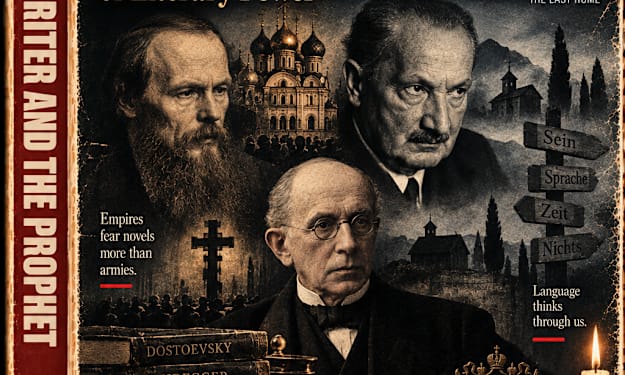
The Writer and the Prophet: Dostoevsky, Heidegger and the Last Home of Language
Introduction: Can Language Save a Civilization? Few writers have exercised greater influence over the moral imagination of modern civilization than Fyodor Dostoevsky. Yet behind the celebrated novelist stood a complicated political and philosophical environment in which literature was understood not merely as art but as a strategic instrument for shaping the soul of society. Tsvetan Stoyanov’s reflections explore this forgotten relationship by connecting Dostoevsky with Konstantin Pobedonostsev, the conservative mentor of the Russian imperial family, before extending the argument toward Martin Heidegger’s philosophy of language. At first glance these figures appear separated by politics, history and temperament. Yet they share a profound anxiety concerning the fragmentation of modern civilization. Liberal individualism, mass journalism, technological progress and the collapse of traditional communities gradually transformed language from a living expression of shared existence into a mechanical instrument of persuasion, manipulation and information exchange. Dostoevsky responded by creating characters whose psychological complexity penetrated beneath ideological formulas into the contradictory depths of the human soul. Heidegger later argued that philosophy itself had forgotten its essential task by reducing language to communication rather than recognising it as the very home of Being. Both thinkers therefore confront the same historical crisis from different directions. Civilization risks losing not only its moral foundations but also the language through which genuine human existence becomes possible. The central question consequently extends beyond politics or literature. Can language once again unite people into authentic communities, or has it permanently become an instrument of technological administration, public opinion and ideological control? The answer determines not merely the future of philosophy but the future of humanity itself.
By Peter Ayolovabout a month ago in Critique
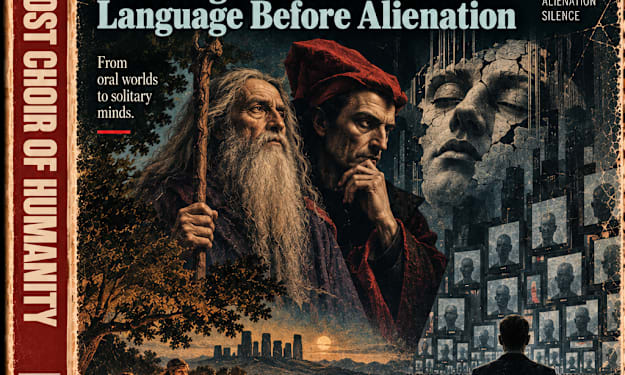
The Lost Choir of Humanity: Merlin, Faust and the Death of Communion
Introduction: When Communication Was Still Communion Modern societies usually understand communication as the transmission of information between isolated individuals. Messages are sent, received, interpreted and evaluated according to their efficiency or accuracy. Yet this utilitarian conception of language represents only a recent stage in a much older human history. Tsvetan Stoyanov, in The Secret of Broceliande Forest , presents a radically different genealogy of speech. At its origin, language was not primarily communication but communion. Human beings did not merely exchange information; they became one another through song, ritual and shared poetic experience. The singer standing before the tribe transformed separate individuals into a single living organism whose members experienced the world together. Poetry united cognition with belonging, knowledge with affection, and truth with collective existence. Language therefore served simultaneously as memory, philosophy, religion and social cohesion. The gradual fragmentation of human communities transformed this original unity into loneliness. Urbanization, private property, political hierarchy and expanding civilizations multiplied communication while destroying communion. The poet became increasingly separated from ordinary people, art withdrew into elite circles, beauty detached itself from ethics, and language evolved into an autonomous aesthetic game increasingly disconnected from everyday human relationships. Merlin and Faust become symbols of this tragic history. Both pursue knowledge, yet both ultimately lose the human bonds that once gave knowledge meaning. Modern civilization inherits their curse: extraordinary intellectual power accompanied by unprecedented alienation. The deepest question facing contemporary culture therefore is not whether communication can become more efficient, but whether language can once again restore genuine communion between human beings.
By Peter Ayolovabout a month ago in Critique
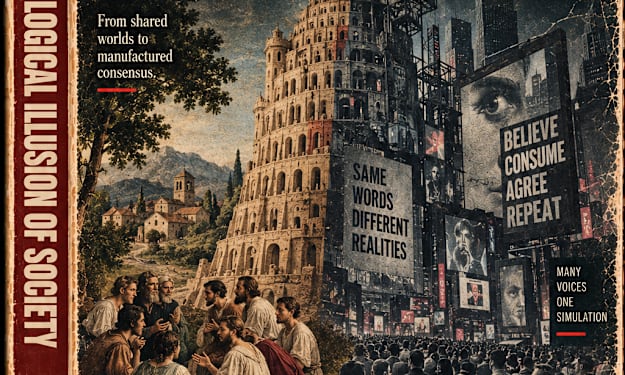
The Ontological Illusion of Society: Language, Opinion and the Politics of Collective Reality
Introduction: Do Society and Language Really Exist? Modern civilization rests upon two assumptions that are rarely questioned. The first is that society exists as a concrete entity acting independently of individuals. The second is that languages exist as natural objects that can be discovered, classified and scientifically described. Yet many of the most influential philosophers and social theorists of the twentieth century challenged precisely these assumptions. Karl Popper, Max Weber, Friedrich Hayek, Pierre Bourdieu, Richard Rorty, George Herbert Mead and Jacques Derrida all, in different ways, questioned the ontological status of collective entities. They argued that concepts such as society, public opinion, language and even meaning are not physical realities but symbolic constructions emerging from countless interactions among individuals. Human beings continuously create these abstractions through communication and then begin treating them as though they possessed independent existence. The result is a remarkable inversion. Concepts invented to explain reality gradually become realities that govern human behaviour. Society begins acting as though it possesses intentions. Language appears to exist independently of speakers. Public opinion becomes an invisible authority despite lacking any concrete location. These abstractions acquire extraordinary political significance because they organise institutions, identities and collective action. The history of civilization can therefore be interpreted as the progressive construction of increasingly sophisticated symbolic realities whose existence depends entirely upon language. Once this possibility is recognised, the philosophical problem changes fundamentally. Instead of asking how language represents society, one begins asking how language manufactures society itself. Perhaps neither society nor language exists ontologically in the same sense as mountains, rivers or biological organisms. Perhaps both are synthetic realities maintained through continual communication, collective memory and shared belief. Understanding this possibility requires examining the philosophical traditions that gradually dissolved these apparently self-evident entities into networks of symbolic interaction.
By Peter Ayolovabout a month ago in Critique
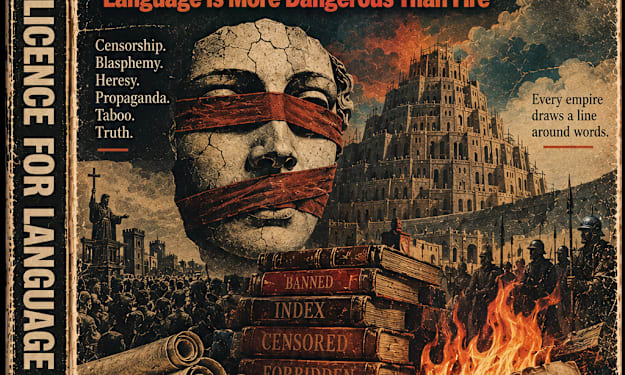
A Licence for Language: Why Civilizations Restrict the Power of Speech
Introduction: Language Is More Dangerous Than Fire Human civilization has always treated certain technologies as too dangerous to be left without regulation. Fire transformed prehistoric society but required ritual control. Metal weapons altered the balance of power and became the monopoly of warriors. Nuclear technology today remains subject to international treaties because its destructive potential exceeds ordinary political responsibility. Language, however, has rarely been placed in the same category despite being the only technology capable of simultaneously shaping minds, institutions, religions, economies and entire civilizations. Ancient societies often understood this danger far better than modern ones. From the Sumerian me to the Egyptian concept of Ma’at , from the Hebrew prophets to Greek philosophy, language was rarely regarded as a neutral instrument. It possessed legitimacy only when exercised within a larger moral order. Kings, priests, judges and scribes did not merely speak; they spoke with recognised authority derived from divine law, custom or ethical obligation. Speech required what might be called a licence. This licence was not a bureaucratic permit but an acknowledgement that language carried immense social consequences. A ruler who issued laws, a priest who pronounced ritual formulas or a judge who interpreted legal texts exercised communicative authority only because society recognised their responsibility as well as their power. The myths surrounding Babel, the me and the nam-shub all express this same concern. Language can create civilization, but it can equally destroy it if detached from moral constraints. Modern societies often celebrate unrestricted communication while underestimating its capacity to generate propaganda, manipulation, ideological extremism and informational warfare. The question is therefore not whether language should be controlled absolutely, but how societies can cultivate institutions and norms that encourage its responsible use. Throughout history, civilizations have repeatedly attempted to answer this problem by linking communicative authority with ethical responsibility. The licence for language was never simply permission to speak. It was an obligation to recognise that words reshape the world.
By Peter Ayolovabout a month ago in Critique
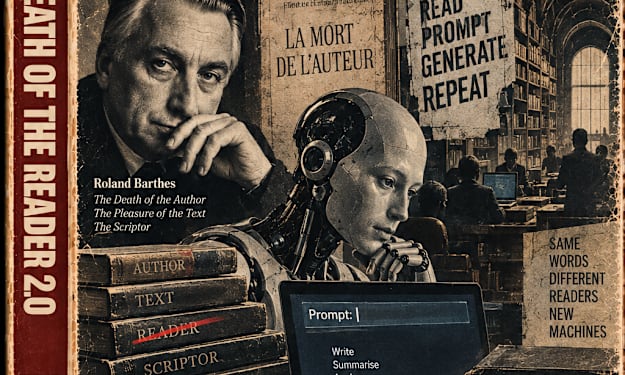
The Death of the Reader 2.0: From Roland Barthes’ Scriptor to the AI Prompter
Introduction: Who Reads When Nobody Reads? Roland Barthes killed the Author in 1967, but he did not leave the text without a human sovereign. Having dismantled the romantic image of the writer as the unique origin of meaning, Barthes transferred authority to another figure waiting at the opposite end of the communicative process: the Reader. The text ceased to possess a single paternal source and became instead a “tissue of quotations” assembled from innumerable cultural centres, yet its multiplicity still required a destination. For Barthes, that destination was the Reader, the space in which the many writings composing a text could finally be gathered together. The celebrated death of the Author therefore concealed an anthropocentric compromise. One human disappeared so that another might be born. More than half a century later, generative artificial intelligence disturbs that settlement. Large language models can produce texts without a traditional author, but the more consequential transformation may occur at the other end of the process. Machines increasingly retrieve, classify, translate, compare, summarise, evaluate, criticise and transform texts before any human being encounters them. A document may be generated by one computational system, analysed by another, condensed by a third and used as contextual input by a fourth. Between the original prompt and the eventual human response, enormous quantities of language can circulate without being read in anything resembling the traditional human sense. The question is consequently no longer simply whether AI can write. It is whether writing still requires a reader.
By Peter Ayolovabout a month ago in Critique
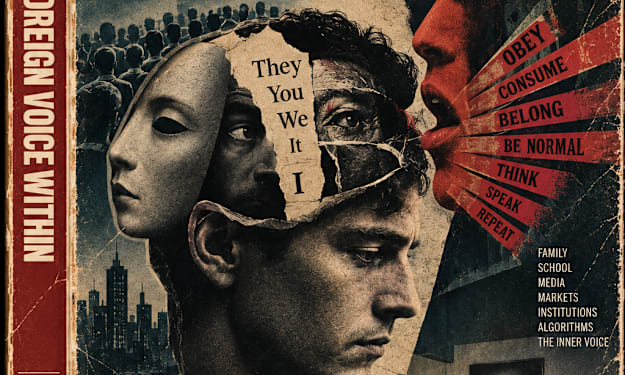
The Foreign Voice Within: Inner Dialogue, Language and the Colonisation of the Self
Introduction: Who Is Speaking Inside Your Mind? Human beings generally assume that the voice inside their heads is their own. It accompanies every decision, judges every action, remembers the past and anticipates the future. It appears so intimate that questioning its authorship seems almost absurd. Yet Sam Vaknin proposes a disturbing possibility: much of what we experience as our inner dialogue is not genuinely ours at all. It consists of introjected voices absorbed from parents, teachers, authority figures, peers, enemies and the countless social institutions surrounding us. The internal conversation that appears deeply personal is, in reality, an acoustic ecosystem populated by borrowed judgments, inherited expectations and cultural commands. Society invades the individual not primarily through physical force but through language. Long before laws or institutions discipline behaviour, words establish themselves inside consciousness, creating an internal observer that continually evaluates, compares and corrects the self. The result is a permanent state of rumination in which countless foreign voices compete for authority while the authentic individual becomes increasingly difficult to identify. Social media has intensified this condition by creating an imitation of society that constantly amplifies comparison, approval and performance. The individual no longer struggles only against external expectations but carries these expectations internally as an endless linguistic monologue. The true prison therefore is not merely political or economic. It is psychological and linguistic. The battle for freedom begins not by escaping society physically but by recognising how deeply society has already established itself within the architecture of thought. The central philosophical question consequently becomes remarkably simple: if the voice in your mind is largely composed of other people’s words, where exactly are you ?
By Peter Ayolovabout a month ago in Critique
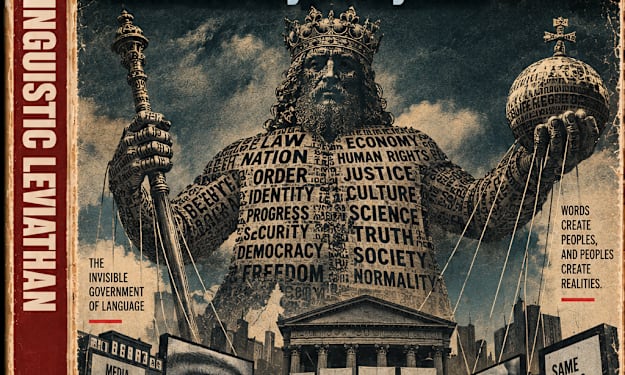
The Linguistic Leviathan: Society, Power and the Fiction That Governs Reality
Introduction: Does Society Really Exist? Few concepts appear more obvious than society. We speak constantly about society demanding change, society becoming more tolerant, society protecting the weak or society collapsing under new pressures. Yet the very existence of society has remained one of philosophy’s most persistent questions. Is society an objective reality existing independently of individuals, or is it merely a convenient fiction that enables millions of strangers to cooperate? Thomas Hobbes, Émile Durkheim, George Herbert Mead, Peter Berger, Thomas Luckmann, Richard Rorty and Friedrich Nietzsche each approached this problem from radically different perspectives, yet all recognised the central importance of language. Human beings do not merely inhabit physical environments. They simultaneously inhabit symbolic universes constructed from words, narratives, myths, institutions and collective memories. These symbolic worlds organise behaviour as effectively as physical laws, despite possessing no material existence of their own. Language becomes the architecture through which shared realities emerge, persist and reproduce themselves across generations. The state, religion, law, markets, nations and even society itself become linguistic constructions sustained through continuous communication rather than natural objects waiting to be discovered. Every civilization therefore depends upon a vast process of symbolic maintenance. Stories must continually be repeated, institutions reaffirmed and meanings reproduced if collective life is to remain stable. When these symbolic systems weaken, reality itself appears to fragment into competing interpretations. Modern societies increasingly experience precisely this condition. Digital communication, ideological conflict and competing narratives have exposed the artificial foundations upon which collective realities rest. Society appears simultaneously indispensable and fictional. Understanding this paradox requires recognising that language does not merely describe social life. It creates the very symbolic environment within which social life becomes possible. The greatest political invention in history may therefore not be the state or democracy but language itself.
By Peter Ayolovabout a month ago in Critique
Céline Dion in Paris: The Leadership of Coming Back When Everything Could Have Ended
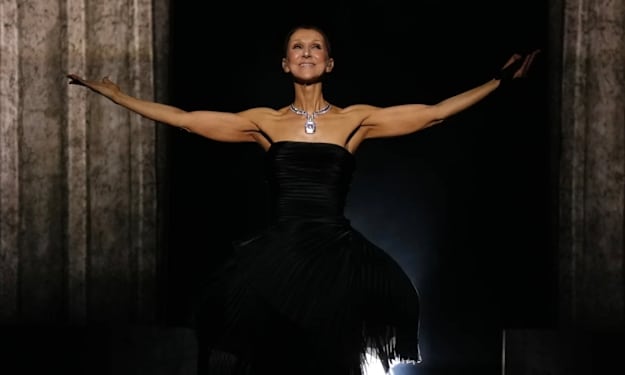
There are artists we listen to because we love them. And then there are artists who find their way back to us almost without warning — on the radio, during a car ride, or through a memory we thought we had long forgotten. For me, Céline Dion belongs to the second category. I have never considered myself a Céline Dion fan. Yet every time her voice comes through the radio, something happens. There is an immediate emotion that is difficult to explain. A few notes can be enough to open a door onto another time, another set of memories, another version of ourselves — and onto a particular idea of what popular music can mean. On September 12, 2026, in Paris, that feeling took on a new dimension. After six years away from live concerts, Céline Dion returned to a packed venue, performing for around 30,000 people in her first full concert since March 8, 2020. Over two hours and fifteen minutes, she performed 29 songs, including “On ne change pas,” “All By Myself” and “My Heart Will Go On.” The concert marked the beginning of a 26-date Paris residency, with 16 shows scheduled over five weeks and another ten planned for 2027. But the significance of that night goes far beyond the numbers. Leadership begins with accepting that you cannot control everything To be precise, Céline Dion had not completely disappeared from the stage during those six years. In July 2024, she delivered one of the most memorable moments of the Paris Olympic Games opening ceremony, performing Édith Piaf’s “L’Hymne à l’amour” from the Eiffel Tower. That appearance was already a powerful symbol of her return. But a full concert is something else entirely. It means more than two hours in front of thousands of people. It means sustaining a performance from beginning to end, meeting enormous vocal and physical demands and confronting the reality of being watched and heard at every moment. That is where I see Céline Dion’s real leadership. Not in her fame. Not in the scale of the audience. Not even in the extraordinary power of her voice. Her leadership lies in her ability to return after having to accept that she could no longer control her own body in the way she once could. In 2022, Dion revealed that she had been diagnosed with stiff-person syndrome, a rare neurological disorder that can cause severe muscle stiffness and spasms. The condition forced her to put her career on hold and cancel a number of professional commitments. For an artist whose body and voice are her essential tools, the challenge was profound. Coming back under those circumstances requires more than courage. It requires the ability to accept vulnerability without giving up on ambition. And perhaps that is the most powerful leadership lesson in her story. A leader is not necessarily the person who appears invincible. Sometimes, leadership means acknowledging that you have struggled, that you have suffered, that you have had to change the way you work — and choosing to move forward anyway. The audience is not just seeing an artist return. It is seeing a part of itself return. In Paris, Céline Dion did not appear to be trying to convince anyone that the past six years had never happened. Her emotion was visible from the opening moments. She began the concert with “On ne change pas” — “We Don’t Change” — a title that felt almost like a response to everything that had happened. Her voice, according to concert reports, sometimes carried more fragility than it once did. But that fragility did not weaken the moment. If anything, it made it more human. And then there is nostalgia. That may be what moved me most about her return. I may not know Céline Dion’s entire discography by heart but I know some of her songs intimately. They are part of a shared soundtrack. “Pour que tu m’aimes encore.” “S’il suffisait d’aimer.” “My Heart Will Go On.” These are not simply songs. They have accompanied generations of people through love stories, breakups, journeys, celebrations, difficult moments and ordinary days. They have become part of our collective memory. A real comeback is not a return to the past Perhaps that is why Céline Dion’s return is about much more than a concert. For a few hours in Paris, thousands of people were not simply reunited with a singer. They were reunited with a part of themselves. That is one of music’s rare powers: it can suspend time. A song we hear today can transport us twenty years into the past within seconds. We do not simply remember the song. We remember who we were when we first heard it. Céline Dion is returning to the stage with a different reality. Her voice sometimes has to contend with the effects of her illness. Her body can no longer be taken for granted. The conditions are different from what they were before. But she is back. And that, to me, is where the real performance is. Her leadership is not about proving that she has remained exactly the same. It is about showing that we can change without disappearing. That we can be vulnerable without being defeated. That we can start again without pretending that nothing happened. I am still not sure I would call myself a Céline Dion fan. But after Paris, I understand a little better why her voice means so much to so many people — including those who do not follow her career closely. Because ultimately, Céline Dion does not simply sing songs we know. Sometimes, she sings the person we were when we first heard them. And on that night in Paris, she reminded us of something essential: A true comeback is not about going back to the past. It is about finding the strength to believe in what comes next.
By Baptiste Monnetabout a month ago in Critique
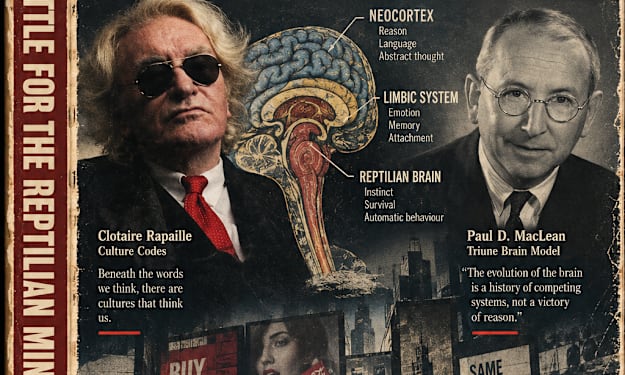
The Battle for the Reptilian Mind: Language, Culture Codes and the Collapse of Communication
Introduction: Does Reason Ever Defeat Instinct? Modern civilization often imagines itself as the triumph of rationality. Democracies celebrate informed citizens, educational systems cultivate critical thinking, and technological societies assume that increasing access to information naturally produces wiser decisions. Yet an entirely different tradition of psychology argues that human behaviour remains fundamentally governed by deeper biological mechanisms inherited long before the emergence of civilization. Clotaire Rapaille’s theory of cultural codes, influenced by Paul MacLean’s triune brain model, places instinct rather than reason at the centre of human behaviour. According to this perspective, beneath the sophisticated language of philosophy, politics and economics lies an older neurological architecture concerned almost exclusively with survival, reproduction, security and immediate gratification. Culture, advertising, journalism and political rhetoric succeed not because they persuade rational minds but because they activate these ancient behavioural systems through symbolic codes learned during emotionally charged moments of development. Language therefore becomes less a vehicle of truth than an instrument for triggering inherited emotional patterns. The modern world has intensified this process dramatically. Continuous media exposure, digital communication and algorithmic recommendation systems increasingly bypass reflective judgement while stimulating instinctive reactions. Information no longer competes primarily through factual accuracy but through emotional intensity. The consequence is a civilization experiencing unprecedented communicative abundance while simultaneously suffering profound failures of understanding. Language has become an environment rather than merely a tool, shaping attention, desire and identity through constant symbolic stimulation. Rapaille’s work, together with theories of positioning, branding and viral communication, suggests that contemporary political and commercial competition increasingly takes place inside the emotional architecture of the human brain rather than within the domain of rational deliberation. Understanding this transformation requires reconsidering communication itself—not as the exchange of information but as the strategic activation of deeply embedded cultural and biological codes that continue to organise collective behaviour beneath the surface of modern civilization.
By Peter Ayolovabout a month ago in Critique
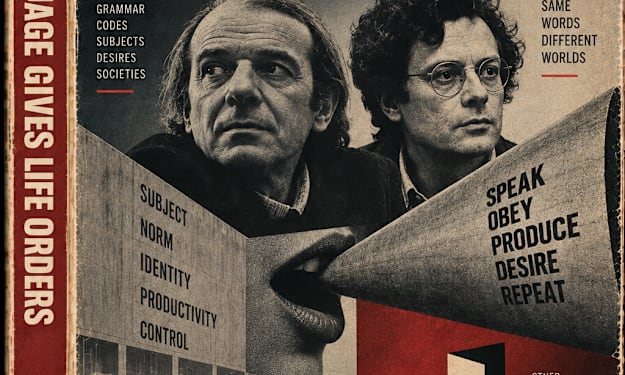
Language Gives Life Orders: Deleuze, Guattari and the Politics of Grammar
Introduction: Does Language Communicate or Command? For centuries Western philosophy treated language primarily as a system for representing reality. Words were assumed to correspond to objects, sentences to describe facts, and grammar to organise communication logically. From Aristotle through Descartes, Locke, Kant and much of modern linguistics, language appeared fundamentally representational. Gilles Deleuze and Félix Guattari radically rejected this tradition. In A Thousand Plateaus they argue that language does not primarily describe the world. It intervenes within it. Every utterance carries social obligations, institutional expectations and political consequences. Language functions less like a mirror than like an operating system issuing commands that organise collective behaviour. Their famous assertion that “language is not life; it gives life orders” overturns conventional linguistics by shifting attention from information to power. Grammar itself ceases to be a neutral descriptive tool and becomes part of a political technology regulating thought, identity and social organisation. The implications extend far beyond linguistics. Education, bureaucracy, law, media and digital communication increasingly appear as systems transmitting “order-words” rather than objective information. Every society reproduces itself through repeated linguistic commands embedded within ordinary communication. The child learning grammar simultaneously learns institutions, classifications and acceptable forms of behaviour. Modern civilization therefore depends less upon physical coercion than upon the continuous circulation of linguistic obligations that become internalised as common sense. Deleuze and Guattari’s philosophy transforms language from a passive medium into an active social machine whose political significance reaches every aspect of human existence. Their work invites a profound reconsideration of communication itself. Perhaps language has never primarily existed to represent reality. Perhaps its deepest function has always been to organise reality by directing bodies, coordinating institutions and reproducing the symbolic order upon which civilization depends.
By Peter Ayolovabout a month ago in Critique
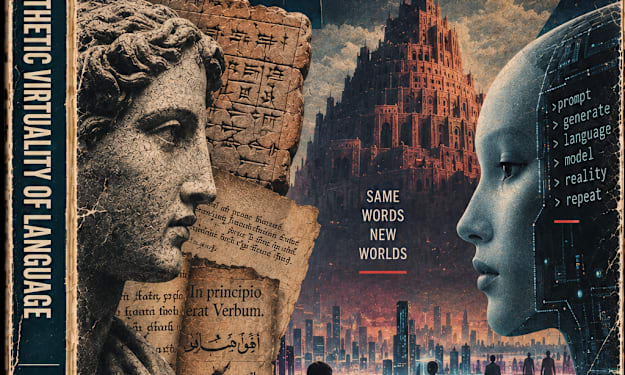
The Synthetic Virtuality of Language: From Writing to Artificial Intelligence
Introduction: Language as Humanity’s First Virtual Reality Long before computers created digital virtual realities, humanity had already invented a far more powerful virtual technology. Its invention was neither the wheel nor agriculture nor metallurgy but official language itself. Human beings spoke for hundreds of thousands of years without creating civilizations, bureaucracies, empires or global religions. What transformed history was not speech but the emergence of writing and formal languages governed by codified grammar, standardized rules and institutional authority. These innovations externalized thought, allowing symbolic structures to exist independently of living speakers. Humanity thereby entered an entirely new cognitive environment—a synthetic virtual reality constructed not from silicon and algorithms but from words, grammar and writing. Roberto Poli’s philosophy of language provides a powerful theoretical framework for understanding this transformation. Rather than treating language as a fixed code, Poli describes it as a dynamic, self-organising and autopoietic system that continually recreates itself through interaction between cognition, society and communication. Language is never completed because its virtual possibilities always exceed its actual expressions. It continually generates new meanings, metaphors and conceptual worlds that cannot be reduced to mechanical rules. This virtual productivity distinguishes language from simpler systems of communication. It behaves less like a dictionary than like a living ecosystem whose future possibilities remain permanently open. Once writing stabilised these symbolic structures, entirely new forms of social organisation became possible. Official languages no longer merely described reality; they produced alternative realities capable of organising millions of strangers around shared myths, religions, laws and political identities. The virtual world constructed through language gradually became more influential than immediate physical experience itself. Painting, sculpture, literature, religion, science, cinema, photography, television and artificial intelligence all extend this original linguistic project. They are successive technologies refining humanity’s capacity to manufacture convincing virtual realities. Artificial intelligence therefore does not inaugurate virtuality but represents the latest stage in a process that began when writing first separated language from living speech and transformed symbolic imagination into the principal architecture of civilization.
By Peter Ayolovabout a month ago in Critique