Essay
The Censor’s Tongue: Language, Moral Authority and the Survival of Civilization
Introduction: Who Guards the Guardians of Language? Every civilisation has confronted the same fundamental problem. Physical violence can be restrained by armies, courts and police, but language itself possesses a subtler and often greater power. Words establish laws, justify wars, create religions, organise economies and define collective identities. They can preserve civilisation or dissolve it from within. For this reason many ancient societies regarded language as something too powerful to be left entirely without moral supervision. The Sumerian me placed speech and writing within a divinely sanctioned order. The biblical Tower of Babel warned against linguistic power detached from higher authority. The Roman Republic developed one of history’s most remarkable political offices devoted not merely to administration but to the preservation of public morality: the Censor. These traditions recognised a common principle. Communication was never simply an individual act. It was a civilisational institution whose integrity determined the stability of society itself. Modern societies often distinguish sharply between communication and morality, treating language primarily as an instrument of individual expression or political competition. Yet the growth of mass media, social networks, propaganda and artificial intelligence has demonstrated that communication can shape entire populations with unprecedented speed. The ancient concern therefore returns in new technological forms. The central issue is no longer whether language should be free or restricted in absolute terms, but how societies cultivate institutions, norms and responsibilities capable of preserving public trust while protecting freedom of inquiry. Historical examples such as the Roman Censor illustrate an enduring attempt to balance communicative authority with moral accountability. They remind us that civilisations have repeatedly sought mechanisms ensuring that those exercising extraordinary influence through language also accepted extraordinary responsibility for its consequences.
By Peter Ayolov2 months ago in Critique
The Trojan Horse of Civilization: Language, Inequality and the Endless Return of History
Introduction: Did Language Invent Inequality? David Graeber and David Wengrow’s The Dawn of Everything challenges one of the most influential stories ever told about human civilization. For more than two centuries the dominant historical narrative has claimed that agriculture inevitably produced cities, cities inevitably produced states, and states inevitably produced hierarchy, inequality and civilization itself. This progressive sequence has become so deeply embedded within modern thought that it appears almost self-evident. Yet Graeber and Wengrow demonstrate that archaeological evidence paints a far more complicated picture. Human societies experimented with multiple political arrangements for tens of thousands of years before permanent states emerged. Large settlements sometimes remained remarkably egalitarian. Seasonal societies repeatedly alternated between hierarchy and equality according to ecological conditions. Agriculture, cities and inequality did not necessarily appear together. Yet perhaps the most neglected question concerns language itself. Throughout these historical transformations another revolution quietly unfolded: the emergence not of speech but of official language. Humans had spoken for hundreds of thousands of years before agriculture. Formal languages with codified grammar, written laws, bureaucratic terminology and abstract political concepts appeared only with increasingly complex sedentary civilizations. The distinction between speech and language therefore becomes decisive. Speech belongs to living bodies communicating immediate experience. Official language belongs to institutions preserving power across generations. Once words such as state, property, citizenship, taxation, sovereignty and humanity entered political life, entirely new forms of social organisation became possible. These concepts allowed millions of strangers to cooperate, yet they simultaneously created unprecedented opportunities for hierarchy, administration and control. Civilization may therefore have depended less upon agriculture than upon linguistic abstraction itself. The official language became the invisible architecture through which institutions, inherited authority and collective identities could be maintained independently of individual experience. Language thus resembles the legendary Trojan Horse: a magnificent gift that quietly carried within itself the mechanisms through which inequality gradually entered civilization.
By Peter Ayolov2 months ago in Critique
The Virtual Language: Žižek, Ideology and the Reality of Words
Introduction: Language Does Not Exist, Yet It Rules Everything One of Slavoj Žižek’s most original philosophical contributions is his distinction between virtual reality and the reality of the virtual. Popular culture usually understands the virtual as something unreal, simulated or artificial. Žižek reverses this intuition. The truly virtual is not simply imaginary. It consists of structures that do not materially exist yet nevertheless organise reality and produce tangible effects. A constitution, money, authority, justice, the nation or the market are not physical objects. They are virtual symbolic structures that coordinate the behaviour of millions of people. Their power derives precisely from the fact that they exist collectively without existing materially. This insight has profound implications for the philosophy of language. Language itself is perhaps the greatest virtual structure ever created. Individual speech acts are material events occurring within living bodies, but “language” as an abstract system exists only virtually. Nevertheless, this virtual system governs laws, science, education, religion, economics and political authority. It shapes civilization precisely because people collectively behave as though it possesses objective existence. Žižek’s theory therefore provides a philosophical vocabulary for understanding one of the central paradoxes of linguistic civilization. Human beings increasingly organise themselves around symbolic entities that possess no independent physical reality yet determine almost every aspect of collective life. Language, ideology and institutions become what might be called virtual machines producing real historical consequences. The result is that civilization itself begins to operate inside symbolic realities whose existence depends entirely upon collective recognition while appearing more permanent than the individuals who created them. The reality of language therefore lies not in its physical existence but in the extraordinary capacity of virtual symbolic systems to organise the material world.
By Peter Ayolov2 months ago in Critique
Generation P and the New Tower of Babel: Advertising, Propaganda and the Death of Meaning
Introduction: From Sacred Speech to Commercial Incantation Victor Pelevin’s Generation P is often described as a satirical novel about post-Soviet Russia, yet beneath its surreal humour lies one of the most penetrating philosophical analyses of language written in contemporary literature. Like Neal Stephenson’s Snow Crash , Pelevin returns to the oldest myths of Mesopotamia in order to explain one of the newest conditions of modern civilization: the transformation of language from a medium of truth into an instrument of manipulation. The collapse of the Soviet Union did not produce intellectual freedom so much as it replaced one linguistic regime with another. Communist slogans gave way to advertising slogans, political mythology became consumer mythology, and ideological propaganda was replaced by commercial propaganda. Language itself remained the primary mechanism of social control. Pelevin recognises that modern advertising functions exactly like ancient ritual. Television replaces the temple, corporations replace the gods, brands become idols, and advertising copywriters assume the role once occupied by priests. Words no longer describe reality but manufacture it. They create desires, identities and political loyalties independently of objective truth. This transformation recalls both the biblical Tower of Babel and the ancient Sumerian concept of the me . In Mesopotamian civilization, language remained embedded within a moral order that limited its political power. In Generation P , by contrast, language has become completely detached from ethical responsibility. It serves only profit, manipulation and spectacle. Pelevin therefore portrays post-Soviet Russia as a new Babel, not because many languages coexist, but because language itself has lost its connection with reality. Every slogan becomes an incantation, every commercial a ritual, every television broadcast a manufactured myth. The protagonist Babilen Tatarsky gradually discovers that those controlling this linguistic machinery no longer believe in truth themselves. They merely manipulate symbols inside what Pelevin calls the “Game with No Name.” Like Stephenson, Pelevin suggests that modern civilization has rediscovered one of the oldest forms of magic: language capable of shaping human consciousness. Yet unlike the Sumerian me , this new magical language possesses no moral foundation. It creates a civilisation built not upon shared meaning but upon endless simulation. The result is not communication but confusion—a modern Tower of Babel constructed from advertisements, television images and political slogans rather than bricks and stone.
By Peter Ayolov2 months ago in Critique
Snow Crash and Babel: The Return of the Universal Language
Introduction: From the Tower of Babel to Computer Code Neal Stephenson’s Snow Crash is often read as one of the defining cyberpunk novels of the twentieth century, yet beneath its futuristic world of hackers, virtual reality and information warfare lies one of the oldest philosophical problems in human history: the relationship between language, power and civilization. Stephenson does not simply borrow Sumerian mythology as decorative background. Instead, he reconstructs one of humanity’s earliest linguistic traditions and projects it into the digital age, suggesting that the oldest myths about language remain fundamentally relevant in the era of artificial intelligence, computer networks and global information systems. At the centre of this reconstruction stand three ancient ideas: the Sumerian me , the nam-shub of Enki and the myth of Babel. Together they become the conceptual architecture of the novel. The me represent the moral and structural principles sustaining civilization. The nam-shub becomes a performative linguistic act capable of altering reality itself. Babel represents the fragmentation of linguistic unity that protects humanity from unlimited communicative power. Stephenson transforms these ancient concepts into cybernetic metaphors. The universal Sumerian language becomes the first programming language of the human brain, while computer code emerges as its modern equivalent. Ancient priests become hackers. Divine incantations become executable code. Linguistic viruses become computer viruses. What appears at first to be science fiction gradually reveals itself as a philosophical meditation on one of the oldest questions ever asked: what happens when language becomes powerful enough to control human consciousness itself? The novel suggests that the true danger of universal language is not merely political domination but the collapse of human freedom. Just as the builders of Babel attempted to centralise communicative power through a single language, modern technological civilisation increasingly constructs universal symbolic systems through programming languages, algorithms and artificial intelligence. The myths of ancient Mesopotamia therefore become unexpectedly contemporary. They remind us that every universal language, whether sacred speech, imperial writing or computer code, possesses enormous creative potential while simultaneously carrying the possibility of unprecedented domination. Snow Crash thus becomes far more than a cyberpunk thriller. It represents a modern reinterpretation of Sumerian linguistics, transforming ancient mythology into a profound warning about the future of communication itself.
By Peter Ayolov2 months ago in Critique
A Licence for Language: Why Civilizations Restrict the Power of Speech
Introduction: Language Is More Dangerous Than Fire Human civilization has always treated certain technologies as too dangerous to be left without regulation. Fire transformed prehistoric society but required ritual control. Metal weapons altered the balance of power and became the monopoly of warriors. Nuclear technology today remains subject to international treaties because its destructive potential exceeds ordinary political responsibility. Language, however, has rarely been placed in the same category despite being the only technology capable of simultaneously shaping minds, institutions, religions, economies and entire civilizations. Ancient societies often understood this danger far better than modern ones. From the Sumerian me to the Egyptian concept of Ma’at , from the Hebrew prophets to Greek philosophy, language was rarely regarded as a neutral instrument. It possessed legitimacy only when exercised within a larger moral order. Kings, priests, judges and scribes did not merely speak; they spoke with recognised authority derived from divine law, custom or ethical obligation. Speech required what might be called a licence. This licence was not a bureaucratic permit but an acknowledgement that language carried immense social consequences. A ruler who issued laws, a priest who pronounced ritual formulas or a judge who interpreted legal texts exercised communicative authority only because society recognised their responsibility as well as their power. The myths surrounding Babel, the me and the nam-shub all express this same concern. Language can create civilization, but it can equally destroy it if detached from moral constraints. Modern societies often celebrate unrestricted communication while underestimating its capacity to generate propaganda, manipulation, ideological extremism and informational warfare. The question is therefore not whether language should be controlled absolutely, but how societies can cultivate institutions and norms that encourage its responsible use. Throughout history, civilizations have repeatedly attempted to answer this problem by linking communicative authority with ethical responsibility. The licence for language was never simply permission to speak. It was an obligation to recognise that words reshape the world.
By Peter Ayolov2 months ago in Critique
Before Babel: Enmerkar, the First Language Crisis and the Birth of Writing
Introduction: The Forgotten Babel of Mesopotamia Long before the Hebrew authors composed the story of the Tower of Babel, Mesopotamian scribes had already reflected upon the relationship between language, political power and divine authority. Among the most remarkable literary works of the ancient world is the Sumerian epic Enmerkar and the Lord of Aratta , composed during the Neo-Sumerian period but preserving traditions reaching much further into the past. This extraordinary text contains what many scholars, beginning with Samuel Noah Kramer, have recognised as one of the earliest known reflections on the unity and fragmentation of human language. Unlike the biblical account, however, the Sumerian narrative does not merely explain the existence of different languages. It situates language within a much broader philosophical framework centred upon kingship, writing, divine legitimacy and the moral order represented by the me . The famous “Incantation of Nudimmud” describes a mythical age when the peoples of Sumer, Akkad, Shubur, Hamazi and the Martu lands all addressed Enlil “in a single language.” Yet this linguistic unity does not remain permanent. Enki, the god of wisdom, changes human speech according to divine purpose, demonstrating that language belongs ultimately to the gods rather than to humanity. The story therefore anticipates the central theological problem later expressed through the Tower of Babel: communication possesses enormous creative power, yet that power requires limits if civilisation itself is to survive. At the same time, Enmerkar and the Lord of Aratta introduces another revolutionary innovation absent from Genesis. During the diplomatic struggle between Uruk and Aratta, Enmerkar invents writing because spoken messages become too complex to memorise. This moment symbolises one of the greatest turning points in intellectual history. Language is no longer confined to speech but becomes externalised into durable symbolic form, making possible administration, literature, law and eventually linguistics itself. The epic therefore links three ideas that would shape the entire history of civilisation: the unity of language, the invention of writing and the necessity of moral authority. Read together with the concept of the me , the narrative suggests that communication becomes dangerous only when it escapes the ethical framework intended to govern it. In this respect, the Sumerian tradition offers a remarkably sophisticated precursor to the later biblical reflections on Babel and the enduring tension between language, civilisation and power.
By Peter Ayolov2 months ago in Critique
The Divine Code of Language: The Sumerian Me and the Moral Birth of Civilization
Introduction: When Language Became More Than Speech The invention of writing in ancient Sumer did far more than create a practical system for recording economic transactions. It transformed communication into the foundation of civilization itself by embedding language within a comprehensive moral, political and religious order. Long before philosophy asked whether language represents reality or whether words are arbitrary signs, the Sumerians had already developed a radically different understanding of communication. Speech, writing, law, kingship, craftsmanship, ritual and morality were not separate human inventions but manifestations of a deeper cosmic structure known as the me . Unlike modern linguistic theories that treat language as an autonomous system of signs, the Sumerian worldview regarded language as inseparable from the divine architecture governing existence itself. Every institution, every profession, every social role and every cultural practice possessed its own me —a divinely ordained principle defining what that thing truly was and how it should function. Language therefore existed not simply to describe reality but to participate in maintaining the cosmic order established by the gods. According to Sumerian mythology, these me were originally held by Enki, the god of wisdom, before being distributed throughout the cities of Mesopotamia to enable civilization itself. They included not only tangible institutions such as kingship, priesthood and craftsmanship but also abstract concepts including justice, truth, victory, falsehood, enmity and lamentation. This remarkable inclusiveness reveals an astonishingly sophisticated understanding of human existence. Civilization was not imagined as the triumph of virtue over vice but as a balanced system containing both creative and destructive forces. Language became the medium through which these divine principles were preserved, transmitted and continually renewed. The earliest cuneiform texts therefore cannot be understood merely as administrative records. They represent the first attempts to encode not only information but the moral and metaphysical foundations of an entire civilization. In this sense, Sumerian writing marks the moment when communication transcended immediate speech and became an organised symbolic order capable of sustaining political authority, religious tradition and cultural memory across generations. The emergence of linguistics itself is inseparable from this transformation, for the first systematic study of language arose precisely because the Sumerians regarded communication as something far greater than practical expression. Language became the visible manifestation of invisible order, and the me became its unwritten grammar. This conception would profoundly influence the entire subsequent history of writing, education and civilization.
By Peter Ayolov2 months ago in Critique
Babel Unbound: The Confusion of Languages and the Moral Collapse of Civilization
Introduction: When Language Escaped the Moral Order The biblical story of the Tower of Babel has traditionally been interpreted as an explanation for the existence of different languages. Humanity, united by a single tongue, attempts to build a tower reaching heaven, provoking divine intervention that confuses their speech and scatters them across the earth. Yet beneath this familiar narrative lies a far deeper philosophical question. The true catastrophe at Babel may not have been the multiplication of languages but the separation of language from the moral order that once governed it. Read against the intellectual background of ancient Mesopotamia, the Babel narrative appears less as a story about linguistic diversity than as a meditation on the dangerous relationship between communication, political power and human ambition. The city of Babel was situated in Shinar, the biblical name commonly associated with Sumer and Babylonia, where writing, lexical scholarship and the earliest systematic study of language first emerged. In that civilisation language had never been understood as a morally neutral instrument. It functioned within the framework of the me , the divine decrees that regulated every institution, every profession, every social role and every cultural practice. Speech and writing possessed legitimacy only because they participated in this larger cosmic order. The builders of Babel therefore represent something radically different. They seek not merely to communicate but to centralise linguistic power itself. Their single language becomes an instrument of unlimited coordination, technological expansion and political domination. God does not destroy language but fragments it, preventing the emergence of absolute communicative power concentrated within a single civilisation. The biblical account thus reverses the earlier Mesopotamian vision. Whereas the Sumerian me integrates language into morality, Babel portrays the moment when language threatens to escape moral restraint altogether. This ancient insight remains remarkably contemporary. Modern civilisation possesses forms of communication far more powerful than anything imagined by either Sumerian scribes or biblical authors. Global media, bureaucratic institutions, artificial intelligence and algorithmic networks increasingly coordinate billions of individuals through shared symbolic systems. The central question therefore remains unchanged across five thousand years of history. Can language exist safely without an accompanying moral framework? Or does communication inevitably become destructive once it acquires power detached from ethical responsibility? The stories of Babel and the me suggest that civilisation itself depends upon the answer.
By Peter Ayolov2 months ago in Critique
The Collapsing Syntax of Empire: Planned Linguistic Obsolescence as the Software of Disgraceful Degradation
The Collapsing Syntax of Empire: Planned Linguistic Obsolescence as the Software of Disgraceful Degradation Orlov’s Disgraceful Degradation and Ayolov’s Planned Obsolescence of Language in the Empire That Never Falls
By Peter Ayolov2 months ago in Critique
The Collapse That Never Comes: From the Fall of Empires to Orlov’s “Disgraceful Degradation”
Introduction: Waiting for the Fall For more than two decades, Dmitry Orlov has been one of the most provocative theorists of contemporary societal collapse. His central comparison appeared deceptively simple. Orlov had personally observed the final years and aftermath of the Soviet Union, and in Reinventing Collapse he asked whether the United States might eventually travel along a comparable road. Both superpowers maintained enormous military systems, expensive geopolitical commitments and bureaucratic structures whose complexity depended upon a continuous flow of energy and money. If one had suddenly disintegrated, why should the other be immune?
By Peter Ayolov2 months ago in Critique
The Heretic and His Heretic: The MacDonald–Cofnas Paradox of Academic Freedom
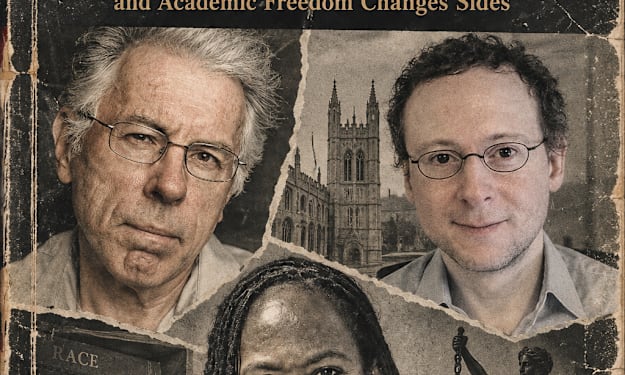
Introduction: Two Scholars on the Forbidden Border There is an extraordinary paradox hidden inside one of the most uncomfortable intellectual controversies of contemporary academia. On one side stands Kevin MacDonald, an American psychologist whose attempt to interpret Judaism through evolutionary psychology made him one of the most condemned academics of his generation. His central hypothesis—that Judaism can be analysed as a “group evolutionary strategy”—was attacked by scholars as methodologically defective and by numerous critics as antisemitic. His own university colleagues publicly distanced themselves from his work. Yet MacDonald was not simply expelled from academic life: California State University, Long Beach explicitly defended his academic freedom while simultaneously repudiating his conclusions. On the other side of the paradox stands Nathan Cofnas, an academic of Jewish background who became one of MacDonald’s most formidable scholarly critics. In 2018, Cofnas subjected MacDonald’s argument to detailed examination and concluded that it depended upon misrepresented sources and cherry-picked evidence. But Cofnas was hardly a conventional progressive critic of controversial research. His own writings about race, heredity and intelligence subsequently generated fierce accusations of racism and brought serious institutional consequences. Years later, after publicly scrutinising the work of the Black Cambridge academic Jason Arday and alleging plagiarism and other problems, Cofnas himself was suspended by Ghent University while disciplinary proceedings examined his conduct.
By Peter Ayolov2 months ago in Critique