Essay
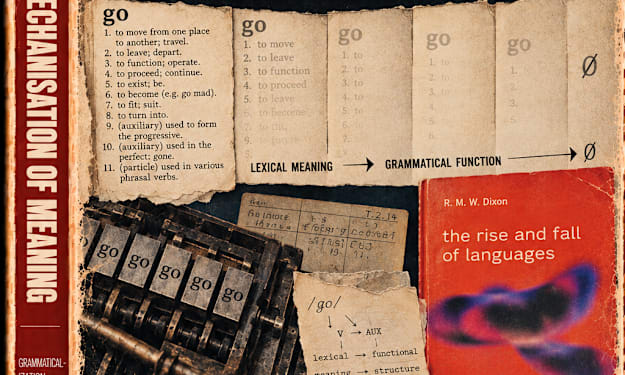
The Mechanisation of Meaning: Grammaticalization, Semantic Bleaching and the Future of Language
Introduction: When Language Begins to Forget Itself Languages do not simply accumulate words throughout history. They also lose them. More precisely, they lose the meanings that once made those words vivid expressions of human experience. Linguistic evolution is therefore not only a history of invention but also a history of erosion. Processes such as grammaticalization, semantic bleaching and the linguistic cycle demonstrate that language continually moves from concrete experience toward increasingly abstract, automatic and economical forms. This transformation is entirely natural from the perspective of historical linguistics, yet it also raises a broader philosophical question. What happens when language becomes progressively detached from the moral, emotional and cultural worlds from which it originally emerged? The movement from lexical richness toward grammatical efficiency mirrors many of the defining tendencies of modern civilization itself: automation, bureaucracy, technological rationalization and artificial intelligence. Language increasingly becomes a mechanism for transmitting information rather than preserving human experience. Daniel Cochrane’s reflections on Babel, Schopenhauer’s ethics, Robert Dixon’s linguistic cycle and modern theories of grammaticalization all point toward a common concern. Language may continue functioning perfectly while gradually forgetting why it exists. The danger is therefore not linguistic change itself but the possibility that communication becomes technically flawless while losing its ability to cultivate compassion, historical memory and moral responsibility. Artificial intelligence accelerates this tendency by perfecting the mechanics of language without participating in the human experiences that originally gave words their meaning. The future of civilization may therefore depend upon preserving not simply language but the humanity embedded within it.
By Peter Ayolovabout a month ago in Critique
The Postmodern Prophet: Alexandre Kojève and the Invention of the Last Human
Introduction: The Philosopher Who Announced the End of Man Few twentieth-century philosophers exercised such enormous influence while remaining relatively unknown outside academic circles as Alexandre Kojève. His celebrated lectures on Hegel’s Phenomenology of Spirit transformed French philosophy and profoundly influenced Jean-Paul Sartre, Jacques Lacan, Georges Bataille and many of the thinkers who would later shape structuralism and postmodernism. Yet Kojève was never merely an interpreter of Hegel. He radically reconstructed Hegel’s philosophy through the combined influences of Marx, Heidegger and revolutionary politics, producing one of the most influential visions of modern history. At the centre of this reconstruction stands the famous doctrine of the “end of history.” Unlike later liberal interpretations, Kojève did not celebrate the triumph of one political system over another. He argued instead that history itself would culminate in a universal and homogeneous state where ideological conflicts disappear, universal recognition becomes institutionalised and human existence loses the struggle that once defined it. The consequence is the emergence of the “last man”—a being liberated from historical conflict yet simultaneously deprived of the creative tension that made philosophy, politics and art possible. Kojève therefore appears not simply as a philosopher of modernity but as one of the first genuine theorists of postmodern civilization. He anticipated a society governed increasingly by administration, bureaucracy, consumption and universal equality, where revolutionary history gives way to permanent management. His philosophy continues to illuminate contemporary debates surrounding globalization, the European Union, artificial intelligence and the exhaustion of grand political narratives because it confronts a question that remains unresolved: what becomes of humanity after history has fulfilled its own purpose?
By Peter Ayolovabout a month ago in Critique
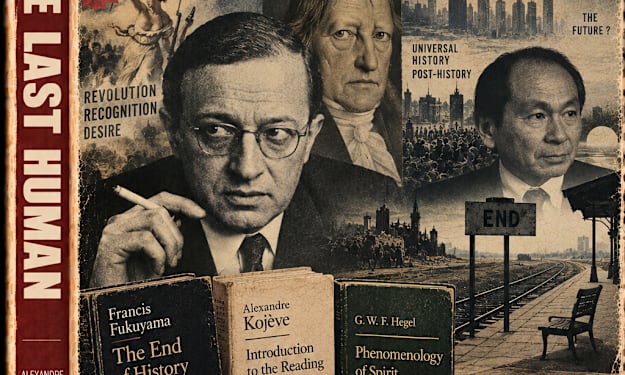
The Last Human: Alexandre Kojève, the End of History and the Death of the Future
Introduction: What Happens After History Ends? Most political philosophies attempt to explain how history advances. Alexandre Kojève asked a far stranger question: what happens when history no longer has anywhere to go? His celebrated interpretation of Hegel transformed the traditional understanding of historical development by arguing that humanity moves toward a final stage in which ideological conflicts disappear, universal recognition becomes possible and political evolution reaches completion. The end of history, however, does not mean that events cease to occur. Rather, it signifies the exhaustion of humanity’s creative historical mission. Once freedom, equality and material security become institutionalised, struggle itself loses its historical purpose. The result is the emergence of the “last man”—a figure who enjoys unprecedented comfort but no longer possesses the existential tension that once generated philosophy, politics, art and revolution. Kojève’s vision has often been interpreted as a celebration of liberal democracy, particularly after Francis Fukuyama popularised the phrase “the end of history.” Yet Kojève’s own position was considerably more complex. He imagined a universal and homogeneous state synthesising elements of capitalism and socialism, governed increasingly through rational administration rather than ideological conflict. His reflections raise questions that have become even more urgent in the age of artificial intelligence. If machines gradually assume productive labour and bureaucratic decision-making, what remains uniquely human? If history reaches completion, does humanity become truly free, or does it merely become comfortable? Kojève’s philosophy ultimately forces modern civilization to confront the unsettling possibility that the greatest danger awaiting humanity is not catastrophe but success itself.
By Peter Ayolovabout a month ago in Critique
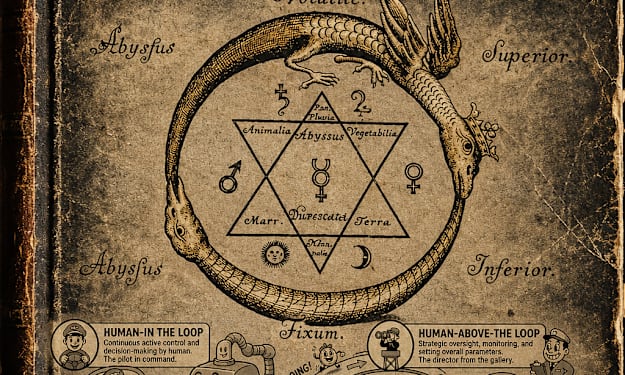
The Kekulé Loop: When Language Begins Eating Its Own Tail
Introduction: The Second Kekulé Dream In 1865, the German chemist August Kekulé famously recounted a strange dream that supposedly solved one of chemistry’s greatest puzzles. Exhausted after years of trying to understand the mysterious structure of benzene, he drifted into sleep and saw atoms dancing before his eyes until they transformed into a serpent seizing its own tail. The image of the Ouroboros suddenly revealed what mathematics alone had failed to show: benzene was not an open chain but a closed ring. Whether the story is historically accurate matters less than the metaphor itself. The dream became one of science’s greatest Eureka moments, demonstrating how an image could reveal a hidden structure invisible to ordinary reasoning.
By Peter Ayolovabout a month ago in Critique
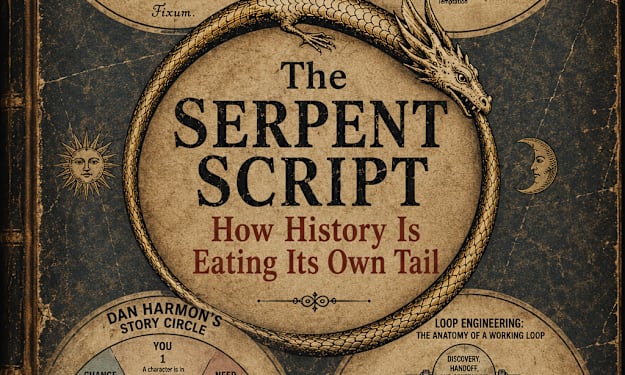
The Serpent Script: How History Is Eating Its Own Tail
Introduction: The Second Kekulé Dream of Storytelling In 1865 August Kekulé claimed that the structure of benzene revealed itself to him in a dream. He watched atoms dancing until they suddenly became a serpent biting its own tail. The ancient image of the Ouroboros solved a scientific mystery that years of conscious reasoning had failed to unravel. Whether the dream happened exactly as Kekulé later described is almost irrelevant. What matters is that a circular image revealed the hidden architecture of something previously believed to be linear. Chemistry discovered that one of its most important molecules was not an open chain but a closed loop.
By Peter Ayolovabout a month ago in Critique
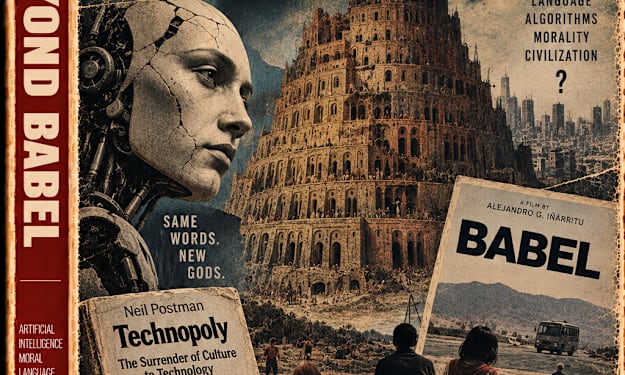
Beyond Babel: Artificial Intelligence, Moral Language and the Future of Human Civilization
Introduction: The Tower Is Built from Words Artificial intelligence is often described as a technological revolution, yet its deepest foundation is neither silicon nor electricity but language. Long before computers existed, language itself functioned as humanity’s first and greatest technology. It enabled memory, cooperation, culture, law, religion and civilization. Daniel Cochrane’s reflections on the Tower of Babel suggest that artificial intelligence should therefore be understood not merely as another machine but as the latest stage in the evolution of linguistic technology. The biblical story of Babel is not simply an ancient myth explaining linguistic diversity. It is a profound meditation on the relationship between language, technology, power and morality. Humanity’s greatest danger was never technological knowledge itself but the combination of unlimited technical capability with insufficient moral restraint. Today, large language models recreate this ancient paradox. Never before has language itself become so programmable, reproducible and universally accessible. Artificial intelligence promises unprecedented communication while simultaneously threatening to eliminate the diversity, friction and misunderstanding through which genuine human cultures have historically developed. The central question is therefore no longer whether machines can speak. It is whether humanity can remain morally responsible once language itself becomes automated. Babel returns not because machines have become intelligent but because humanity once again mistakes linguistic power for wisdom. The future of civilization will depend less upon creating more powerful technologies than upon rediscovering the ethical foundations that once restrained humanity’s own ambitions.
By Peter Ayolovabout a month ago in Critique
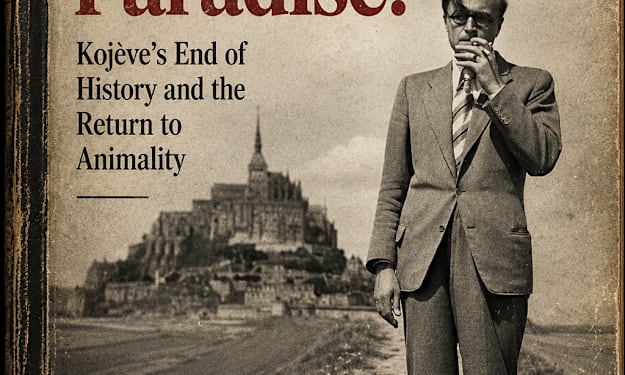
The Last Man’s Paradise: Kojève’s End of History and the Return to Animality
Introduction: When the End Finally Arrived Alexander Kojève’s interpretation of Hegel, most famously developed through his influential lectures on the Phenomenology of Spirit, transformed one of philosophy’s most obscure ideas into one of the defining political myths of the twentieth century. His vision of the “End of History” suggested that human history was not an endless succession of events but a finite process driven by one uniquely human force: the struggle for recognition. Every revolution, empire, ideology, religion and political movement represented another attempt by human beings to gain acknowledgement from one another as free and equal individuals. Once universal recognition had finally been achieved, history, understood as the dramatic struggle that distinguished humanity from mere biological existence, would simply stop. Humanity would enter a post-historical age in which political conflict, ideological revolutions and existential battles would gradually disappear. What remained would no longer be heroic history but administration, consumption, management and routine. As Kojève provocatively suggested, the “Last Man” would slowly return to a form of animality—not because civilisation had collapsed, but because it had succeeded.
By Peter Ayolovabout a month ago in Critique
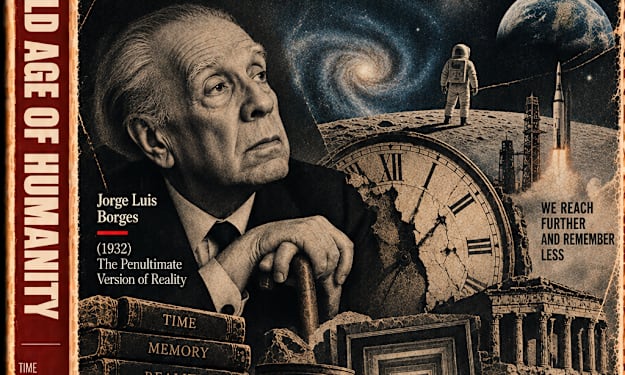
The Old Age of Humanity: Time Against Space and the Last Revolution of Consciousness
Introduction: Humanity Has Conquered Space but Forgotten Time Modern civilization celebrates the conquest of space. History is measured by expanding empires, larger cities, longer roads, faster transportation and the continuous occupation of new territories. Progress itself has become synonymous with geographical expansion, economic growth and technological acceleration. Yet Jorge Luis Borges proposes a radically different perspective. Humanity’s true destiny has never been the domination of space but the mastery of time. Space belongs to matter, while time belongs to consciousness. Plants accumulate energy from the sun, animals conquer movement across landscapes, but human beings alone possess memory, anticipation and the awareness of duration. The greatest human achievement is therefore neither agriculture nor industry nor artificial intelligence. It is the capacity to collect centuries within a single consciousness. Modern materialism has reversed this hierarchy. It teaches humanity to measure success in kilometres, territories, possessions and physical expansion while neglecting the unique dimension that distinguishes human existence from every other form of life. Civilization consequently mistakes spatial conquest for historical maturity. The result is imperialism, endless competition and the accumulation of objects instead of experiences. Borges suggests that the next revolution cannot be political or technological. It must restore the forgotten depth of time. Humanity has reached old age precisely because it has become obsessed with conquering space while abandoning its true inheritance: the conscious possession of the past and the imaginative creation of the future.
By Peter Ayolovabout a month ago in Critique
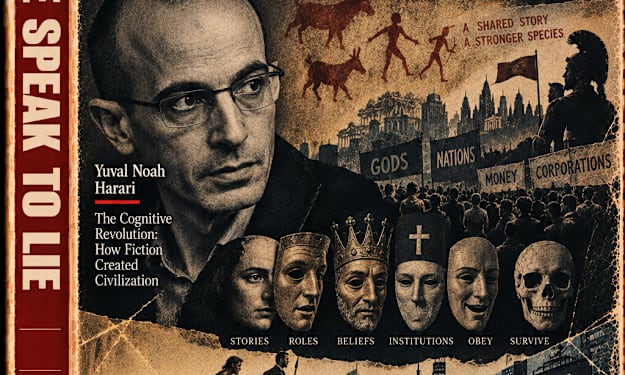
We Speak to Lie: Fiction, Cooperation and the Evolution of Human Deception
Introduction: The First Human Invention Was Not Truth but Fiction Human beings often celebrate language as the instrument through which truth became possible. Yet evolutionary psychology, anthropology and cognitive science increasingly suggest the opposite conclusion. Language did not evolve primarily to describe reality accurately but to organize cooperation among increasingly complex social groups. Ian Leslie, Yuval Noah Harari and many evolutionary theorists argue that lying, imagination, myth-making and storytelling are not unfortunate by-products of language but among its original functions. Humans became successful not because they perceived reality more accurately than other animals, but because they learned to create convincing fictional realities capable of coordinating thousands and eventually millions of strangers. Every civilization depends upon stories that do not physically exist yet produce entirely real consequences. Gods, nations, money, corporations, constitutions, property, honour, justice and even history itself function as collectively maintained fictions. They survive because enough people continue behaving as though they are objectively real. The history of civilization is therefore also the history of increasingly sophisticated lies—not necessarily malicious lies, but useful symbolic constructions that generate cooperation, trust and common purpose. Human beings do not merely lie despite possessing language. They speak because language allows them to create realities that nature itself never provided. Truth remains important, but civilization itself rests upon carefully maintained fictions. The question therefore changes fundamentally. Instead of asking why people lie, we must ask why lying became one of humanity’s greatest evolutionary advantages.
By Peter Ayolovabout a month ago in Critique
The Outsourced Mind: Memory, Technology and the Myth of Natural Stupidity
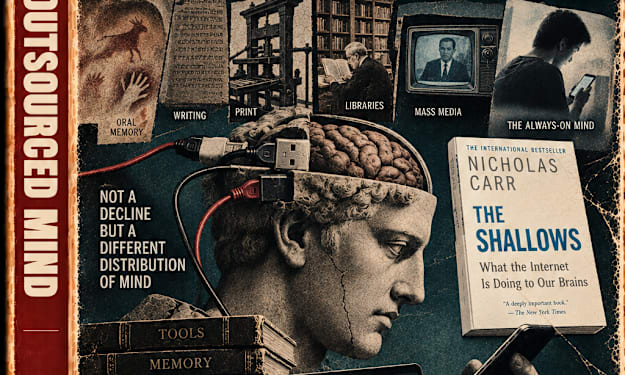
Introduction: Is Technology Making Us Stupid? The popular question “Is technology making us stupid?” is misleading because it assumes that stupidity is a natural property of the human brain. Nicholas Carr’s The Shallows suggests something far more interesting. Human intelligence has never been independent of its tools. Every major communication technology has reorganised the architecture of consciousness, from speech and writing to printing, television and the Internet. Human beings do not simply use technologies; technologies gradually redesign the ways they remember, think, imagine and understand the world. The history of civilization is therefore also the history of cognitive prostheses. Every technological breakthrough promises liberation while simultaneously introducing a new form of dependence. Writing frees memory yet weakens remembering. Printing democratizes knowledge while overwhelming readers with information. Digital networks connect billions while fragmenting attention into countless interruptions. Artificial intelligence promises to think for us while threatening to eliminate thinking as a personal activity altogether. The problem, therefore, is not natural stupidity. Human beings are not becoming biologically less intelligent. Rather, intelligence is continually reorganised around external systems that increasingly perform cognitive functions once carried out internally. The greatest danger lies not in machines becoming intelligent but in people gradually abandoning the slow mental practices through which intelligence originally emerged. Memory, concentration and judgment are not natural gifts. They are cultural achievements requiring continuous exercise. When these practices disappear, civilization risks producing not a society of naturally stupid individuals but a society whose intelligence has been systematically outsourced to technology.
By Peter Ayolovabout a month ago in Critique
The Courage to Speak: Parrhesia, Power and the Death of the Author
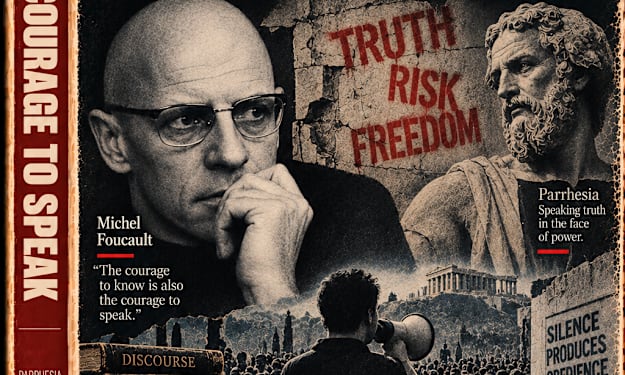
Introduction: Why Truth Is Always Dangerous Truth has never been merely a question of correspondence between words and reality. Throughout history, the greatest danger has not been discovering the truth but daring to speak it before those who possess power. Michel Foucault revived the ancient Greek concept of parrhesia —fearless truth-telling—not simply as freedom of speech but as a moral practice in which the speaker knowingly risks reputation, exile, imprisonment or death for the sake of truth. Parrhesia differs fundamentally from rhetoric. The rhetorician seeks persuasion regardless of truth, while the practitioner of parrhesia binds his own life to the truth he speaks. This ethical relationship between speaker, truth and political power became one of the central foundations of Greek democracy and later evolved into one of the defining questions of modern philosophy. Yet modernity transformed this relationship. The public sphere became increasingly regulated by institutions, authorship became a mechanism of control, discourse acquired rules of exclusion, and truth itself became administered by bureaucracies, academic disciplines and systems of legitimacy. Speaking truth to power gradually became speaking within power. Foucault therefore asks not simply who possesses the truth but who is allowed to speak, under what conditions, and at what personal cost. The genealogy of modern discourse reveals that truth is inseparable from courage, while language itself becomes one of the principal battlefields upon which freedom, obedience and human dignity are negotiated. The history of civilization may therefore be understood as the continual struggle between fearless speech and the institutions seeking to regulate, authorise and domesticate it.
By Peter Ayolovabout a month ago in Critique
The Gods of Postmodernity: Enlightenment, Crowds and the New Religion of Money
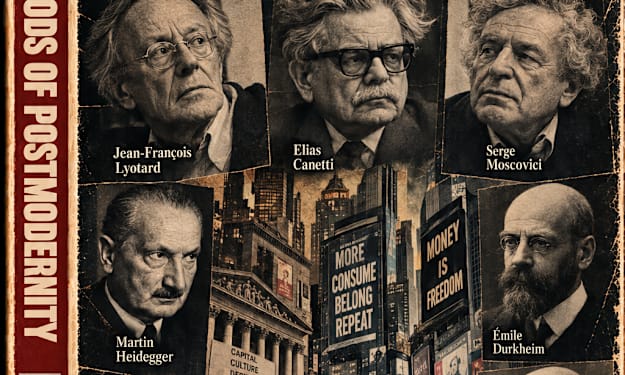
Introduction: After the Death of God Came the Religion of Everything The Enlightenment promised humanity liberation through reason. Superstition would disappear, science would replace myth, bureaucracy would replace arbitrary power, democracy would replace tyranny, and rational debate would overcome fanaticism. Yet the twentieth century produced a remarkable paradox. The more rational modern civilization became, the more irrational its everyday life appeared. Rick Roderick, Jean-François Lyotard, Elias Canetti, Serge Moscovici, Martin Heidegger, Émile Durkheim and Georg Simmel each described different aspects of this contradiction. The Enlightenment did not destroy mythology. It transformed it. Instrumental reason became intertwined with new myths of progress, bureaucracy, science, technology, money and permanent consumption. Television banalized reality, scientific narratives replaced religious narratives, money displaced language as the universal medium of social interaction, while crowds continued searching for prophets, sacred symbols and collective missions. Human beings did not become less religious after modernity. They merely changed their gods. Bureaucracies replaced churches, scientific institutions inherited the authority once possessed by theology, markets became new temples, and currencies became new totems around which modern societies organised themselves. The crisis of contemporary civilization therefore cannot be understood as the disappearance of belief. It is the multiplication of beliefs hidden beneath the language of rationality. The greatest illusion of modernity is not that people continue believing in myths, but that they believe themselves to have escaped mythology altogether. The postmodern condition therefore represents neither the end of reason nor the triumph of irrationality. It is the complete entanglement of both, where every rational system quietly produces its own sacred objects, rituals and unquestionable truths.
By Peter Ayolovabout a month ago in Critique