Essay
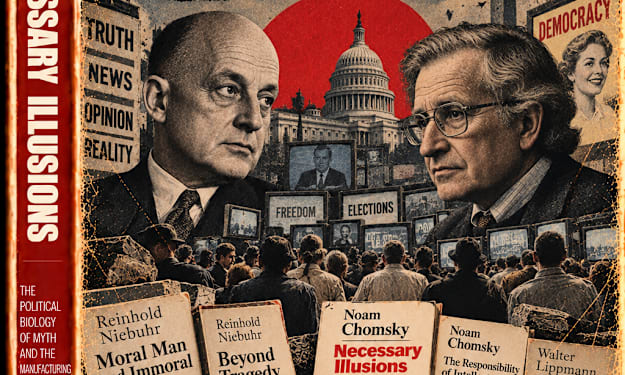
Necessary Illusions: The Political Biology of Myth and the Manufacturing of Reality
Introduction: Is Democracy Built on Truth or on Necessary Lies? Modern democratic societies proudly define themselves as political systems founded upon free discussion, rational deliberation and informed public consent. Citizens are presumed to make independent judgments after evaluating competing arguments presented in an open marketplace of ideas. Yet one of the twentieth century’s most influential political theologians, Reinhold Niebuhr, proposed a profoundly different understanding of democracy. Human beings, he argued, are not primarily rational creatures. The average citizen responds less to evidence than to emotionally powerful stories, myths and simplified moral narratives. Consequently, democratic societies cannot function through reason alone. They require what Niebuhr famously called necessary illusions —emotionally potent oversimplifications deliberately constructed by educated elites to mobilize populations toward politically desirable goals. This disturbing argument stands in direct opposition to the democratic ideal of autonomous citizenship. If democracy depends upon manipulation, then public consent becomes something manufactured rather than freely formed. Decades later, Noam Chomsky transformed Niebuhr’s insight into a devastating critique of modern liberal societies. What Niebuhr regarded as a necessary instrument for maintaining democratic order, Chomsky interpreted as an elaborate machinery of propaganda serving political and economic elites. Between these two thinkers emerges one of the defining philosophical conflicts of the modern age. Are myths indispensable instruments of civilization, or are they mechanisms of domination? More fundamentally, does language primarily communicate truth, or does it manufacture realities that organize collective behaviour? The debate reaches far beyond politics. It concerns the biological function of language itself. If humans evolved not primarily to discover truth but to coordinate large social groups, then necessary illusions may not represent an accident of history but one of language’s oldest evolutionary functions.
By Peter Ayolov29 days ago in Critique
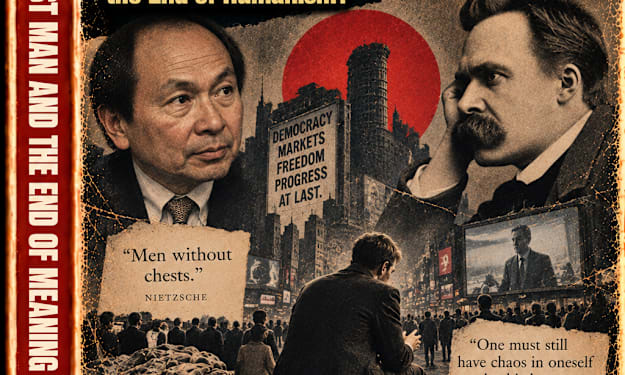
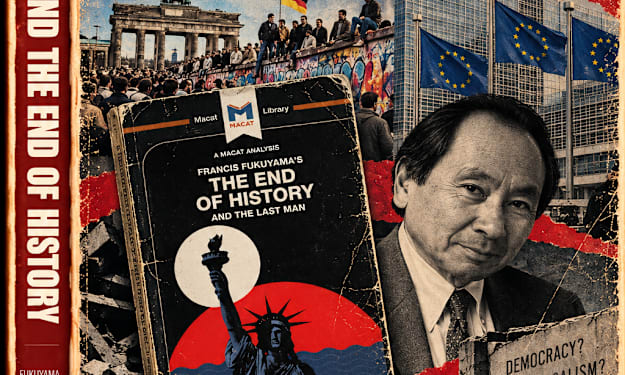
The Last Man and the End of Meaning: Fukuyama, Nietzsche and the Biological Exhaustion of Liberal Democracy
Introduction: Does the End of History Mean the End of Humanity? Few political ideas have generated as much debate as Francis Fukuyama’s interpretation of Alexandre Kojève’s famous thesis concerning the End of History . Frequently misunderstood as a celebration of liberal democracy, Fukuyama’s argument is in fact a profound anthropological question concerning the future of human nature itself. If history is fundamentally driven by the struggle for recognition, what happens once universal recognition has supposedly been achieved? If every citizen receives equal legal dignity within a liberal democratic state, what remains for humanity to desire? Kojève answered that history ends because the universal and homogeneous state finally satisfies the deepest human longing. Nietzsche answered exactly the opposite. Universal satisfaction destroys the very qualities that made humanity human. The heroic individual gives way to the Last Man —comfortable, secure, prosperous and utterly incapable of greatness. This conflict reveals one of the deepest paradoxes of modern civilization. Liberal democracy successfully protects individual rights, material prosperity and political equality, yet in doing so it may gradually eliminate precisely those psychological forces that created civilization in the first place. The ancient thymotic desire for honour, prestige and recognition becomes increasingly domesticated until only consumption, entertainment and procedural politics remain. Yet an even deeper question emerges from this debate. Is the struggle for recognition truly the highest expression of humanity, or does liberal democracy merely reveal that prestige itself is another biological instinct gradually losing its evolutionary function? Perhaps the end of history represents not the perfection of humanity but the exhaustion of one particular evolutionary strategy. If so, the Last Man is not civilization’s final achievement but a transitional biological form awaiting an entirely new conception of human dignity.
By Peter Ayolov29 days ago in Critique
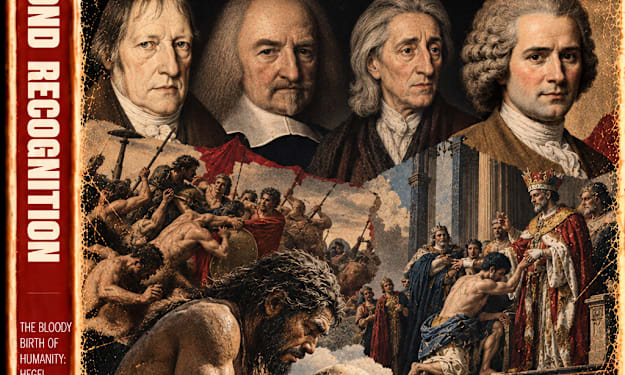
Beyond Recognition: The First Human Between Prestige and Humility
Part I. The Bloody Birth of Humanity: Hegel, Hobbes and the First Man Few philosophical myths have exercised greater influence on modern political thought than the Hegelian story of the first human being. Interpreted most famously by Alexandre Kojève and later developed by Francis Fukuyama, this narrative locates the birth of humanity not in labour, language or cooperation, but in a violent struggle for recognition. According to this interpretation, freedom begins precisely where biological nature ends. Human beings cease to be merely animals when they become capable of risking their own lives for something that possesses no biological value whatsoever. The first human confrontation is therefore neither a struggle for food nor territory nor reproduction, but a struggle for prestige , honour and recognition . Unlike every other living creature, the first man demonstrates his humanity by willingly placing symbolic value above survival itself. Freedom is thus defined as the ability to transcend instinct through moral choice.
By Peter Ayolov29 days ago in Critique
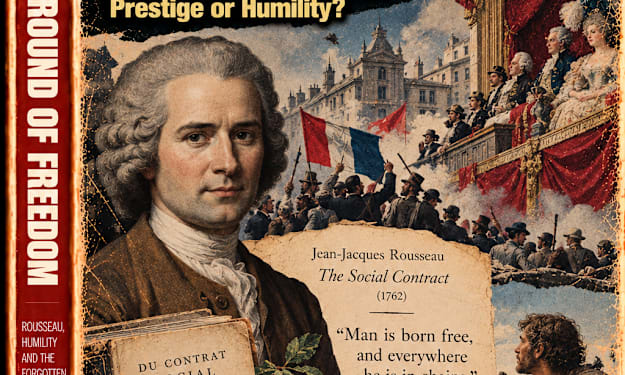
The Ground of Freedom: Rousseau, Humility and the Forgotten Origin of Human Dignity
Introduction: Does Freedom Begin with Prestige or Humility? Jean-Jacques Rousseau’s The Social Contract (1762) begins with one of the most famous sentences in political philosophy: “Man is born free, and everywhere he is in chains.” The paradox immediately establishes the central problem of modern political thought. Human beings possess natural freedom, yet every historical society limits, disciplines and regulates that freedom through institutions, laws and customs. Rousseau’s revolutionary solution was neither the glorification of absolute individual liberty nor submission to arbitrary authority. Instead, he proposed that genuine freedom emerges only when individuals voluntarily obey laws that they collectively prescribe for themselves. Moral liberty replaces instinct. Civil equality replaces natural inequality. Human beings become truly free precisely by participating in the creation of a common political order.
By Peter Ayolovabout a month ago in Critique
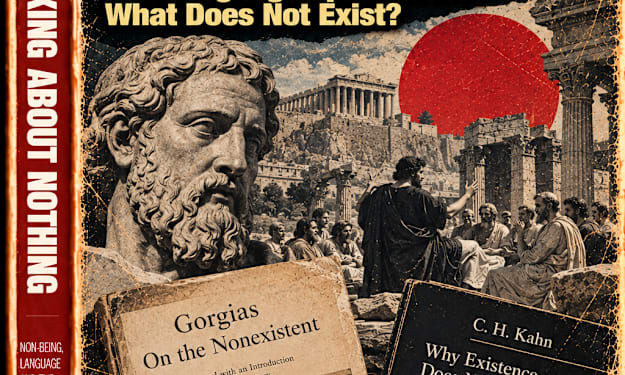
Speaking About Nothing: Non-Being, Language and the Triumph of Sophistry
Introduction: Can Language Speak About What Does Not Exist? Few questions have occupied philosophy more persistently than the relationship between language and reality. Every time human beings speak, they assume that words somehow correspond to things, events, ideas or experiences. Yet one of the oldest paradoxes in Western thought immediately challenges this assumption: if language refers to reality, how can it successfully refer to what does not exist? Every language contains countless words that have no direct counterpart in the material world. We speak effortlessly about ghosts, justice, unicorns, infinity, democracy, morality, the soul, emptiness, tomorrow, the past and countless abstract entities that cannot be pointed to as physical objects. Even the word language itself is an abstraction rather than an observable object. This paradox became one of the central philosophical problems of ancient Greece. Parmenides insisted that non-being cannot be thought or spoken because thinking already grants it a form of existence. Gorgias radicalized this position by arguing that nothing exists, and even if something exists it cannot be known, and even if it can be known it cannot be communicated. Plato attempted to rescue both philosophy and rational discourse by redefining non-being not as absolute nothingness but as otherness , thereby making falsehood and illusion philosophically intelligible. Behind these apparently abstract disputes lies one of the deepest questions concerning language itself. Is language primarily a tool for describing reality, or is its principal function something entirely different? If much of what language discusses consists of abstractions, fictions, values and imagined possibilities rather than material objects, perhaps the real purpose of language has never been the faithful description of reality. Perhaps language evolved primarily to persuade, organise, influence, coordinate and manipulate human behaviour. In that case, sophistry rather than philosophy may represent the normal condition of language. The ancient debate about non-being therefore anticipates many contemporary discussions concerning communication, politics, artificial intelligence and the biological function of speech itself.
By Peter Ayolovabout a month ago in Critique
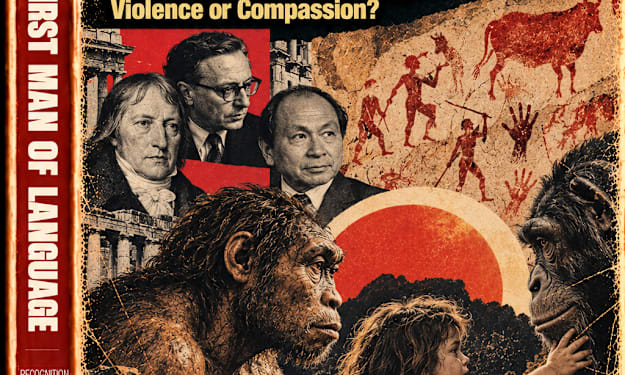
The First Man of Language: Recognition, Compassion and the Biological Origin of Human Freedom
Introduction: Was Humanity Born Through Violence or Compassion? Francis Fukuyama’s interpretation of Alexandre Kojève’s reading of Hegel places one dramatic event at the very beginning of human history: a bloody struggle for recognition . Before economics, before politics, before religion, before civilization itself, there stood two human beings confronting one another, each demanding to be recognized as something more than a biological organism. This primordial encounter was not motivated by hunger, reproduction or survival. Quite the opposite. According to Kojève, the first truly human act consisted in the willingness to sacrifice life itself for something entirely symbolic—prestige, honour, dignity and recognition. Humanity was therefore born not through labour but through the voluntary risk of death. This interpretation has become one of the most influential philosophical myths of modern political thought, shaping thinkers from Jean-Paul Sartre to Francis Fukuyama himself. Yet it also raises one of the deepest questions about human nature. Is the willingness to kill and die over symbolic values really the defining characteristic of humanity? Does recognition necessarily require domination? Must history begin with violence? Or is there another possibility that Hegel overlooked? The very linguistic history of words such as compassion , sympathy , empathy , prestige , passion and recognition suggests an entirely different genealogy of human civilization. Whereas Hegel locates human dignity in the contempt for biological survival, the language of compassion points toward another uniquely human capacity: the ability to suffer together with another rather than against another. Instead of defining freedom through the willingness to kill, compassion defines freedom through the willingness to restrain violence despite possessing the capacity for it. The conflict between prestige and compassion therefore becomes much more than a disagreement about ethics. It becomes a disagreement about the biological origin of humanity itself. Did language emerge primarily to organize struggles for recognition, or did it evolve first as an instrument for cooperation, mutual care and social cohesion? The answer fundamentally alters our understanding of history, politics and the very meaning of being human.
By Peter Ayolovabout a month ago in Critique
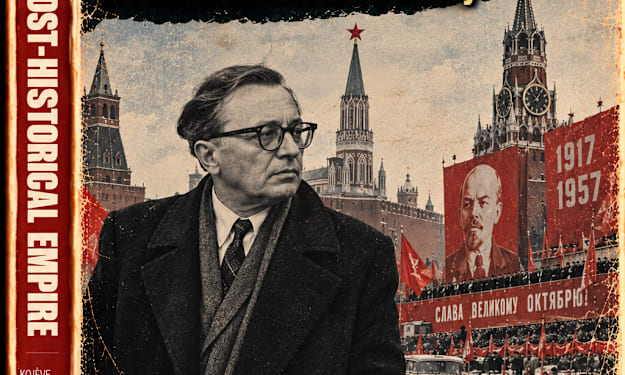
The Post-Historical Empire: Alexandre Kojève, Soviet Russia and the Cold War Beyond Politics
Introduction: Moscow After the End of History Alexandre Kojève’s unpublished memorandum “Moscow, August 1957” occupies a unique place in twentieth-century political philosophy because it reveals the extraordinary tension between his famous theory of the End of History and the rapidly changing political reality of the Cold War. Few philosophers have attempted to unite abstract Hegelian philosophy with direct diplomatic observation as consistently as Kojève. While serving as one of France’s most influential civil servants during the negotiations that eventually produced the European Economic Community, Kojève simultaneously continued developing one of the most ambitious philosophical systems of the twentieth century. His visit to the Soviet Union during Khrushchev’s Thaw confronted him with an apparent contradiction. According to his own philosophical system, history had already reached its conclusion. Liberal democracy, Soviet communism and the post-war international order represented different administrative forms of the same universal historical process. Yet everywhere around him history appeared to continue. Stalin had died only four years earlier. Khrushchev had denounced Stalin’s crimes, Hungary had exploded into revolution, the Cold War intensified through nuclear competition, European integration accelerated under the Treaty of Rome, and decolonisation was transforming global politics. Instead of abandoning his philosophy, Kojève interpreted these dramatic developments as confirmation of its deepest assumptions. Political conflict, he argued, had not disappeared but had fundamentally changed its nature. The great ideological struggles that once transformed civilizations had given way to administrative competition between vast technological empires pursuing essentially identical goals. His Moscow memorandum therefore offers far more than observations about Soviet society. It presents one of the earliest philosophical attempts to understand the Cold War as a fundamentally post-political phenomenon and reveals how Kojève increasingly modified his famous End of History thesis in response to the realities of the late 1950s.
By Peter Ayolovabout a month ago in Critique
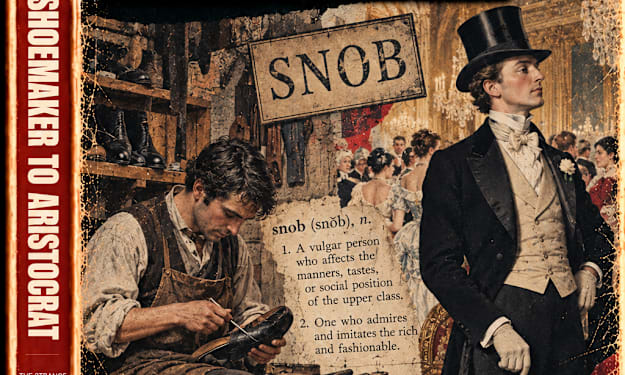
From Shoemaker to Aristocrat: The Strange Genealogy of the Word “Snob”
Introduction: A Word That Changed Social Direction The history of the English word snob is one of the most fascinating examples of semantic evolution in the modern language because almost every modern speaker misunderstands both its original meaning and its historical development. Today, the word immediately evokes images of wealthy elites, cultural pretension, refined tastes and social exclusiveness. A snob is generally understood as someone who believes himself superior to others because of education, wealth, culture or social status. Yet none of these meanings belonged to the word when it first appeared in English during the eighteenth century. Far from describing aristocrats or people aspiring to nobility, snob originally referred to something remarkably ordinary: a shoemaker or the apprentice of a shoemaker. From this humble occupational beginning, the word gradually travelled through university slang, class distinctions, Victorian social criticism and twentieth-century psychology before acquiring its present meaning. Along the way, numerous false explanations emerged, the most famous being the charming but entirely mythical claim that snob derives from the Latin phrase sine nobilitate (”without nobility”), supposedly abbreviated as “s. nob.” beside the names of commoners attending English schools. Although the story continues to circulate because of its elegance and simplicity, historical evidence demonstrates that it is entirely unfounded. The real history of snob is far more revealing because it exposes how language itself reflects changing social hierarchies, economic transformations and cultural anxieties. The evolution of a single word allows us to observe the emergence of modern class consciousness, the decline of hereditary aristocracy and the birth of new forms of symbolic distinction that would later fascinate thinkers such as Thorstein Veblen, Pierre Bourdieu and Alexandre Kojève. The genealogy of snob is therefore not merely a linguistic curiosity but a miniature history of modern society itself.
By Peter Ayolovabout a month ago in Critique
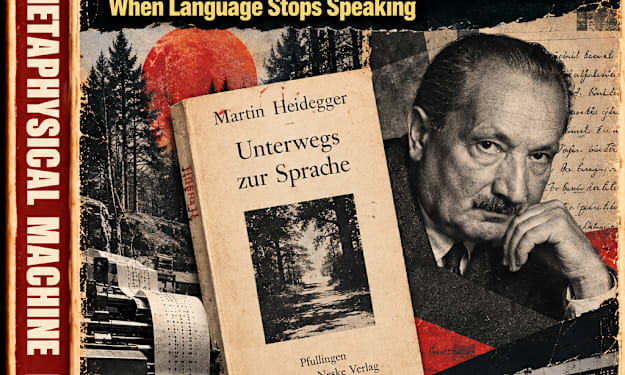
The Metaphysical Machine: Heidegger, Metalanguage and the Technical Conquest of Speech
Introduction: When Language Stops Speaking Martin Heidegger’s On the Way to Language represents one of the twentieth century’s most profound attempts to rethink the nature of language after centuries of metaphysics. Unlike traditional philosophy, which treated language as an instrument for representing reality or communicating information, Heidegger reverses the relationship entirely. Human beings do not first exist and then invent language as a convenient tool; rather, language is the condition that allows humanity to dwell within the world at all. It is the house of Being, the medium through which reality first appears as meaningful. Yet Heidegger believed that modern civilization was witnessing the gradual destruction of this primordial relation. Language was increasingly becoming an object of scientific analysis, technical regulation and computational manipulation. Linguistics, analytic philosophy, symbolic logic and the emerging sciences of information all shared a common ambition: to transform natural language into a precise technical instrument capable of universal operation. Heidegger called this tendency metalinguistics , arguing that it was not merely another branch of linguistics but the final expression of Western metaphysics itself. His provocative declaration that “Metalinguistics and rocketry are the same” was not intended as rhetorical exaggeration but as a diagnosis of an entire civilization. Rockets, computers, cybernetics and metalanguages all participate in the same historical movement—the technological reduction of reality into information, calculation and control. The question therefore becomes much larger than language itself. What happens to human existence once language is no longer experienced as the place where Being reveals itself but merely as another operational technology? Heidegger’s answer anticipates many contemporary concerns surrounding artificial intelligence, algorithmic communication, digital bureaucracy and computational linguistics. His reflections invite us to reconsider whether the future of language lies in increasingly sophisticated information systems or whether something uniquely human disappears whenever language becomes perfectly functional.
By Peter Ayolovabout a month ago in Critique
Beyond the End of History: Fukuyama, Postmodern Politics and the Plurality of the Good
Introduction: The Triumph That Became a Crisis When Francis Fukuyama published The End of History and the Last Man , many readers interpreted it as a triumphant proclamation that liberal democracy had permanently defeated all ideological rivals. Yet beneath its optimistic title lies a remarkably melancholic philosophy inherited almost entirely from Alexandre Kojève. Fukuyama’s central paradox is that the victory of liberal democracy simultaneously represents humanity’s greatest political achievement and its deepest spiritual loss. Universal equality, prosperity and peace appear to eliminate precisely those heroic struggles that once gave history its meaning. The result is the emergence of Nietzsche’s “last man”—comfortable, secure and materially satisfied, yet deprived of greatness, transcendence and historical purpose. This tension reveals that Fukuyama’s work is less a celebration of liberal democracy than an expression of the broader pessimism that shaped much postmodern political thought. His philosophy inherits Kojève’s tragic understanding of modernity while attempting to reconcile it with American optimism. The consequences extend well beyond the end of the Cold War. They influence contemporary debates about recognition, identity politics, postmodernism and the future of democracy itself. The question ultimately becomes whether equality necessarily destroys excellence or whether the very opposition between them rests upon a mistaken understanding of political life.
By Peter Ayolovabout a month ago in Critique
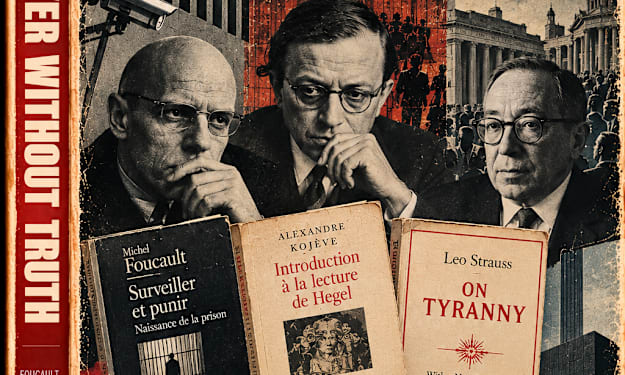
Power Without Truth: Foucault, Kojève, Strauss and the Genealogy of Postmodern Revolt
Introduction: When Truth Becomes a Political Technology Michel Foucault transformed one of philosophy’s oldest questions into one of its most unsettling investigations. Instead of asking whether truth exists, he asked how societies manufacture truth. This shift profoundly altered twentieth-century thought. Truth was no longer understood as the discovery of an objective reality waiting to be uncovered but as the outcome of historical struggles, institutional practices and relations of power. In this sense, Foucault radicalized Nietzsche’s genealogy while simultaneously extending many of Alexandre Kojève’s reflections on history, recognition and the exhaustion of modern civilization. Yet Foucault’s project reaches beyond epistemology. His genealogies of madness, punishment, sexuality and medicine reveal a society governed not primarily through force but through normalization, surveillance and the production of knowledge itself. Modernity appears not as the triumph of enlightenment but as the triumph of subtle forms of domination operating beneath the language of science, progress and reason. This diagnosis profoundly influenced postmodern philosophy by replacing universal truths with competing discourses and stable identities with historical constructions. Yet Foucault’s work also raises a profound paradox. If every truth is merely an expression of power, what status can his own philosophy possibly claim? His answer is neither skepticism nor relativism but perpetual critique. Philosophy no longer discovers eternal foundations. Instead, it continuously exposes the historical conditions that make particular truths possible. The consequence is a vision of history driven less by progress than by endless acts of deconstruction.
By Peter Ayolovabout a month ago in Critique
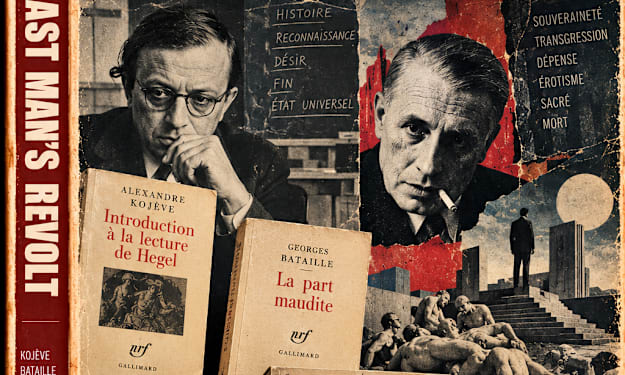
The Last Man’s Revolt: Kojève, Bataille and the Birth of Postmodernism
Introduction: From the End of History to the End of Meaning If Alexandre Kojève announced the end of history, Georges Bataille asked what kind of humanity could survive after history had ended. Together they occupy a decisive place in the genealogy of postmodernism. Kojève described a future in which universal equality, technological prosperity and rational administration would eliminate the great struggles that had driven civilization. Bataille refused to accept this conclusion. Where Kojève saw completion, Bataille saw catastrophe. If reason conquered history completely, humanity itself would disappear beneath bureaucracy, utility and economic calculation. The result would not be liberation but an unprecedented form of spiritual exhaustion. Their disagreement became one of the defining moments of twentieth-century philosophy because it anticipated many of the central concerns of postmodern thought: the suspicion of universal reason, the rejection of grand narratives, the celebration of transgression and the search for authenticity beyond modern institutions. Yet both thinkers remained prisoners of the same Hegelian framework. They accepted that history moved toward a decisive culmination, differing only over whether this destination represented fulfilment or disaster. The dialogue between Kojève and Bataille therefore reveals the philosophical origins of contemporary debates surrounding technology, consumer society, identity politics and artificial intelligence. Their arguments continue shaping discussions about whether modern civilization represents humanity’s greatest triumph or its gradual disappearance.
By Peter Ayolovabout a month ago in Critique