Essay
The Manufacture of Deviance 2.0: The Economic Policy of Online Atrocities
(From the series: The Economic Policy of Online Media: Manufacture of Dissent, 2023) Abstract This article develops the concept of the “Manufacture of Deviance* 2.0” as an extension of the economic model proposed in The Economic Policy of Online Media: Manufacture of Dissent. It argues that the transition from traditional mass media to decentralised digital platforms has produced not simply a transformation in the distribution of violent imagery, but a new economic relationship between attention, taboo and atrocity. Traditional broadcast media developed institutional and ethical mechanisms intended to restrict representations of real torture, mutilation and death. The online attention economy partially reverses this logic: what is forbidden, disturbing, transgressive or difficult to access can acquire additional informational value precisely because of its exceptional character. As audiences become saturated with conventional news, entertainment and political controversy, increasingly extreme material can compete successfully for the scarce resource of human attention. Violence consequently becomes capable of generating multiple currencies simultaneously: advertising value, subscriptions, donations and cryptocurrency, but also views, followers, notoriety, group membership, prestige and social recognition. The article traces a genealogy from the spectacle of public punishment and execution, through the controversial appearance of uncensored atrocity footage on traditional television, to gore communities, extremist propaganda, cartel execution videos, closed social-media groups and contemporary networks of digitally performed vigilantism. Particular attention is given to the evolution of so-called “pedophile hunter” subcultures associated with Maxim “Tesak” Martsinkevich and Occupy Pedophilia, in which humiliation and violence could be transformed into reproducible performances possessing recognisable scripts, symbols and gestures. Rather than assuming the existence of a single organisation commissioning such violence, the article proposes a more disturbing possibility: networked media can reproduce violent behaviour without central command because attention, imitation, belonging and social currency themselves operate as incentives. Against this background, the article examines the 2026 Youth Hill case in Plovdiv, Bulgaria, involving teenagers accused of participating in the fatal assault and humiliation of a 37-year-old man after he had allegedly been lured to a meeting. The case is treated cautiously, distinguishing established information, prosecutorial allegations and media reporting from the broader theoretical interpretation developed here. It nevertheless provides a disturbing case through which to investigate the migration of violent spectacle from the screen into physical behaviour and its subsequent return to the screen as content. The article argues that this process resembles, in technologically transformed form, the public scaffold: the condemned sinner, the righteous crowd, ritual humiliation and spectacular punishment return within a global digital square in which spectators can simultaneously watch, judge, distribute and reward the spectacle. The Manufacture of Deviance 2.0 therefore describes a potentially advanced stage of the attention economy: not merely the monetisation of disagreement and outrage, but the conversion of transgression, cruelty and ultimately human suffering into communicative value.
By Peter Ayolov25 days ago in Critique
The Ghost from Egypt: How the Immortal Soul Conquered European Philosophy Twice
Abstract This article advances a deliberately provocative genealogy of what may be one of the most consequential ideas ever introduced into Western thought: the belief that the true human being is an invisible and potentially immortal entity residing within, yet fundamentally separable from, the mortal body. Rather than treating the history of the soul as a continuous discovery of an independently existing metaphysical reality, the article examines it as a transformation of concepts of life, death, interiority and transcendence that entered European philosophy through two distinct encounters with ancient Egypt. The first occurred in the archaic Mediterranean world, when Egyptian conceptions of posthumous existence, ritual purification and the complex constitution of the person encountered Greek religious and philosophical traditions and became associated, through processes that cannot be reduced to simple borrowing, with Orphism, Pythagoreanism, metempsychosis and ultimately the Platonic elevation of the immortal psyche above the mortal body. The second occurred more than two millennia later, when ancient Egypt returned to European philosophy as mystery, symbol, hieroglyph and enigma, becoming crucial to the German Idealist imagination and particularly to Hegel’s account of the historical emergence of Spirit. Taking as a contemporary point of departure the lecture “Hegel on Ancient Egypt: Where Spirit Began!” and placing it alongside Jon Stewart’s analysis of Hegelian interpretations of Egyptian religion, the article argues that Hegel’s opposition between the hidden inner and visible outer reproduces, on an enormously expanded philosophical scale, the ancient architecture of soul and body. Egypt appears in Hegel as the moment when Spirit struggles within natural and material form to liberate itself and become self-conscious. The individual ghost has become a philosophy of history. The article therefore proposes that the real historical danger of the immortal soul lies not simply in the promise of survival after death, but in the conceptual hierarchy it establishes between invisible abstraction and embodied existence. Once something supposedly eternal is declared more valuable than the mortal organism, bodies can be subordinated to souls, gods, Spirit, History, Nation, State, Class, Race, Revolution or Future. In this sense, the immortal soul may be understood as the prototype of the immortal abstraction: an idea potentially more dangerous than any individual weapon or pathogen because it can provide the symbolic justification through which the destruction of finite human beings is represented as sacrifice to something higher that supposedly cannot die.
By Peter Ayolov25 days ago in Critique
The Triumph of Nominalism
Introduction: The Philosophy That Quietly Built the Digital Age What if one of the oldest philosophical disputes in Western civilisation had already been decided—not by philosophers, but by machines? For centuries, the conflict between realism and nominalism remained one of the most abstract debates in philosophy, apparently confined to medieval monasteries, university lecture halls and specialist works on metaphysics. Yet beneath this seemingly technical controversy lay one of the most fundamental questions human beings can ask: do the concepts through which we understand the world correspond to objective realities, or are they merely names that we have invented to organise experience? Every scientific theory, every legal system, every political ideology, every religious doctrine and every act of communication depends upon how this question is answered. Whether we speak of justice, democracy, intelligence, humanity, freedom or truth, we inevitably assume either that these concepts possess an existence independent of language or that they are products of language itself. The debate over universals is therefore not an obsolete medieval curiosity but one of the hidden foundations of modern civilisation. As John Stuart Mill famously observed, there is nothing general except names, a statement that captures the central intuition of nominalism and simultaneously challenges nearly every philosophical tradition built upon eternal essences and objective categories.
By Peter Ayolov25 days ago in Critique
EVERYTHING IS A REMIX 2.0
Introduction: From Remix Culture to Remix Reality Kirby Ferguson’s landmark video essay series Everything is a Remix begins with a deceptively simple proposition that has gradually become one of the defining ideas of the digital age: originality is largely an illusion because every creative act is constructed from materials that already exist. Creativity, Ferguson argues, is fundamentally combinatorial. Artists, musicians, writers, filmmakers, programmers and designers do not create ex nihilo; instead, they copy, transform and combine existing ideas into new configurations. Hip-hop sampling, Hollywood remakes, internet memes, comic books, video games and artificial intelligence all demonstrate the same underlying principle. Remixing is not a marginal artistic technique but the hidden architecture of creativity itself. Ferguson illustrates this idea through dozens of examples ranging from DJ Kool Herc and Grandmaster Flash to Led Zeppelin, Quentin Tarantino, Spider-Man: Into the Spider-Verse and contemporary image-generating artificial intelligence, arguing that copying is not the opposite of creativity but its indispensable beginning. Everything, from music to cinema and from software engineering to internet culture, emerges through the endless recombination of previous cultural forms.
By Peter Ayolov25 days ago in Critique
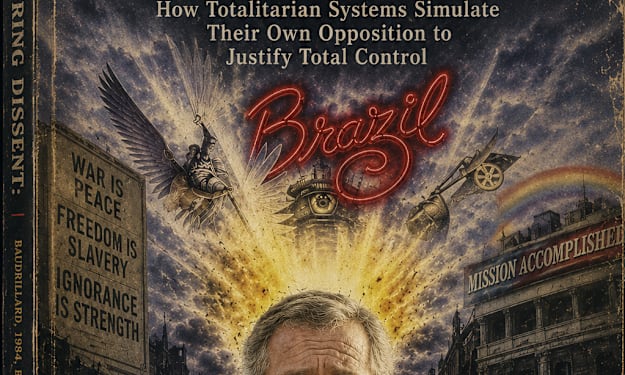
Manufacturing Dissent: Baudrillard, 1984, Brazil, and the Staged Enemy
On the Evolution of Propaganda “While classical propaganda in totalitarian and mass-media systems sought ideological unity through censorship and the Big Lie, the emerging Propaganda 2.0 model… monetises anger by manufacturing dissent and deliberately populating the public sphere with absurd, polarising narratives.” On Dissent as a Commodity “Within this model, dissent is not a failure of the system but its primary commodity: outrage, scandal, and perpetual disagreement function as renewable resources that can be continuously harvested, circulated, and monetised.” On the Illusion of the Enemy “Where anticommunism or the war on terror once provided a stable enemy, the platform environment produces a permanent culture war in which the target is endlessly replaceable… The propaganda system therefore no longer aims to secure belief but to sustain volatility.” “The Economic Policy of Online Media: Manufacture of Dissent” By Peter Ayolov, Routledge 2023
By Peter Ayolov25 days ago in Critique
Bulgarization: How National Independence Became Financial Dependence
Introduction: The Nation That Borrowed Its Freedom Every nation possesses two histories. The first is written in monuments, school textbooks, patriotic speeches and national holidays. It celebrates heroes, battles, revolutions and declarations of independence. The second history is written in ledgers, bank contracts, sovereign bonds, debt restructurings and bankruptcy agreements. One tells the story of freedom; the other records the price paid for it. Rarely do these two histories coincide. Even more rarely do historians attempt to read them together. Yet the modern history of Bulgaria cannot be understood without recognising that its political liberation and its financial dependence emerged almost simultaneously. The creation of the Bulgarian state after 1878 did not simply mark the end of Ottoman rule. It marked the beginning of another form of imperial integration—one organised not by armies or governors but by international finance, sovereign debt and the expanding capital markets of nineteenth-century Europe. The nation became politically independent precisely when it entered the global financial system. From that moment onward, the struggle for sovereignty increasingly unfolded not on battlefields but in negotiations with foreign creditors.
By Peter Ayolov26 days ago in Critique
The Self-Colonisation of a Nation and the Financialization of Sovereignty
Maria Todorova’s concept of Balkanism fundamentally transformed the study of the Balkans by demonstrating that the region is not merely a geographical space but a discursive invention of Western Europe. The Balkans became Europe’s “internal Other”—a place imagined as perpetually incomplete, semi-European, irrational and historically condemned to instability. Bulgaria occupies a particularly revealing position within this discourse. It is simultaneously inside Europe and outside its imagined civilisation, forever measured against a Western standard that it can never completely attain. Balkanism therefore explains how the West produces an image of the Balkans through a language of deficiency, backwardness and permanent transition.
By Peter Ayolov26 days ago in Critique
No Kings? Why Democracies Keep Inventing New Caesars
Introduction: The Republic’s Eternal Longing for the Crown “No Kings!” has become one of the defining political slogans of the present decade. It appears on banners, social media, protest marches and demonstrations as an apparently self-evident declaration that democracy and monarchy belong to incompatible worlds. The slogan assumes that the greatest political achievement of modern civilisation has been the elimination of hereditary authority and its replacement with elected representatives whose legitimacy derives exclusively from popular consent. It is the language of republicanism distilled into two simple words. Yet the very popularity of the slogan conceals a historical paradox. If societies genuinely no longer need kings, why do modern political systems continuously recreate figures who perform remarkably similar functions? Why do presidents, supreme leaders, constitutional courts, central banks, international financial institutions and supranational organisations increasingly occupy positions that ordinary citizens neither directly control nor fully understand? The disappearance of crowns has not eliminated hierarchy. Instead, authority has merely changed its clothing.
By Peter Ayolov26 days ago in Critique
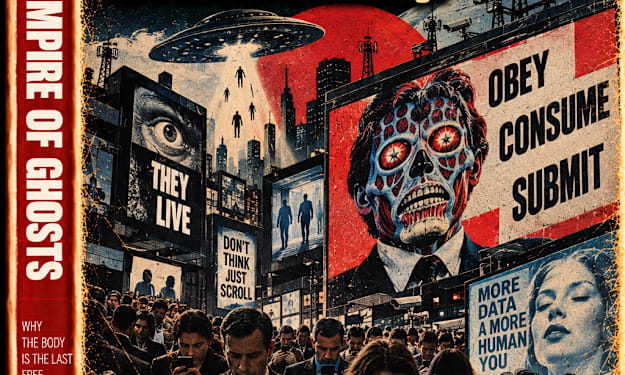
The Empire of Ghosts: Why the Body Is the Last Free Territory
Introduction: Escaping the Ghost Inside the Machine In his influential essay “Delete Your Account: On the Theory of Platform Capitalism,” Leif Weatherby argued that digital platforms should not be understood merely as technological innovations but as ideological infrastructures that quietly reorganise economic and social life. Nick Srnicek later demonstrated that platform capitalism emerged as capitalism’s structural response to declining industrial profitability, while José van Dijck, Thomas Poell and Martijn de Waal revealed how platforms gradually evolved into the invisible infrastructures governing journalism, education, transport, healthcare and democratic participation. Shoshana Zuboff expanded this analysis through the concept of surveillance capitalism, arguing that human experience itself had become the primary raw material for algorithmic prediction and commercial profit. Building upon these theories, the previous article argued that platform capitalism represents not simply a new economic model but the latest historical disguise of empire itself. Instead of conquering territories, contemporary empires increasingly occupy consciousness. They harvest attention instead of wheat, behavioural data instead of precious metals, and emotional reactions instead of taxes. The modern citizen is no longer primarily a worker or a consumer but a continuously monitored producer of profitable information. The metaphor of the “Body Snatchers” therefore acquires an entirely new significance. Human beings are no longer replaced by alien replicas; they are gradually transformed into algorithmically synchronised organisms who continue believing themselves autonomous precisely because the mechanisms directing their behaviour remain invisible.
By Peter Ayolov27 days ago in Critique
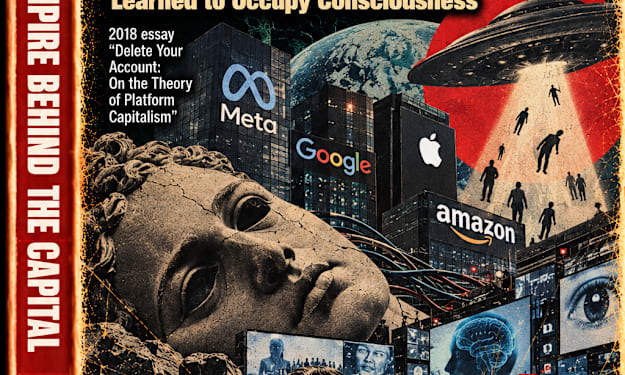
The Empire Behind the Capital: How Platform Capitalism Became the New Invasion of the Body Snatchers
Introduction: The Platform Empire: How Empires Learned to Occupy Consciousness In his influential 2018 essay “Delete Your Account: On the Theory of Platform Capitalism,” published in the Los Angeles Review of Books , Leif Weatherby proposed a provocative interpretation of the digital age by arguing that the concept of the “platform” functions primarily as an ideological disguise. Rather than representing an open, democratic, and participatory space, the platform conceals an increasingly centralised infrastructure through which a handful of technological monopolies extract rent, behavioural data, attention, and ultimately social power. Drawing upon Nick Srnicek’s theory of platform capitalism while engaging broader discussions of digital political economy, Weatherby challenged the widespread belief that technological problems can be solved through purely individual decisions, ethical consumption, or voluntary withdrawal from social media. Simply deleting one’s account cannot alter the underlying architecture of digital capitalism because the problem is structural rather than personal. This article revisits Weatherby’s argument from an entirely different perspective by placing it within a much longer genealogy of imperial power, political conformity, behavioural engineering, and mass psychological control. It argues that platform capitalism should not be understood merely as a new economic system but as the latest historical façade behind which much older imperial mechanisms continue to operate. Throughout history empires have constantly reinvented their ideological appearance. They have spoken in the language of divine kingship, religious salvation, national destiny, civilisation, communism, liberal democracy, free markets, human rights, globalisation or technological progress, yet beneath these changing narratives the central objective has remained remarkably stable: the concentration of power through the management of populations. The digital platform represents only the newest architectural form of this ancient political technology. Instead of conquering territories alone, contemporary empires increasingly compete to occupy attention, shape identity, organise emotion, manufacture consensus and colonise everyday consciousness itself. The battlefield is no longer simply geographical; it has become cognitive. The citizen is transformed into behavioural data, the voter into an algorithmic prediction, and the individual into a continuously monitored producer of profitable information. In this sense Weatherby’s analysis provides an essential starting point, but its implications extend far beyond digital monopolies. They invite a reconsideration of the entire history of empire as a succession of changing masks concealing remarkably persistent forms of domination.
By Peter Ayolov27 days ago in Critique
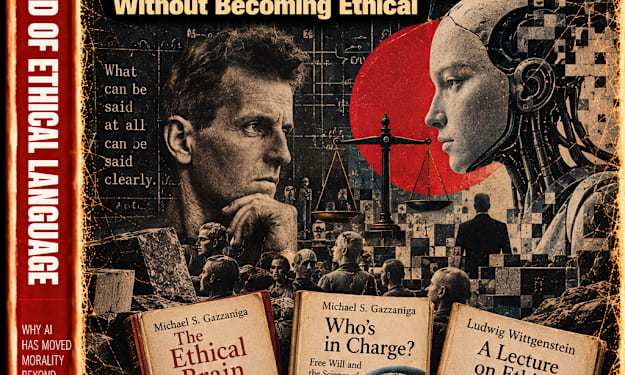
The End of Ethical Language: Why AI Has Moved Morality Beyond Words
Introduction: When Machines Learn Ethics Without Becoming Ethical For more than two thousand years Western philosophy assumed that ethics was fundamentally connected to language. Plato wrote dialogues, Aristotle defined virtues, the Stoics formulated moral principles, Kant built ethical systems from reason, and modern philosophy attempted to derive universal rules through argument. Moral progress appeared inseparable from better language. Humanity developed increasingly sophisticated vocabularies for justice, rights, dignity, equality, freedom and responsibility. The assumption behind all these traditions was remarkably simple: if language became more rational, morality itself would improve.
By Peter Ayolov27 days ago in Critique
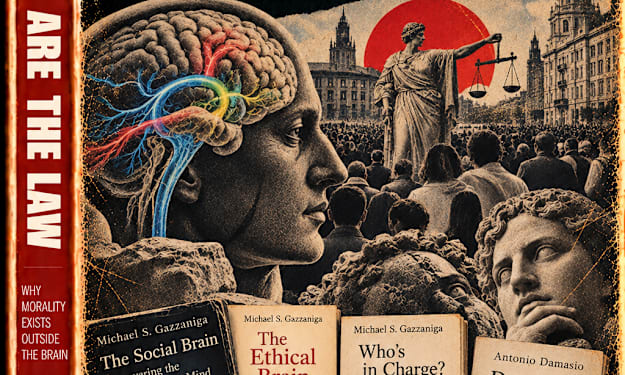
We Are the Law: Why Morality Exists Outside the Brain
Introduction: Does the Brain Create Morality or Does Society Create the Brain? One of the most important revolutions in contemporary neuroscience has been the growing realization that the brain cannot be understood in isolation from the social world it inhabits. For centuries philosophers searched for morality inside the soul, while modern neuroscience increasingly searches for it inside neural circuits. Michael Gazzaniga proposes a remarkably different solution. Although human behaviour is generated by biological brains, morality, responsibility and law emerge not from individual neurons but from interactions among people. Human beings are biological organisms, yet justice is not a biological organ. Responsibility exists because societies create systems of expectations that regulate behaviour between individuals. The law therefore exists neither inside the brain nor outside nature as a metaphysical principle. It emerges from collective human interaction. This insight fundamentally transforms the ancient philosophical debate concerning free will. Even if neural activity determines behaviour at the biological level, individuals remain socially responsible because responsibility itself is an emergent property of organized communities rather than isolated nervous systems. Gazzaniga thus challenges both religious notions of an immaterial soul and reductionist attempts to explain ethics entirely through neurons. His work suggests that human beings become moral not because they possess special moral substances but because evolution produced brains capable of sustaining complex social networks governed by collectively created rules. The law is therefore not imposed upon humanity from above. Nor is it hidden inside the brain waiting to be discovered. Quite literally, we are the law , because law emerges from the biological interactions of social organisms capable of language, cooperation and shared expectations.
By Peter Ayolov27 days ago in Critique