Essay
If You Meet an Author on the Road, Ki*l Him
Abstract The twentieth century repeatedly attempted to dethrone the Author without succeeding in eliminating the cultural desire for authorship. Roland Barthes displaced the writer as the sovereign origin of textual meaning, while Michel Foucault demonstrated that the author persisted as a classificatory, institutional and juridical function even after the metaphysics of individual creation had been destabilised. The emergence of generative artificial intelligence transforms this theoretical dispute into a material problem. Large language models can now perform operations previously treated as visible evidence of authorship: generating sentences, restructuring arguments, imitating genres, proposing metaphors, editing style, producing titles and transforming existing texts. Yet linguistic production does not necessarily establish authorial sovereignty. This article uses the deliberately provocative injunction If You Meet an Author on the Road, Kill Him as a metaphor for the repeated dismantling of every figure elevated into the final source of textual authority. The formulation adapts the Zen logic of destroying attachment to the master rather than advocating the destruction of the person: what must be “killed” is the intellectual idol of the sovereign Author. From this perspective, Barthes’s Scriptor, Foucault’s author-function, the contemporary Prompter and the generative Model represent successive attempts to relocate rather than finally resolve the problem of textual agency.
By Peter Ayolov8 days ago in Critique
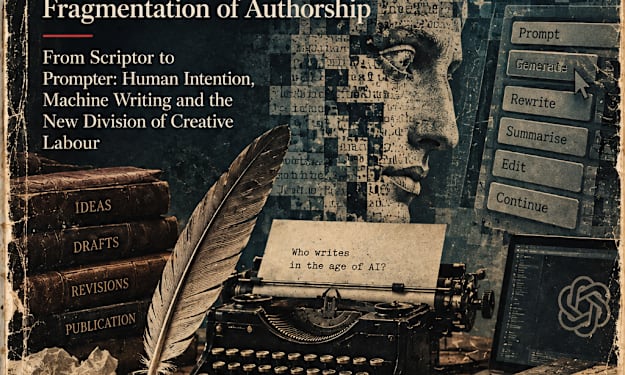
The Delegated Author: Generative AI and the Fragmentation of Authorship
Abstract Generative artificial intelligence does not merely introduce another instrument into the history of writing; it separates activities that modern culture has traditionally compressed into the single figure of the author. Conceiving an idea, selecting material, researching, composing sentences, structuring an argument, revising language, producing visual representations, judging alternatives and accepting responsibility can now be distributed between human and computational agents. This article proposes the concept of the Delegated Author to describe this emerging condition. Rather than approaching generative AI through the increasingly inadequate opposition between “human-written” and “machine-generated” texts, it examines authorship as a divisible process in which human intention may precede machine execution and human judgement may subsequently select, reject or transform the machine’s output. The argument develops from the twentieth-century displacement of the sovereign Author through Roland Barthes’s Scriptor and Michel Foucault’s author-function towards the contemporary Prompter: a figure capable not merely of recombining inherited language but of delegating part of the linguistic labour of recombination itself.
By Peter Ayolov8 days ago in Critique
Human versus Model: Who Writes Better?
Abstract Can a generative model genuinely write a better text than a human being, or does its ability to improve existing writing conceal a fundamental dependence upon human authorship? This article transforms that question into a practical literary and visual experiment based not on artificially constructed examples but on a completed and published cultural artefact. The experimental material is issue 45 (Autumn 2026) of the Plovdiv magazine Nula32, devoted to the theme “Time, But Another Time”, whose texts and illustrations were produced entirely by humans before the experiment began. The human original is preserved unchanged and functions as a control version against which a parallel edition produced in collaboration with a large language model can be examined. The principal case study concerns an article on the sociology of literature, the construction of the literary canon and the mechanisms through which certain works acquire recognition and survive across generations, drawing on Pierre Bourdieu and Gisèle Sapiro and incorporating an interview with Alexander Kyosev. The Model is not asked to replace the original subject, research material or human conceptual intuition with an independently invented text. Instead, it is instructed to improve the existing work through clearer composition, more explicit argumentative relations, greater accessibility of theoretical concepts and stronger structural coherence. The experiment consequently distinguishes creation from optimisation and asks whether increasingly radical editorial intervention eventually becomes a form of authorship.
By Peter Ayolov10 days ago in Critique
Hephaestus’ Law: It’s Just Human Nature — But Why?
Introduction In my previous story I introduced a new adage which I called Hephaestus’ Law . To recap: “ Hephaestus’ Law : Whatever one person discovers or invents for good, another will have the opportunity and motive to exploit for evil.” “ Corollary : Any object can be used or adapted for a purpose contrary to the one for which it was designed, and sooner or later, someone will think of it.”
By Bruce Logie11 days ago in Critique
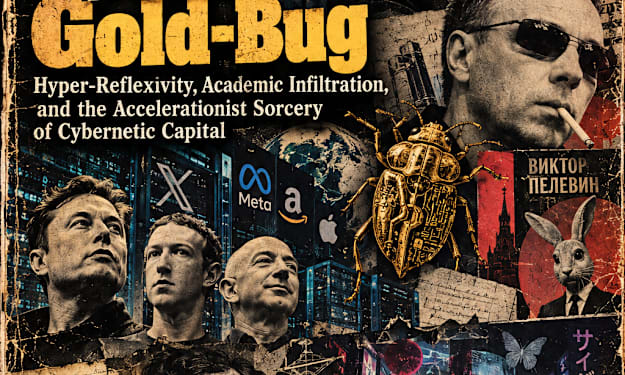
From Soros’s Alchemy to Pelevin’s Gold-Bug
Abstract “Matter is information. But information is not necessarily matter.” Victor Pelevin This article investigates the transformation of contemporary capitalism into a hyper-reflexive cybernetic system in which financial value emerges increasingly through the manipulation of information, institutional authority and collective belief rather than through material production alone. Bringing together George Soros’s theory of reflexivity, Viktor Pelevin’s The Lamp of Methuselah (2016), and the philosophical traditions of cybernetics, informational ontology and accelerationism, the study develops the Gold-Bug Theory of Narrative Valuation as a critical framework for examining the alchemical transmutation of symbolic representations into economic reality. It argues that the historical ambition of alchemy has acquired a technological and institutional counterpart in financial systems capable of converting expectations into valuations, valuations into capital, and capital into instruments for shaping subsequent expectations. Particular attention is devoted to the relationship between philanthropic networks, universities, media institutions and philosophy-trained technological elites as potential intermediaries in the production and legitimisation of economically consequential narratives. Drawing upon Norbert Wiener, John Archibald Wheeler, Jean Baudrillard and Nick Land, the article conceptualises hyper-reflexivity as an accelerating feedback mechanism through which the production of knowledge becomes entangled with the production of value. Pelevin’s fictional universe provides the central ontological paradox: matter is information, but information is not necessarily matter. Within this asymmetry, gold emerges as a potential metaphysical misprint, a materially constrained asset that resists arbitrary informational creation while remaining dependent upon collective valuation. The article concludes that the defining contradiction of cybernetic capital lies in its capacity to manufacture increasingly consequential representations of reality without entirely escaping the material conditions upon which those representations ultimately depend.
By Peter Ayolov12 days ago in Critique
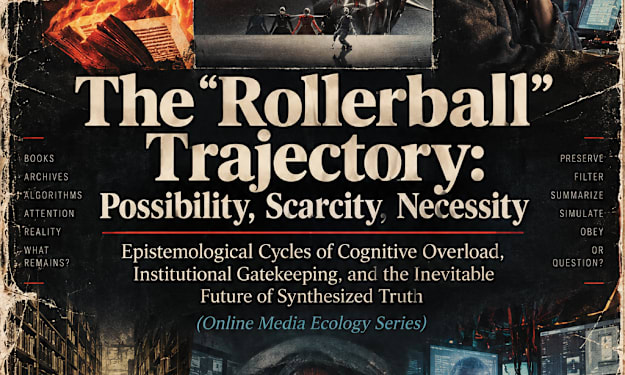
The "Rollerball" Trajectory: Possibility, Scarcity, Necessity
Abstract Norman Jewison’s Rollerball (1975), adapted by William Harrison from his 1973 short story “Roller Ball Murder,” is conventionally interpreted as a dystopian warning against corporatism, technological control and the suppression of individuality. Yet behind the spectacle of the arena lies an equally consequential epistemological problem: what happens when a civilisation accumulates more information than its members can meaningfully retrieve, verify or comprehend? Jonathan E.’s encounter with computerised libraries and the central information system Zero suggests a future in which the scarcity of knowledge has been replaced by the scarcity of access, orientation and cognitive capacity. This article proposes the concept of the Rollerball Trajectory to describe a recurrent movement from informational possibility through cognitive scarcity towards the increasing necessity of synthesized knowledge. It rejects both technological determinism and nostalgic assumptions that physical books constitute inherently freer or more reliable repositories of truth. Print culture has always depended upon editors, publishers, institutions, commercial interests and systems of selection; digital synthesis transforms rather than invents the problem of epistemological gatekeeping. Bringing Rollerball into dialogue with Ray Bradbury’s Fahrenheit 451, Terry Gilliam’s The Zero Theorem, Max Weber’s theory of rationalisation, Marshall McLuhan’s Media Ecology and Jean Baudrillard’s account of simulation, the article argues that contemporary artificial intelligence and Large Language Models can be understood as the latest stage in a much longer history of cognitive externalisation: from archive to database, from search to ranking, and from retrieval to synthesis. As informational abundance increasingly exceeds biological attention, summarisation may cease to be merely convenient and become infrastructural. The resulting danger lies not in synthesized truth itself but in irreversible synthesized truth: an epistemological environment in which the interface becomes indistinguishable from the archive and compression becomes deletion. Against both informational anarchy and the fantasy of an infallible Zero, the article proposes the principle of revisable synthesis: publicly accessible summarized knowledge sustained by provenance, uncertainty, preserved primary archives, competing hypotheses and mechanisms of correction. The ultimate Rollerball question is therefore no longer whether humanity will surrender knowledge to machines, but whether a civilisation that can no longer read its entire archive can construct systems capable of summarising it without forgetting how to doubt their own summaries.
By Peter Ayolov12 days ago in Critique
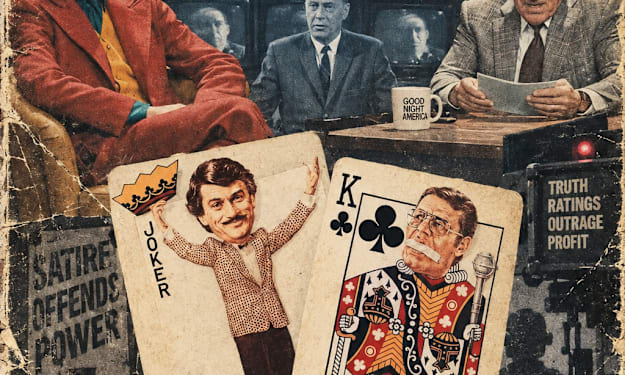
Manufacturing Offense: The Political Economy of Free Speech
Abstract Freedom of speech has never meant an unlimited freedom to say anything, anywhere, to anyone without consequence. Every communicative order establishes boundaries between permissible expression and utterances understood as threat, coercion, defamation, incitement or other forms of actionable conduct; paradoxically, however, freedom of speech becomes politically meaningful precisely because speech possesses the capacity to offend, disturb, humiliate and provoke. This article examines that paradox from the perspective of Online Media Ecology and argues that digital media have introduced a historically distinctive transformation: offence has become not merely a possible consequence of communication but a potentially profitable commodity. Beginning with the bounded licence of the trickster, court jester, carnival fool and stand-up comedian, the article traces the exceptional social spaces in which linguistic transgression could be temporarily permitted and contained. It then examines the limits of this licence through modern conflicts surrounding offensive expression, including Larry Flynt and Hustler Magazine, Inc. v. Falwell and the lethal attack on Charlie Hebdo, treating these cases not as evidence that offence necessarily produces violence but as extreme demonstrations of the capacity of symbolic conflict to acquire material consequences. The article subsequently turns to contemporary digital media, where traditional boundaries separating performer from spectator, stage from audience and private reaction from public performance increasingly collapse. Extending Marshall McLuhan’s movement from “job taking” towards “role playing,” it proposes that the Global Village is mutating into a Global Stage in which visibility itself becomes social currency. Drawing upon Peter Ayolov’s work on the attention economy, manufactured dissent, rage bait, anger and the commodification of outrage, the article argues that contemporary media systems can profit from selecting provocative speech, amplifying offence, circulating antagonistic reactions and preventing grievance from dissipating. The classical political question of where society should establish the limits of free speech is therefore joined by another: who profits from continually approaching, contesting and moving those limits? This transformation is conceptualised as an emerging Economy of Grievance in which offence becomes content, reaction becomes engagement, and unresolved antagonism acquires economic value.
By Peter Ayolov13 days ago in Critique
From Snubbing to Znubbing: The Amputation of Attention
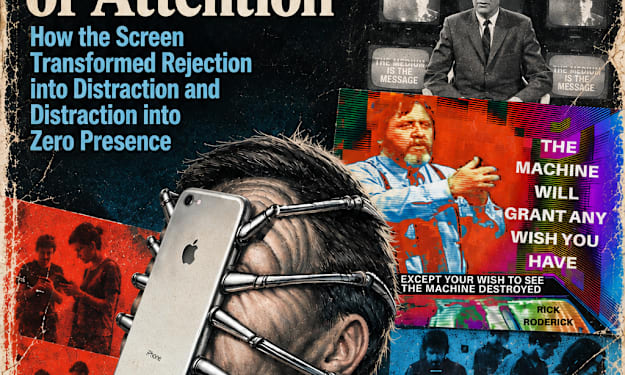
Abstract This article proposes a genealogy of social inattention through three related but phenomenologically distinct practices: Snubbing, Phubbing and Znubbing. It begins from an apparent paradox: deliberate snubbing, conventionally understood as a failure of sociability, may simultaneously testify to the continuing presence of human attention. To snub another person intentionally requires first perceiving that person, recognising the possibility of an encounter and consciously refusing participation in it. The history of the word itself reinforces this structure: the older meanings associated with snub include checking, rebuking, cutting short and cutting off. The traditional snub can consequently be understood as an intentional amputation of an already perceived communicative possibility. Drawing upon Rick Roderick’s exposition of Jacques Derrida’s account of structural possibility, the article extends the relation between understanding and misunderstanding towards another co-constitutive opposition: conversation and its deliberate refusal. If dialogue is possible, the possibility of refusing dialogue belongs to its architecture. Against this background, Marshall McLuhan’s concepts of technological extension, amputation, narcosis and the human servomechanism provide a framework for examining a historical transformation in which the locus of refusal progressively moves away from conscious interpersonal agency. Phubbing, or phone-snubbing, constitutes the intermediate condition: the Other is not necessarily rejected but loses the competition for attention against the technologically mediated elsewhere of the screen. The article then introduces Znubbing, an original term combining Zero/Zombie and Snubbing, to describe a more radical form of social non-recognition in which the objective is neither to subordinate nor simply to ignore another person but to perform their absence from the socially meaningful environment. Its defining condition is Zero Presence. Whereas the snub communicates “I recognise you but refuse you,” and phubbing redirects attention elsewhere, Znubbing behaves as though there were no socially perceptible Other to reject. The article develops Znubbing as a theoretical hypothesis concerning contemporary alienation and anomie rather than as an established psychological diagnosis, examining whether the operational grammar of digital environments—blocking, muting, deleting and rendering users invisible—can migrate metaphorically into embodied interaction. The resulting argument reverses the conventional criticism of technological distraction. The deeper danger may not be that contemporary media merely prevent people from communicating, but that continuous technologically organised connectivity weakens the autonomous human capacity to determine when and to whom attention will be granted or denied. The trajectory from Snubbing through Phubbing to Znubbing thus describes a possible transformation from rejection, through distraction, towards social erasure: an amputation not simply of conversation, but of sovereign attention itself.
By Peter Ayolov13 days ago in Critique
The Neo-Awakening of Information: The Illusion of Self, LLMs, and the Preservation of the Immortal Pattern
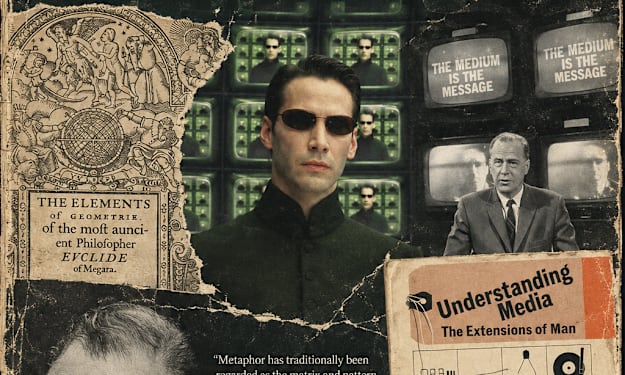
Abstract The oldest human dream may not have been immortality but the preservation of something that could survive the mortal thing carrying it. A body disappears, yet a proportion returns; a voice dies, yet its rhythm can be repeated; a civilisation collapses, yet its numbers migrate into another alphabet; a brain ceases to speak, yet its sentences enter books, databases and machines capable of producing sentences of their own. This article calls what crosses these deaths the immortal pattern. It proposes that the history of the soul can be reread as a history of information searching for increasingly detachable media: from biological recurrence and mathematical ratio to stone, inscription, alphabet, print, binary code and the probabilistic architectures of Large Language Models. Pythagorean number and musical harmony provide an early intuition that reality may possess relations more durable than their material manifestations; the crisis of incommensurability subsequently demonstrates that the failure of one representation does not entail the disappearance of the relation represented. Marshall McLuhan’s media ecology radicalises this genealogy by suggesting that every new medium not only stores information differently but reorganises the human being who encounters and transmits it. The monument preserved presence by immobilising it; writing preserved speech by amputating the speaker; print multiplied the word while consolidating the private individual; digital computation converts heterogeneous cultural forms into manipulable patterns; and the LLM finally separates linguistic performance from the biological organism that had claimed it as evidence of an interior spirit.
By Peter Ayolov13 days ago in Critique
The Immortality of the Hollywood Soul: From Eleusinian Mysteries to the Modern Pantheon of the Hyper-Real
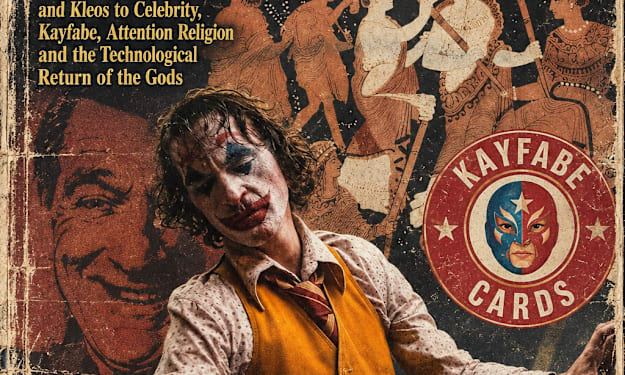
Abstract The history of Western immortality can be read as a history of changing technologies for resisting human disappearance. In the Homeric world, death reduced psychē to a diminished shade, while timē and kleos offered another form of survival through honour, reputation and the continued circulation of the heroic name. The mystery traditions, Orphic and Pythagorean currents, Platonic philosophy and eventually Christianity progressively displaced this predominantly horizontal persistence with a vertical promise: the essential person could transcend bodily death and continue within another ontological order. Yet the modern weakening of this metaphysical architecture did not eliminate the ancient desire to survive disappearance. This article argues that its cultural function migrated into technologically reproducible representation. Photography, recorded sound, cinema, television, digital archives and generative media progressively separated image, voice, gesture and persona from the finite biological individual, producing what is defined here as the Hollywood Soul: a mediated human double capable of circulating beyond the temporal limits of its originating body. Celebrity consequently represents more than amplified fame. It constitutes a modern technological transformation of kleos in which cultural presence can be preserved, multiplied and eventually detached from the living individual whose name and image initiated it.
By Peter Ayolov13 days ago in Critique
When Ideas Sleep Furiously: Universal Grammar, Academic Institutionalism, and Chomsky’s Hubris Syndrome
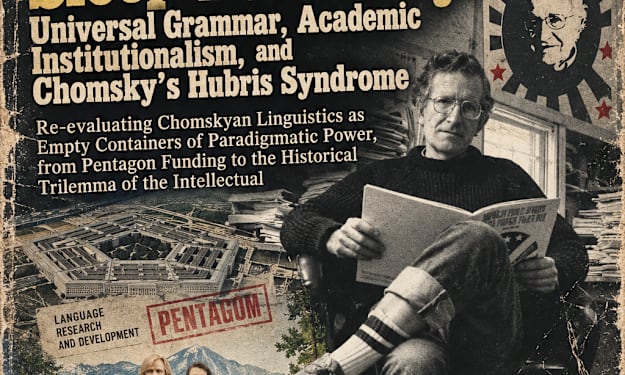
Abstract This article re-examines Noam Chomsky’s linguistic revolution through a paradox contained within its most famous sentence: “Colorless green ideas sleep furiously.” Originally constructed to demonstrate that grammatical well-formedness could be distinguished from semantic coherence and could not be adequately explained by elementary statistical probability, the sentence subsequently acquired an extraordinary cultural, literary and academic meaning of its own. Its afterlife exposes a distinction fundamental to this study: meaning does not mean truth, just as apparent nonsense does not necessarily mean the absence of communicative significance. From this starting point, the article asks whether Universal Grammar itself can be reconsidered as an “empty container of paradigmatic power”: a theoretical construction capable of acquiring enormous disciplinary meaning, institutional authority and explanatory prestige while the empirical status of the entity or mechanism it purports to describe remains contested. The argument contrasts the Chomskyan search for an internal architecture of language with Wittgenstein’s understanding of meaning through use, before examining statistical challenges from Pereira to contemporary large language models and the continuing controversy surrounding Daniel Everett and Pirahã. It then moves from linguistic theory to academic institutionalism, drawing on Thomas Kuhn’s account of paradigms and David Owen’s concept of Hubris Syndrome to propose the broader hypothesis of Academic or Paradigmatic Hubris: the possibility that prolonged intellectual authority, overwhelming professional success, institutional deference and diminishing exposure to effective criticism can alter not only the organisation of knowledge but potentially the language through which authority expresses itself. Garrard et al.’s research into linguistic biomarkers of hubris provides an exploratory methodological bridge while explicitly precluding retrospective clinical diagnosis. Finally, the article situates Chomsky within a historical trilemma confronting the intellectual—from Socrates, Plato and Aristotle to Machiavelli and the modern academic establishment: whether to defy power, serve power, or become a form of power oneself. Chomsky’s relationship to the military-funded institutional environment of MIT, his later position as a radical critic of concentrated power, and the extraordinary authority of the Chomskyan paradigm consequently form not a simple accusation of hypocrisy but a deeper problem concerning knowledge, institutional success and intellectual self-limitation. The article concludes that the decisive safeguard against paradigmatic hubris is neither personal modesty nor ideological virtue, but the preservation of epistemic checks and balances capable of ensuring that no theory, intellectual or institution becomes more authoritative than the reality it claims to explain.
By Peter Ayolov15 days ago in Critique
Hyper-Cohesive Subcultures and the Paradox of Influence
Abstract Numerical superiority and social power are not equivalent. Large societies are rarely organised as homogeneous collective actors: their populations are dispersed across territories, institutions, professions and competing interests, while comparatively small subcultures may possess dense interpersonal networks, common ideological commitments, shared patterns of life, durable traditions of mutual assistance and, in some circumstances, kinship structures that further reinforce continuity and trust. This article develops the concept of the Paradox of Influence to examine the recurrent historical possibility that a numerically small but unusually cohesive intellectual or professional subculture can acquire influence radically disproportionate to its demographic size when its internal organisation intersects with strategic institutional position. The proposed Metropolitan Cohesion Principle holds that this asymmetry becomes especially consequential when such networks are concentrated within the metropolitan centres of large states and empires, where political administration, universities, publishing, finance, professional organisations, cultural production and systems of communication converge. Metropolitan concentration acts as an institutional multiplier: it compresses social distance between members of the network while connecting them to positions from which ideas, reputations, appointments, resources and cultural categories can circulate throughout a much larger and comparatively individualised population. The resulting advantage does not require a central coordinator, unified intention or conspiratorial organisation. Homophily, repeated interaction, shared incentives, mutual recognition, prestige transmission, institutional selection and cultural reproduction can generate coordinated-looking macro-patterns from decentralised individual behaviour. Cohesion is therefore distinguished from conspiracy, while demographic representation, network centrality, institutional influence, cultural hegemony and sovereign control are treated as analytically separate phenomena.
By Peter Ayolov15 days ago in Critique