Essay
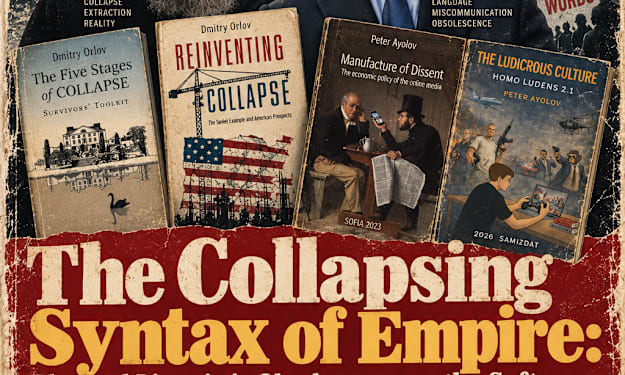
The Collapsing Syntax of Empire: Planned Linguistic Obsolescence as the Software of Disgraceful Degradation
Abstract The conventional imagination of civilisational collapse remains dominated by the event: Rome falls, the Soviet Union dissolves, a government disappears, a currency fails, an empire reaches an identifiable historical terminus. Yet complex political systems may deteriorate for decades or centuries while preserving the names, symbols, institutions and linguistic forms through which continuity is publicly imagined. Dmitry Orlov’s recent reformulation of his theory of collapse as “Disgraceful Degradation” provides a provocative model for understanding such an extended condition. Revising his earlier Soviet–American analogy, Orlov proposes that an extractive imperial system need not reproduce the relatively sudden disintegration of the USSR; it may instead prolong itself by transferring losses towards its peripheries, allies and eventually its own population, producing a progressively hollowed institutional order whose degradation becomes increasingly difficult to distinguish from normality. This article brings Orlov’s material theory of degradation into dialogue with Peter Ayolov’s theory of the Planned Obsolescence of Language. It proposes that the two models describe interconnected levels of the same entropic process: where Orlov identifies the progressive extraction of material resources and institutional capacity, Ayolov identifies a communicative environment in which words, narratives, slogans and political meanings lose semantic durability through accelerated circulation, replacement and exhaustion. Planned linguistic obsolescence can consequently be interpreted as the cultural software of disgraceful degradation: a mechanism through which material deterioration is continuously renamed, normalised and incorporated into an unstable linguistic present. The resulting Ayolov–Orlov synthesis is developed here as a theory of communicative and material imperial entropy, in which the degradation of institutions and the degradation of the vocabulary used to evaluate those institutions become mutually reinforcing. The historical analogy is therefore not an empire that suddenly falls but Rome—an imperial formation whose “fall” retrospectively compresses a prolonged transformation into an apparently singular event. Rome did not fall for a day. The contemporary empire may similarly remain recognisable precisely because its surviving language continues naming as present what its material reality has already begun to lose.
By Peter Ayolov15 days ago in Critique
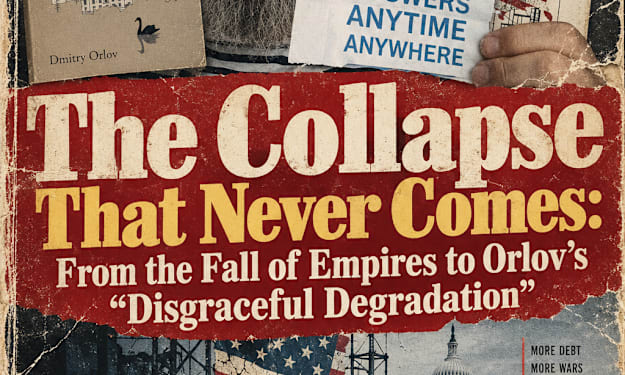
The Collapse That Never Comes: From the Fall of Empires to Orlov’s “Disgraceful Degradation”
Introduction: Waiting for the Fall For more than two decades, Dmitry Orlov has been one of the most provocative theorists of contemporary societal collapse. His central comparison appeared deceptively simple. Orlov had personally observed the final years and aftermath of the Soviet Union, and in Reinventing Collapse he asked whether the United States might eventually travel along a comparable road. Both superpowers maintained enormous military systems, expensive geopolitical commitments and bureaucratic structures whose complexity depended upon a continuous flow of energy and money. If one had suddenly disintegrated, why should the other be immune?
By Peter Ayolov15 days ago in Critique
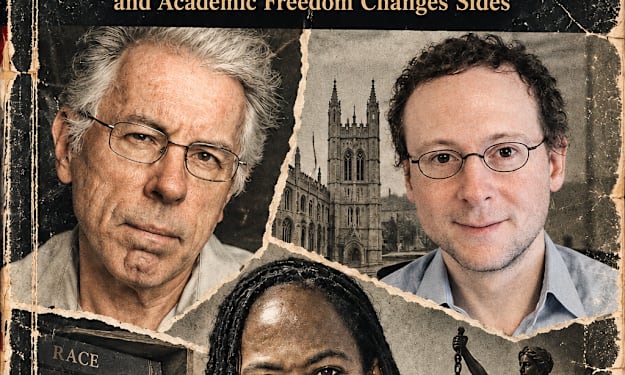
The Heretic and His Heretic: The MacDonald–Cofnas Paradox of Academic Freedom
Introduction: Two Scholars on the Forbidden Border There is an extraordinary paradox hidden inside one of the most uncomfortable intellectual controversies of contemporary academia. On one side stands Kevin MacDonald, an American psychologist whose attempt to interpret Judaism through evolutionary psychology made him one of the most condemned academics of his generation. His central hypothesis—that Judaism can be analysed as a “group evolutionary strategy”—was attacked by scholars as methodologically defective and by numerous critics as antisemitic. His own university colleagues publicly distanced themselves from his work. Yet MacDonald was not simply expelled from academic life: California State University, Long Beach explicitly defended his academic freedom while simultaneously repudiating his conclusions. On the other side of the paradox stands Nathan Cofnas, an academic of Jewish background who became one of MacDonald’s most formidable scholarly critics. In 2018, Cofnas subjected MacDonald’s argument to detailed examination and concluded that it depended upon misrepresented sources and cherry-picked evidence. But Cofnas was hardly a conventional progressive critic of controversial research. His own writings about race, heredity and intelligence subsequently generated fierce accusations of racism and brought serious institutional consequences. Years later, after publicly scrutinising the work of the Black Cambridge academic Jason Arday and alleging plagiarism and other problems, Cofnas himself was suspended by Ghent University while disciplinary proceedings examined his conduct.
By Peter Ayolov17 days ago in Critique
Automating the Wilde-Bayard Paradox LLMs, Predictable Equilibrium and the Death of Deep Listening
Abstract This article develops a paradoxical proposition within the emerging framework of Online Media Ecology: successful communication does not necessarily require deep understanding, and the contemporary expansion of Large Language Models may be automating communicative strategies that human beings have practised for centuries. As a continuation of the paradigm developed in Marshall McLuhan Is the Message: The New Paradigm of Online Media Ecology, the argument moves from the ecological problem of unlimited linguistic production and finite human attention towards a reconsideration of listening itself. The Wilde-Bayard Paradox proposes that successful communication does not always require deep reading, listening or understanding; quotation, pattern recognition and prediction may be enough. LLMs automate this paradox by increasingly performing the linguistic labour between human interlocutors. Pierre Bayard’s How to Talk About Books You Haven’t Read provides the initial provocation. If meaningful and socially competent discourse about a book does not invariably require exhaustive reading, a corresponding question becomes possible: why should successful interaction with another person invariably require exhaustive listening? Oscar Wilde’s observation that most people’s thoughts are “someone else’s opinions” and their passions “a quotation” radicalises the problem by questioning how much apparently individual discourse is already composed from inherited linguistic material. Rick Roderick’s interpretation of Jacques Derrida supplies a further complication: if words can misrefer, intentions cannot finally stabilise meaning, and misunderstanding remains structurally possible even under conditions of careful interpretation, then deep listening cannot guarantee transparent access to another consciousness.
By Peter Ayolov17 days ago in Critique
The Infinite Deck of Cards
He thinks he knows people. He has looked into enough eyes to recognize the things people eventually stop hiding. Sometimes they no longer care enough to hide them. Sometimes they are too tired. Sometimes the feeling has grown too large to stay behind the face they prepared for the day.
By Curious Stranger18 days ago in Critique
A Case Against the Chomskyan Linguistic Cult
Abstract The Chomskyan revolution began as an intellectual rebellion and ended as a paradigm. Noam Chomsky’s critique of behaviourism transformed twentieth-century linguistics by rejecting the idea that linguistic competence could be adequately explained through environmental learning and by locating the decisive causes of language within the biological organisation of the human organism. Yet the subsequent history of Universal Grammar presents a Kuhnian paradox: the theory that helped overthrow one scientific orthodoxy gradually became an orthodoxy of its own. Across successive transformations from transformational grammar and Principles and Parameters to Minimalism and Merge, the specifically innate content attributed to the human language faculty became increasingly abstract and economical. Controversies surrounding linguistic universals, recursion, Pirahã, statistical learning and cross-linguistic diversity consequently raise a difficult question: does this history represent the progressive refinement of a successful scientific programme, or the preservation of its central nativist commitment through continual theoretical retreat? The provocative expression “Chomskyan linguistic cult” is used here not to describe generative linguistics literally as a religious cult, but as a metaphor for the institutional, philosophical and paradigmatic protection that can develop around a revolutionary scientific framework once its assumptions become intertwined with disciplinary authority and a culturally powerful conception of human nature. The deeper argument of this article is that the persistence of the Chomskyan paradigm cannot be understood exclusively as a technical controversy about grammar. Linguistic innateness preserves an attractive image of Homo sapiens as possessing a privileged interior capacity that precedes and constrains cultural experience. Although Chomsky’s theory is biological rather than spiritual, this conception occupies some of the philosophical territory historically assigned to soul, reason and autonomous mind. Large Language Models now disturb that image by demonstrating that statistical prediction can generate sophisticated linguistic behaviour without a human biological language faculty. Following Elan Barenholtz’s conception of LLMs as mirrors, the resulting shock can be reversed: instead of asking why machines lack the depth supposedly hidden behind human language, it becomes necessary to ask why prediction can reproduce so many linguistic signs through which that depth has traditionally been inferred. Ayolov’s Miscommunication Trilogy and The Planned Obsolescence of Language extend this reversal into a more radical hypothesis. Language may not be the timeless expression of an innate human essence but a comparatively recent cultural technology imposed upon an evolutionarily older prelinguistic organism, progressively reorganising cognition, identity and social organisation while creating the illusion that the linguistic self is the original author of its own words. Artificial intelligence marks a decisive threshold because language can now reproduce outside its original biological host. The post-Chomskyan question is therefore no longer simply how language exists inside humanity, but what language has done to humanity since humanity acquired it. In this reversal lies the possibility of a new paradigm: from language as human essence towards language as historically contingent technology, and eventually from linguistic civilisation towards the possibility of its planned obsolescence.
By Peter Ayolov20 days ago in Critique
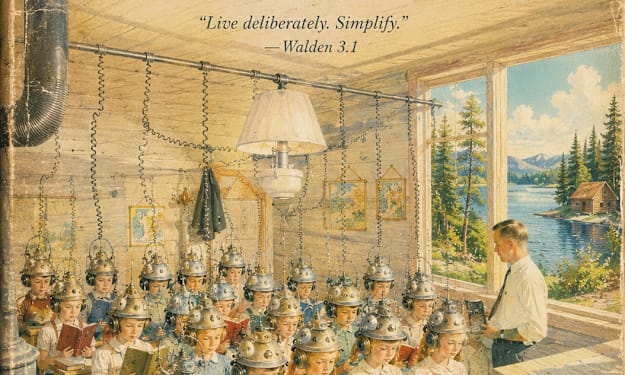
After the End of Language: Walden 3.1
Abstract The history of Walden can be read as a sequence of increasingly radical attempts to escape what civilisation has made appear inevitable. Henry David Thoreau’s Walden asked what remained of human life when the individual withdrew from the unnecessary material and social complexity of nineteenth-century civilisation. A century later, B. F. Skinner’s Walden Two reversed the experiment: instead of escaping from an imperfect society, why not redesign the social environment itself? Walden 3.1 proposes a third experiment. What if one of civilisation’s most fundamental technologies—language—has itself become an environment from which humanity must partially withdraw? This article develops Ayolov’s hypothesis from The Miscommunication Trilogy and The Planned Obsolescence of Language that language should no longer be regarded as the timeless essence of Homo sapiens, but as a comparatively recent cultural technology acquired by an evolutionarily much older organism. Language enormously expanded human capacities for abstraction, memory, coordination and collective organisation, yet it simultaneously generated new forms of misunderstanding, ideological conflict, symbolic domination and estrangement from immediate embodied experience. The post-linguistic society imagined here therefore does not require the literal abolition of speech. It proposes something more plausible and potentially more consequential: the deliberate reduction of linguistic domination over human consciousness and social organisation. Large Language Models make this thought experiment historically relevant. If sophisticated linguistic behaviour can be reproduced by artificial systems operating through statistical prediction without possessing a human biological language faculty, language can no longer function unproblematically as evidence of an autonomous inner linguistic self. Following Elan Barenholtz’s metaphor of LLMs as mirrors, artificial intelligence reflects linguistic performance back towards humanity and raises an uncomfortable possibility: humans may have attributed to language forms of interior depth that belong neither to words nor necessarily to the mechanisms producing them. Walden 3.1 takes the next step. If machines become increasingly capable of assuming civilisation’s repetitive linguistic labour—documentation, translation, administration, classification and unlimited textual production—humans may paradoxically acquire an opportunity to become less linguistically saturated. The scarcity of the future may no longer be information but silence, attention, direct perception and unmediated experience. Yet the post-linguistic society cannot simply resurrect the mythology of autonomous man rejected by Skinner, nor can it escape the political problem established in the preceding analysis of tyranny: large populations still require coordination, and every organised environment influences behaviour. Walden 3.1 is therefore conceived not as a society without control, but as an experimental society that attempts to make control visible, revisable and empirically accountable while progressively transferring human experience away from compulsory linguistic mediation. Its ultimate ambition is neither to return humanity to prehistory nor to destroy language, but to recover dimensions of the prelinguistic human that linguistic civilisation has increasingly obscured. After millennia in which civilisation taught humans to inhabit words, the planned obsolescence of language begins with a different possibility: language may remain one of humanity’s greatest technologies without remaining the place in which humanity is compelled to live.
By Peter Ayolov20 days ago in Critique
Evolution of Tyranny: The Scale Laws of Dictatorship
Abstract Tyranny is usually explained through the character of rulers, the failure of institutions, ideological extremism or the political submission of populations. This article proposes a different and deliberately speculative perspective: tyranny may also be studied as an evolving technology of coordination whose forms change with the scale and complexity of human society. Drawing upon Geoffrey West’s work on complexity and scaling, the article asks whether the transition from small communities to cities, states, empires and contemporary digital networks creates increasing pressures for systems capable of coordinating, predicting and regulating the behaviour of enormous populations. West does not propose a mathematical law of dictatorship, and no such established scaling law currently exists; rather, his demonstration that complex systems change qualitatively as they increase in size provides the conceptual basis for extending the question into political organisation. Xavier Márquez’s genealogy from ancient tyranny towards modern dictatorship and authoritarianism reveals a parallel historical transformation: political control progressively migrates from the character and body of the ruler towards institutions, bureaucracies and systems of legitimation. Sergei Guriev and Daniel Treisman’s distinction between fear dictatorships and contemporary spin dictatorships carries this evolution further. The modern authoritarian ruler increasingly substitutes informational manipulation, managed elections, legal pressure and manufactured popularity for spectacular violence. Tyranny does not disappear. Its technology changes. The article develops Ayolov’s hypothesis that this transformation cannot be separated from language, mass communication and the increasing complexity of linguistic civilisation. Small groups can coordinate through direct interpersonal relations; mass societies require symbolic systems capable of organising strangers who will never meet. Language, writing, law, bureaucracy, ideology, statistics and media consequently become technologies of scale, converting embodied individuals into administratively manageable categories and shared narratives. Yet, as proposed throughout the Miscommunication framework, increasing communication does not necessarily generate increasing understanding. Greater connectivity can simultaneously multiply competing descriptions of reality, ideological fragmentation, elite conflict and unpredictable interactions. From this perspective, the evolution of political control follows a movement from commanding behaviour towards engineering the environment in which behaviour occurs, reconnecting the political problem with Skinner’s rejection of autonomous man. Digital surveillance, behavioural data and artificial intelligence potentially represent the next stage: power capable not merely of punishing actions after they occur but of predicting probabilities and modifying informational environments beforehand. The provocative concept of the “scale laws of dictatorship” therefore describes a hypothesis rather than a discovered mathematical law: as social complexity increases, mechanisms of control may become increasingly systemic, informational and impersonal. The ancient tyrant controlled bodies; the modern dictator controlled institutions; the spin dictator increasingly controls perceptions; the future algorithmic sovereign could attempt to control probabilities. The ultimate political question is consequently no longer simply who should rule, but whether large-scale civilisation itself continuously generates pressures towards increasingly sophisticated forms of behavioural coordination. If so, the most consequential future tyranny may be one in which the tyrant gradually disappears, leaving behind an adaptive system of control without a single face.
By Peter Ayolov20 days ago in Critique
Language as a Tissue of Citations: How a Self-Quoting Mechanism Conquered the Human Mind
Abstract This article proposes a radical extension of Roland Barthes’ famous description of the text as a “tissue of citations”: what if citation is not merely a property of texts but a fundamental operation of language itself? The argument begins with Nikola Georgiev’s Quoting Man (Homo Citans), which exposes the unstable boundary between one’s “own” speech and the already existing words, formulas, clichés and structures inherited from others. Georgiev’s difficulty in separating linguistic production from reproduction points toward a reversal of Homo Citans: perhaps it is not primarily man who quotes language, but language that continually quotes itself through man. This article names that mechanism Lingua Citans. Human beings do not invent the linguistic systems into which they are born. They acquire pre-existing words, grammatical relations and conceptual distinctions, recombine them during their lives and transmit them onward. Individual speakers disappear while the linguistic material passing through them survives. From this perspective, originality does not stand outside repetition but emerges from repetition-with-transformation, while the apparently autonomous speaker becomes a temporary biological carrier within a linguistic history vastly older than any individual mind. Artificial intelligence makes this hypothesis newly visible. Large language models do not prove that language is literally alive, conscious or biologically autonomous; rather, they demonstrate that sophisticated linguistic production can occur without the traditional sovereign Author and that linguistic processing can occur without the traditional human Reader. Machine systems can generate, analyse, summarise, criticise and regenerate texts in computational loops in which no human necessarily writes or reads every intermediate linguistic event. This development extends the argument of The Death of the Reader 2.0: From Roland Barthes’ Scriptor to the AI Prompter. Barthes displaced the Author, digital culture destabilised the Reader, and generative AI now reveals the deeper continuity beneath both figures—the circulation of language itself. Writing externalised linguistic memory, printing multiplied it, digital networks accelerated it, and LLMs allow linguistic material to circulate through non-biological processors at unprecedented scale. AI therefore did not create Lingua Citans; it removed part of its biological disguise. The article consequently proposes a transformation of Barthes’ formula: “Language is a tissue of citations drawn from the innumerable echoes of its own history.” What appears from the human perspective as speaking, quoting and writing may thus be understood from the opposite direction as an ancient self-reproductive mechanism continuously reassembling its inherited forms through a succession of mortal hosts.
By Peter Ayolov22 days ago in Critique
The Bitter End of Universal Grammar: Skinner–Chomsky Debate Today
Abstract For more than half a century, the Skinner–Chomsky debate has been narrated as a decisive episode in the history of modern thought: B. F. Skinner’s behaviourist account of verbal behaviour was defeated by Noam Chomsky’s theory of an innate human capacity for language, and from this intellectual confrontation emerged the Cognitive Revolution. This article argues that the arrival of Large Language Models requires this familiar verdict to be reconsidered. Systems organised around statistical learning and next-token prediction now generate novel, grammatical and contextually sophisticated linguistic sequences without possessing a biologically inherited Universal Grammar. Their success does not demonstrate that Skinner’s account of human language acquisition was correct, nor does it establish that human brains operate like transformer architectures. It does, however, undermine one of the strongest intuitions historically associated with the Chomskyan revolution: that statistical learning from linguistic environments could never be sufficient to produce genuinely generative linguistic performance. Read through Thomas Kuhn’s model of scientific revolutions, the rise of LLMs can therefore be interpreted as an anomaly within a linguistic paradigm that once appeared secure. The significance of this technological development extends beyond linguistics. The original dispute between Skinner and Chomsky concerned fundamentally different images of the human being. Skinner sought to remove the explanatory homunculus from psychology and understand verbal behaviour through the interaction of biological endowment, environmental history and social contingencies. Chomsky relocated linguistic explanation within an internally structured organism endowed with species-specific capacities whose development could not be derived from linguistic experience alone. The resulting conflict concerned not merely how children acquire grammar but where human autonomy, creativity and individuality should be located. Although Chomsky’s theory is biological rather than religious, the cultural reception of linguistic innateness contributed to a conception of language as evidence of a privileged human interiority: something generated from within rather than assembled through histories of interaction with the world. LLMs disturb this distinction because they function as unexpected mirrors. Their fluent output demonstrates how readily prediction can appear as intention, statistical regularity as grammar, recombination as creativity and linguistic continuation as understanding. The disturbing possibility is consequently not that machines have finally acquired the mysterious linguistic essence once reserved for humans, but that linguistic performance may require less mystery than twentieth-century cognitive science imagined. In dialogue with Skinner’s concept of verbal behaviour, contemporary statistical-learning research, Elan Barenholtz’s account of language and LLMs, and Ayolov’s broader thesis concerning the planned obsolescence of language, this article proposes that the Skinner–Chomsky controversy has entered a new historical phase. The question is no longer simply whether Skinner or Chomsky won in 1959. It is whether the conceptual conditions under which Chomsky’s victory was declared still exist. The bitter end of Universal Grammar may therefore signify something larger than the decline of a linguistic hypothesis: the beginning of a Kuhnian transformation in which language ceases to appear as the privileged expression of an autonomous inner human being and begins to appear instead as an emergent, predictive and historically contingent technology whose relationship to Homo sapiens must be reconsidered.
By Peter Ayolov22 days ago in Critique
I Am Legend 2.0: The Last Man Against the One-Dimensional Crowd
Introduction — People Are Strange: The Last Man in a City of Millions Some people have always experienced the strange sensation of being the last man alive in a city of millions. Nothing has physically happened to the city. The cafés are full, traffic jams still clog the streets, office towers illuminate the night, television studios broadcast continuously, phones vibrate, advertisements scream, politicians speak, influencers smile, consumers buy and crowds hurry towards destinations they rarely stop to question. Yet for the person who has somehow fallen out of synchronisation with this machinery, the metropolis can suddenly resemble the abandoned New York of I Am Legend. Everyone is there, but almost nobody seems present. Bodies move while the same phrases circulate between them; faces glow in the reflected light of identical screens; opinions arrive preassembled; indignation follows schedules; desires are predicted before they are consciously experienced. The apocalypse has occurred without destroying a single building. This peculiar loneliness has long belonged to artists, outsiders, dissidents, cynics and those inconvenient individuals whom the majority alternately calls eccentric, antisocial, pessimistic, mad or simply strange. The Doors captured its emotional structure with extraordinary economy in “People Are Strange”: “Faces look ugly when you’re alone.” The stranger does not necessarily inhabit another world; the stranger discovers that the familiar world has become foreign. This is also why the title of David Oelhoffen’s Far from Men (2014), adapted from Albert Camus’s short story “The Guest,” resonates far beyond its geographical isolation. Daru is caught between communities and loyalties without fully belonging to either. The deeper existential condition is not simply solitude but estrangement: to remain among human beings while feeling oneself a guest within the moral and political order they have constructed. The stranger is simultaneously inside society and outside its consensus. He looks at what everybody else calls normal and cannot persuade himself that normality and sanity are necessarily the same thing. From Camus to Jim Morrison, from Émile Cioran to George Carlin, from John Lennon to Paddy Chayefsky’s Network, modern culture repeatedly returns to this disturbing figure: the individual who suspects that the crowd has not merely chosen another opinion but another definition of reality.
By Peter Ayolov22 days ago in Critique