
The Infinite Deck of Cards
He thinks he knows people.

He thinks he knows people.
He has looked into enough eyes to recognize the things people eventually stop hiding. Sometimes they no longer care enough to hide them. Sometimes they are too tired. Sometimes the feeling has grown too large to stay behind the face they prepared for the day.
There is usually something there. A piece of resentment. Anger. Fear. Hopelessness disguised as realism. Desire disguised as indifference. Every so often there is wonder, still alive after everything that could have beat it into silence.
Once you talk to enough people, you begin to see these things. At least he thinks you do. He thinks he knows people.
That sentence bothers him immediately. Who is he to say he knows people? How many people has he really known? How many lives has he only watched from the outside? How many cultures has he been exposed to? How many countries has he lived in? He cannot make a simple observation without building a case for his right to have observed it.
This is how he loses the beginning of every story.
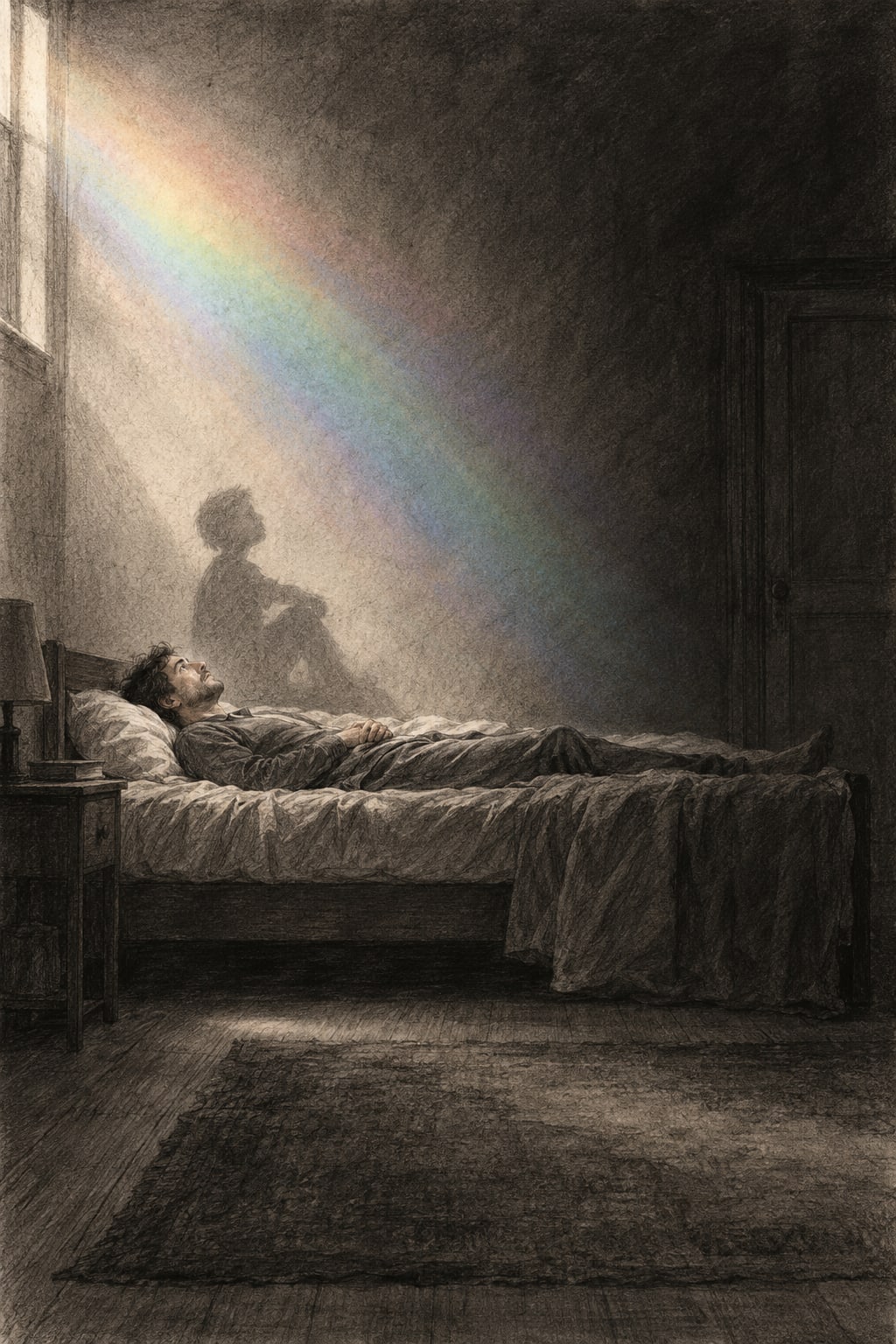
He is 37 years old, lying in his bedroom, watching a ray of light cross the wall. He should get up. There are things to finish, messages to answer, ideas to make real, and several versions of his life waiting for him to choose one of them.
The visible rays of light brings back the feeling of being 7, trying to figure out how the universe work.
He cannot remember the bedroom. He cannot see the walls, the floor, or the furniture. The room has disappeared, but the feeling remained. A small boy was looking at particles in the light and trying to understand the world, his place inside it, and what any of it was for.
Thirty years later, not much changed. He is still that boy, and the mystery still feels like an adventure. There is so much in front of him to discover, experience, taste, hear, build, love, and become.
The same mystery also contains fear, purposelessness, chaos, and the possibility that none of it means anything beyond the meaning people invent so they can get out of bed.
The world feels like a sandbox with no assigned mission. Everything is available. Nothing tells you what to do with it.
You arrive inside groups that existed before you. Families, countries, schools, religions, professions, neighborhoods, marriages, and art scenes, each have their own rules. Every group teaches you what counts as success, what deserves shame, what can be said aloud, and which version of you will be allowed to stay.
He has tried many of them. He has spent a third of his life in Europe, a third in Asia, and a third in America. Across those places, he has been foreign and local, husband and single man, father and child, musician and businessman, artist and strategist, nerd, outsider, and host. Some groups fit until they did not. Some gave him a language for a part of himself and then asked the rest of him to to be quiet. Some offered belonging at the price of becoming predictable.
He wants to try them all, and there are too many.
Maybe his purpose is to keep discovering them. Maybe exploration is the only mission he can give himself honestly.
This creates another problem. He has always believed that knowledge and wisdom comes from going deeper. You study a subject, enter it, and keep descending until the imposter syndrome shuts down. You keep reading, learn the history, and understand the exceptions. Eventually, you earn the right to say you know something.
Culture reveals itself differently. You understand one culture more clearly after seeing another. A sound changes when you hear the music that surrounds it. A flavor becomes visible beside another flavor. The same thing happens with humor, beauty, manners, desire, ambition, color, grief, and love. Contrast shows you what immersion alone can hide.
The world keeps adding to his palette. Every city gives him another color. Every person shows him another way a life can be arranged. Every song adds a new emotion to the range he might one day express. There is always another smell, another rhythm, another room, another form of tenderness, and another kind of fear, and he cannot get enough of it.
The more he encounters, the less qualified he feels to speak. He spends his time moving across the surface of many worlds, so he rarely feels entitled to claim any one of them. His range grows at the same time as his certainty shrinks.
Imagine explaining a collection of five cards. You can remember every one of them individually: the picture, the crease in the corner, where it came from, who gave it to you, and why you kept it. Ten cards ask a little more of your memory. Fifty-two may still feel manageable.
Then the collection grows into hundreds or thousands.
Holding every card separately becomes impossible. The details begin to blur. To remember the collection and explain it to someone else, you start sorting. You group the cards by color, place, period, mood, subject, or person. The categories make the collection easier to carry, but each card loses something when it becomes an example of a category. Its particular strangeness disappears.
This is the loop curiosity has created for him.
He went to new places because the categories he inherited felt incomplete. Words such as foreign, local, traditional, modern, open, and closed could never contain the people he met. Every country complicated the story he had heard about it. Every person contradicted some box. Travel filled his life with exceptions and gave him a larger sense of what a person or a life could be.
As those exceptions accumulated, he needed categories simply to remember them. Someone asks what a country was like, what a culture taught him, or how the people were, and the honest answer contains thousands of cards. Conversation usually asks for something smaller. He compresses years into a few traits, a city into a mood, or several people into a type. He hears himself rebuilding the same boxes his experiences had broken apart.
The more he sees, the more he has to simplify in order to share it. The more he simplifies, the less honest the explanation feels.
He is trying to connect with people around what he has experienced. He wants the experience to become a place they can enter together. It never transfers intact. Telling requires selection. Listeners need recognizable shapes before they can picture what he means. The cards that resist those shapes are often the ones that taught him the most, and they are the hardest ones to communicate.
This gap makes him feel isolated. People with similarly crowded collections sometimes recognize the problem before he explains it. Other people hear an abstraction, a contradiction, or an unfinished story. He wants them to see what he saw, then realizes that explanation can only hand them categories he no longer trusts.
Maybe this is why range makes him feel less qualified to speak. Every new card makes the generalization less honest. Keeping quiet protects the complexity and leaves him alone. Speaking creates a chance for connection while flattening the thing he hoped to share.
Part 2.
Lately, he has been thinking about peace.
Where is it? What would it feel like? When does the job become complete enough for him to rest without feeling that he has abandoned something?
Maybe peace waits at the end of the day. He finishes the work, closes the computer, and gives himself permission to stop. Tomorrow arrives with the unfinished parts still waiting.
Maybe peace waits at the end of the week, after the deadline, the launch, the long project, or the difficult conversation. Each ending clears enough space for another responsibility to become visible.
Maybe it waits at the end of the decade he has spent trying to make something of himself. He has worked on his professional life, musician life, love life, father life, social life, and mental-health life. He has collected skills, games, films, songs, friendships, cities, mistakes, and versions of himself. Every part of life seems to have its own progress bar, and none of them reaches one hundred percent at the same time.
He keeps waiting for the moment when the work is done and the reward arrives. He wants to feel that he has done enough, become enough, understood enough, loved enough, and lived enough. He wants a voice somewhere to confirm that he can finally rest, and the voice never comes.
So what is all this research for? What is he trying to discover? What would he do with the answer if he found it?
The more he sees, the less he knows. The more expressive his palette becomes, the harder it is to choose one color. Every new possibility enlarges his life and makes any single direction feel like the abandonment of all the others.
He lies in bed and waits for the feeling to pass. Feelings always pass. Something else eventually takes their place.
He cannot stay there forever. Hunger, another person's need, or a real deadline will eventually move him. A melody will appear, or an image, or something he will be afraid to lose, and he will go back to work.
He will explore because curiosity keeps moving after certainty stops. He will create because creation lets him use fragments that never became a complete answer. He will turn the people, groups, colors, smells, fears, pleasures, and unfinished questions into something that another person might recognize.
Maybe peace is the moment he stops demanding an ending from life. Maybe the search itself can become a place to live.
The ray of light has moved across the wall while he has been thinking. He takes that movement as enough instruction for the morning and follows it out of bed.
About the Creator
Curious Stranger
Passing through lives, collecting glimpses, following the questions.
Enjoyed the story? Support the Creator.
Subscribe for free to receive all their stories in your feed.
Comments
There are no comments for this story
Be the first to respond and start the conversation.