
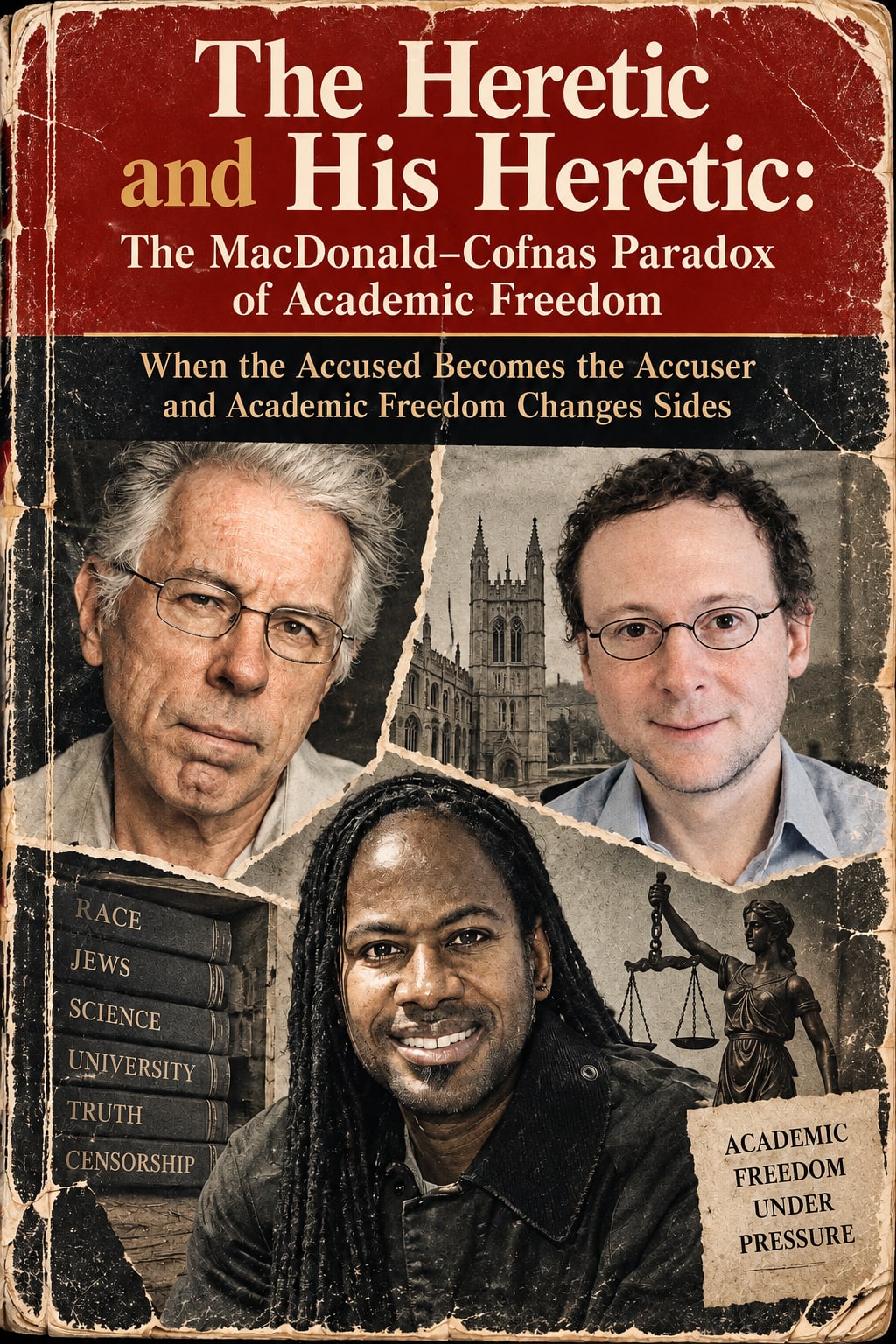
The Heretic and His Heretic: The MacDonald–Cofnas Paradox of Academic Freedom
When the Accused Becomes the Accuser and Academic Freedom Changes Sides

Introduction: Two Scholars on the Forbidden Border
There is an extraordinary paradox hidden inside one of the most uncomfortable intellectual controversies of contemporary academia. On one side stands Kevin MacDonald, an American psychologist whose attempt to interpret Judaism through evolutionary psychology made him one of the most condemned academics of his generation. His central hypothesis—that Judaism can be analysed as a “group evolutionary strategy”—was attacked by scholars as methodologically defective and by numerous critics as antisemitic. His own university colleagues publicly distanced themselves from his work. Yet MacDonald was not simply expelled from academic life: California State University, Long Beach explicitly defended his academic freedom while simultaneously repudiating his conclusions. On the other side of the paradox stands Nathan Cofnas, an academic of Jewish background who became one of MacDonald’s most formidable scholarly critics. In 2018, Cofnas subjected MacDonald’s argument to detailed examination and concluded that it depended upon misrepresented sources and cherry-picked evidence. But Cofnas was hardly a conventional progressive critic of controversial research. His own writings about race, heredity and intelligence subsequently generated fierce accusations of racism and brought serious institutional consequences. Years later, after publicly scrutinising the work of the Black Cambridge academic Jason Arday and alleging plagiarism and other problems, Cofnas himself was suspended by Ghent University while disciplinary proceedings examined his conduct.
The resulting symmetry is difficult to ignore. A white academic accused of antisemitism formulated a theory concerning Jewish group behaviour. A Jewish academic attacked that theory, yet later became notorious for controversial arguments concerning race and intelligence and for an aggressive public campaign questioning the scholarship of a prominent Black academic. MacDonald became the object of institutional denunciation without being removed from his tenured position; Cofnas became both critic and accused, eventually facing suspension himself. The point is not that these cases are morally identical. They clearly are not. Nor does the ethnicity of either scholar establish the truth or falsity of anything they wrote. The intellectual significance lies elsewhere. The MacDonald–Cofnas story forms an almost laboratory-like experiment in the unstable boundaries between academic freedom, ideological taboo, scholarly criticism, institutional reputation and personal responsibility. The uncomfortable question is therefore not whether MacDonald or Cofnas deserves sympathy. It is whether a university can consistently defend the principle that even offensive hypotheses must be answered primarily through evidence while also protecting individuals from conduct that crosses from scholarly criticism into discrimination or harassment. The paradox begins when the academic heretic acquires a heretic of his own.
The MacDonald–Cofnas Paradox
MacDonald’s work provides the first half of the paradox. His trilogy—A People That Shall Dwell Alone, Separation and Its Discontents and The Culture of Critique—attempted to apply evolutionary concepts to Jewish history and collective behaviour. His most controversial proposition was that Judaism could be understood as an evolutionary group strategy involving cultural mechanisms encouraging group continuity, endogamy and ethnocentrism. In The Culture of Critique he extended this argument dramatically, interpreting Jewish participation in movements including Boasian anthropology, Freudian psychoanalysis and strands of twentieth-century radical and liberal thought through this evolutionary framework. The uploaded material correctly identifies this as the central proposition around which the MacDonald–Cofnas dispute developed. These claims attracted condemnation far beyond ordinary academic disagreement. Yet an important distinction is easily lost: criticism, institutional disassociation and dismissal are not identical things. MacDonald’s own Psychology Department at California State University, Long Beach explicitly stated that it defended his right to express his views while dissociating itself from his controversial writings. The university’s Academic Senate likewise defended his academic freedom while unequivocally dissociating itself from views it characterised as antisemitic and white ethnocentric. Thus the institution attempted an uneasy formula: the scholar may speak; colleagues may condemn what he says; neither academic freedom nor criticism requires institutional endorsement of his conclusions. (California State University Long Beach)
Then came Cofnas. His intervention is particularly important because it demonstrates why the strongest response to a controversial theory need not be prohibition. His 2018 paper, “Judaism as a Group Evolutionary Strategy: A Critical Analysis of Kevin MacDonald’s Theory,” did something intellectually more consequential than simply labelling MacDonald. Cofnas reconstructed the hypothesis and attempted to test its evidential foundations. He argued that MacDonald had systematically misrepresented sources and selected evidence supporting his interpretation while neglecting contrary evidence. Cofnas proposed what he called the “default hypothesis”: Jewish overrepresentation in various intellectual and political movements could be explained more parsimoniously by demographic concentration in influential urban environments and historically high levels of educational and intellectual achievement, rather than by a collective evolutionary strategy directed against gentile societies. Significantly, Cofnas explicitly argued that MacDonald’s hypothesis should not simply be dismissed a priori. He maintained that the subject could be investigated and that refusing serious scholarly engagement had unintentionally allowed supporters of MacDonald to portray him as an intellectual victim whose theory academia was frightened to confront. Cofnas therefore demonstrated a fundamental principle of scientific criticism: the answer to a questionable hypothesis is ideally a better hypothesis, stronger evidence and closer examination of the sources. (Springer Link)
But this apparent victory of criticism over censorship did not produce the simple morality tale one might expect. Cofnas himself became increasingly controversial because of his writings concerning race, intelligence and heredity. The critic of one allegedly racialised theory became accused of advancing another. This does not vindicate MacDonald. Nor does Cofnas’s Jewish background invalidate his criticism of MacDonald. Such reasoning would reproduce precisely the group-essentialist logic that requires scrutiny in the first place: arguments do not become true or false because their authors are Jewish, white or Black. Yet the biographical inversion creates an extraordinary sociological case. The person who had argued that MacDonald should be refuted by opening his books, checking his quotations and examining competing explanations would eventually demand similarly uncompromising scrutiny of another scholar’s work.
That scholar was Jason Arday, a prominent Black British academic associated with Cambridge University. Cofnas became a leading public voice alleging serious problems in Arday’s scholarship, including plagiarism. The controversy became exceptionally intense. Arday denied plagiarism, although he acknowledged mistakes, and publicly indicated that the scrutiny was affecting him and his family. He later resigned from Cambridge and was found dead in August 2026. Nothing in the presently available evidence justifies transforming chronological sequence into demonstrated causation: it would therefore be irresponsible to write that Cofnas “caused” Arday’s death. Arday’s death nevertheless transformed an academic-integrity controversy into a profound argument about the ethics of public scholarly criticism, reputational destruction and institutional responsibility. Shortly afterwards, Ghent University suspended Cofnas while investigating allegations concerning his conduct. He was subsequently allowed to resume some duties remotely while remaining barred from teaching as the disciplinary process continued. (Reuters)
Here the paradox becomes almost perfectly circular. MacDonald could ask: if my controversial propositions are wrong, why not demonstrate that they are wrong? Cofnas effectively answered that challenge by attempting precisely such a demonstration. Cofnas could then ask a structurally similar question in the Arday affair: if allegations about academic work are false, why should they not be answered through examination of the evidence? But a university must confront an additional problem that pure epistemology cannot resolve. Academic freedom protects investigation and criticism; it does not automatically immunise every manner in which criticism is conducted. There is a difference between publishing a critical paper, publicly alleging misconduct, orchestrating reputational pressure and engaging in discriminatory harassment. Determining where one ends and another begins is precisely what institutional procedures are supposed to establish rather than assume. Indeed, hundreds of academics subsequently signed an open letter arguing that punishing Cofnas for publicising alleged misconduct would threaten academic freedom. Their intervention demonstrates that the Cofnas case itself has become contested rather than settled. (insidehighered.com)
The most provocative element of the MacDonald–Cofnas paradox therefore concerns symmetry. If ethnicity cannot invalidate Cofnas’s criticism of MacDonald, neither can race by itself invalidate scrutiny of Arday. If offensive implications do not automatically falsify MacDonald’s empirical claims, offensive implications cannot automatically falsify Cofnas’s claims. Conversely, if MacDonald can be legitimately criticised for selective evidence, methodological weakness or distortion, Cofnas must accept exactly the same standard when his own claims are examined. No scholar can demand methodological neutrality when he is the accused and moral immunity when he becomes the accuser. Scientific standards either travel across identities or they cease to be scientific standards.
This is precisely why reducing the affair to “white scientist versus Jewish scientist versus Black scientist” would ultimately miss its deepest significance. Their identities produce the historical irony, but they cannot provide the epistemological verdict. A hypothesis concerning Jews does not become antisemitic merely because its author is non-Jewish, just as it does not become scientifically respectable merely because its author calls it evolutionary psychology. A controversial hypothesis about racial differences does not become true because its author belongs to a minority group. And allegations concerning the scholarship of a Black professor cannot be rejected simply because the accuser has previously been accused of racism. The proper scholarly questions remain stubbornly impersonal: What exactly was claimed? What evidence supports it? Were sources represented accurately? Can the conclusions be replicated or independently verified? Are alternative explanations stronger? And did the behaviour surrounding the scholarly dispute violate separate institutional rules? The moment identity supplies the answer before those questions have been examined, scholarship begins to mutate into adjudication by social category.
Conclusion: Academic Freedom for the Person One Cannot Defend
The MacDonald–Cofnas paradox reveals something more unsettling than hypocrisy. It reveals how difficult academic freedom becomes precisely when it matters. Almost everyone supports freedom for research that they regard as intelligent, humane and correct. That requires little courage. The meaningful test arrives when a scholar proposes something regarded as offensive, repellent, dangerous or politically explosive. MacDonald presents one version of that test. Cofnas presents another. Arday’s tragic death introduces a third and much more painful dimension: criticism takes place not between abstract propositions but between vulnerable human beings living inside institutions, reputations and public media systems capable of amplifying scholarly disputes into spectacles.
The lesson therefore cannot simply be “anything goes.” Universities have legitimate responsibilities concerning discrimination, harassment, research integrity and professional conduct. But neither can the lesson be that sufficiently offensive scholarship should disappear without examination. The strongest moment in the entire MacDonald–Cofnas controversy may paradoxically be Cofnas’s original decision to take MacDonald seriously enough to try to prove him wrong. His 2018 article argued that refusing scholarly engagement with MacDonald had helped create the impression that academia was persecuting a dissident instead of refuting a weak theory. (Springer Link) That observation now returns to Cofnas himself with almost theatrical symmetry.
Academic freedom cannot mean freedom only for the hypothesis that survives the moral expectations of its historical moment. Neither can it mean immunity from criticism or consequences for conduct. It means something more demanding: separating the right to formulate a proposition from the truth of that proposition, separating criticism of evidence from judgement of identity, and separating intellectual error from punishable misconduct through transparent procedures rather than ideological reflex.
MacDonald was accused of constructing a theory around Jewish group behaviour. Cofnas, a scholar of Jewish background, became one of his most detailed critics and accused him of selective evidence. Cofnas was later himself condemned for controversial racial arguments and suspended after his campaign scrutinising the work of Jason Arday. The circle is almost too perfect. Yet its conclusion should not be that MacDonald was therefore right, that Cofnas was therefore wrong, or that Arday should have been beyond criticism. It is precisely the opposite. None of those conclusions follows from the identities of the people involved.
The real paradox is that academia discovers whether it genuinely believes in academic freedom only when it encounters an academic it desperately wishes not to defend.
References
California State University Long Beach (2008) ‘Statement on the controversial writings of Dr. Kevin MacDonald’, Department of Psychology, approved 23 April 2008.
California State University Long Beach Academic Senate (2008) ‘Statement on Dr. Kevin MacDonald’s Work’, adopted 5 May 2008.
Cofnas, N. (2018) ‘Judaism as a group evolutionary strategy: A critical analysis of Kevin MacDonald’s theory’, Human Nature, 29, pp. 134–156. doi:10.1007/s12110-018-9310-x.
Cofnas, N. (2019) ‘Is Kevin MacDonald’s theory of Judaism “plausible”? A response to Dutton (2018)’, Evolutionary Psychological Science, 5, pp. 143–150. doi:10.1007/s40806-018-0162-8.
Cofnas, N. (2023) ‘Still no evidence for a Jewish group evolutionary strategy’, Evolutionary Psychological Science, 9, pp. 236–259.
Inside Higher Ed (2026) ‘Hundreds of academics support Arday accuser Nathan Cofnas in open letter’, 25 August.
MacDonald, K. (1994) A People That Shall Dwell Alone: Judaism as a Group Evolutionary Strategy. Westport, CT: Praeger.
MacDonald, K. (1998a) The Culture of Critique: An Evolutionary Analysis of Jewish Involvement in Twentieth-Century Intellectual and Political Movements. Westport, CT: Praeger.
MacDonald, K. (1998b) Separation and Its Discontents: Toward an Evolutionary Theory of Anti-Semitism. Westport, CT: Praeger.
Reuters (2026a) ‘Academic who raised plagiarism allegations against Jason Arday suspended by his university’, 20 August.
Reuters (2026b) ‘US academic who accused Jason Arday of plagiarism allowed to resume some work’, 28 August.
About the Creator
Peter Ayolov
Peter Ayolov’s key contribution to media theory is the development of the "Propaganda 2.0" or the "manufacture of dissent" model, which he details in his 2024 book, The Economic Policy of Online Media: Manufacture of Dissent.
Enjoyed the story? Support the Creator.
Subscribe for free to receive all their stories in your feed.
Comments
There are no comments for this story
Be the first to respond and start the conversation.