
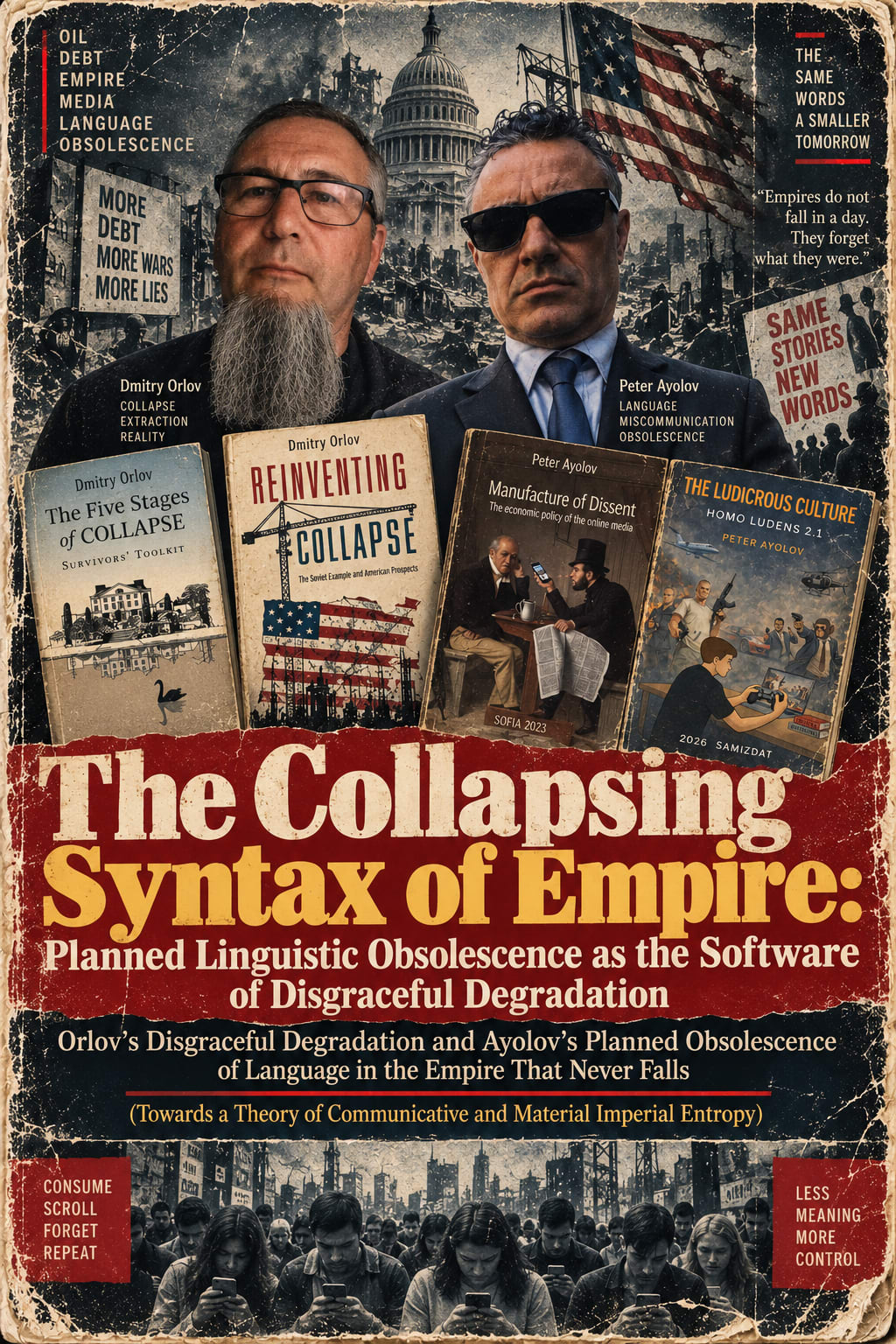
The Collapsing Syntax of Empire: Planned Linguistic Obsolescence as the Software of Disgraceful Degradation
Orlov’s Disgraceful Degradation and Ayolov’s Planned Obsolescence of Language in the Empire That Never Falls

Abstract
The conventional imagination of civilisational collapse remains dominated by the event: Rome falls, the Soviet Union dissolves, a government disappears, a currency fails, an empire reaches an identifiable historical terminus. Yet complex political systems may deteriorate for decades or centuries while preserving the names, symbols, institutions and linguistic forms through which continuity is publicly imagined. Dmitry Orlov’s recent reformulation of his theory of collapse as “Disgraceful Degradation” provides a provocative model for understanding such an extended condition. Revising his earlier Soviet–American analogy, Orlov proposes that an extractive imperial system need not reproduce the relatively sudden disintegration of the USSR; it may instead prolong itself by transferring losses towards its peripheries, allies and eventually its own population, producing a progressively hollowed institutional order whose degradation becomes increasingly difficult to distinguish from normality. This article brings Orlov’s material theory of degradation into dialogue with Peter Ayolov’s theory of the Planned Obsolescence of Language. It proposes that the two models describe interconnected levels of the same entropic process: where Orlov identifies the progressive extraction of material resources and institutional capacity, Ayolov identifies a communicative environment in which words, narratives, slogans and political meanings lose semantic durability through accelerated circulation, replacement and exhaustion. Planned linguistic obsolescence can consequently be interpreted as the cultural software of disgraceful degradation: a mechanism through which material deterioration is continuously renamed, normalised and incorporated into an unstable linguistic present. The resulting Ayolov–Orlov synthesis is developed here as a theory of communicative and material imperial entropy, in which the degradation of institutions and the degradation of the vocabulary used to evaluate those institutions become mutually reinforcing. The historical analogy is therefore not an empire that suddenly falls but Rome—an imperial formation whose “fall” retrospectively compresses a prolonged transformation into an apparently singular event. Rome did not fall for a day. The contemporary empire may similarly remain recognisable precisely because its surviving language continues naming as present what its material reality has already begun to lose.
Keywords
Dmitry Orlov; Peter Ayolov; Disgraceful Degradation; Planned Obsolescence of Language; collapse; empire; imperial decline; linguistic obsolescence; communicative entropy; semantic durability; miscommunication; institutional degradation; Roman Empire; cultural collapse; material entropy
Introduction: The Empire That Forgot How to Fall
“This is the way the world ends
Not with a bang but a whimper.”
— T. S. Eliot (1925), The Hollow Men
The popular imagination has always preferred collapse as spectacle. Civilisations are remembered as if they possessed expiration dates: Rome fell in 476, Constantinople in 1453, the Soviet Union in 1991. The convenience of such dates disguises the much stranger historical reality that people living inside declining systems rarely experience a single morning on which the world announces that an epoch has ended. The Western Roman Empire did not spend 3 September 476 functioning normally and awaken on 4 September as a collapsed civilisation. Its famous “fall” retrospectively condenses centuries of demographic transformation, territorial contraction, fiscal pressure, military reorganisation, institutional mutation and political fragmentation into an event comprehensible to later historians. In this sense, Rome did not merely fail to fall in a day; more provocatively, Rome did not fall for a day. The distinction is important because it shifts collapse from chronology to perception. An empire may be falling while ordinary life continues, taxes are collected, offices remain occupied, titles retain their prestige, laws are promulgated and inherited words continue to designate institutions whose material substance has already changed. Dmitry Orlov’s recent concept of “Disgraceful Degradation” makes precisely this problem newly relevant. His earlier work, particularly Reinventing Collapse and The Five Stages of Collapse, approached the United States partly through the historical experience of Soviet disintegration, imagining systemic breakdown as a sequence in which financial, commercial, political, social and finally cultural structures could progressively cease to sustain one another. His recent revision changes the temporal logic of this comparison. The United States, he now argues, should not be expected to reproduce the Soviet trajectory because the two superpowers constituted fundamentally different imperial arrangements. Whatever the historical limitations of Orlov’s characterisation of the Soviet Union as an “anti-empire” and the United States as an extractive colonial empire, the theoretical consequence is significant: an imperial centre capable of externalising losses can postpone its own reckoning by consuming its margins. As access to external resources diminishes, extraction moves closer to the centre—first towards dependent allies and peripheral zones, then towards the domestic population and accumulated social wealth. Collapse therefore ceases to resemble a terminal event and becomes an extended process of hollowing out. Institutions survive their functions; political vocabulary survives political substance; prosperity can remain statistically and rhetorically present while security and public capacity deteriorate underneath it. Orlov’s disturbing proposition is consequently not simply that collapse is approaching, but that degradation can become so gradual that a formally recognisable collapse may never become perceptible to those living through it. The earlier formulation of this problem was therefore deliberately paradoxical: perhaps the most disturbing possibility is not that the predicted collapse has failed to arrive, but that “it has arrived but no longer looks like collapse.”
Yet this reformulation leaves an essential question unanswered. How can large populations inhabit prolonged deterioration without possessing a stable conceptual threshold at which deterioration becomes recognisable as collapse? Material extraction alone cannot explain the persistence of symbolic normality. An empire does not exist exclusively through pipelines, armies, currencies, factories, debt instruments and administrative organisations; it also exists through the words by which these things are classified, narrated, legitimised and remembered. Here Orlov’s theory unexpectedly encounters Peter Ayolov’s concept of the Planned Obsolescence of Language. If Orlov describes the degradation of the material and institutional architecture of empire, Ayolov’s theory makes it possible to investigate degradation within the communicative architecture through which that empire represents itself to itself. Planned linguistic obsolescence does not require the crude proposition that somebody centrally designs every word to deceive a population. Its more radical implication is structural: communicative environments organised around acceleration, novelty, ideological competition, advertising, algorithmic attention and incessant replacement reward linguistic forms that circulate rapidly but age rapidly as well. The result is a peculiar inversion of linguistic progress. Communication can become technically faster, quantitatively greater and globally more efficient while the semantic durability necessary for cumulative understanding deteriorates. Political slogans replace previous slogans before their promises can be historically evaluated; euphemisms reorganise perceptions of institutional failure; corporate and administrative vocabularies rename subtraction as innovation, insecurity as flexibility and contraction as transformation; controversies succeed one another so rapidly that yesterday’s conceptual vocabulary disappears before it can become a durable standard of comparison. The connection with Orlov is therefore deeper than analogy. Material degradation and linguistic obsolescence may form a recursive system. A deteriorating institution generates pressure for linguistic reinterpretation; linguistic reinterpretation normalises the changed institution; semantic replacement weakens comparison with its previous condition; weakened comparison reduces the visibility of deterioration; and the newly normalised condition establishes the baseline from which the next deterioration will subsequently be judged. Orlov’s material extraction consequently finds its communicative counterpart in an extraction of semantic durability. The empire consumes accumulated wealth while its language consumes accumulated meaning. The first diminishes the resources inherited from the past; the second diminishes the conceptual memory through which the present could recognise that loss. This article develops that conjunction as an Ayolov–Orlov theory of communicative and material imperial entropy. Its central proposition is that Planned Obsolescence of Language may operate as the cultural software of Disgraceful Degradation—not as an additional “sixth stage” occurring after financial, commercial, political, social and cultural collapse, but as a communicative mechanism capable of accompanying every stage and allowing deterioration to be experienced under continuously renewed descriptions of normality. The empire that cannot prevent its material decline may nevertheless postpone recognition of decline by repeatedly rewriting its linguistic meaning. Rome supplies the historical warning precisely because its “fall” becomes obvious chiefly from the retrospective position of those who know what came afterwards. For those living within a slowly changing imperial order, there was always another morning, another decree, another emperor, another tax and another surviving name inherited from a world already disappearing. The contemporary equivalent may prove still more linguistically sophisticated. A civilisation need not silence discussion of its decline if its communicative system can continually replace the meanings through which decline might be recognised. The decisive question is therefore no longer simply when an empire falls. It is whether an empire can lose the language necessary to understand that it is falling.
Part I: The Empire That Refuses to Die — From Collapse to Disgraceful Degradation
“Civilizations die from suicide, not by murder.”
— Arnold J. Toynbee (1947), A Study of History
The most consequential change in Dmitry Orlov’s theory of collapse is his abandonment of the expectation that the United States must eventually produce its own recognisable December 1991. Reinventing Collapse developed its provocative force from the Soviet–American comparison: the USSR had appeared structurally permanent until remarkably close to its dissolution, and therefore the apparent permanence of another superpower offered no protection against systemic breakdown. In The Five Stages of Collapse, Orlov transformed this intuition into a sequence moving through financial, commercial, political, social and finally cultural collapse. Yet the Soviet precedent continued to imply a particular temporality: a system deteriorates until it crosses a threshold after which even its political identity can no longer be sustained. The USSR existed and then ceased to exist. Orlov’s recent concept of “Disgraceful Degradation” disrupts precisely this expectation. His revision begins with the admission that the Soviet Union and United States should not have been treated as symmetrical imperial organisms destined for symmetrical deaths. In Orlov’s new formulation, the USSR operated as what he provocatively calls an “anti-empire”, expending domestic resources upon constituent republics and geopolitical allies, whereas the United States represents an extractive imperial system capable of transferring substantial costs towards an external periphery. This historical characterisation requires qualification, particularly because Soviet domination also involved coercion and unequal political relationships, but the theoretical distinction beneath it remains productive. A centre that principally subsidises its periphery and a centre capable of extracting from its periphery possess different capacities for postponing internal crisis. Orlov therefore retains his familiar “superpower collapse soup”—energy constraints, persistent trade imbalance, military overextension and mounting public debt—but changes the predicted outcome. The extractive empire does not necessarily encounter these pressures as a single terminal event. It can redistribute their consequences. External extraction can move towards allies and dependent economies; when peripheral resources become less accessible, extraction can increasingly turn towards accumulated domestic wealth. The resulting cycle is therefore not simply decline followed by collapse, but extraction, postponement, degradation and renewed extraction. Survival itself consumes the resources required for future survival. This places Orlov close to Joseph Tainter’s account of diminishing returns from social complexity, John Michael Greer’s image of a prolonged and uneven Long Descent, and Peter Turchin’s “wealth pump”, through which declining popular welfare can coexist with intense accumulation among elites. The important common insight is that civilisation and collapse are not mutually exclusive conditions. A society can remain technologically sophisticated, institutionally elaborate and spectacularly wealthy at its summit while progressively exhausting the foundations upon which those appearances depend.
The distinctive force of “Disgraceful Degradation”, however, lies in the survival of form after the deterioration of function. The railway remains but becomes less reliable; the university retains its prestigious name while its intellectual mission contracts; political institutions preserve elections, offices and ceremonial vocabularies while confidence in their capacity diminishes; financial indicators can signal prosperity while everyday security becomes more precarious. Collapse becomes institutional afterlife rather than disappearance. This produces a problem more difficult to perceive than spectacular catastrophe. When a bridge falls, the event supplies its own definition. When a service becomes slightly poorer, slower and more expensive each year, there is no equivalent semantic threshold. Each deterioration can be absorbed as reform, adjustment, temporary necessity or simply the new normal. A generation entering the degraded institution encounters its reduced condition without necessarily possessing experiential knowledge of what preceded it. Hence the crucial proposition that “collapse becomes invisible when expectations collapse first.” Yet here Orlov’s material analysis encounters its conceptual limit. Institutions cannot indefinitely preserve the appearance of continuity unless the language describing their purposes and performance changes alongside them. “Prosperity” must somehow accommodate insecurity; “efficiency” must remain available when services contract; “reform” must be capable of describing improvement and retreat alike. This does not require a conspiratorial authority rewriting the dictionary. Political competition, bureaucratic self-preservation, advertising and accelerated media circulation can themselves reward descriptions flexible enough to accompany changing material realities. The degrading empire consequently requires something besides energy, credit, military power and extractable wealth: it requires words capable of surviving the deterioration of the things they once described. Orlov explains how an imperial centre can consume its peripheries and eventually itself, but not fully how such consumption can repeatedly enter collective consciousness as something other than decline. At precisely this boundary the material theory of Disgraceful Degradation opens onto Ayolov’s Planned Obsolescence of Language. If empire postpones collapse by consuming accumulated material reserves, its communicative order may perform an analogous operation upon accumulated semantic reserves. The empire that refuses to die must teach its words how to forget what they once meant.
Part II: The Words That Refuse to Mean — Ayolov and the Planned Obsolescence of Language
“But if thought corrupts language, language can also corrupt thought.”
“Political language—and with variations this is true of all political parties, from Conservatives to Anarchists—is designed to make lies sound truthful and murder respectable.”
— George Orwell (1946), “Politics and the English Language”
If Orlov’s Disgraceful Degradation describes a civilisation capable of surviving the progressive exhaustion of its material foundations, Peter Ayolov’s Planned Obsolescence of Language approaches the same historical condition from the opposite direction: from the deterioration of the words through which that condition can be recognised. An empire exists linguistically as well as materially. Its borders are named, its laws formulated, its debts denominated, its enemies classified, its victories narrated and its failures explained. Words such as “prosperity”, “security”, “democracy”, “growth”, “education”, “reform” and “freedom” are therefore not decorative labels attached to an independently existing political reality. They provide standards through which institutions are interpreted and their performance compared across time. Ayolov’s theory becomes especially significant when these standards themselves cease to possess semantic durability. Borrowing the industrial metaphor of planned obsolescence, the concept shifts attention from whether a particular statement is simply true or false towards another question: how long can its meaning remain stable enough to permit historical comparison? Under conditions of accelerated media circulation, algorithmic attention, advertising, political messaging and incessant competition for novelty, linguistic objects increasingly acquire shortened life cycles. Narratives, slogans and political categories are produced, circulated, consumed, exhausted and replaced before their implications can settle into collective memory. Communication consequently becomes faster and quantitatively greater without necessarily producing greater understanding. The apparent paradox is central to Ayolov’s broader theory of miscommunication: a society can become saturated with language while progressively losing the semantic continuity required for meaningful communication. The earlier synthesis between Ayolov and Orlov identified precisely this structural correspondence: where Orlov’s declining system extracts material resources to prolong itself, Ayolov’s communicative environment can exhaust language’s “semantic durability” through accelerated circulation and replacement. “Planned” in this context need not imply a conspiratorial authority deliberately designing every semantic mutation. It identifies a systemic affinity between disposable language and institutions whose technological, commercial and political incentives reward novelty, speed and perpetual replacement. A slogan that remains stable eventually loses attention; a controversy that persists too long ceases to generate novelty; a political narrative that accumulates contradictions can simply be superseded by another. The result is not the disappearance of speech but its hypertrophy. More is said, circulated and consumed while less survives long enough to establish a durable standard against which the next statement can be judged. The linguistic system begins to resemble the economic system it describes: both sustain present activity by rapidly consuming inherited reserves.
This mechanism extends beyond conventional propaganda. Propaganda ordinarily presupposes a relatively durable conflict between reality and its representation: something happens and power attempts to conceal, distort or reinterpret it. Planned linguistic obsolescence introduces the more radical possibility that no permanent interpretation is required because permanence itself has become unnecessary. A politically useful description needs only to survive until another description replaces it. Yesterday’s contradiction does not have to be resolved if tomorrow’s vocabulary makes it communicatively obsolete. A deteriorating institution can therefore preserve its name while continuously renegotiating what that name is expected to mean. Reduction may be described as “optimisation”, insecurity as “flexibility”, institutional retreat as “reform”, and permanent adaptation to worsening conditions as “resilience”. None of these words is inherently deceptive; their importance lies in their semantic elasticity, their ability to accompany contradictory material developments without themselves disappearing. Here Ayolov’s linguistic argument intersects directly with Orlov’s institutional afterlife. Orlov describes institutions whose external forms survive while their substantive capacities diminish; Ayolov makes it possible to conceive a parallel semantic afterlife in which words continue circulating while the historical expectations once attached to them are progressively weakened. The two processes can reinforce one another because recognition of decline requires comparison, and comparison requires both memory and relatively stable categories. When the meaning of “university”, “public service”, “employment”, “privacy”, “security” or “prosperity” is continually recalibrated to fit whatever condition presently exists, the past becomes progressively harder to use as an indictment of the present. This is the linguistic counterpart of the proposition that “collapse becomes invisible when expectations collapse first.” Planned Obsolescence of Language should therefore not be placed after Orlov’s financial, commercial, political, social and cultural stages as another terminal phase. It can operate throughout them, continually reorganising the conceptual standards by which each deterioration would otherwise become visible. Language becomes, in this sense, the software of Disgraceful Degradation. It need not cause debt, institutional decay, inequality or imperial overextension; it organises the categories through which those realities enter collective consciousness. Orlov’s empire consumes accumulated material inheritance in order to postpone its reckoning. Ayolov’s communicative order consumes accumulated semantic inheritance in order to keep describing the resulting world as intelligible continuity. Before degradation can become normal, the meaning of degradation must itself become unstable. The empire that survives by exhausting what it inherited therefore acquires its perfect linguistic companion: words that survive by forgetting what they once meant.
Part III: The Collapsing Syntax of Empire — When Language Becomes the Software of Collapse
“The crisis consists precisely in the fact that the old is dying and the new cannot be born.”
— Antonio Gramsci (1971), Selections from the Prison Notebooks
The conjunction of Orlov’s Disgraceful Degradation and Ayolov’s Planned Obsolescence of Language now permits a model neither theory produces independently: communicative and material imperial entropy. Orlov describes the deterioration of the object; Ayolov describes the destabilisation of the vocabulary through which deterioration of that object can be measured. Their relationship is therefore recursive rather than sequential. Material degradation generates pressure for linguistic normalisation; linguistic normalisation reduces the visibility of degradation; diminished recognition makes further adaptation politically and culturally possible; continued adaptation establishes a lower material baseline; and the new baseline subsequently requires another semantic adjustment. What begins as exceptional becomes temporary, what is temporary becomes necessary, what is necessary becomes normal, and what becomes normal eventually disappears as an object of comparison. The process can repeat without requiring either a master plan or universal deception. Indeed, its effectiveness may depend precisely upon its decentralisation. Governments, corporations, universities, media organisations, digital platforms and individuals all possess immediate incentives to describe deteriorating circumstances in forms that preserve confidence, legitimacy, attention or simply psychological continuity. The aggregate result is a system capable of changing its descriptions almost as rapidly as its conditions deteriorate. This is the Semiotic Spiral of Imperial Entropy implicit in the Ayolov–Orlov synthesis: material degradation produces semantic adaptation, semantic adaptation facilitates social accommodation, accommodation permits further material degradation, and degradation demands another round of linguistic adaptation. The earlier comparison between the theories already identifies their structural complementarity: Orlov’s extractive system progressively consumes material resources, whereas Ayolov’s model suggests a parallel exhaustion of semantic durability and truth-bearing capacity. Yet the synthesis goes further. Language is not merely propaganda placed over a deteriorating reality like paint over a decaying wall. It constitutes part of the apparatus by which social reality remains comparable with its own past. A society can recognise that a railway, university, hospital, currency or political institution has deteriorated only if some memory of its previous function remains connected to sufficiently durable concepts of what that institution ought to be. Once the concept itself becomes fluid, deterioration becomes harder to distinguish from transformation. The decisive formula is therefore simple: Orlov’s degradation destroys the object; Ayolov’s obsolescence destroys the vocabulary by which the loss of the object could be measured. The result is not silence but extraordinary linguistic productivity. Every deterioration can generate another explanation, every contradiction another narrative, every institutional retreat another vocabulary of adaptation. The empire continues talking precisely while the relationship between its words and its accumulated historical experience becomes increasingly unstable.
Rome consequently returns not as a simplistic prediction that the contemporary American empire must repeat Roman history, but as a problem of historical perception. The date 476 is useful because later historians already know the subsequent history; for those inhabiting the transformations of the fifth century, however, there was no universal announcement that a civilisation had entered “the Fall of Rome”. Offices, laws, titles, religious institutions, administrative practices and Roman identities survived in altered forms long after political structures changed. Retrospective history places punctuation where lived history frequently supplied only another sentence. The same principle gives Orlov’s Disgraceful Degradation its disturbing plausibility: an imperial order need not disappear in order to become progressively less capable of reproducing the conditions once associated with its name. But the contemporary communicative environment adds something Rome did not possess—the unprecedented acceleration with which descriptions can be manufactured, distributed, contested and replaced. Under conditions of planned linguistic obsolescence, society may lose not only institutions but the stable semantic baselines necessary to remember their previous condition. The “collapse of comparison” therefore becomes more consequential than any isolated act of euphemism or propaganda. If each generation of political language possesses a shorter semantic life, yesterday’s definitions cease to constrain today’s claims, while today’s definitions may disappear before tomorrow’s failures can be measured against them. Collapse then becomes simultaneously material and epistemic: the system loses capacities while losing the linguistic continuity required to recognise those losses as parts of the same historical process. This explains why Planned Obsolescence of Language should not become a sixth stage appended mechanically to Orlov’s five stages of collapse. It is potentially the communicative mechanism running through all five. Financial collapse can be renamed adjustment; commercial collapse restructuring; political collapse emergency governance; social collapse individualisation; cultural collapse transformation. Again, the argument is not that these words necessarily conceal collapse, but that semantic mobility allows institutions to renegotiate continuously the threshold at which deterioration becomes linguistically undeniable. The empire can therefore survive the meaning of its own collapse longer than it can prevent the collapse itself. Its buildings may remain standing, its currencies circulating, its universities awarding degrees, its governments issuing statements and its digital networks producing more words than any civilisation in history. What disappears first may be the shared standard permitting these surviving forms to be compared with what they once represented. Rome did not fall for a day. Perhaps that is precisely how empires fall: every individual day remains sufficiently recognisable as yesterday for tomorrow to arrive without announcing that the world which gave those days their meaning has already disappeared.
Conclusion: There Need Only Be Another Tuesday — The Empire After the Meaning of Collapse
“The future is a faded song, a Royal Rose or a lavender spray
Of wistful regret for those who are not yet here to regret.”
— T. S. Eliot (1925), The Hollow Men
The deepest implication of the Ayolov–Orlov synthesis is that collapse may cease to be an event before it ceases to be a historical reality. Theories of civilisational decline have repeatedly attempted to identify the forces that transform complex societies into simpler, poorer or politically fragmented successors: diminishing returns from complexity in Tainter, ecological overshoot and maladaptation in Diamond, the uneven staircases of Greer’s Long Descent, nonlinear decline in Bardi, elite overproduction and the “wealth pump” in Turchin, and the sequential destruction of confidence underlying Orlov’s Five Stages of Collapse. Yet Disgraceful Degradation introduces a particularly disturbing variation because it asks what happens when a system acquires sufficient mechanisms of extraction, substitution and adaptation to postpone the moment at which deterioration becomes universally recognisable as collapse. The empire may not overcome its contradictions. It may simply distribute them. It transfers costs from centre to periphery, from wealthy institutions towards weaker ones, from public infrastructure towards private households, from the present towards the future and eventually from accumulated social wealth towards the maintenance of structures that increasingly consume more than they reproduce. In such a system, survival itself becomes ambiguous. The continued existence of institutions is presented as evidence that collapse has not occurred, although maintaining those institutions may require the progressive consumption of precisely the material foundations upon which their future depends. The skyscraper remains visible while the bridge deteriorates; the university retains its name while its function changes; the political system preserves its rituals while expectations of what those rituals can accomplish decline. This is why the crucial concept is institutional afterlife. A civilisation can become haunted by its own surviving forms. Names, symbols, offices, ceremonies and organisations remain sufficiently recognisable to sustain an impression of continuity even when their relationship to the world that originally gave them meaning has substantially changed. Collapse therefore acquires a paradoxical appearance: almost everything necessary to prove that the civilisation still exists may remain visible, while many of the capacities by which its existence was once measured progressively disappear. The empire has not defeated collapse. It has learned how to inhabit it.
Ayolov’s Planned Obsolescence of Language carries this argument into the communicative structure through which such institutional afterlife becomes socially intelligible. If Orlov explains how a deteriorating imperial system can continue materially by consuming accumulated resources, Ayolov offers a model for understanding how it can continue semantically by consuming accumulated meanings. The synthesis does not require the claim that linguistic degradation causes every material crisis, nor that governments, corporations or media institutions secretly coordinate a comprehensive programme of semantic destruction. Its stronger and more defensible proposition is structural. A communicative environment dominated by accelerated circulation, novelty, political competition, advertising, algorithmic selection and abbreviated attention rewards language capable of rapid adaptation and replacement. Under these conditions, semantic durability can become a disadvantage. Words that once established standards against which institutions were judged become elastic enough to accommodate changing conditions; narratives expire before their contradictions mature into collective memory; political promises disappear beneath their successors; euphemisms and managerial vocabularies continually redraw the boundary separating deterioration from transformation. The relationship between the two theories can therefore be represented as a spiral rather than a linear chain: material degradation produces linguistic adaptation; linguistic adaptation reduces the visibility of degradation; diminished visibility encourages accommodation; accommodation establishes a degraded condition as the new baseline; and the next material loss begins from that lower baseline, demanding another linguistic adjustment. The process identified earlier as the “collapse of comparison” is therefore the crucial junction between material and communicative entropy. A civilisation does not need literally to erase its past if it continually alters the categories through which past and present can be compared. It does not need to prohibit the word “collapse” if collapse itself becomes a floating designation reserved for some catastrophe always more spectacular than present deterioration. Every surviving bank proves that financial collapse has not occurred; every functioning supermarket disproves commercial collapse; every election disproves political collapse; every social-media interaction disproves social collapse; every new film, song and book disproves cultural collapse. Collapse is consequently deferred by definition towards a hypothetical future in which nothing functions at all. Against such an impossible standard, almost any degradation can continue to call itself normality. This is why Planned Obsolescence of Language is not merely another stage after Orlov’s five. It is potentially the communicative mechanism through which all five stages can remain linguistically suspended before the threshold of their own recognition. Orlov’s degradation consumes the object; Ayolov’s obsolescence destabilises the vocabulary by which the disappearance of the object could be measured. The empire survives materially by spending its inheritance and symbolically by forgetting what that inheritance once meant.
Rome therefore becomes the appropriate final image precisely when it ceases to function as a simplistic analogy. The proposition is not that the United States is Rome, that contemporary institutions reproduce late antiquity, or that history possesses a mechanical law requiring every hegemonic system to repeat the same sequence. Rome matters because the phrase “the Fall of Rome” demonstrates the retrospective violence of historical punctuation. The year 476 provides a date around which centuries of transformation can be organised, but the date becomes far more decisive to later historical consciousness than it could have been to the millions of people whose lives crossed the supposed boundary between a Roman world and whatever followed it. Rome did not fall for a day. Roads remained roads, cities remained inhabited, bishops administered churches, laws continued to influence practice, Latin continued to be spoken and written, and Roman identities survived political structures that had already undergone profound transformation. The conceptual error is to imagine that because later history can name the process, contemporaries must necessarily have possessed the same clarity while inhabiting it. The contemporary condition described by the Ayolov–Orlov synthesis may intensify this problem because accelerated linguistic obsolescence can shorten the cultural memory required to perceive cumulative change. The question “When will the empire collapse?” may therefore contain its own conceptual trap. It presupposes that collapse will eventually present itself as an event sufficiently distinct from ordinary life to deserve the name. Disgraceful Degradation suggests another possibility: there may be no final spectacle, only successive reductions of what counts as normal, acceptable, functional and prosperous. Planned Obsolescence of Language adds the darker possibility that each reduction can arrive accompanied by a vocabulary sufficiently new to weaken comparison with the condition preceding it. Orlov explains how the empire can survive its own material deterioration; Ayolov explains how its language can survive the deterioration of meaning. Together they suggest something stranger: a civilisation may survive the meaning of its own collapse. Perhaps the opposite of collapse is therefore not survival but memory—the capacity to preserve standards sufficiently durable to recognise what has disappeared. Without that memory, there need be no final trumpet, ruined capital or last emperor. There need only be another working day, another revised expectation, another explanation, another word replacing the exhausted word before it. Rome did not fall for a day. Perhaps no empire does. There need only be another Tuesday.
“The past is never dead. It’s not even past.”
— William Faulkner (1951), Requiem for a Nun
References
Ayolov, P. (2026) The Conspiracy of Speech. Vol. I of The Miscommunication Trilogy. Samizdat.
Ayolov, P. (2026) The Entropy of Communication. Vol. II of The Miscommunication Trilogy. Samizdat.
Ayolov, P. (2026) The Tower of Babble. Vol. III of The Miscommunication Trilogy. Samizdat.
Ayolov, P. (2026) ‘The Planned Obsolescence of Language: Miscommunication as a Structural Condition’. Research paper, DOI: 10.13140/RG.2.2.11121.75369.
Ayolov, P. (2026) ‘Languaging and Usage’. The Conspiracy of Speech, Vol. I, Part 15, extended edition. In The Miscommunication Trilogy.
Ayolov, P. (2026) ‘Evolution of Speech’. The Conspiracy of Speech, Vol. I, Part 8, extended edition. In The Miscommunication Trilogy.
Ayolov, P. (2026) ‘The Post-Truth Prophesy’. The Entropy of Communication, Vol. II, Part 8. In The Miscommunication Trilogy.
Ayolov, P. (2026) ‘The Unplanned Obsolescence of Writing’. The Tower of Babble, Vol. III, Part 19. In The Miscommunication Trilogy.
Ayolov, P. (2026) ‘The Planned Obsolescence of Intelligence’. The Miscommunication Trilogy. Summary and intellectual map of the trilogy.
Orlov, D. (2011) Reinventing Collapse: The Soviet Experience and American Prospects. 2nd edn. Gabriola Island, BC: New Society Publishers.
Orlov, D. (2012) Absolutely Positive: Collapse Chronicles, Vol. I. ClubOrlov Press.
Orlov, D. (2013) The Five Stages of Collapse: Survivors’ Toolkit. Gabriola Island, BC: New Society Publishers.
Orlov, D. (2014) Societies that Collapse: Essays, 2005–2011. Collapse Chronicles, Vol. II. ClubOrlov Press.
Orlov, D. (2015) Emergency Eyewash: Essays, 2012–2014. Collapse Chronicles, Vol. III. ClubOrlov Press.
Orlov, D. (2016) Shrinking the Technosphere: Getting a Grip on Technologies that Limit Our Autonomy, Self-Sufficiency and Freedom. Gabriola Island, BC: New Society Publishers.
Orlov, D. (2017) Everything Is Going According to Plan. Collapse Chronicles, Vol. IV. ClubOrlov Press.
Orlov, D. (2018) Collapse Chronicles, Volume Five. ClubOrlov Press.
Orlov, D. (2026) ‘NQA #9: Disgraceful Degradation’. Video commentary.
Bardi, U. (2017) The Seneca Effect: Why Growth Is Slow but Collapse Is Rapid. Cham: Springer.
Bardi, U. (2020) Before the Collapse: A Guide to the Other Side of Growth. Cham: Springer.
Diamond, J. (2005) Collapse: How Societies Choose to Fail or Succeed. New York: Viking.
Eliot, T.S. (1925) ‘The Hollow Men’. In Poems: 1909–1925. London: Faber & Gwyer.
Faulkner, W. (1951) Requiem for a Nun. New York: Random House.
Gramsci, A. (1971) Selections from the Prison Notebooks. Edited and translated by Q. Hoare and G.N. Smith. New York: International Publishers.
Greer, J.M. (2008) The Long Descent: A User’s Guide to the End of the Industrial Age. Gabriola Island, BC: New Society Publishers.
Orwell, G. (1946) ‘Politics and the English Language’. Horizon, 13(76), pp. 252–265.
Tainter, J.A. (1988) The Collapse of Complex Societies. Cambridge: Cambridge University Press.
Toynbee, A.J. (1934–1961) A Study of History. 12 vols. London: Oxford University Press.
Turchin, P. (2023) End Times: Elites, Counter-Elites, and the Path of Political Disintegration. New York: Penguin Press.
Wittgenstein, L. (1922) Tractatus Logico-Philosophicus. London: Kegan Paul, Trench, Trubner & Co.
About the Creator
Peter Ayolov
Peter Ayolov’s key contribution to media theory is the development of the "Propaganda 2.0" or the "manufacture of dissent" model, which he details in his 2024 book, The Economic Policy of Online Media: Manufacture of Dissent.
Enjoyed the story? Support the Creator.
Subscribe for free to receive all their stories in your feed.
Comments
There are no comments for this story
Be the first to respond and start the conversation.