Essay
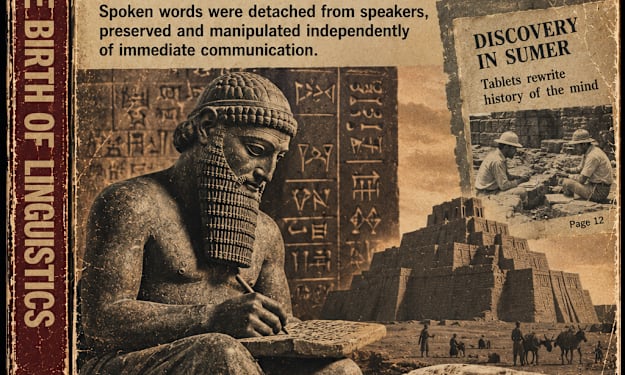
The Birth of Linguistics: How Sumerian Scribes Invented the Idea of Language
Introduction: From Administrative Records to the First Science of Language The history of linguistics does not begin with the philosophers of Greece, the grammarians of India, or the comparative philologists of nineteenth-century Europe. Its true origins lie much deeper in history, in the mud-brick cities of ancient Sumer, where writing itself first emerged as an instrument of administration. Long before language became an object of philosophical speculation, Sumerian scribes were already analysing words, classifying signs, comparing meanings and constructing systematic lexical lists. These activities, initially developed for practical purposes, gradually produced something far more revolutionary than efficient bookkeeping. They created the first abstraction of language itself. Before writing, speech was inseparable from the people who spoke it. Communication disappeared as soon as it was uttered, leaving only memory behind. The invention of cuneiform transformed this situation completely. Spoken words could now be detached from speakers, preserved on clay tablets and manipulated independently of immediate communication. This technological innovation allowed scribes to observe speech from the outside, comparing words, organising them into categories and eventually treating language itself as an object of systematic inquiry. The earliest lexical lists, originally intended to organise commodities, professions, animals and administrative categories, soon expanded beyond immediate bureaucratic necessity. They increasingly explored the combinatorial possibilities of writing itself, demonstrating that scribes were no longer merely recording communication but investigating its internal structure. When Sumerian gradually ceased to be the dominant spoken language and Akkadian replaced it in everyday life, this process accelerated dramatically. Sumerian became one of history’s earliest learned languages, preserved through education rather than ordinary conversation. Teaching a language that was no longer naturally acquired required an entirely new intellectual enterprise. Bilingual lexical lists paired Sumerian words with Akkadian translations, grammatical paradigms documented morphological patterns, and scribal schools transformed practical record-keeping into systematic linguistic education. Language itself became separated from speech and redefined as an organised system capable of preservation, transmission and analysis. In this sense, Mesopotamian lexical traditions represent not merely the beginnings of writing but the birth of linguistics itself. They reveal the moment when communication ceased to be understood simply as speech and became an abstraction that could be classified, taught and theorised independently of its living speakers. This transformation would shape the entire future history of civilisation, making possible grammar, philology, linguistics and eventually every scientific attempt to understand human communication. The origins of linguistics therefore belong not to abstract philosophy but to the practical intelligence of Sumerian scribes working within the administrative machinery of the world’s first cities. Their clay tablets became humanity’s first laboratories of language.
By Peter Ayolov2 months ago in Critique
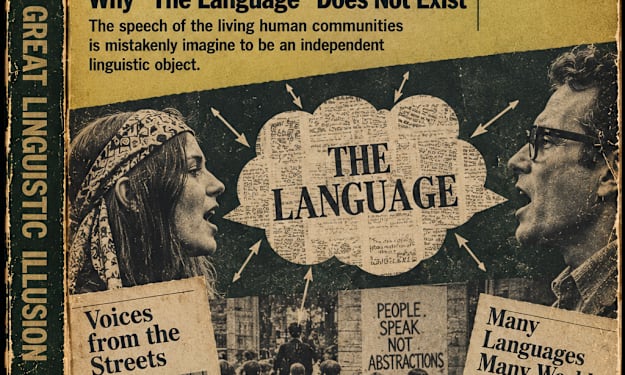
The Great Linguistic Illusion: Why "The Language" Does Not Exist
Introduction: The Most Powerful Fiction Ever Created Language is commonly described as one of humanity’s defining characteristics, yet this seemingly obvious statement conceals one of the greatest conceptual confusions in intellectual history. We constantly speak about language as though it were an independent object existing somewhere beyond the countless individuals who speak, write, remember and continually recreate it. We refer to English, Arabic, Chinese or Bulgarian as if these were stable entities comparable to mountains, rivers or biological species. Linguistics itself often reinforces this assumption by treating language as an object that can be classified, measured and analysed independently of its speakers. Yet the closer we examine this idea, the more elusive language becomes. No one has ever seen language itself. We hear voices, observe speech, read texts and record sounds, but language never appears independently of these activities. It possesses no body, no location and no material existence outside human behaviour. Every spoken sentence immediately disappears after it is uttered. Every written text remains meaningless until another living mind reconstructs it through reading. If every speaker of a language were suddenly to disappear, that language would not continue existing as a living phenomenon. Dictionaries, books and recordings would survive only as silent artefacts requiring future interpreters. Without communities capable of understanding them, they would become no more meaningful than undeciphered inscriptions carved into forgotten stones. Language therefore resembles institutions such as money, governments, religions or laws. None of these exists independently of collective human participation. They are abstractions sustained through continual social agreement rather than independently existing things. The concept of language emerged because human beings gradually transformed speech into an abstract system that could be described, standardised and institutionalised. This abstraction proved enormously useful for education, administration and scientific inquiry, yet it also encouraged the illusion that language possesses an existence separate from those who continually create it. Once this illusion became accepted, linguistics increasingly studied language as though it were an autonomous object rather than an ongoing social activity. Recovering this forgotten distinction transforms not only our understanding of communication but also our understanding of humanity itself. Perhaps language has never existed as an independent entity. Perhaps only speaking people exist, while language remains one of civilisation’s most successful abstractions—a fiction so powerful that it eventually convinced humanity of its own objective reality.
By Peter Ayolov2 months ago in Critique
The Invention of Language: How Speech Became an Instrument of Empire
Introduction: From the Human Tongue to the Abstract Idea of Language The word “language” appears so natural today that few people ever question whether it has a history separate from speech itself. We speak about language as though it were an objective entity existing independently of the millions of human beings who constantly create, transform and abandon it through everyday conversation. Yet the history of the word itself reveals something remarkably different. The English word language originates from the Old French langage , which derives from the Latin lingua , meaning both the physical tongue and speech. This dual meaning preserves an older understanding in which communication remained inseparable from the body that produced it. The tongue was not merely the symbol of language but language itself. Only gradually did this physical activity become transformed into an abstract system supposedly existing beyond individual speakers. This conceptual transformation represents one of the most significant intellectual shifts in human history. Long before linguistics became an academic discipline, civilizations had already begun separating speech from the people who spoke it. Writing systems encouraged this abstraction by making spoken sounds visible, permanent and transferable across generations. Once words could survive independently of speakers, it became possible to imagine language itself as an autonomous object governed by rules, structures and laws. Philosophers, grammarians and later linguists reinforced this process by treating language not primarily as an activity but as a system requiring analysis. From Plato’s reflections on names to Aristotle’s investigations of rhetoric, from Panini’s Sanskrit grammar to Ferdinand de Saussure’s distinction between langue and parole , language gradually became detached from speech and elevated into an independent theoretical entity. Yet this development was never merely intellectual. Every abstraction possesses historical conditions, and the abstraction called language emerged alongside writing, administration and the rise of increasingly complex political societies. As communication expanded beyond small communities into kingdoms and empires, speech alone could no longer satisfy administrative demands. Language became standardised, codified and institutionalised. The result was not simply better communication but the creation of a new form of social organisation in which linguistic uniformity became inseparable from political authority. Understanding this genealogy forces us to reconsider one of the central assumptions of modern linguistics: perhaps language was never simply discovered as an objective phenomenon. Perhaps it was progressively invented as an abstraction capable of governing increasingly large populations through writing, education and institutional power.
By Peter Ayolov2 months ago in Critique
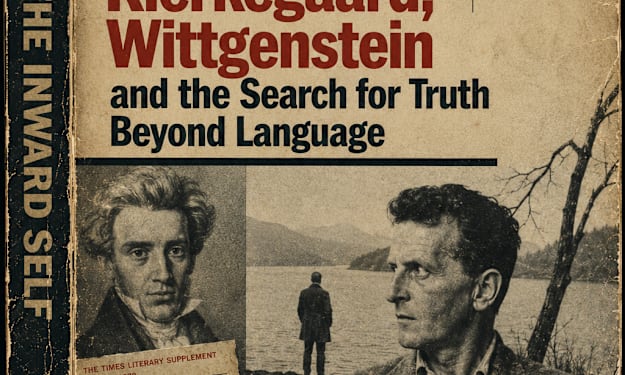
The Inward Self: Kierkegaard, Wittgenstein and the Search for Truth Beyond Language
Introduction: Why the Most Important Truths Cannot Be Spoken Western philosophy has long searched for certainty through reason, concepts and logical argument. From Plato to Kant, philosophers attempted to establish universal foundations capable of explaining morality, knowledge and reality itself. Yet Søren Kierkegaard introduced a radically different question. What if the most important truths are not those that can be demonstrated objectively but those that must be lived subjectively? What if the deepest human experiences—love, faith, conscience, despair, hope and responsibility—cannot be fully communicated through language at all? This shift from objective knowledge toward inward existence transformed modern philosophy and later profoundly influenced Ludwig Wittgenstein. Both thinkers became deeply suspicious of abstraction, although they approached it from different directions. Kierkegaard criticised philosophy for forgetting the individual who exists in time, reducing human life to universal concepts detached from experience. Wittgenstein, after initially constructing one of the most rigorous logical systems in philosophy, eventually reached a remarkably similar conclusion: language possesses limits beyond which the essential dimensions of existence can only be shown rather than said. Their shared concern was not simply language itself but the illusion that language can replace life. Ethical responsibility, religious faith and personal commitment cannot be transferred through propositions in the same manner as mathematical formulas or scientific facts. They require inward participation rather than detached observation. Truth therefore becomes something fundamentally different from factual correctness. It becomes an existential relationship between the individual and existence itself. The modern world increasingly forgets this distinction. Digital communication encourages endless expressions of opinion while requiring little personal investment. Artificial intelligence produces coherent language without inward experience. Bureaucracies formulate ethical codes without necessarily cultivating ethical individuals. Against this background Kierkegaard and Wittgenstein appear unexpectedly contemporary. They remind us that language can organise information, but it cannot automatically generate meaning. Genuine understanding requires an inner transformation that no external explanation can accomplish. Their philosophies therefore challenge one of modern civilisation’s deepest assumptions: that communication alone is sufficient for wisdom. Instead, they argue that the most significant truths emerge only through inwardness, through the continuous effort of living rather than merely speaking about existence.
By Peter Ayolov2 months ago in Critique
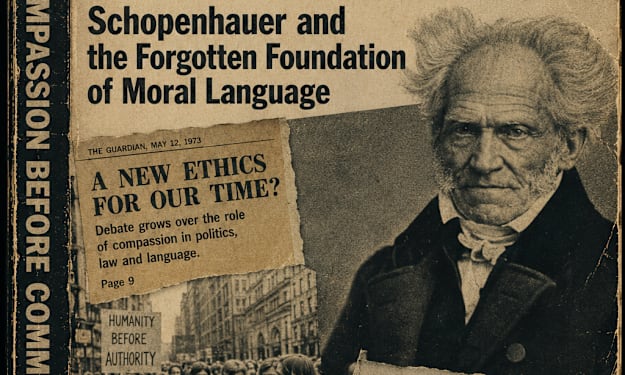
Compassion Before Command: Schopenhauer and the Forgotten Foundation of Moral Language
Introduction: Why Morality Cannot Be Built on Commands Alone Arthur Schopenhauer opens On the Basis of Morality with one of the most revealing observations in the history of ethics: preaching morality is easy, but justifying morality is extraordinarily difficult. Every civilization possesses moral commandments, codes of conduct, religious laws and political constitutions, yet far fewer have successfully explained why human beings should obey them in the first place. Is morality merely obedience to authority? Is it fear of punishment, hope for reward, social convention or rational duty? Or does it emerge from something much deeper than law itself? These questions become even more urgent in an age where communication technologies multiply faster than ethical reflection. Modern society speaks endlessly about values, rights, inclusion and justice, yet the language used to defend morality increasingly resembles the language of administration, bureaucracy and ideological competition rather than genuine human concern. Schopenhauer recognised this danger almost two centuries ago. He argued that morality cannot be founded upon abstract concepts detached from lived experience. Kant’s categorical imperative attempted to establish morality through universal rational principles, but Schopenhauer believed that such principles remain suspended in abstraction, like a cobweb hanging in empty space, unable to move real human beings toward moral action. A law without emotional substance becomes merely another linguistic formula repeated without understanding. Words alone cannot produce ethical behaviour because language itself only represents thoughts about reality rather than reality itself. Moral codes written in constitutions, sacred books or philosophical systems remain external until they become part of personal consciousness. The central problem is therefore not discovering new ethical rules but understanding how moral awareness actually develops inside human beings. Conscience cannot simply be imposed through speech. It emerges through experience, reflection and the gradual discovery of one’s own character. Every individual eventually confronts the difficult question of whether morality is merely something spoken publicly or something genuinely lived privately. This distinction between public language and inner experience forms the starting point for Schopenhauer’s search for a foundation of ethics that reaches beyond commands, institutions and abstract philosophical systems toward the deepest structure of human existence.
By Peter Ayolov2 months ago in Critique
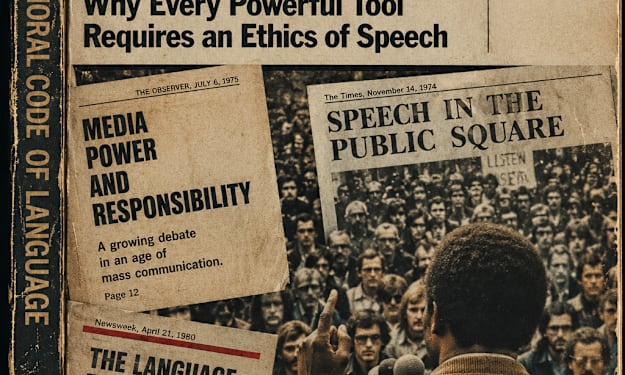
The Moral Code of Language: Why Every Powerful Tool Requires an Ethics of Speech
Introduction: The Forgotten Responsibility of Language Every civilization eventually discovers that no powerful invention can survive without rules governing its use. Fire demanded rituals. The sword demanded honour. Medicine required ethics. Nuclear technology required international treaties. Yet the most influential technology ever invented—language—has often been treated as though it requires no comparable discipline. We celebrate freedom of speech, defend unrestricted expression, and build ever more powerful communication technologies while rarely asking whether language itself possesses an inherent moral code.
By Peter Ayolov2 months ago in Critique
The Corporate Machine of Bulgarian Television
“Life doesn’t imitate art, it imitates bad television.” — Woody Allen They say that time is money. If you wanted to understand contemporary Bulgarian television in a single sentence, it would be this: a short, precisely measured amount of screen time—every second of a viewer’s attention is worth thousands of leva. Every Bulgarian citizen possesses the absolute and sovereign right to ask television for that time, and television will gladly sell it, provided that the citizen can afford to pay for it. The law of television is to make money.
By Peter Ayolov2 months ago in Critique
The Last Man Won: Why Francis Fukuyama Was Right About the End of History
“The future has come and gone, where were you?” is a line from an advertisement seen within the world of the film The Zero Theorem. Director Terry Gilliam intended the phrase to be a piece of social commentary, suggesting that technological advancements and the speed of modern life mean we are effectively already living in the future, often without fully engaging with the present moment. In an interview, Gilliam explained the message behind the line:“The future has come and met us, we actually don’t live in the present anymore, we live in the future because it’s happening so quickly. It’s really about the world we’re living in and being connected. When, as an individual, can we be alone in a connected world like this? Those are the things that intrigue me”. Terry Gilliam
By Peter Ayolov2 months ago in Critique
The Death of the Reader 2.0: From Roland Barthes' Scriptor to the AI Prompter
Introduction: When Nobody Reads and Everybody Writes In 1967 Roland Barthes announced one of the most influential ideas in twentieth-century literary theory: the death of the author . The traditional Author—with a capital A—whose biography, intentions and personal genius supposedly determined the meaning of every text, had reached the end of his historical role. According to Barthes, a text no longer belonged to its creator but to language itself and to its readers. Every work became a fabric woven from innumerable cultural quotations rather than the expression of a unique consciousness. The writer ceased to be the supreme authority behind meaning and was replaced by a far more modest figure whom Barthes deliberately named the scriptor —someone who writes but does not own language, does not control interpretation and does not stand above the text as its sovereign creator. Writing became an event rather than an act of individual genius, while meaning was transferred from the author to the reader. The unity of the text no longer resided in its origin but in its destination. The authority of the Author disappeared precisely because language itself became the true producer of meaning.
By Peter Ayolov2 months ago in Critique
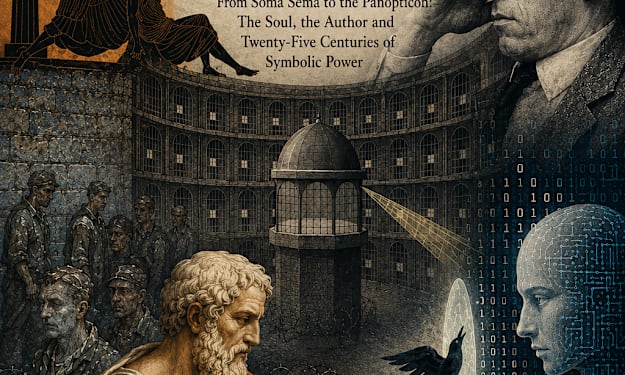
How Plato Invented the Prison, Foucault Discovered the Prisoner, and AI Killed the Warden
Introduction: The Long Escape from Plato’s Prison The history of Western civilisation can be read as the history of one invisible invention: the creation of symbolic prisons. Long before walls, watchtowers, surveillance cameras and artificial intelligence, philosophy itself built the first prison—not around the body but inside it. This prison had no stones, no chains and no iron bars. It was constructed from language, concepts and metaphors. It was called the soul.
By Peter Ayolov2 months ago in Critique
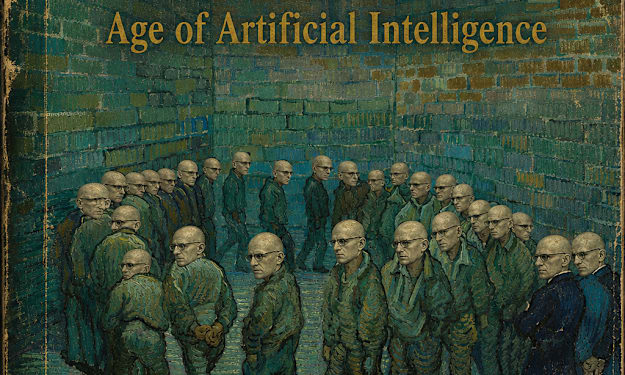
The Last Prison: Why Michel Foucault's Discipline and Punish Matters More in the Age of Artificial Intelligence
Introduction: The Last Prison in the Age of Artificial Intelligence Few philosophical books have become more relevant in the twenty-first century than Michel Foucault’s Discipline and Punish: The Birth of the Prison . Published in 1975, decades before the internet, social media, smartphones or artificial intelligence, the book anticipated one of the defining features of our age: the replacement of visible coercion with invisible systems of surveillance, classification and behavioural control. Today its most famous sentence—”the soul is the prison of the body”—sounds less like an abstract philosophical metaphor and more like a precise description of contemporary digital life. At first sight, Foucault’s statement appears to contradict more than two thousand years of Western philosophy. Since Plato popularised the Orphic doctrine of Sōma Sēma —the body as the prison or tomb of the soul—Western civilisation largely accepted that the immortal soul represented humanity’s true essence while the body was merely a temporary, corrupt and imperfect vessel. Philosophy, religion and morality therefore concentrated on liberating the soul from bodily existence. Foucault turned this entire tradition upside down. He argued that modern power no longer imprisons an immortal soul inside a physical body. Instead, it manufactures what we call the “soul” itself—a psychological identity, a conscience, a personality, a permanent sense of being observed and judged—and then uses this invisible construction to discipline the body from within. The soul, far from being humanity’s eternal liberator, becomes the most efficient instrument ever invented for governing human behaviour.
By Peter Ayolov2 months ago in Critique
Next Generation
Next Young Generations by Katherine Aguilar The world has been moving for thousands of years. Scientists and Theologians have written about the cycles going on in our current climate. Over the years, people seemed to ignore the people, as they were considered too extreme.
By Katherine Aguilar2 months ago in Critique