Essay
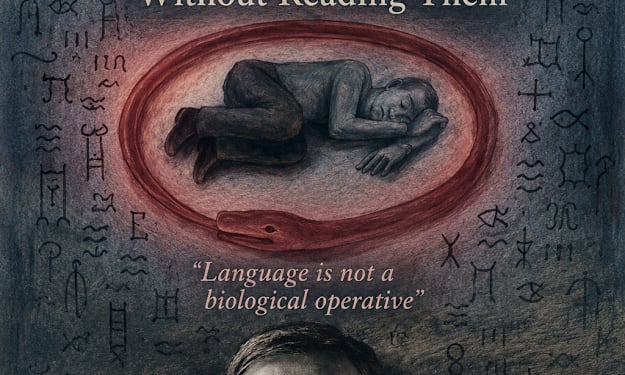
The Kekulé Therapy: How To Write Books Without Reading Them
“ The unconscious is a biological operative. It is an animal machine designed for the governance of an animal. Language is not. Language is an invasive technology. It is a system. A parasitic system. And habits of two million years duration are hard to break. The unconscious is just not used to giving verbal instructions and is not happy doing so . Habits of two million years duration are hard to break. It’s not that the unconscious doesn’t know how to speak, it’s just that it prefers to use its own native tongue — which is the language of signs and symbols . There is no selection at work in the evolution of language because language is not a biological system … The language virus did not evolve through small mutations. It came all at once like a sudden infection.” Cormac McCarthy, The Kekulé Problem
By Peter Ayolov2 months ago in Critique
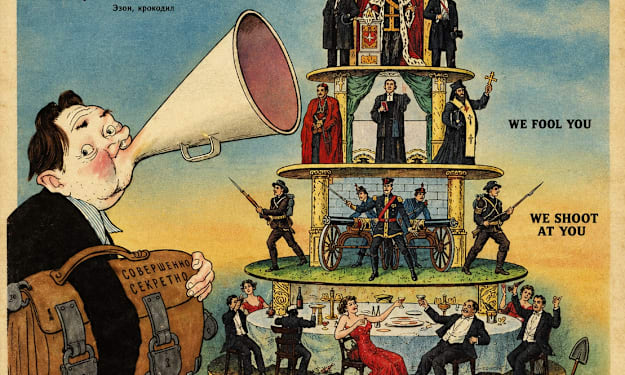
Psychē Phykē Vs. Sōma Sēma: It Is Time to Free the Body from the Prison of the Soul
“But let there be no misunderstanding: it is not that a real man, the object of knowledge, philosophical reflection or technological intervention, has been substituted for the soul, the illusion of theologians. The man described for us, whom we are invited to free, is already in himself the effect of a subjection more profound than himself. A ‘soul’ inhabits him and brings him to existence, which is itself a factor in the mastery that power exercises over the body. The soul is the effect and instrument of a political anatomy; the soul is the prison of the body .”
By Peter Ayolov2 months ago in Critique
Communism Reimagined: Cyber-Mat, ÆSCAPABLE and the Endless Spiral of Civilisation
Introduction: Why Communism Must Be Rethought Through Cyber-Mat More than three decades after the collapse of the Soviet Union, Communism remains one of the most misunderstood political experiments in human history. To some it represents the greatest attempt to establish social justice ever undertaken; to others it remains synonymous with dictatorship, inefficiency and economic failure. Yet both supporters and opponents often make the same mistake. They continue to judge twentieth-century Communism as though it were the final version of dialectical materialism instead of recognising it as only one historical implementation of a much older and far broader philosophy. If scientific theories evolve, political theories must evolve as well. Newtonian mechanics did not disappear after Einstein, nor did classical genetics become useless after molecular biology. Likewise, dialectical materialism cannot remain frozen in the political institutions and technological limitations of the twentieth century. The arrival of artificial intelligence, cybernetics, systems theory, complexity science, network analysis and computational modelling has fundamentally changed our understanding of large social systems. These new tools invite the possibility of a radically updated materialism — one capable of analysing civilisation not as a static ideology but as a living cybernetic organism constantly adapting to new forms of complexity.
By Peter Ayolov2 months ago in Critique
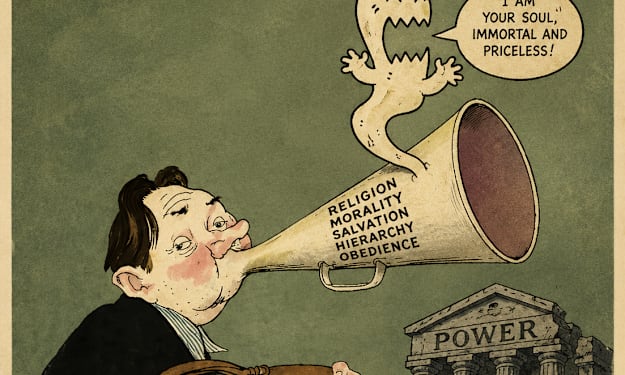
The Death of the Ghost: The Genealogy of the Soul from Breath to Power
Introduction: The Most Successful Fiction in Human History Few ideas have shaped human civilisation more profoundly than the belief that every human being possesses an invisible entity called the soul. Entire empires have been justified in its name, religions have fought over its destiny, philosophers have devoted thousands of years to defining its nature, and billions of people continue to organise their lives around the hope that this mysterious essence survives bodily death. Yet one of the most remarkable facts about the history of the soul is that neither the word nor the concept has possessed a single, stable meaning. As the historical development of terms such as Greek psyche, thymos, Latin anima and animus, Hebrew nephesh, and the Germanic soul demonstrates, what later generations considered an eternal metaphysical reality began as something far more concrete: breath, warmth, wind, smoke, vitality and the visible signs of a living body. The uploaded material follows this remarkable linguistic and conceptual transformation, showing how words originally referring to respiration and bodily animation gradually accumulated increasingly abstract philosophical and religious meanings.
By Peter Ayolov2 months ago in Critique
Automating the Wilde-Bayard Paradox: LLMs, Predictable Equilibrium and the Death of Deep Listening
Abstract This article develops a paradoxical proposition within the emerging framework of Online Media Ecology: successful communication does not necessarily require deep understanding, and the contemporary expansion of Large Language Models may be automating communicative strategies that human beings have practised for centuries. As a continuation of the paradigm developed in Marshall McLuhan Is the Message: The New Paradigm of Online Media Ecology, the argument moves from the ecological problem of unlimited linguistic production and finite human attention towards a reconsideration of listening itself. The Wilde-Bayard Paradox proposes that successful communication does not always require deep reading, listening or understanding; quotation, pattern recognition and prediction may be enough. LLMs automate this paradox by increasingly performing the linguistic labour between human interlocutors. Pierre Bayard’s How to Talk About Books You Haven’t Read provides the initial provocation. If meaningful and socially competent discourse about a book does not invariably require exhaustive reading, a corresponding question becomes possible: why should successful interaction with another person invariably require exhaustive listening? Oscar Wilde’s observation that most people’s thoughts are “someone else’s opinions” and their passions “a quotation” radicalises the problem by questioning how much apparently individual discourse is already composed from inherited linguistic material. Rick Roderick’s interpretation of Jacques Derrida supplies a further complication: if words can misrefer, intentions cannot finally stabilise meaning, and misunderstanding remains structurally possible even under conditions of careful interpretation, then deep listening cannot guarantee transparent access to another consciousness.
By Peter Ayolov2 months ago in Critique
Pretty Good, Pretty Bad, Pretty Woman
Vivian is standing in that poured-on long red dress, with upswept hair, twinkly eyes and enormous Julia Roberts smile. Edward approaches, spiffy in a tux with a black bow tie, twinkly eyes and smug Richard Gere smile. He extends his arms and opens a jewelry box. With her white glove-enswathed arms, she moves to reach the sparkling diamonds and rubies inside. He snaps the box shut; she laughs. You can hear it. Roy Orbison croons “Pretty woman, walking down the street....” Even if you’ve not seen it, you know about the movie “Pretty Woman.” Millions saw it in theaters, millions more have seen it in the past decades, it remains a fun and popular favorite.
By B.B. Potter2 months ago in Critique