
Two Drifting Grifters in a Large City
Why Breakfast At Tiffany's Is Hugely Overrated


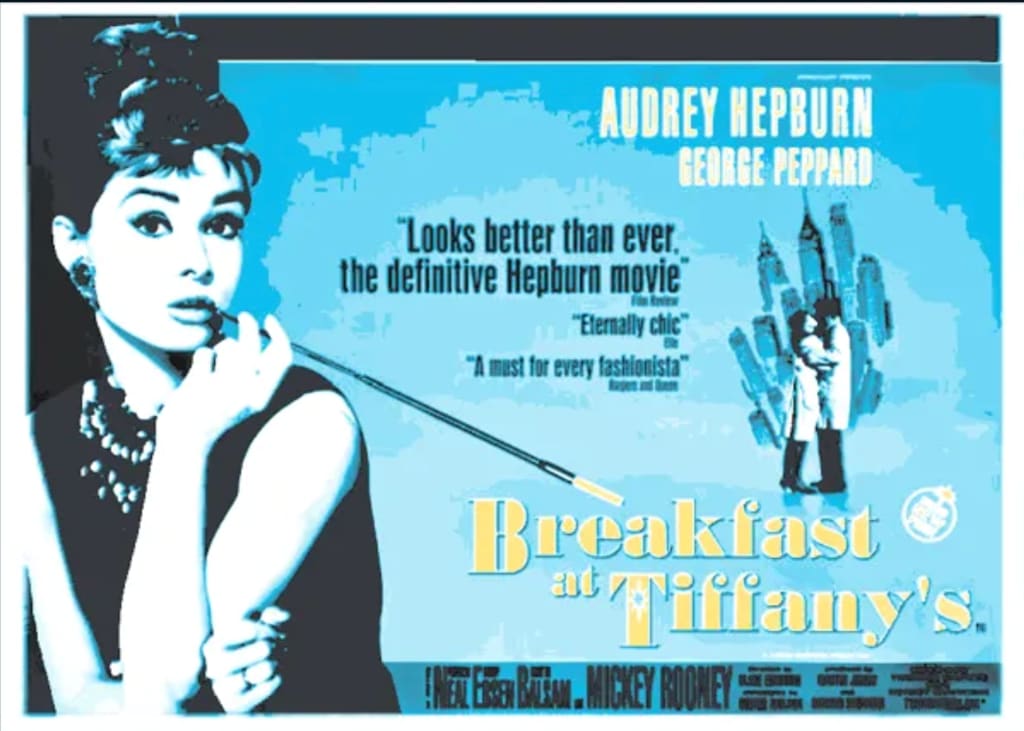
I'm going to be crucified for tearing into the beloved American classic, but I never understood all the fuss and critical acclaim around it.
It might be because I watched it as a fully grown adult woman, in 2019, for the first time in my life. And as a fully grown adult woman coming from a different culture, I found its premise baffling and the obsession with luxury revolting. But let me start my critique from the other end, though.
Ask anyone in the US, even the movie buffs of younger generations, what images come to their mind when they hear "Breakfast at Tiffany's" and they'll describe the style before they render the movie plot: a beautiful young woman in a black cocktail dress and pearls, sunglasses at dawn, a pastry in one hand and a long cigarette in the other, staring into a jewelry store window like it's a place of worship (which it is, at least in the movie -- was it the first instance of quiet product placement? 😊). That image has been reproduced on more dorm-room posters, tote bags, and "girl dinner" memes than almost any other frame from an American film. Along with a trench-coat-wearing man walking away in the rain. The movie is treated as the platonic ideal of chic, wistful romance -- a story about a free spirit finding love in the big city. It was sold that way at the time it came out, as a glamorous romantic comedy.
Watch it from the modern perspective, though, and a different movie comes into focus: one about two broke, directionless adults who are both being paid, quite literally, for their good looks, charm, and availability. Holly Golightly (Audrey Hepburn) and Paul Varjak (George Peppard) aren't bohemian dreamers. They're kept people who've built their entire personalities and lives avoiding any introspection into what they actually do for money. That would have been a much more interesting movie than the one the poster is selling, more honest and pertinent. It's a shame the popular memory of the film chooses to ignore it.
The lifestyle everyone politely ignores
Let's start with Paul. He's introduced as a writer, but we almost never see him writing anything. What the film does show, repeatedly, is a wealthy older woman from Apt. 2E -- his "decorator" -- paying his rent and slipping cash into his pocket after visits. The film treats this arrangement with a wink and keeps moving, as if the joke is enough to excuse the character from having to reckon with it. I'm sure at the time it was. But at the core of this commodified relationship, Paul is a kept man. That's the actual premise of his character arc. However, the film creators are so eager to get him to his romantic epiphany about Holly that they never ask him to sit with what it means that his own life runs on the same transaction he'll later act scandalized by in hers.
Then there's Holly, who is far more honestly written, if you're paying attention. She's explicit, in her own roundabout way, about visiting "the powder room" for fifty dollars a trip from men she has no romantic interest in, about needing a fixed sum a week to stay afloat, about her entire social calendar being built around men who can pay for it. She isn't coy about the calculations in her life. The film is coy about it for her, dressing the reality up in pearls, cocktail dresses, lavish dinners with champagne and situational comedy so the audience can enjoy her as a whimsical fragile beauty with a whispering spell-binding voice who would never think twice about taking advantage of her suitors.
Two con artists, one game of pretend
What makes the pairing genuinely compelling -- and genuinely undercut by the film's posh style -- is that Paul and Holly recognize something of themselves in each other. But they can't admit it even to themselves, not to mention saying it out loud. They're both running versions of the same scheme: they trade charm and availability for financial security, and build an entire aesthetic of carefree spontaneity, lightness of being, if you will, on top of it so no one, including themselves, have to call it out for what it is. Holly's constant refrain about not wanting to be "owned," about needing to stay unattached and mobile, isn't really about romantic or financial freedom. It's a grifter's logic -- stay alert, stay uncommitted, always have an exit. Paul's judgmental distance from her lifestyle would be a lot more earned if he weren't financing his own apartment the same way.
That's the movie I actually saw: Two people who are drawn to each other precisely because they can see through each other's performance, forced to decide whether they can drop the act for something real, or whether the act is all either of them knows and desires. Occasionally the film gestures at this -- Paul's line about Holly being a "wild thing" who can't be caged lands harder if you read it as a precise diagnosis of them both. But then the movie flinches. It resolves into a rain-soaked, cat-retrieving, kiss-in-the-alley ending that asks us to believe two people who have spent the entire runtime avoiding honesty about how they survive can suddenly become honest about love, off-screen, in about ninety seconds. How easily we fall for happy endings!
Style as a substitute for depth
None of this would sting as much if the film weren't so confident in its own cleverness. Every scene is lit and scored like a fable -- Henry Mancini's score cues you exactly how to feel before the plot or the characters on screen have earned it. And that confidence is precisely why audiences remember the mood and forget the essence. The Tiffany's window scene, the party sequence, the cab ride: gorgeous, memorable, meticulously constructed. But they're constructed to distract from a script that doesn't actually resolve its own premise. It wants Holly's grift to read as charming eccentricity wrapped in feminine vulnerability and Paul's scheme to read as a footnote, so their romance can land as sweet rather than mutually transactional.
That's not sophistication. That's a movie letting its production design do the work its characters' arcs should be doing. But in any case, it's like putting a style lipstick on a pig of an oversimplified plot and deeply flawed characters. This becomes even clearer when the movie is compared to the original Truman Capote's much darker and more honest novella that had to be lightened up for the movie script, according to Hollywood's ideas of what audiences expect from a romance movie.
Why the reputation persists anyway
I think the film's canonization has less to do with the story than with the two things that made it possible. First, Audrey Hepburn's performance, which really is extraordinary and carries far more emotional depth than the script gives her. Second, the sheer density of iconic cinematic imagery the film produced in under two hours. Both are real achievements. Neither is the same thing as the underlying story being as good as its reputation suggests. A movie can generate a fashion legacy and a lasting soundtrack standard and still be structurally flawed where it counts, in the honesty of its central relationship.
Breakfast at Tiffany's isn't a bad movie. It's a beautifully dressed one that never quite has the nerve to follow its own best idea to the end. Two grifters circling each other, each one the other's mirror, is a story worth telling all the way through.
The tragedy isn't that Holly and Paul live transactional lives. The tragedy is that the film understands exactly what they're doing, then loses its nerve and disguises that uncomfortable truth as romance with a happy ending. Sixty-five years later, audiences still remember the pearls, the little black dress, and "Moon River." They remember almost every striking visual that has become a meme, except the story hiding underneath.
About the Creator
Lana V Lynx
Avid reader and occasional writer of satire and short fiction. For my own sanity and security, I write under a pen name. My books: Moscow Calling - 2017 and President & Psychiatrist
@lanalynx.bsky.social
Enjoyed the story? Support the Creator.
Subscribe for free to receive all their stories in your feed. You could also become a paid subscriber, letting them know you appreciate their work.
Comments
There are no comments for this story
Be the first to respond and start the conversation.