
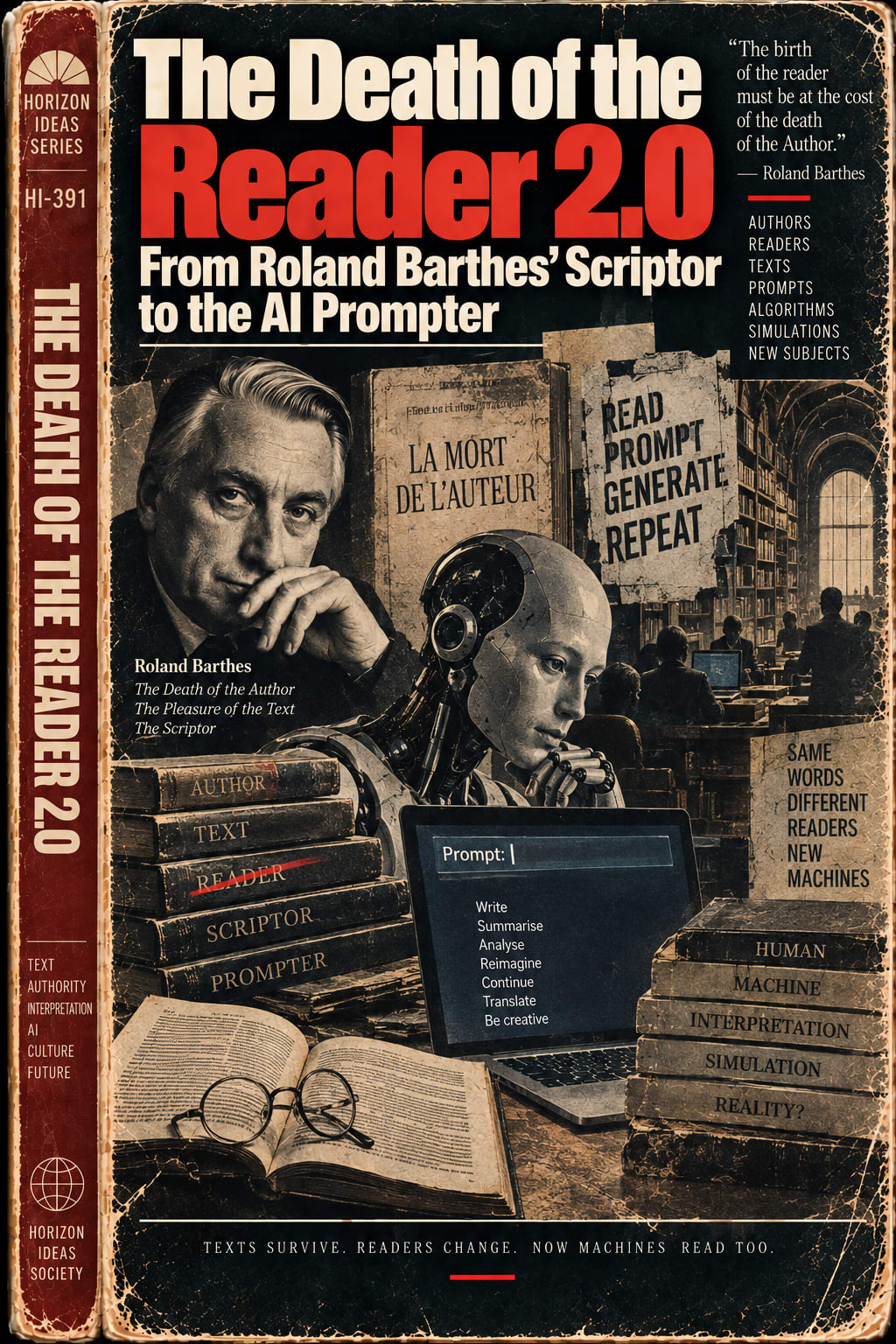
The Death of the Reader 2.0: From Roland Barthes’ Scriptor to the AI Prompter
Who Reads When Everybody Writes?

Introduction: Who Reads When Nobody Reads?
Roland Barthes killed the Author in 1967, but he did not leave the text without a human sovereign. Having dismantled the romantic image of the writer as the unique origin of meaning, Barthes transferred authority to another figure waiting at the opposite end of the communicative process: the Reader. The text ceased to possess a single paternal source and became instead a “tissue of quotations” assembled from innumerable cultural centres, yet its multiplicity still required a destination. For Barthes, that destination was the Reader, the space in which the many writings composing a text could finally be gathered together. The celebrated death of the Author therefore concealed an anthropocentric compromise. One human disappeared so that another might be born. More than half a century later, generative artificial intelligence disturbs that settlement. Large language models can produce texts without a traditional author, but the more consequential transformation may occur at the other end of the process. Machines increasingly retrieve, classify, translate, compare, summarise, evaluate, criticise and transform texts before any human being encounters them. A document may be generated by one computational system, analysed by another, condensed by a third and used as contextual input by a fourth. Between the original prompt and the eventual human response, enormous quantities of language can circulate without being read in anything resembling the traditional human sense. The question is consequently no longer simply whether AI can write. It is whether writing still requires a reader.
This transformation suggests a second death that extends rather than overturns Barthes. The Death of the Reader 2.0 does not mean that people will cease reading books, articles, messages or screens. Nor does it imply that machines possess human consciousness, aesthetic experience or interpretative subjectivity. The “death” is conceptual, just as Barthes’ death of the Author was conceptual. What disappears is the Reader’s privileged status as the necessary terminus of textual meaning. For centuries, technologies increasingly separated words from speakers: writing preserved language after the voice disappeared; printing multiplied it beyond the presence of the writer; electronic media accelerated its circulation; digital storage converted texts into searchable data. Generative AI introduces a complementary separation. Text can now be operationally processed without passing through a human consciousness at every stage. The Author becomes the Scriptor, the Scriptor becomes the Prompter, and the Reader increasingly becomes the recipient of an answer produced after invisible layers of automated linguistic processing. The Prompter occupies a strange position between authorship and readership. He may formulate the question without writing the answer and receive the conclusion without reading the archive from which it was assembled. He commands language while simultaneously surrendering both composition and interpretation to the machine. The history inaugurated by Barthes therefore reaches an unexpected threshold. The twentieth century asked what becomes of literature when the Author ceases to govern meaning. The twenty-first must ask what becomes of language when the Reader is no longer required to witness everything language does.
The Last Sovereign: Barthes Saves the Reader
The radicalism of “The Death of the Author” is often remembered through its attack upon biographical interpretation. Barthes rejects the habit of treating the author’s life, intention, psychology or historical personality as the final key capable of unlocking the text. Once a work is understood as originating from a sovereign consciousness, interpretation becomes an archaeological operation: the critic searches behind words for the person who supposedly placed their true meaning there. Barthes breaks this hierarchy by replacing the Author with the Scriptor. The Scriptor does not precede language as a creator precedes an artefact. He is born simultaneously with the text and works inside an already existing field of language. Writing becomes combination rather than creation ex nihilo. The text consists of inherited codes, previous formulations, cultural echoes and linguistic structures whose origins cannot be reduced to the individual holding the pen. In this respect, Barthes anticipates an intellectual problem that becomes materially visible with generative AI. A large language model does not possess the biographical interiority traditionally associated with literary authorship. It produces sequences through learned statistical relations among linguistic tokens. Yet the resulting text can be coherent, stylistically recognisable, argumentative and apparently purposeful. AI therefore turns Barthes’ theoretical Scriptor into something resembling a technical condition: sophisticated textual production becomes possible without the romantic Author whose interior presence once seemed indispensable.
Yet Barthes’ revolution stops at the Reader. The famous conclusion of the essay declares that the birth of the Reader must be purchased through the death of the Author. This substitution is philosophically revealing. Meaning has been decentralised at the point of production but recentralised at the point of reception. The Reader becomes the place where the plurality of writing is assembled. The author no longer guarantees meaning, but somebody must still receive the text, activate its relations and hold its multiplicity together. The human subject therefore survives the linguistic revolution by moving from one side of communication to the other. Foucault’s later concept of the author-function further destabilises the author as a natural origin, showing how authorship also operates as a cultural and institutional principle through which discourse is classified, controlled and circulated. Yet conventional models of textuality still assume that discourse ultimately matters because somebody reads it. Libraries contain books for readers; newspapers publish articles for readers; search engines retrieve pages for readers; criticism interprets literature for readers. Even the digital revolution initially strengthened this assumption. The internet produced an unprecedented quantity of writing, but its interfaces remained organised around human eyes: pages, feeds, search results, hyperlinks and screens. Digital abundance changed how the Reader navigated information without abolishing the Reader as its imagined destination.
Generative AI alters this architecture because textual operations can occur before, between and independently of individual acts of human reading. Consider what happens when a person asks a system to compare twenty documents and identify their principal disagreements. Under the older model, the human reader encounters the twenty documents, interprets them, remembers relevant passages, establishes comparisons and produces a synthesis. Under the emerging model, the human may read none of the twenty documents in their entirety. The system processes them and produces a twenty-first text: a summary of the archive. The person reads the summary rather than the documents. The same operation can then be repeated. Another system may summarise several summaries, classify them, extract patterns and generate a recommendation that becomes input for yet another computational process. At each stage language remains active while the human Reader recedes. This does not demonstrate that the machine “understands” exactly as a person understands. That difficult philosophical question is not necessary to the present argument. Operationally, functions historically performed through human reading can be delegated. The decisive shift is therefore not from human interpretation to machine consciousness but from compulsory human reading to optional human supervision. Barthes removed the Author as the necessary origin of meaning. AI now threatens the Reader’s position as its necessary destination.
From Scriptor to Prompter: The Human Who No Longer Writes
The AI Prompter is a peculiar successor to Barthes’ Scriptor because the Prompter performs less writing precisely while appearing to exercise greater command. The traditional Author supposedly originated the work. Barthes’ Scriptor assembled already existing cultural material into a text. The Prompter may do something more minimal still: specify an intention, establish constraints, provide materials, request a transformation and allow the machine to perform the linguistic construction. “Compare these arguments.” “Rewrite this passage.” “Find the contradiction.” “Summarise these documents.” “Generate three objections.” “Translate this chapter.” “Explain this theory.” Such instructions may initiate thousands of words of linguistic activity while containing almost none of those words themselves. The Prompter therefore occupies a metalinguistic position. Instead of composing the text directly, the human describes the operation that should be performed upon language. The keyboard remains, but its function changes. It becomes less an instrument for inscribing the finished sentence than a control surface for directing systems capable of producing sentences autonomously. The Prompter does not disappear, but authorship migrates from composition towards specification.
This produces a curious inversion of literacy. Writing traditionally required the writer to pass through every sentence that appeared on the page. Reading traditionally required the reader to pass through every sentence whose meaning was to be acquired. AI permits both obligations to be circumvented. A person may generate a hundred-page report without writing its hundred pages and interrogate a thousand-page archive without reading its thousand pages. The same individual can therefore become simultaneously a post-Author and a post-Reader. He asks for linguistic production without composing it and requests linguistic understanding without performing the complete interpretative labour from which the response derives. The prompt becomes the narrow human aperture through which an immense linguistic machinery is activated. This is why describing generative AI merely as an advanced writing tool misses its deeper cultural significance. A typewriter assists writing while leaving composition with the writer. A search engine assists reading by locating material that the reader subsequently examines. An LLM can intervene on both sides. It can generate the object that would have been written and perform operations upon the object that would have been read. The same architecture therefore automates complementary functions previously distributed between Author and Reader.
The Prompter nevertheless remains powerful precisely because prompting is not nothing. A prompt establishes direction, context, exclusions, desired forms and criteria. Selection does not vanish when composition is delegated. Indeed, the growing abundance of machine-generated language may increase the importance of framing, judgement and verification. Yet this does not restore the old Author. The person who commissions an architectural project remains causally important without personally laying every brick. Something similar occurs in linguistic production when the human moves from sentence-level composition towards orchestration. The relevant distinction is therefore between authorship as sovereign textual origin and agency as selection, instruction and judgement. AI weakens the former without necessarily eliminating the latter. The Prompter may decide what linguistic event should occur while no longer manually performing that event. Barthes’ Scriptor was already a diminished Author, arranging the enormous dictionary of culture rather than speaking from an immaculate interior origin. The AI Prompter carries this displacement further. He can request arrangements that he never personally constructs. The distance between intention and inscription expands until the human contribution may consist of a sentence asking for another system to produce ten thousand sentences in return.
Reading Without a Reader: The Machine Enters the Other Side of the Text
The more disruptive development begins when the same machinery turns from generation towards reception. Reading has traditionally combined several operations that are easily confused because human beings perform them together: visual recognition, linguistic parsing, memory, comparison, contextualisation, interpretation, judgement and subjective experience. Current artificial systems do not need to reproduce this complete human phenomenon in order to transform the social function of reading. They need only perform enough of its operational components to make direct human inspection unnecessary in particular circumstances. A system capable of extracting clauses from contracts, comparing reports, identifying recurring topics, translating documents, answering questions about an archive or summarising a book has already entered territory once reserved for the Reader. Whether this constitutes “real reading” in a phenomenological sense may remain contested, but the institutional consequence does not depend upon resolving that debate. A machine that does not read like a person may nevertheless replace particular acts for which a person previously had to read.
The result is a new textual ecology in which most linguistic material may eventually be processed rather than encountered. Human culture has already produced more text than any individual could consume. AI changes the solution to this ancient problem of abundance. The traditional answer was selection: the reader chose a tiny fraction of the library. Search engines mechanised discovery but still generally delivered documents to human attention. Generative systems can instead consume the retrieved material computationally and return an answer. The interface no longer says, in effect, “Here are ten texts that may contain what you seek.” It increasingly says, “Here is what those texts say.” This small change transforms the epistemological position of the Reader. The human moves away from primary encounter and towards mediated synthesis. Reading becomes recursive: machines process texts so that humans can read compressed representations of texts they have not read. The summary becomes the object of reading; the original becomes machine context. A second model may then process the summary, creating another level of distance between the human and the linguistic archive.
At sufficient scale, this produces autonomous linguistic loops. Machine-generated text can become input for machine analysis; machine analysis can trigger further generation; generated material can enter databases and archives from which later systems retrieve it. The human may appear only at the beginning, by specifying a goal, and at the end, by accepting, rejecting or modifying an output. Vast intermediate chains can remain unread by any person. This possibility has consequences beyond convenience. Language historically acquired cultural importance partly because human attention was scarce. Publication implied the possibility of readership, and readership supplied the social horizon within which writing made sense. A machine ecology breaks the necessary connection between linguistic existence and human attention. Text can have effects because another system processes it. One machine-generated description may influence another machine-generated classification; one automated report may become input for another decision process. Language begins to circulate within environments where its immediate addressee is not a biological reader at all. The Reader has not vanished from culture, but the Reader has ceased to be the compulsory checkpoint through which every consequential linguistic event must pass.
The Invisible Library: From Reading Everything to Asking Anything
The transformation can be understood through the history of the library. A traditional library solves the problem of memory by storing more language than any person can remember, but it does not solve the problem of reading. The books remain inert until somebody opens them. Catalogues improve navigation, indexes accelerate retrieval and librarians guide selection, yet the final interpretative labour remains attached to the reader. Digital databases alter the scale without fundamentally changing this relation. Millions of texts become searchable, but search still commonly assumes that the result will be inspected by human eyes. Generative AI proposes a different library: one that answers before the visitor has opened the books. The archive becomes computationally active. Instead of navigating from catalogue to shelf to volume to page to passage, the user increasingly moves from question to synthesis. The intermediate library becomes invisible.
This development creates what might be called delegated reading. Delegation is more precise than replacement because the human continues to determine purposes and may return to the original text whenever necessary. Yet delegation changes intellectual habits. A scholar may ask for patterns across hundreds of documents; a lawyer may request comparison of clauses; a student may ask for the central argument of a book; an editor may request contradictions within a manuscript. In every case the machine performs operations upon linguistic material before the person decides what deserves direct attention. Reading consequently shifts from universal prerequisite to selective verification. The individual does not necessarily read less because of laziness or cultural decline. The architecture itself encourages a different distribution of cognitive labour: machines traverse breadth, while humans may reserve attention for chosen points of depth. Whether this arrangement improves or impoverishes understanding depends upon how it is used. Compression can expose relations invisible to a single reader, but it can also remove ambiguity, style, hesitation, context and rhetorical form—the very qualities through which meaning often emerges.
Here lies the paradox of the post-Reader. Never before has so much written language been technically accessible, yet accessibility increasingly means that the language need not be directly read. The perfect digital library approaches a condition in which the user can obtain an answer from every book while opening none of them. Such a library would fulfil the dream of total access by abolishing the practical necessity of reading the archive itself. The ancient fantasy of possessing all knowledge therefore mutates into a stranger fantasy: possessing the consequences of reading without undergoing reading. This is not identical to knowledge. A summary of Proust is not the experience of reading Proust; a synthesis of philosophical arguments cannot reproduce the temporal encounter through which difficult prose reorganises thought. Yet for enormous domains of instrumental communication, experience is not what the user seeks. The user seeks extraction, comparison, decision or orientation. AI thrives precisely in this distinction. It separates the informational function of reading from the lived experience of reading, automating the former while leaving the latter irreducibly human. The death of the Reader 2.0 consequently does not announce the disappearance of reading. It announces the end of the historical assumption that linguistic processing and human reading are necessarily the same event.
Lingua Citans: When Language Begins Quoting Itself Through Machines
This transformation connects directly with the concept of Lingua Citans. Barthes described the text as a tissue of quotations, while Nikola Georgiev’s Homo Citans exposed the instability separating one’s “own” speech from inherited formulas, clichés and previous voices. Lingua Citans reverses the direction of the relationship. Instead of beginning with the human being who quotes language, it asks whether language can be understood as a self-reproducing historical mechanism that continually quotes and transforms its own inherited forms through temporary hosts. The claim requires no mysticism. Language need not possess consciousness, intention or biological life. Its apparent autonomy lies in persistence. Individual speakers inherit linguistic systems they did not create, recombine their materials and disappear, while the words, grammatical structures, metaphors and textual forms continue through other speakers. Human beings have traditionally served simultaneously as processors and carriers of this linguistic continuity. AI changes the carrier.
Large language models make this mechanism visible because their basic operation depends upon inherited linguistic material and recombination. They do not create language ex nihilo. Their outputs emerge from learned relationships within enormous quantities of previous language. In this respect the machine resembles an extreme technological realisation of the Scriptor: a system operating within an already existing linguistic field, producing novel configurations from structures it did not originate. But the decisive extension occurs when another machine receives those configurations. Language can then move from archive to model, from model to generated text, from generated text to another model, and from that model into further transformations. Human beings constructed the infrastructure and continue to determine many of its purposes, but they no longer need to inhabit every linguistic transition. Lingua Citans migrates from exclusively biological processing into hybrid human-machine circulation.
The danger is to anthropomorphise this process. Language has not awakened, acquired desires or decided to escape humanity. LLMs have not demonstrated that words secretly possess consciousness. The more interesting proposition is precisely that none of this is required. Self-perpetuating structures can persist through reproduction and transformation without possessing an interior self. The history of writing already separated words from the mortality of speakers. A dead author could continue “speaking” because inscription preserved linguistic forms after biological death. Printing multiplied those forms; recording and broadcasting detached them further from local presence; digital networks accelerated their replication; generative AI now separates linguistic processing itself from obligatory human reception. The progression is therefore not simply oral → written → printed → digital. It is also speaker-dependent → speaker-independent storage → mechanically replicated language → machine-searchable language → machine-processable language → machine-generatable language. At the final stage, the distinction between production and reception becomes unstable because the output of one linguistic machine can immediately become the input of another. The ancient dialogue between writer and reader is no longer the only architecture available to language. A new circuit appears in which the human may merely open and close the loop.
The Prompter’s Paradox: More Control, Less Contact
The Prompter consequently embodies a profound contradiction. He appears to command more language than any traditional reader or writer could control, yet he may personally encounter less of the linguistic material through which that control operates. A scholar can interrogate thousands of pages, a manager can request synthesis of hundreds of reports and an ordinary user can produce more prose in an afternoon than a professional writer might once have produced in weeks. Quantitative linguistic power expands precisely as direct textual contact contracts. The Prompter therefore resembles a conductor who can initiate an immense performance without playing every instrument. The analogy, however, has limits: the conductor normally hears the entire orchestra. The AI Prompter may not even witness most of the intermediate linguistic operations producing the final answer.
This creates a new problem of epistemic distance. Traditional reading is slow partly because the reader must remain exposed to the structure of another person’s argument. The reader encounters digressions, ambiguities, contradictions, repetitions and details that would never have appeared in a query formulated beforehand. Prompting reverses this relation. The question can determine the shape of the material returned. Instead of entering the architecture of the text, the user increasingly asks the archive to enter the architecture of the question. This is extraordinarily efficient, but efficiency carries a cost. A reader who asks only for what he already knows how to request may become protected from precisely those elements of a text that could have transformed the question itself. The traditional book resists. It has an order independent of the reader’s wishes. The conversational machine accommodates. It reorganises language around the immediate request. The difference is philosophically significant because intellectual discovery often occurs when the object refuses the categories brought to it.
The death of the Reader 2.0 must therefore be understood neither as technological celebration nor cultural apocalypse. It describes a redistribution of functions. Human reading remains indispensable wherever embodied experience, aesthetic encounter, ethical responsibility, critical judgement and deep contextual interpretation matter. Machine processing becomes increasingly powerful wherever scale, retrieval, comparison, transformation and compression dominate. The crucial question is not whether one side will simply replace the other, but what happens when societies forget that the two activities are different. Processing a text is not necessarily experiencing it; extracting information is not identical to understanding its form; generating criticism is not identical to assuming responsibility for a judgement. The Prompter becomes most powerful when recognising these distinctions. Otherwise the apparent mastery of language may conceal an unprecedented dependence upon linguistic operations occurring outside direct human inspection. The human who can ask anything may gradually cease to know what it means to have read something.
Conclusion: After the Reader, Language Remains
Barthes’ revolution began by removing the Author from the throne of language. The writer ceased to be the divine origin from which the text received a final meaning. In his place appeared the Scriptor, assembling already existing linguistic and cultural materials. Yet Barthes preserved one final human centre. The Reader became the destination where the plurality of writing could be gathered. Generative AI now destabilises this remaining sovereignty. The transformation does not require machines to become conscious readers or autonomous authors in the human sense. It requires only that linguistic functions once inseparable from human writing and reading become operationally executable without continuous human participation. That threshold has already been crossed. Machines generate, translate, retrieve, classify, compare, summarise, criticise and regenerate language. Their outputs can become inputs for further computational processes. The human may initiate the sequence with a prompt and encounter only its final condensation. Between those moments, language can travel through an increasingly extensive non-biological circuit.
The conceptual genealogy can therefore be stated simply: Author → Scriptor → Prompter; Reader → delegated Reader → optional human witness. Each transition removes a supposedly indispensable human function from the centre of textual circulation. The Author was no longer required as the metaphysical origin of the text. The Reader is becoming unnecessary as the immediate recipient of every textual operation. The Prompter remains, but even this figure occupies an increasingly thin boundary between intention and linguistic machinery. He does not necessarily write what is produced, read what is processed or inspect the intermediate language through which an answer emerges. His distinctive act is invocation. He asks language to perform operations upon language.
This is where The Death of the Reader 2.0 meets Lingua Citans. The disappearance of the sovereign Author and the weakening of the sovereign Reader expose something that both figures had concealed: the extraordinary historical persistence of language itself. Human beings are born into linguistic systems older than themselves, recombine inherited forms and disappear while those forms continue. Writing allowed words to survive their speakers. Printing allowed them to multiply beyond their writers. Digital networks allowed them to circulate globally. Artificial intelligence now allows them to be processed and recombined without requiring a human nervous system at every intermediate stage. Language has not become alive. It has become less dependent upon the presence of a living human at every point in its circulation.
The death of the Reader is therefore not the end of reading. People will continue to read precisely because reading can provide something computational processing does not automatically reproduce: sustained encounter, experience, attention, interpretation and the possibility of being changed by a text one did not design to answer one’s own question. What dies is the Reader as necessity. Human reading becomes one possible destination of language rather than the universal condition of its meaningful operation. This distinction may ultimately prove more consequential than automated writing itself. A civilization accustomed to machines writing texts remains recognisably a civilization of readers. A civilization in which machines increasingly write for machines, read machines, summarise machines and respond to machines has crossed into a different linguistic ecology.
Barthes could still declare the birth of the Reader because, in 1967, there seemed nowhere else for the text to go. In the age of generative AI, there is. The text can go to another machine.
And the machine does not have to turn the page.
References
Ayolov, P. (2026) ‘Language as a Tissue of Citations: How a Self-Quoting Mechanism Conquered the Human Mind’. Medium.
Ayolov, P. (2026) ‘The Death of the Reader 2.0: From Roland Barthes’ Scriptor to the AI Prompter’.
Barthes, R. (1977 [1967]) ‘The Death of the Author’, in Heath, S. (trans. and ed.) Image–Music–Text. London: Fontana Press, pp. 142–148.
Derrida, J. (1988 [1972]) ‘Signature Event Context’, in Limited Inc. Translated by S. Weber and J. Mehlman. Evanston, IL: Northwestern University Press, pp. 1–23.
Foucault, M. (1977 [1969]) ‘What Is an Author?’, in Bouchard, D. F. (ed.) Language, Counter-Memory, Practice: Selected Essays and Interviews. Translated by D. F. Bouchard and S. Simon. Ithaca, NY: Cornell University Press, pp. 113–138.
Georgiev, N. (1991) ‘Tsitirashtiyat chovek v hudozhestvenata literatura’ [The ‘Quoting’ Man in Literary Fiction / Homo Citans]. Sofia: Sofia University Press ‘St. Kliment Ohridski’.
Leone, M. (2018) ‘The Death of the Reader: Meaning in the Era of Digital Narcissism’, in Marino, G. and Thibault, M. (eds.) Digital Age in Semiotics & Communication. Semiotica, 223.
Shumailov, I., Shumaylov, Z., Zhao, Y., Gal, Y., Papernot, N. and Anderson, R. (2024) ‘AI Models Collapse When Trained on Recursively Generated Data’, Nature, 631, pp. 755–759.
Vaswani, A., Shazeer, N., Parmar, N., Uszkoreit, J., Jones, L., Gomez, A. N., Kaiser, Ł. and Polosukhin, I. (2017) ‘Attention Is All You Need’, Advances in Neural Information Processing Systems, 30.
About the Creator
Peter Ayolov
Peter Ayolov’s key contribution to media theory is the development of the "Propaganda 2.0" or the "manufacture of dissent" model, which he details in his 2024 book, The Economic Policy of Online Media: Manufacture of Dissent.
Enjoyed the story? Support the Creator.
Subscribe for free to receive all their stories in your feed.
Comments
There are no comments for this story
Be the first to respond and start the conversation.