
AI Is Flooding Web Fiction — But It Still Can’t Write the Human Heart
The 74.5% statistic sounds like the future. After 500,000 words with Claude, Gemini, and GPT, here’s what I learned about free platforms, paid readers, and the stories AI can’t tell.
AI Writing Share at 74.5%: The Ecological Split Behind a Number
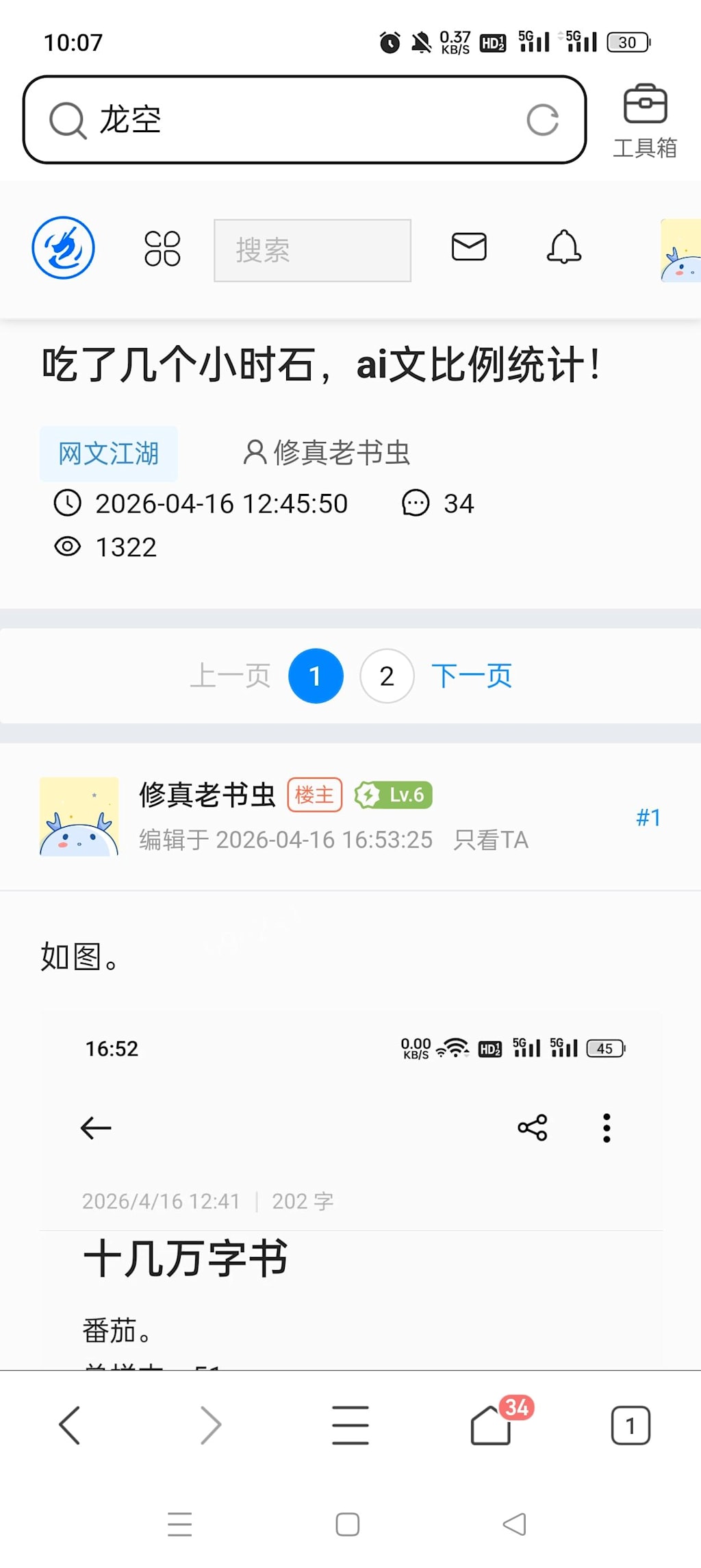
“Tomato’s AI writing share is 74.5%; Qidian’s is only 10%.”
This set of figures has circulated widely among authors. It is used to prove one thing: free platforms have already been occupied by AI, while paid platforms are still holding out. But if you trace where the number comes from, you will find it does not hold up under scrutiny.
Where does this number come from?
It was not published by Tomato officially, nor is it a full audit by a third-party institution. It most likely comes from informal sampling in author communities—local counts in Longkong, Tieba, author groups—or batch scoring by some AI-detection tool.
The problem is that “what counts as AI writing” has no unified standard.
Pure AI generation counts as AI writing. AI writes the outline, a human expands it—does that count? AI generates a draft, a human rewrites half—does that count? AI is used only to polish, name things, or write fight scenes—does that count?
By the broadest definition, almost any work that has used AI assistance could be included, so 74.5% is not surprising. By the strictest definition, only “AI one-click generation with almost no human involvement” counts, and the number shrinks drastically.
The same goes for Qidian. 10% may be an underestimate, because many authors quietly use AI for outlines, settings, and polishing; detection tools simply do not catch it easily.
An editor said that AI accounts for roughly 20% to 40% of submissions. That does not match 74.5%.
So the point of this set of figures is not precision. It reflects a collective anxiety: on free reading platforms, AI writing has grown so abundant that human authors feel suffocated; on paid reading platforms, AI writing is still seen as something that needs to be cleaned out.
The trend is real. The number does not have to be fully believed.
Tomato and Qidian: not a technology war
Many people understand this as “advanced technology vs. backward technology.” That is a misreading.
Tomato is free reading, monetized by ads. Its core logic is traffic, scale, and dwell time. Under that logic, content is more like traffic filler. Readers do not pay, so their psychological expectations for quality are naturally lower. The platform needs massive amounts of content to match a massive user base, and AI writing happens to satisfy this need for low cost, large scale, and rapid trial and error.
Qidian is paid subscription, monetized by readers paying real money. Its core logic is trust, quality, and fan loyalty. What readers buy is not just plot, but foreshadowing, character arcs, emotional tension, language style, and the trust that “the author is seriously telling me a story.” Once readers discover they are paying for AI filler, they feel fooled. Once that trust collapses, the paid ecosystem rots from the root.
So Qidian’s toughness on AI writing is not because it rejects advanced technology, but because its business model cannot bear the side effects of AI filler.
According to author community counts, Qidian once delisted a batch of works with average subscriptions over 10,000, and works near the top of the monthly ticket rankings were also cleared out. Measures included removing them from rankings and canceling official recommendation traffic. These actions cut off the works’ channels for rising.
Tomato is not unaware that AI writing degrades the content pool. It chose another path: first use AI to prop up scale, then govern it slowly. Qidian chose another path: rather than sacrifice short-term content supply, protect paid readers’ trust.
This is not a war of technology routes. It is a war of survival routes.
“Industry defeats handicraft”—the metaphor is wrong
“AI writing is industry; hand-crafted writing is handicraft; industry will inevitably defeat handicraft.”
This metaphor ignores a premise: industry defeated handicraft because products could be standardized.
Cups can be standardized. Screws can be standardized. Clothes can be standardized. Industry used assembly lines to push costs extremely low and quality to “good enough,” and handicraft workers were squeezed out of the mass market.
Fiction is not a cup.
Fiction is an emotional experience product. It can be mass-produced, but it is hard to standardize. Readers do not just consume plot; they consume feeling. With the same “broken engagement” opening, one writer makes readers slap the table in admiration, another makes them drowsy. The difference is not in the plot itself, but in rhythm, tone, detail, character psychology, subtext, humor, and tragedy. These are exactly what AI currently struggles to output reliably.
AI can write ten thousand sunrises, but it cannot write why he wanted to cry at one sunrise. AI can write “she smiled,” but it cannot write “she had venom in her heart yet still smiled like a flower.” AI can write a hero’s sacrifice, but it cannot write the hesitation, fear, and relief in the second before the sacrifice.
Industry can make ten million identical cups, but it cannot make the crack at the bottom of a cup that only one person understands.
So it is not that industry will inevitably defeat handicraft. Industry will occupy the daily necessities market; handicraft will hold the art market. The web fiction industry will also stratify in the future: traffic fiction to traffic fiction, quality fiction to quality fiction. AI will occupy a huge share of the former; in the latter, it can only be an assistant.
A writer’s AI experiment
I wrote a 500,000-word book. The method: give AI an outline, generate, then manually revise.
Claude was best. It could produce 8,000 words at once, logic still smooth, prose relatively dry. But dry prose is not fatal; later polishing can bring the human flavor back. Compared with plot, many readers really do not care about prose. They care more about “what happened” and “what happens next.”
Gemini’s prose was better. It occasionally wrote beautiful sentences, but beyond 2,500 words at once it started bullshitting. Adjectives were often inappropriate, and logic was slightly worse. The early manual revisions were mainly fixing those inappropriate adjectives. Repeated prompt alchemy still ended with large-scale manual revision before the plot felt natural. The finished product was about 50 out of 100, barely failing, but still many readers liked it.
GPT was another matter. You often had no idea what it was doing, and it was impossible to use practically.
Conclusion: Claude is best as a draft generator, Gemini as a prose reference, GPT is not yet suitable for long-form writing.
But the more important conclusion is: this method is not much faster than typing everything by hand.
Assume a mature author writes 4,000 words in 2 hours. With AI, it depends on luck. Maybe today it takes only 15 minutes to fix; maybe an hour and it is still not done. Efficiency improves, but it cannot crush handwriting. If you expect to make money this way, you can only chase volume. The faster the speed, the worse the quality.
Writing with AI cannot produce quality work.
Because no matter which AI you use, it cannot grasp the two most critical points in a work.
First, AI cannot write human psychology and emotion well. How to scheme against each other, how to love and hate in entanglement, how to have venom in the heart yet still smile like a flower, the grandeur of a hero’s sacrifice. These are not solved by smooth logic. They require the author’s understanding of human nature, capture of emotion, and control of subtext.
Second, AI cannot write the brilliance that makes you smile knowingly. Appropriate dirty jokes and verbal tics, an offbeat side character’s brain wiring, the moment an ordinary person shines. These are almost all things I thought of and put in the outline myself. AI can expand, but it is hard for it to originate.
This makes me doubt the necessity of using AI.
First, you get no training. If you do not write delicate emotional transitions, you will not improve. Next time you write, it will still be dry, and your handling of human interaction will still be imprecise. You save a little time, but not much.
Second, if you only have an outline, starting with AI is actually fine. Because you have not even entered the industry yet; talking about good or bad is superfluous. Write one book and you will know what is going on. But if you want to become a real author, AI cannot grow for you.
Two things AI cannot write
The core competitiveness of web fiction has never been word count. It is being good to read.
Being good to read usually comes from two places.
One is psychological description. A person smiles on the surface while plotting in their heart how to kill the other; a person says they do not care, then turns away with red eyes; a person is clearly scared to death but still stands in front of someone else. These psychological layers—AI can imitate them, but it is hard for it to reliably write the “right” layer. It tends to write too plainly, too formulaically, too much like a standard answer.
Two is brilliant passages. The kind of sentence that makes readers suddenly sit up, slap their thigh, screenshot and share. Maybe a perfectly placed roast, an offbeat side character’s brain wiring, a moment when an ordinary person suddenly shines. These things have no formula. They come from the author’s creative spirit, experience, and observation of life. AI can combine; it is hard for it to create.
So AI can raise the lower limit, but it is hard for it to raise the upper limit.
It can let someone who does not know how to write produce a “readable” 500,000 words. It is hard for it to let someone who does know how to write produce an “astonishing” 500,000 words.
Saved time, or saved growth?
Many authors use AI to save time.
After the time is saved, then what?
If you use the saved time to write more books, then you are indeed chasing volume. Chasing volume can make money, provided the platform does not crack down and readers are not picky. Once the platform tightens, or readers get tired of the same thing, the volume-chasing model collapses.
If you use the saved time to learn, to live, to observe people, then you may still have room to improve. If you just use AI as a crutch, you probably will never learn to walk on your own.
The more hidden problem is: AI is addictive. Once you get used to “give an outline and get a draft,” it becomes hard to tolerate clawing out one word at a time yourself. You will feel handwriting is too slow, too tiring, too uneconomical. But writing is precisely in the slow and tiring that the things truly belonging to you grow.
You write delicate emotional transitions; next time you write them more precisely. You write complex scheming; next time you write it more naturally. You write an offbeat side character’s brain wiring; next time you write more brilliance.
These, AI cannot replace.
Will Qidian die?
Back to the original question: will Qidian die because hand-crafted writing is technologically backward?
No.
Qidian’s risk is not technological backwardness. It is declining content quality and loss of reader trust. As long as it can keep a group of readers willing to pay, willing to follow updates, willing to pay for human flavor, it will not die. It may become smaller; it will not die.
Tomato will not keep winning forever either. A flood of AI writing degrades the content pool, readers get aesthetic fatigue, advertisers lower their bids, and the platform eventually still has to govern it. The free model can tolerate low quality; it cannot tolerate completely unreadable content. When AI writing becomes so abundant that readers swipe three screens and still cannot find one book worth following, Tomato will also face user loss.
The more likely future is:
Traffic fiction to traffic fiction, quality fiction to quality fiction. Free platforms use AI to serve the lower-tier market; paid platforms use quality to filter core users. AI raises the industry’s lower limit; the upper limit is still decided by human authors.
Qidian will not die because of hand-crafting; it will die because of losing trust. Tomato will not die because of AI; it will die because of complete degradation of content.
The place of AI
If you ask me how AI should actually be used.
As a co-pilot, not autopilot.
It can help you generate an outline draft, which you revise; provide plot branches, which you choose; write fight scenes, scenery, transitional chapters, which you polish; look up information, name things, think up settings; when you are stuck, give you a few not-so-smart options that stimulate you to think of better ones.
It cannot help you write a character’s psychological turning point, cannot help you write the climax of emotion, cannot help you write the brilliance that makes you smile knowingly, cannot help you write what you truly want to express.
If you treat AI as a typewriter, it is very useful. If you treat AI as an author, it is terrible.
Ending
Cao Xueqin hand-crafted Dream of the Red Chamber. Lu Xun hand-crafted The True Story of Ah Q. Jin Yong hand-crafted The Deer and the Cauldron. They could of course also use the advanced technology of their time, such as dictation, ghostwriting, printing. The core thing was still ground out one word at a time by themselves.
AI is a tool, not a civilization. Hand-crafting is not backwardness; it is a choice.
Industry will defeat handicraft; it will not defeat craftspeople. Industry makes products; craftspeople make works.
Tomato’s industrial torrent will continue to surge; Qidian’s hand-crafting dignity will continue to exist. What decides an author’s fate is not whether he uses AI, but whether he has written something people remember.
Readers can finish 500,000 words in 4 hours; what they remember is often just a certain sentence, a certain look, a certain heartbeat.
That is what AI cannot take away.
About the Creator
Jin
Writer of reamstories
https://reamstories.com/jin
Enjoyed the story? Support the Creator.
Subscribe for free to receive all their stories in your feed. You could also become a paid subscriber, letting them know you appreciate their work.
Comments
There are no comments for this story
Be the first to respond and start the conversation.