product review
Product reviews for true crime fans. Forensic kits, creepy collectibles, novelty gifts and more.
The Ghost Statistics: Why Americans Fear Crime More Than Ever — While Murder Hits a 100-Year Low
M Mehran She locks her door twice now. She didn't used to. For eleven years, Maria lived in the same mid-sized Ohio city, raised two kids on the same street, waved at the same neighbors over the same chain-link fence. She felt safe. Not naive — just settled. Comfortable in the ordinary rhythms of her neighborhood. Then came the headlines. Not from her street. Not from her city, even. From everywhere, all at once — television, Facebook, the algorithm that learned she clicked on crime stories and fed her more, and more, and more. Shootings in cities she'd never visited. Car thefts in states she'd never driven through. A world, according to her screen, that was unraveling at every seam. Now she locks the door twice. Maria is not unusual. She is, in fact, perfectly American. The Number That Should Have Changed Everything In early 2026, researchers confirmed what the data had been quietly building toward for months: America's homicide rate had potentially reached its lowest point in more than a century. Let that land for a moment. Not the lowest in a decade. Not the lowest since the 1990s crime wave receded. The lowest in one hundred years. Since before the Great Depression. Before World War II. Before the crack epidemic tore through American cities. Before nearly every crime narrative that has shaped the country's collective psychology was even written. Violent crime overall fell 5.8% in 2024 alone. And then 2025 arrived and shattered expectations further — homicides dropped another 21% in a single year. By every measurable standard, America became dramatically safer. And virtually nobody felt it. The Machinery of Fear To understand why, you have to understand how fear actually travels. It doesn't move through experience anymore — not primarily. It moves through screens. And screens have a fundamental, structural bias toward the alarming, the urgent, the viscerally threatening. A neighborhood where nothing violent happened today generates no content. A single shooting three states away generates seventeen articles, four expert panels, and a Twitter thread that runs for six days. This isn't conspiracy. It's economics. Outrage and anxiety drive engagement. Engagement drives revenue. And so the information environment that most Americans swim through daily is, by design, a relentless highlight reel of the worst things happening anywhere in the country at any given moment — stripped of context, stripped of proportion, stripped of the crucial fact that most of those places are also getting safer. The algorithm doesn't show you the thousand nights that passed without incident. It shows you the one that didn't. When the Map Becomes the Territory Psychologists have a term for what happens when our mental model of reality drifts far enough from reality itself: they call it a cognitive distortion. In clinical settings, it's treated. In political settings, it's exploited. Fear of crime has become one of the most durable and powerful political tools in the American arsenal — and it operates almost entirely independently of actual crime rates. Study after study over the past three decades has shown that public concern about crime rises and falls based on media coverage and political rhetoric, not on what's actually happening on the streets. This creates a troubling loop. Politicians campaign on the fear, which validates the fear, which generates more media coverage, which deepens the fear, which makes the next election's crime rhetoric even more potent — while the streets themselves grow incrementally quieter. The fear is real. The danger driving the fear is, increasingly, not. The People the Numbers Miss Here is where the story demands honesty. The decline is real. The historic nature of it is real. But safety in America has never been distributed equally, and that remains true today. The communities that suffered most during the 2021 homicide surge — predominantly Black and brown urban neighborhoods, economically hollowed-out rural areas, communities living downstream from the fentanyl pipeline — have seen improvement, yes. But the gap between their experience of violence and the experience of wealthier, whiter communities remains vast and persistent. When researchers say homicides are at a century-low, they are describing an average. Averages can obscure as much as they reveal. A mother in a still-struggling Chicago neighborhood doesn't experience the national statistics. She experiences her block. Her nephew. The funeral she attended last spring. For her, the century-low is an abstraction that lives in a different world entirely. Any honest accounting of this moment has to hold both truths simultaneously: the broad, genuine, remarkable decline — and the stubborn, painful unevenness of who gets to feel it. What We Owe the Truth There is something almost willfully perverse about a society that stands at a historic low point in its most serious crime — and chooses, collectively, to feel more afraid than ever. It speaks to broken information systems. To political incentives that profit from anxiety. To a media ecosystem that has confused engagement with journalism. And to something older and harder to fix — the human tendency to weight bad news more heavily than good, to remember the threat more vividly than the reprieve. But it also speaks to an opportunity. If public fear of crime is partly a constructed narrative — assembled from selective data, amplified by algorithms, weaponized by campaigns — then it can be reconstructed. Not through denial of real pain, not through dismissing the communities still bearing the heaviest burden, but through honest, proportionate, clear-eyed storytelling about what is actually happening. America is safer than it has been in living memory. That sentence is true. It is documented. It deserves to exist in the same conversation as every legitimate concern about the work still left to do. Maria locks her door twice now. Maybe one day, the story she's told about her world will finally match the world itself.
By Muhammad Mehran5 months ago in Criminal
The Year America Stopped Killing Itself: Inside the Most Stunning Crime Collapse in a Century
M Mehran There's a particular kind of silence that falls over a city when the violence stops. It doesn't announce itself. There's no ceremony, no headline that reads: Things Are Getting Better Now. It just settles in, quietly, the way dawn arrives — you don't see it coming, and then suddenly it's here. That silence has been spreading across the United States. By the close of 2025, something remarkable had taken shape — something criminologists, law enforcement veterans, and social researchers are still struggling to fully explain. America's homicide rate had fallen to what may be its lowest point in more than a hundred years. Not a small dip. Not a statistical blip. A historic, sweeping, jaw-dropping collapse in the country's most serious crime. And yet, ask most Americans how safe they feel, and the answer will likely shock you. The Peak That Changed Everything To understand where we are, you have to go back to where we were. 2021 was a brutal year. The country was still reeling from the pandemic — locked down, economically shattered, emotionally fractured. And violence surged. Homicides climbed at a rate not seen in decades, concentrated in urban centers but spreading outward, touching communities that had never imagined they'd be part of this story. Families buried sons. Mothers buried daughters. City councils held emergency meetings. And politicians on every side of the aisle reached for the same blunt instrument: fear. Crime became the defining narrative of an era. It was real. The pain was real. The grief was absolutely real. But what happened next — almost nobody predicted. The Collapse Nobody Saw Coming Starting in 2022, and accelerating with each passing year, the numbers began to shift. Slowly at first, then with gathering momentum, homicides started falling. By 2024, violent crime nationwide had dropped 5.8%. Significant, but perhaps not shocking on its own. Then came the 2025 data. Homicides fell 21% compared to the year before. Twenty-one percent — in a single year. That's not a trend. That's a transformation. Researchers began reaching for historical comparisons and finding that they had to go back over a century to find a homicide rate this low in the United States. Think about what a century means. Two World Wars. The Great Depression. The crack epidemic. The crack-era violence of the late 1980s. The gang wars. The opioid crisis. Through all of it, the homicide rate in America never fell to where it stands today. That is the story of this moment. And it's almost invisible. Why Aren't We Celebrating? Here is where the story gets complicated — and deeply human. Crime didn't disappear from American consciousness. It deepened. News cycles still lead with shootings. Social media amplifies every act of violence into a national event. Politicians campaign on fear because fear, historically, works. The human brain is wired to remember the murder it heard about, not the thousand murders that didn't happen. We feel threat more acutely than safety. We process danger faster than we process relief. So even as the data tells one story — things are genuinely getting better — the felt experience of millions of Americans tells another. And that gap between reality and perception has enormous consequences: for policy, for policing, for how communities invest in themselves, for whether a family decides to stay in a neighborhood or flee. The perception of crime shapes cities just as powerfully as crime itself. The Incomplete Picture None of this means the story is simple or clean. Not every community has shared equally in the decline. Some cities still struggle with pockets of persistent violence. Drug offenses have trended upward in certain regions, bringing with them their own cascading harms. The fentanyl crisis continues to carve its own lethal path through communities the homicide statistics don't fully capture. And the causes of the decline remain genuinely contested. Was it changing demographics? Improved economic conditions post-pandemic? Shifts in policing strategy? The expansion of community violence intervention programs? Hospital trauma care that saves lives that once would have been lost? Researchers are actively debating all of it. What isn't debated is the number itself. What This Moment Deserves America has spent decades defined by its violence. True crime dominates entertainment. Crime statistics anchor political debates. The image of a dangerous, unraveling nation has calcified into something that feels almost like identity. But data has a way of disrupting narratives, if we let it. The year 2025 may well be remembered as the moment the long arc of American violence bent — sharply, historically — toward something better. That deserves to be seen clearly, discussed honestly, and understood fully, not because it means the work is done, but because knowing what's working is the only way to keep it working. The silence on those streets isn't emptiness. It's the sound of something going right, for once — and it's long past time we listened.
By Muhammad Mehran5 months ago in Criminal
Shots at the Press Dinner: The Night Someone Tried to Kill Trump Again
M Mehran Washington, D.C. had dressed up for the evening. The White House Correspondents' Association dinner — one of the most glamorous nights in American political life — filled the Washington Hilton with journalists, cabinet members, celebrities, and the President of the United States. Champagne. Chandeliers. A room full of some of the most powerful people in the country, all gathered in one place. It was, as it turned out, exactly the kind of opportunity that Cole Tomas Allen had been planning for. At approximately 8:40 p.m. on April 25, 2026, Allen approached a security checkpoint on the Terrace Level of the Washington Hilton, leading to the hotel's ballroom. (U.S. Department of Justice) Shots rang out. Secret Service agents rushed the President out of the room. And America — still not fully recovered from the trauma of Butler, Pennsylvania and West Palm Beach — found itself staring at breaking news banners it had hoped never to see again. Another assassination attempt on Donald Trump. Who Is Cole Tomas Allen? Cole Tomas Allen is a 31-year-old man from Torrance, California. (U.S. Department of Justice) By most visible accounts, he was not a figure in any radical movement. He had no known extremist affiliations, no history of prior violence, no public profile that would have set off alarms. Extremism experts noted that Allen left no radical digital footprint — unlike the more typical profile of someone who commits politically motivated violence, who is usually steeped in conspiratorial thinking and false narratives. (NPR) One researcher put it plainly: most violent extremists feel "a little off" when you encounter them. Allen didn't read that way at all. And yet, he planned this with cold, deliberate precision. On April 6, 2026 — nearly three weeks before the dinner — Allen made a hotel reservation at the Washington Hilton for three nights. He traveled by train from near Los Angeles to Chicago, then boarded another train to Washington, D.C., arriving the afternoon of April 24. (U.S. Department of Justice) He checked in. He unpacked. He waited. At about 8:00 p.m., Allen took a photo of himself standing in front of his hotel room mirror, dressed in black with a red necktie. (Wikipedia) It was a chilling final image — composed, deliberate, almost theatrical. The Email He Sent Before Walking Out Shortly before 8:40 p.m., Allen sent an email to members of his family and a former employer. He signed it: "Cole 'coldForce' 'Friendly Federal Assassin' Allen." (U.S. Department of Justice) The manifesto he left behind — roughly 1,000 words — offers a window into a mind consumed by political grievance. The letter referenced a range of issues: immigration detentions, U.S. strikes on alleged drug boats in the Caribbean, the bombing of a girls' school in Iran, and the Epstein scandal. (NPR) In an apparent reference to Trump, the letter declared he was "no longer willing to permit a pedophile, rapist, and traitor" to implicate him in crimes. (NPR) Trump told Fox News that Allen had written an anti-Christian declaration, calling him "a sick guy." (Al Jazeera) Authorities believe Allen specifically traveled to Washington to target Trump and members of his administration who were attending the dinner. (Al Jazeera) The Attack — and What Stopped It Allen was armed with guns and knives when he tried to rush the event. Trump was whisked away by security as gunshots rang out. (Al Jazeera) A Secret Service agent was shot in the process of subduing Allen. The agent's quick response — absorbing the danger while protecting the room — was credited with preventing a catastrophe. (Al Jazeera) "This foiled plot was a brazen attempt to assassinate the president and numerous high-ranking U.S. government officials," said FBI Assistant Director Darren Cox. "Violence is never an acceptable means of expressing political dissent." (U.S. Department of Justice) Allen was charged with three criminal counts: using a firearm during a crime of violence, transporting a firearm across state lines with intent to commit a felony, and attempting to assassinate a United States president. (Wikipedia) The incident marked the third apparent attempt on Trump's life since 2024 — and the second presidential assassination attempt at the Washington Hilton, the first being the shooting of Ronald Reagan in 1981. (Wikipedia) A President Who Keeps Surviving Step back and the timeline is staggering. July 2024 — Butler, Pennsylvania. A 20-year-old climbs a rooftop with a rifle. Trump is shot in the ear. One rally attendee dies. September 2024 — West Palm Beach, Florida. A man hides in bushes outside Trump's golf course for twelve hours with a rifle. Secret Service fires on him. He flees. He is caught. He is later sentenced to life in prison. April 2026 — Washington, D.C. A man books a hotel room at the same venue as the White House Correspondents' Dinner, travels cross-country by train, arms himself, and walks toward the ballroom where the President is sitting. No modern president has faced this many attempts on his life. (Axios) Trump himself, after the dinner attack, was unusually measured — calling for unity and bipartisan healing, something observers noted was a striking departure from his typical tone. (Al Jazeera) "This is not the first time in the past couple of years that our republic has been attacked by a would-be assassin," he told reporters. The Bigger Picture Nobody Wants to Face There is a debate raging — loudly and bitterly — about what is causing this. The White House pointed to political rhetoric from the opposition. Press Secretary Karoline Leavitt said that "deranged lies and smears against the president, his family, his supporters have led crazy people to believe crazy things, and they are inspired to commit violence." (Al Jazeera) Others argue that a deeper, slower rot is responsible — a political climate so poisoned, so stripped of common ground, that ordinary people with ordinary grievances are arriving at extraordinary and violent conclusions. Both arguments may contain some truth. Neither fully explains a 31-year-old man in a red tie, alone in a hotel room, photographing himself before walking toward a checkpoint with a loaded shotgun. What experts do agree on is this: the weekend's incident stands out even against the grim backdrop of rising political violence in America. Allen had no radical community feeding him narratives, no online echo chamber radicalizing him over months. He appears to have arrived at this point largely on his own — which, in many ways, makes him harder to detect and more frightening as a model. (NPR) America at a Crossroads The Washington Hilton's chandeliers were still lit when the Secret Service swept the room. The champagne glasses were still on the tables. Somewhere in the chaos, hundreds of journalists — people whose job it is to witness history — became part of it instead. Three attempts. Three survivors. A country that increasingly cannot agree on basic facts, let alone shared values. And a president who keeps raising his fist, keeps walking away, keeps standing at the next podium. The question that haunts all of this isn't whether the security held. It did — barely, each time. The question is: what kind of country produces a man who books a hotel room three weeks in advance, packs a shotgun, boards a train, and calls himself a "Friendly Federal Assassin"? America is still working on that answer. And time, it seems, is not on its side.
By Muhammad Mehran5 months ago in Criminal
They Kept Coming for Him: The Terrifying Wave of Assassination Attempts on Donald Trump
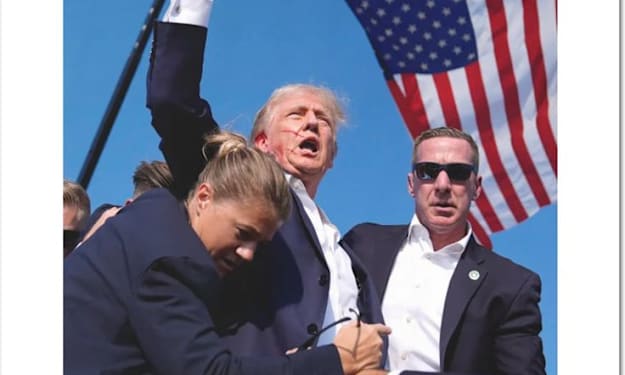
M Mehran The blood on his ear was real. On July 13, 2024, Donald Trump raised his fist to a roaring crowd in Butler, Pennsylvania — and in that single frozen image, something shifted in American political history that hasn't fully stopped shaking since. A 20-year-old named Thomas Matthew Crooks had climbed onto a rooftop just outside the rally's security perimeter and fired an AR-style rifle. The bullet grazed Trump's right ear. One spectator, Corey Comperatore, was killed. (LiveNOW from FOX) The shooter was neutralized by a Secret Service sniper seconds later. America exhaled. Trump survived. And most people assumed it was a horrifying one-time event — the kind of thing that reshapes a nation precisely because it almost never happens. They were wrong. Attempt Two: The Man in the Bushes Sixty-four days later, it happened again. On September 15, 2024, Trump was golfing at Trump International Golf Club in West Palm Beach, Florida, when a Secret Service agent conducting a sweep of the sixth hole spotted something alarming: a man hiding in the shrubbery, holding an SKS rifle, approximately 400 yards from where Trump was walking along the fifth hole. (Wikipedia) The man had been there for nearly twelve hours. Waiting. Patient in a way that is difficult to comprehend. His name was Ryan Wesley Routh — a 58-year-old roofer and self-described Russo-Ukrainian war activist. (Wikipedia) A Secret Service agent fired at him. Routh fled. He was caught shortly after while driving away. What emerged during the investigation painted a portrait of something more premeditated than an impulsive act of rage. An indictment revealed that Routh had been planning the assassination as early as February 2024, communicating with an accomplice in Mexico who called himself "Ramiro." (Wikipedia) He had sought military weapons. He had written notes to himself about failing. He had even reached out — in a self-published ebook — to Iran, suggesting they should feel free to assassinate Trump themselves. In September 2025, a jury found Routh guilty on all counts — attempted assassination, assault on a federal officer, and multiple firearms offenses. (Ballotpedia) He was sentenced to life in prison on February 4, 2026. (Wikipedia) Two attempts. Two men. And a nation asking: who's next? The Security Failures Nobody Wants to Talk About In the Butler attack, the answer to "how did this happen?" was almost as disturbing as the attack itself. An internal investigation into the Secret Service's handling of the Pennsylvania rally led to six Secret Service employees being suspended without pay. (LiveNOW from FOX) A Senate report faulted the agency for failures in planning, communication, and leadership. Crooks had been flagged as suspicious by local law enforcement before he fired. The warning never reached the right people in time. In West Palm Beach, law enforcement officials acknowledged that the golf course perimeter had not been fully secured because Trump's visit was unscheduled. (Wikipedia) A former president — the leading candidate for the nation's highest office — was playing golf without a secured perimeter. These were not extraordinary oversights. They were systemic ones. And the people paying the price for them were a man whose ear got grazed by a bullet and a father named Corey who never came home from a rally. Attempt Three: The Press Gala Shooting Then came April 2026 — and the most brazen incident yet. Cole Tomas Allen, 31, of Torrance, California, allegedly attempted to breach security at the White House Correspondents' Association dinner, shooting a Secret Service agent in the process. (Al Jazeera) Trump was inside. Federal prosecutors charged Allen with attempting to assassinate the president of the United States — an offense that carries a potential sentence of life in prison. (Al Jazeera) The White House called it the third assassination attempt against Trump since 2024. (Al Jazeera) The press gala — one of Washington's most traditionally safe, carefully vetted events — had been turned into a crime scene. "This is not the first time in the past couple of years that our republic has been attacked by a would-be assassin," Trump told reporters after the shooting. (Axios) A Pattern Bigger Than Politics Step back from the political noise — the blame, the rhetoric, the cable news debates — and what remains is something quietly terrifying. No modern president has faced this many threats. (Axios) The attempts span two years, multiple states, different perpetrators with different motivations, and different levels of planning. One was a young man who left almost no traceable digital footprint. One was a middle-aged activist with months of premeditation and foreign contacts. One allegedly walked into a black-tie dinner with a weapon. There is no single profile. No single motive. No single point of failure to fix and move on from. What there is, instead, is a climate — one in which political violence has gone from the unthinkable to the recurrent. And while the debate rages about what caused it and who bears responsibility, the facts remain: Three attempts. Multiple security failures exposed. One conviction with a life sentence. More suspects charged. More investigations ongoing. And somewhere, right now, law enforcement agencies are working leads they can't yet talk about publicly. The Question America Hasn't Answered The Butler photograph became iconic — Trump with his fist raised, blood on his face, Secret Service agents surrounding him, the American flag in the background. It is one of the most striking political images in modern history. But images don't fix broken security protocols. They don't address the radicalization pipelines that produce young men willing to climb rooftops. They don't explain why a man spent twelve hours in a bush with a rifle, or why someone tried to storm a press dinner with a shotgun. These are criminal acts — each one of them. But they are also symptoms of something larger that American society has yet to honestly reckon with. The bullets keep coming. The fist keeps rising. And the country keeps watching, still not sure what it's supposed to do next.
By Muhammad Mehran5 months ago in Criminal
The Digital Devil: How Modern Criminals Hijacked the 21st Century
M Mehran It was a Tuesday morning when Sandra noticed something wrong. She'd woken up at 6 a.m. like always, made her coffee, and opened her banking app out of habit — the same nervous ritual she'd kept since her divorce left her raising two kids alone. But the number staring back at her wasn't her number. Her $4,200 savings account read $0.00. Her hands went cold. By the time she reached her bank, four separate transfers had already cleared — each one just under the $1,000 threshold that triggers automatic fraud alerts. Whoever had done this knew exactly how the system worked. They knew her limits better than she did. Sandra is not alone. She is one of millions. Crime Has Evolved — And Most People Haven't Noticed When people picture a criminal, they still imagine something cinematic — a dark alley, a weapon, a ski mask. But the most dangerous criminals of our time don't operate in shadows. They operate on servers. They send emails. They build fake websites that look more legitimate than real ones. Cybercrime is now the fastest-growing category of crime on the planet, costing the global economy an estimated $8 trillion in 2023 alone — and that number is expected to climb past $10 trillion by 2025. To put that in perspective, it exceeds the GDP of every country on Earth except the United States and China. The criminals behind these numbers aren't masterminds hunched over supercomputers in foreign bunkers. Many are ordinary people — bored, broke, or simply opportunistic — who discovered that stealing digitally carries almost none of the risk of stealing physically. No getaway car needed. No witness. No fingerprints. The New Face of Crime Today's most active criminal categories paint a disturbing portrait of modern society. Identity theft has exploded into a billion-dollar underground industry. Your name, Social Security number, date of birth, and mother's maiden name are being bought and sold on dark web marketplaces for as little as $15. Sometimes less than a cup of coffee. Romance scams — where criminals pose as romantic partners online to manipulate victims emotionally and financially — are now one of the top-reported frauds in the United States. The FBI's 2023 report found Americans lost over $1.3 billion to romance scams in a single year. The victims aren't naive. They're lonely. They're grieving. They're human. Ransomware attacks have brought hospitals to their knees, shut down school districts, and paralyzed entire city governments. In 2021, a ransomware attack on a Florida water treatment plant briefly allowed a hacker to increase sodium hydroxide levels to potentially lethal concentrations. The plant's operator caught it — but only barely. And then there's human trafficking, which has evolved with technology too. Social media platforms have become primary recruitment tools. Traffickers build fake relationships over weeks, create false promises of jobs and stability, and then exploit the vulnerable before anyone realizes what happened. Why Are We Losing? The uncomfortable truth is that law enforcement is playing catch-up — and has been for years. Jurisdictional boundaries that made perfect sense in 1950 are almost meaningless now. A scammer in Eastern Europe targeting a grandmother in Ohio crosses three continents of legal complexity before a single arrest warrant can be drafted. Meanwhile, the money moves in cryptocurrency and disappears in minutes. Social media companies, internet service providers, and financial institutions are each responsible for pieces of the puzzle — and none of them are fully accountable for the whole picture. We built an interconnected world at breathtaking speed. We didn't stop to ask who might misuse the connections. The Human Cost Nobody Talks About Statistics are numbing. Stories aren't. Sandra spent four months fighting her bank to recover her money. She won — eventually — but the anxiety never fully left. She checks her accounts three times a day now. She trusts less. She sleeps worse. Victims of romance scams often describe the experience not just as financial loss, but as grief — mourning a person who never existed while feeling ashamed for having believed. Children whose parents are trafficked carry wounds that follow them into adulthood. Crime in the present day is no less devastating than it has ever been. It has simply gotten better at hiding. So What Do We Do? We talk about it. Loudly, and often. Awareness remains the most powerful tool available to ordinary people. Knowing that no legitimate company will ever ask for payment in gift cards. Knowing that a romantic interest who refuses a video call is a red flag, not a quirk. Knowing that an email address with one transposed letter is not the IRS. The criminals of our time are sophisticated — but they rely, more than anything else, on silence and shame. Don't give it to them. The world has changed. So has crime. The only question is whether we change fast enough to protect the people we love.
By Muhammad Mehran5 months ago in Criminal
The Woman Who Disappeared on a Tuesday
M Mehran The coffee was still warm when Officer Dana Pryce arrived at 14 Millbrook Lane. It sat on the kitchen counter in a blue ceramic mug — the kind with a chipped handle that someone keeps because they love it, not because it's useful. The television was on. A half-eaten piece of toast sat on a plate near the sink. A purse, a phone, a set of car keys — all of it still there, exactly where a woman named Claire Sutton had left them. Claire had not. An Ordinary Tuesday By every account, Claire Sutton's morning of March 4th had been completely unremarkable. She was thirty-seven years old. A dental hygienist. Mother of one daughter, nine-year-old Brooke, who was at school. She had texted her coworker at 8:14 AM saying she was running ten minutes late. She had liked a photo on Instagram at 8:31 AM. She had, according to her neighbor Helen Marsh, waved from the driveway while backing out her recycling bins sometime around 8:45. After that — nothing. She never showed up to work. She never picked up Brooke from school. When her husband, Daniel Sutton, came home at 6:20 PM and found the warm coffee and the cold toast, he called 911. He sounded, the dispatcher would later testify, appropriately frantic. The Husband In missing persons cases, investigators are trained not to assume. They are also trained to notice things. They noticed that Daniel Sutton answered every question quickly — too quickly, some detectives felt, as though he'd already rehearsed the shape of his answers without knowing exactly what the questions would be. They noticed that when asked to describe his relationship with Claire, he used the word fine four times in six minutes. They noticed that his eyes filled when discussing Brooke, but not when discussing his wife. None of this was evidence. People grieve differently. Shock takes strange shapes. But investigators noticed. Forty-Eight Hours The first two days of a missing persons investigation are the most critical — and the most brutal. Search teams combed the woods behind Millbrook Lane. Divers checked the reservoir two miles east of town. Claire's photo circulated on local Facebook groups, then regional news, then national outlets. Tips flooded in — a woman matching her description spotted at a bus station in Columbus, at a rest stop off I-70, at a diner in rural West Virginia. Every tip was chased. Every tip went cold. Claire's coworkers described her as warm, funny, and quietly unhappy. That last part came out in pieces — a comment here, a hesitation there. Nobody wanted to say it directly. But when Detective Paul Orena pressed gently, the picture that emerged was of a woman who had been pulling away from her life for months. Quieter than usual. More distracted. Jumping whenever her phone buzzed. "She seemed scared," her closest friend, Tara, finally said on day three. "I asked her about it once. She said everything was fine." Fine. What the Phone Revealed On day five, investigators obtained a full extraction of Claire's cell phone data. What they found cracked the case open like a dropped plate. Claire had been communicating — extensively, secretly, for seven months — with a man named Paul Reeves, a former college acquaintance she'd reconnected with online. The messages painted a relationship that had moved quickly from innocent to intense to frightening. In the final weeks, Claire had been trying to end contact. Reeves had not accepted that. His final message to her, sent at 8:52 AM on March 4th, read: "If you won't talk to me, I'll make sure we talk." It was sent four minutes after her neighbor saw her in the driveway. The Search Shifts Paul Reeves was located within eighteen hours — at a motel forty miles outside the city, registered under a different name, his car parked behind the building as if hidden. He did not run. He sat on the edge of the motel bed when officers entered, his hands clasped between his knees, and said nothing for a very long time. Claire Sutton was found alive — badly injured, but alive — in a storage unit that Reeves had rented three months earlier under a business name. She had been there for four days. She had left a water bottle within reach. She had counted the hours by the strip of light under the door. When the door opened and she saw police uniforms, she didn't scream or cry. She just exhaled — one long, shaking breath — like a person surfacing after nearly drowning. What Happened to Daniel People always want to know about the husband. Daniel Sutton was, ultimately, exactly what he appeared to be: a man in a failing marriage who didn't know his wife well enough to realize she was in danger. He was cleared of any involvement. He got his daughter back. He got his wife back — though not in the way any of them imagined, because trauma remakes people whether they consent to it or not. He still lives on Millbrook Lane. Claire does not. The Sentence Paul Reeves was convicted of kidnapping, unlawful restraint, and aggravated assault. He was sentenced to twenty-two years. At sentencing, Claire was permitted to read a statement. She stood at the podium for a long moment before speaking, and when she finally did, she addressed Reeves directly. "You thought silence was the worst thing I could give you," she said. "You were right. I have nothing left to say to you. Not one word. Not ever again." She folded her paper. She walked out. Why This Case Matters Claire Sutton's case became a reference point in discussions about digital stalking, online reconnection dangers, and how quickly private communications can escalate into physical threat. Investigators now use it in training. The seven-month communication window, the escalating language, the final threatening message — it is, in the language of threat assessment, a textbook pattern. The tragedy is how many people still don't recognize it until it's too late. If someone in your life seems quietly scared — ask twice. The first answer is almost never the real one.
By Muhammad Mehran5 months ago in Criminal
The Man Who Never Left Footprints
M Mehran The first thing people noticed about Daniel Harlow was not his face—it was the absence he left behind. No fingerprints. No footprints. No digital trail. In a world obsessed with surveillance, Daniel existed like a ghost. And ghosts, as it turns out, can be very dangerous. The city of Greyhaven had always been loud—sirens, chatter, neon reflections bouncing off rain-soaked streets. But lately, something else filled the air: fear. Not loud, not obvious—quiet, creeping, suffocating fear. It started with small crimes. A jewelry store emptied overnight with no sign of entry. A private vault in a high-security bank opened without triggering a single alarm. A politician’s laptop stolen from a locked penthouse, containing secrets that could burn governments. Each crime was flawless. Surgical. And at every scene, investigators found… nothing. No DNA. No camera footage. No witnesses. Detective Laura Vance hated mysteries that behaved like perfection. Crime, in her experience, was messy. People made mistakes. But this? This wasn’t just skill—it was design. “Someone is studying us,” she said during a briefing. “Not just the targets—the system.” Her colleagues exchanged glances. It sounded paranoid. But Laura wasn’t wrong. Daniel Harlow had spent years learning how systems fail. Not hacking them—understanding them. He once worked in cybersecurity, designing protection protocols for major corporations. He knew where cameras overlapped, where blind spots naturally formed, and how human laziness created invisible doors in the strongest defenses. But Daniel didn’t become a criminal for money. He became one for control. His childhood had been a lesson in powerlessness. A broken home. A father who disappeared. A mother who trusted the wrong people. Daniel learned early that the world rewarded those who took, not those who waited. So he stopped waiting. At first, it was small—identity manipulation, data erasure, financial misdirection. Then, bigger risks. Bigger rewards. But his real breakthrough came when he realized something chilling: The best crime is not the one you escape—it’s the one nobody knows happened. Laura’s investigation finally got a lead—not evidence, but pattern. Every victim had one thing in common: they had something to hide. The jewelry store owner was laundering money. The politician had offshore accounts. The bank vault? It belonged to a shell company tied to illegal arms deals. “This isn’t random,” Laura said, staring at the board filled with red threads. “He’s choosing them.” “Why?” her partner asked. She paused. “Because he can.” Daniel didn’t see himself as a villain. In his mind, he was correcting imbalance. Taking from those who operated in shadows, exposing the hypocrisy of systems built on illusion. But there was a flaw in his philosophy. He enjoyed it. The thrill. The control. The silent victory of walking through a locked world unnoticed. And that enjoyment? It made him careless. Laura found it in the smallest detail—a pattern in timing. Every crime happened exactly 23 days apart. Not 22. Not 24. Twenty-three. “Why that number?” her partner asked. Laura didn’t answer immediately. She was already digging deeper—cross-referencing dates, locations, events. Then she saw it. A cybersecurity conference. Years ago. Held every year… on the 23rd. Daniel Harlow had attended all of them. Tracking him wasn’t easy. He had erased himself too well. No current address, no active accounts, no clear identity. But Laura knew something about criminals like Daniel. They don’t disappear. They relocate. And they always leave behind one thing—habit. Daniel sat in a quiet café, watching the rain. The city blurred outside, lights melting into streaks of gold and red. He checked his watch. Two days until the next job. A museum this time. Private collection. Rare artifacts. Untouchable security. Perfect. He took a sip of coffee, unaware that across the street, Laura Vance was watching him for the first time. “No way…” she whispered. He looked… normal. Not dangerous. Not extraordinary. Just a man. But Laura knew better. That’s what made him terrifying. The arrest wasn’t dramatic. No chase. No gunfire. Just timing. As Daniel exited the café, Laura stepped forward. “Daniel Harlow.” He froze. For a moment, the world went silent. Then he smiled. “Took you long enough.” Interrogation was… strange. Daniel didn’t deny anything. But he didn’t confess either. “You won’t find proof,” he said calmly. “I made sure of that.” Laura leaned forward. “Then why stop?” “I didn’t stop,” he replied. “You just interrupted.” In the end, they couldn’t charge him for most of the crimes. No evidence. No witnesses. Just suspicion. But they held him on lesser charges—fraud, identity manipulation, technical violations. Not enough to define the legend. Months later, another crime occurred. Same precision. Same silence. Same absence of evidence. Laura stared at the report, her stomach tightening. It wasn’t possible. Daniel was still in custody. Unless… She looked at the wall, at the old case board. And slowly, the truth settled in. Daniel Harlow hadn’t been working alone. The real crime wasn’t what he stole. It was what he created. A system. A philosophy. A way to disappear. And now, someone else had learned it.
By Muhammad Mehran5 months ago in Criminal
She Spent 17 Years in Prison for a Crime She Did Not Commit
M Mehran The day DianeRul walked out of Decatur Correctional Center, she stood on the sidewalk for eleven minutes without moving. Not because she was overwhelmed by emotion. Not because the cameras were watching. But because she had genuinely forgotten which direction you walk when nobody is telling you where to go. Seventeen years. That is how long it takes to forget something as simple as choosing a direction. She was twenty-six when they took her in. She was forty-three when they let her out. In between, her mother died, her son grew from a gap-toothed seven-year-old into a man she recognized only in photographs, and the world changed so completely around her that the smartphone a volunteer handed her in the parking lot felt like an artifact from a science fiction novel. She had not committed the crime she was convicted of. Not even close. How Innocent People End Up Behind Bars Wrongful conviction is not a glitch in the criminal justice system. It is, researchers and legal scholars increasingly argue, a predictable outcome of a system riddled with structural failures — failures that have been documented, studied, and largely left unaddressed. The Innocence Project, a nonprofit legal organization dedicated to exonerating wrongfully convicted individuals, has helped free more than 375 people in the United States through DNA evidence alone. Those are only the cases where DNA evidence existed and was preserved. For every exoneration, legal experts estimate there are many more wrongful convictions quietly serving out their sentences with no biological evidence left to test. The leading causes are achingly familiar: eyewitness misidentification, which contributes to roughly 69 percent of overturned convictions. False confessions, which seem impossible until you understand the psychological pressure of an interrogation room at 3 a.m. after fourteen hours without sleep. Junk science — forensic methods that were presented to juries as ironclad and have since been discredited entirely. And informant testimony, offered by people with powerful incentives to say whatever the prosecution needs to hear. Diane Rul's case contained three of the four. The Night Everything Went Wrong In the spring of her twenty-sixth year, Diane was working double shifts at a diner outside of Springfield, Illinois, saving money to move her son closer to a better school district. A woman was murdered six blocks from her apartment. A witness — later revealed to have been standing more than 90 feet away in poor lighting — identified Diane from a photo lineup. The detective running the lineup, a man who knew which photo was the suspect's, made small unconscious gestures that researchers now understand reliably influence witness choices. Diane's court-appointed attorney met with her a total of four times before trial. He was managing 94 other cases simultaneously. A jailhouse informant testified that Diane had confessed to him during a brief period of pretrial detention. He received a reduced sentence for his cooperation. He later recanted, in writing, in an affidavit that sat in a legal filing for nine years before anyone with the power to act on it did. Diane was convicted by a jury of twelve people who believed, genuinely and in good faith, that they were doing the right thing. That is perhaps the most devastating part. Nobody in that courtroom, with one or two quiet exceptions, thought they were making a mistake. What 17 Years Actually Costs We talk about wrongful conviction in legal terms — overturned verdicts, exoneration, compensation statutes. The language is clean and procedural and bears almost no relationship to what actually happens to a human being who loses seventeen years to a crime they did not commit. Diane missed her mother's diagnosis. Missed the decline. Missed the death and the funeral and the particular grief of sitting beside someone you love as they go. She was notified by letter. She missed her son's first day of high school, his graduation, his first heartbreak, the version of himself he became in the years she wasn't there to see it happen. He visited when he could. It was never enough. How could it be? She missed her own thirties entirely — a decade that, for most people, is consumed by building: careers, relationships, a sense of who you are becoming. Diane spent it in a system that had decided who she was and was not interested in being corrected. Illinois awarded her $175,000 upon exoneration — the maximum allowed under state compensation law at the time. One hundred and seventy-five thousand dollars for seventeen years. Do that math slowly. Let it settle. The Criminal Justice System as a Criminal Act This is the conversation we resist having. We are comfortable discussing criminals — people who have broken the law, hurt others, made choices that led them to justice. That narrative has clear roles and a certain moral tidiness. We are far less comfortable discussing what happens when justice itself becomes the source of harm. When the system designed to protect the innocent becomes the mechanism of their destruction. Diane Rul did not choose her direction on that sidewalk for eleven minutes because the concept of choice had been systematically removed from her life for nearly two decades. The state did that. In all of our names. She is rebuilding. Slowly, imperfectly, with the particular determination of someone who has already survived the unsurvivable. She chose a direction eventually. She started walking. She Still Believes in Justice Not the system — she is clear-eyed about the system, its failures, its casual cruelties. But justice itself. The idea that truth should matter. That innocence should mean something. That the machinery built in the name of right and wrong carries an obligation to be right more often than it is. "I have to believe it can be better," she told a journalism student who interviewed her two years after her release. "Because the alternative is that it was all for nothing. And I can't live in that world." She won't. She's already decided. Wrongful convictions happen more often than most people know. Organizations like the Innocence Project work tirelessly to correct them — and they need support. Look them up. Learn the names.
By Muhammad Mehran5 months ago in Criminal
The Smartest Man in the Room Was Stealing From Everyone In It
M Mehran Raymond Colt never carried a weapon. He never wore a mask. Never threatened anyone. Never once raised his voice in anger inside a professional setting. He had excellent posture, a firm handshake, and a laugh that made people feel like they had said something genuinely clever. He also stole just under four million dollars from 200 ordinary people over the course of eleven years — retirees, teachers, a retired firefighter, a widow who had been saving since her husband died and trusted Raymond because he had kind eyes and a framed certificate on his wall. When federal agents finally walked into his glass-walled office on a Tuesday morning in October, Raymond Colt was on the phone with another potential client. He asked the agents if they could give him five minutes to finish the call. They could not. The Crime That Wears a Suit White-collar crime is the great blind spot of the American criminal conversation. We pour enormous cultural energy into the image of the criminal as someone who takes things by force — the robber, the burglar, the violent offender whose crimes we can visualize and fear with our bodies. These criminals frighten us in a primal, immediate way, and so they dominate our headlines, our courtroom dramas, our political speeches about law and order. But the crimes that devastate the most people, that hollow out life savings and collapse retirements and push ordinary families into poverty, often happen in offices. Behind spreadsheets. Inside handshakes. White-collar crime costs the United States an estimated $300 to $600 billion annually — a figure so enormous it barely feels real. By comparison, all property crimes combined cost roughly $16 billion per year. The math is staggering. The attention paid is not proportional. Raymond Colt understood this asymmetry perfectly. He built his entire criminal career on it. How a Confident Man Becomes a Criminal Raymond did not start out intending to steal four million dollars. He started, as many white-collar criminals do, by stealing a little. A small redirection of funds here. A fee charged that was never quite disclosed. A return figure slightly adjusted on a statement that clients rarely scrutinized because Raymond was so warm, so reassuring, so genuinely fun to have coffee with, that scrutiny felt almost rude. Criminal psychologists who study fraud and financial crime identify a consistent pattern they call the fraud triangle — three converging forces that turn an otherwise conventional person into a criminal: pressure, opportunity, and rationalization. Raymond had all three. Pressure came first — a failed investment of his own, a lifestyle he had built on the assumption of continued success, a pride too enormous to admit things were collapsing. Opportunity was baked into his profession; he managed other people's money with minimal oversight. And rationalization, the most dangerous of the three, came naturally to a man who had spent his entire career convincing others of things. I'll pay it back. They can afford it. It's temporary. It's not hurting anyone. It is always hurting someone. It is just easier not to picture their faces. The Faces Raymond Didn't Picture Margaret Osei was 71 years old when she discovered that the retirement account Raymond had managed for sixteen years contained less than $4,000. She had believed it contained $340,000. She had planned her entire final chapter around that number — the apartment closer to her grandchildren, the trips she had promised herself, the cushion that would keep her from becoming a burden. In a single meeting with a federal investigator, every plan she had made dissolved. She went back to work. At 71. Greeting customers at a home improvement store four days a week because there was nothing else to do and the alternative was sitting alone in her apartment doing arithmetic that never came out right. "I trusted him," she said simply, in a victim impact statement read aloud at Raymond's sentencing. "I trusted him the way you trust a doctor. The way you trust someone who holds something fragile and promises not to drop it." Raymond Colt received seven years in federal prison. White-collar sentences, even for crimes of this scale, tend toward the lenient. He will likely serve less. Margaret Osei will work until her body won't let her anymore. Why We Need to Take White-Collar Crime Seriously There is a persistent cultural instinct to regard white-collar criminals as somehow lesser criminals — as if the absence of a weapon or a threatening voice makes the act less destructive, the victim less harmed, the crime less real. It is a dangerous instinct, and it is one that white-collar criminals count on. Raymond Colt never scared anyone. He charmed them. He remembered their grandchildren's names and sent cards at Christmas and made every client feel like the most important person in the room. His weapon was trust itself — and trust, once weaponized by someone skilled enough to wield it, is more devastating than most things you can hold in your hand. The violence of white-collar crime is just quieter. It arrives in the form of a bank statement. A phone call. A number that doesn't make sense on a page. It arrives in the voice of a 71-year-old woman reading a piece of paper in a courtroom, trying to explain what $340,000 meant to her and what its absence means now. Raymond Colt's Excellent Posture He maintained it, they say, all the way through sentencing. Straight back. Hands folded. Expression composed. The kind of man who never stopped performing, even when the audience had finally figured out the show. Financial fraud destroys real lives. If something feels wrong about how your money is being managed, trust that instinct. Ask questions. Demand transparency. The most dangerous criminals are often the ones you never think to fear.
By Muhammad Mehran5 months ago in Criminal
The Boy Who Robbed Banks Was Never Trying to Get Rich
M Mehran Kevin Darts robbed his first bank at the age of twenty-three wearing a golf hat, a fake mustache, and an expression that one teller later described to police as "almost apologetic." He passed a note. He waited politely while the cashier counted out the bills. He said thank you. Then he walked out, got into a used Honda Civic, drove exactly at the speed limit to a motel six miles away, and ordered a large pepperoni pizza. He was arrested four days later, not because investigators were particularly brilliant, but because Kevin used his real rewards card at the pizza place. He had robbed the bank for $2,200. He had $4,000 sitting untouched in a savings account. When the arresting detective asked him why, Kevin Darts looked at the table for a long moment and said, "I just needed something to happen." The Crimes Nobody Understands Not every criminal is driven by greed. Not every robbery is about money. Not every act of lawbreaking is a calculated effort to gain something tangible. Some crimes are cries. Some are escapes. Some are the only language a person knows for a feeling they cannot name. Criminal psychologists have long documented a category of offenders who commit crimes not for profit or power, but for sensation — for the chemical explosion of adrenaline, for the illusion of control, for the desperate need to feel something in a life that has gone completely, suffocatingly numb. Kevin Darts, it turned out, had been depressed for three years before he walked into that bank. Clinically, quietly, invisibly depressed — the kind that doesn't make you cry in the shower but makes you stare at the ceiling at 2 a.m. wondering if the world would rearrange itself in any noticeable way if you simply stopped being in it. He hadn't told anyone. Not his mother. Not his roommate. Not the doctor he'd seen twice for back pain and never mentioned anything else to. "I felt like I was watching my own life through a window," he told a forensic psychologist during his pre-sentencing evaluation. "The bank was the first time in years I felt like I was actually inside it." When Crime Becomes a Symptom America incarcerates more people per capita than any other nation on earth. It is a statistic repeated so often it has nearly lost its power to shock. But buried inside that number is a quieter, more uncomfortable truth: a significant portion of the people cycling through the criminal justice system are not career criminals or calculating predators. They are mentally ill. They are addicted. They are traumatized. They are people who needed a doctor and got a judge instead. Studies consistently show that somewhere between 20 and 25 percent of incarcerated individuals in the United States have a serious mental illness. The prison system has become, by default and by failure, one of the largest mental health providers in the country — and one of the worst equipped to actually provide mental health care. Kevin Darts was not a dangerous man. He had no prior record. He had never hurt anyone. He had walked into a bank with a fake mustache and a handwritten note and a savings account he hadn't touched because some part of him, the part that was still fighting to survive, wanted to be stopped. Wanted someone to finally ask what was wrong. The Sentence Kevin served eighteen months in a federal correctional facility. During that time, he received more consistent mental health treatment than he had in the previous three years combined. A psychiatrist diagnosed him with major depressive disorder. He was prescribed medication that worked. He attended group therapy three times a week and, for the first time in years, talked openly about the fog he had been living inside. "Prison was the worst and the most helpful experience of my life," he said in a personal essay he published after his release. "Which tells you everything you need to know about how invisible I had been before." The irony is not lost on him. It shouldn't be lost on us either. What Kevin Darts Teaches Us About Crime The easy story here is a punchline — the guy who robbed a bank with his rewards card, the apologetic thief, the bumbling criminal who couldn't even manage to be competent at breaking the law. The real story is about a young man who was drowning in plain sight and found the most extreme, chaotic, irrational way he could think of to scream for help. Criminal behavior, at its edges, is often less about malice and more about desperation. Not always. Sometimes people make evil choices with clear eyes and cold hearts. But sometimes — more often than our justice system is designed to recognize — a crime is a symptom of something that went untreated for far too long. The golf hat and the fake mustache were absurd. The pain underneath them was not. He's Doing Better Now Kevin Darts works in IT. He still sees a therapist every two weeks and has for four years. He runs a small blog about mental health and what he calls "the years I went missing from my own life." He doesn't romanticize what he did. He is embarrassed by it, he says, in ways that have nothing to do with getting caught and everything to do with how far he had to fall before he asked for help. His savings account, by the way, is still active. He's actually added to it. Mental health struggles can push people to unimaginable places. If you're going numb and don't know why, please reach out — to anyone. You don't have to rob a bank to deserve to be heard.
By Muhammad Mehran5 months ago in Criminal
She Trusted Him With Her Life. He Was Planning to Take It.
M Mehran The neighbors described him as quiet. They always do. Greg Halston mowed his lawn every Saturday morning. He waved at the mail carrier by name. He brought homemade chili to the block party two years in a row. He coached his daughter's soccer team and never once raised his voice at a referee. He also had a second phone. A storage unit no one knew about. And a carefully constructed plan to disappear — and take his wife with him in a way that would look like an accident. Carol Halston found out about all three on a Wednesday afternoon in March, when she reached into her husband's jacket pocket looking for car keys and found a receipt instead. That receipt saved her life. When the Criminal Lives in Your House We spend so much energy teaching people to fear the stranger — the figure in the dark alley, the unknown threat lurking at the edges of our lives. And yet, statistically, the most dangerous person to a woman is not a stranger at all. It is someone she knows. Someone she sleeps beside. Someone who knows exactly how she takes her coffee and exactly which fears she'd never dare voice out loud. Intimate partner violence and domestic crime remain among the most underreported, misunderstood, and devastating categories of criminal behavior in the world. Not because victims don't recognize the danger — but because the danger is wrapped in history, in love, in shared children and shared mortgages and fifteen years of a life built together. Greg Halston had never hit his wife. Not once. And he used that fact like a shield. "He'd say, 'I've never laid a hand on you,'" Carol recalled in a victim advocacy interview published by a women's safety nonprofit. "Like that was the whole definition. Like that was the bar." The Anatomy of a Calculated Criminal What makes premeditated domestic crime so chilling is its patience. Greg, investigators would later discover, had been planning for nearly eight months. He had taken out a life insurance policy on Carol two years prior — unremarkable on its own, but damning in context. He had researched, on an incognito browser he didn't know forensic analysts could still trace, accident statistics and toxicology detection windows. He had opened a private bank account with diverted funds. He had, in the language of the detective who worked the case, "built the architecture of a crime long before he ever committed one." This is what separates the impulsive criminal from the calculated one. Impulsive crimes happen in moments of rage, desperation, or fracture. Calculated crimes happen in silence, over time, hidden behind normalcy. And calculated criminals are, in many ways, far harder to catch — because they have already imagined being caught and planned around it. The Receipt The receipt Carol found was for a storage unit in a town forty minutes away, rented under a variation of Greg's middle name. She almost put it back. That moment — fingers touching paper, mind working through explanations, heart not yet willing to believe — is one that many people in her position describe. The brain manufactures reasons. He must be storing a birthday surprise. It's probably for his brother. There's an explanation. The heart, which has invested years into a person, lobbies hard for innocence. Carol didn't put it back. She photographed it with her phone, replaced it in the jacket, and called her sister from the parking lot of a grocery store forty minutes later. Her sister, who had never liked Greg and had said so exactly once before being shut down, listened without interrupting for the first time in her life. That call led to a conversation with a domestic violence advocate. That conversation led to a safety plan. That safety plan led to Carol leaving on a Thursday morning while Greg was at work, taking her daughter, the dog, and a single suitcase, and never going back. Three weeks later, police executed a search warrant on the storage unit. What they found inside led to Greg Halston's arrest, and eventually, to a twelve-year prison sentence for conspiracy and criminal solicitation — because he hadn't planned to do it himself. He had been paying someone else. What We Get Wrong About "Normal" Criminals The reason cases like Greg Halston's are so destabilizing is that they collapse the story we tell ourselves about what a criminal looks like. We want criminals to be recognizable. We want them to give themselves away — to seem off, to have cold eyes, to make the hair on the back of our necks stand up when they enter a room. We want our instincts to protect us. But criminal behavior does not always announce itself. Sometimes it wears a coaching jersey and brings chili to the block party. Sometimes it sleeps in the bed next to you and kisses you goodbye before it drives to work. This is not meant to breed paranoia. It is meant to breed honesty. Because the greatest tool a hidden criminal has is our disbelief. Our refusal to look. Our deeply human tendency to protect the story we have already written about someone we love. Carol Halston looked. She picked up that receipt and she looked. She's Okay Now Carol has a new apartment, a new job, and a therapist she describes as "the most no-nonsense woman I've ever met, and I mean that as the highest compliment." Her daughter is in counseling. The dog, she reports, is thriving. She still struggles to reconcile the man she thought she knew with the man who sat across from a stranger and negotiated the price of her life. She's not sure that reconciliation is even possible. Or necessary. "I don't need it to make sense," she said. "I just need to be alive to not understand it." She is. And that, for now, is everything
By Muhammad Mehran5 months ago in Criminal
The Last Confession of a Man Who Chose the Wrong Life
M Mehran Some criminals are born into chaos. Others walk in with their eyes wide open. This is the story of one man who did both — and what it cost him. The first time Marcus Webb stole something, he was nine years old. It was a candy bar — a Snickers, specifically — slipped under the waistband of his jeans while his mother argued with the cashier about expired coupons. He ate it behind a dumpster in the parking lot, heart pounding, chocolate melting on his fingers. He remembers thinking it tasted better than anything he had ever eaten before. He was wrong, of course. But at nine, guilt and excitement wear the same face. By the time Marcus was seventeen, the candy bars had turned into car stereos. By twenty-two, it was armed robbery. By thirty, he had spent more of his adult life inside a prison cell than outside one. And now, at forty-six, sitting across from me in a visitation room that smelled of industrial bleach and stale coffee, Marcus Webb was a man trying to explain how a Snickers bar became a life sentence. "People think criminals are stupid," he said, leaning forward on his elbows. "That's the first mistake. Most of the guys in here? Smart. Genuinely smart. They just aimed it in the wrong direction." The Anatomy of a Criminal Mind Criminal psychology researchers have long debated what turns a person toward a life of crime. Is it environment? Genetics? Trauma? A cocktail of all three? The truth, as Marcus Webb would tell you, is that it's rarely a single moment. It's a series of tiny decisions — each one seeming reasonable at the time — that collectively build a road you don't realize you're walking until you're already miles down it. Marcus grew up in East Baltimore, the second of four children raised by a single mother who worked double shifts at a hospital laundry. He wasn't abused. He wasn't neglected. He was, by his own account, loved fiercely by a woman who was simply stretched too thin. "She couldn't be everywhere," he said. "So the streets raised me the rest of the way." By middle school, Marcus was running errands for older boys in the neighborhood — nothing serious at first. Then more serious. Then very serious. Each step felt like a promotion, a sign of trust, a badge of belonging. This is what criminologists call criminal drift — the gradual process by which individuals slide from conventional behavior into criminal activity without ever making one conscious, definitive choice to become a criminal. They drift. And the current is stronger than it looks. The Moment That Changes Everything Every person serving a long sentence has a moment they return to. The pivot point. The decision that, in hindsight, cleaved their life into before and after. For Marcus, it was a gas station on a Tuesday night in November. He needed money. He had a gun. He told himself no one would get hurt. Someone got hurt. "I didn't plan for it to go that way," he said, and his voice dropped to almost nothing. "But that doesn't change what happened. That doesn't change anything." The victim — a 34-year-old father of two named Daniel Reyes — survived. Barely. He spent three months in the hospital and still walks with a limp. Marcus knows this because Daniel Reyes came to his parole hearing six years ago. Not to protest. To speak. "He said he forgave me," Marcus told me, eyes red. "I still don't know what to do with that." What Prison Actually Does to a Person The American criminal justice system is built on two competing philosophies: punishment and rehabilitation. In practice, it often delivers the first and undermines the second. Marcus has spent nearly two decades behind bars. In that time, he earned a GED, then an associate's degree through a prison education program. He mentors younger inmates. He leads a weekly discussion group on conflict resolution. He has not had a single disciplinary infraction in eleven years. He is, by every measurable standard, a rehabilitated man. He is also still in prison. "The system doesn't trust change," he said. "And honestly? I get it. We spent a long time proving we couldn't be trusted. That debt takes a long time to pay." The Uncomfortable Truth About Crime We like our criminals simple. We want them to be monsters — hollow-eyed, remorseless, fundamentally different from us. It's more comfortable that way. But Marcus Webb is not a monster. He is a man who made devastating choices, hurt real people, and has spent the better part of two decades reckoning with that weight. He is also a man who grew up with too little support, too many wrong influences, and not enough people who showed him what a different life could look like. Both things are true. They have to be. Because if we pretend that criminals exist in a vacuum — that their crimes have no roots, no context, no beginning — then we will keep producing them, generation after generation, and keep acting surprised each time. Marcus Webb goes up for parole again next spring. He is cautiously hopeful. "I'm not the same person who walked in here," he said as the guard signaled that our time was up. "I just need somebody to believe that." He stood, straightened his prison-issued shirt, and walked back through the door. The room felt emptier without him.
By Muhammad Mehran5 months ago in Criminal