
The Phantom Who Listened Beyond Language
A philosophical memoir about music, solitude, post-colonial identity, and the invisible voice that shaped a child before he could understand the meaning of words.

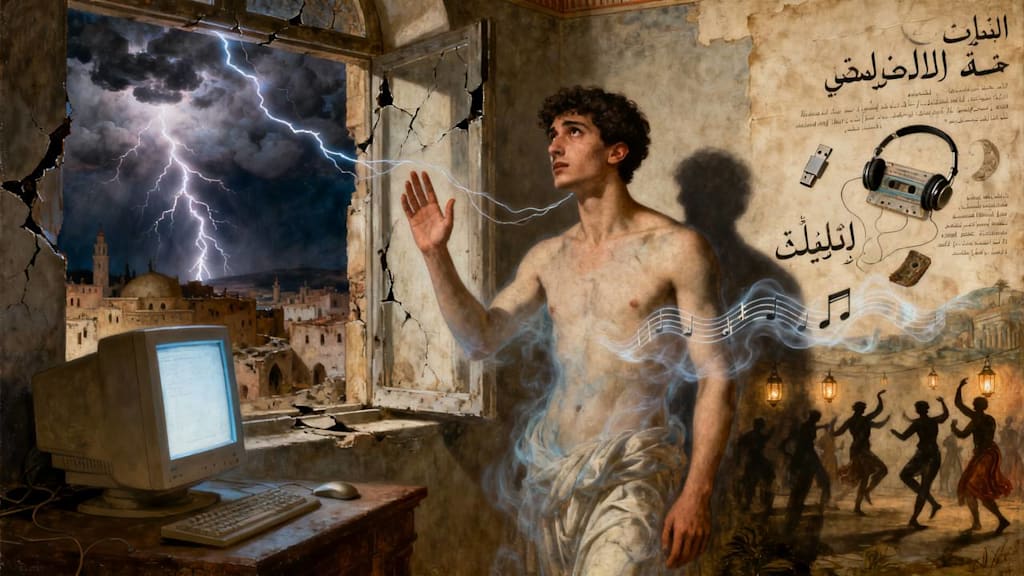
Before I start writing, I always open YouTube and search for a song or a soundtrack to listen to. Today, I found a song I used to hear during my childhood. Back then, as a Moroccan child, I did not understand the lyrics at all - I was only fascinated by the feeling of the song itself. It felt as if the child within me chose what to listen to instinctively.
In my environment, most of the music around me was limited to familiar themes in Darija. People rarely listened to music to understand it deeply; they listened only to dance, escape, or enjoy the vibe. Music, in our culture, often loses its spiritual and emotional depth and becomes only entertainment.
Yet this does not mean our culture lacks great music. Morocco has legendary musical movements such as Nass El Ghiwane, whose influence reached far beyond the country itself - even filmmakers like Martin Scorsese spoke about their artistic power. Across the Arab world and Africa, there are also classical Egyptian songs and intellectual musical works filled with poetry, philosophy, symbolism, and emotional depth.
The problem was never truly in the music itself, but in the ears of the people listening to it. Many hear music only through rhythm and habit, not through reflection or consciousness.
When I began exploring music more consciously, I found many songs glorifying poverty, suffering, emotional misery, and social despair. Even at the age of ten, I felt disconnected from that atmosphere. I knew I could not fully belong to it.
Back then, I had a friend who felt more like a brother to me.
My family owned a simple computer with only 256 MB of RAM, and that friend was older than me, more experienced with music, technology, and the internet.
One day, he introduced me to English music. As far as I remember, one of the first songs he showed me was "Bring Me to Life" by Evanescence.
At that time, I did not understand the lyrics or even the meaning behind the song, but I was certain about one thing: the voice carried something powerful within it.
I kept listening to that song repeatedly, trying to understand the emotions hidden inside the sound itself.
Later, I bought a USB drive and went to him saying, "My brother Iniss, install some English songs for me."
He smiled and answered jokingly, "You'll get yourself into trouble with the people here."
And in some way, he was right.
In my hometown, the image of an intellectual person was often connected to speaking French.
There is a hidden trauma in many post-colonial societies - a kind of colonial paradox. Even after independence, many people still unconsciously associate intelligence, refinement, and social value with the language and culture of the former colonizer.
It is as if political independence arrived, but mental independence remained unfinished.
Because of that, people who spoke French were often automatically seen as educated or intellectually superior, while others were judged differently.
Maybe that is why discovering English music felt strange and liberating to me at the same time. I was not searching for superiority or another identity - I was searching for resonance, for something that could speak to the inner world I carried silently within myself.
I started listening to English songs every day, dancing alone in my room for hours while trying to capture the sound, the atmosphere, and the architecture of the music itself.
As days passed, my friends and classmates began noticing the difference in me. Some of them even envied me simply because I listened to something unfamiliar to them.
Ironically, I still listened to the same songs they played around me, but in many of them, I only heard voices dragging people toward misery, resignation, and emotional emptiness.
One day, I openly told them that I did not connect with that kind of music.
What I searched for instead was philosophical art - songs that carried thought, emotion, symbolism, or spiritual depth, no matter the language.
It did not matter whether the voice came from Morocco, the Middle East, England, France, or anywhere else. In every nation, I found similar invisible threads hidden inside classical and folkloric music.
I began exploring Maghrebian music, Middle Eastern classics, English rock, French songs, and many other sounds from different cultures.
At that time, I did not care about language differences, and honestly, I still do not.
Because beyond language, music carries something older and more universal - a human echo that speaks directly to the soul.
I learned to live like a fool here, because in certain places you cannot survive by being completely honest about who you are. You have to play your cards carefully.
Too many eyes watch every light, waiting for the moment it shines too brightly so they can extinguish it.
Back then, I was only a light - or perhaps a void capable of containing the darkness people carried within themselves.
Inside that inner void, I created my own realm, a silent space where I could absorb what the outside world could not understand.
As time passed, I slowly became like a phantom. Not because the world forced me to disappear, but because part of me chose invisibility.
And even now, I still feel like that distant ghost people fear without truly understanding.
And today, before writing, I opened YouTube once again, and another old song from my childhood appeared before me: "Titanium" by Sia.
This time, I was no longer the child who listened only to the emotion of the sound. I could finally hear the words clearly.
"I'm bulletproof, nothing to lose."
And suddenly, a strange question crossed my mind:
How could a bullet ever kill a phantom?
A phantom is already beyond the reach of ordinary violence. You cannot truly destroy what has already learned how to disappear.
Then I thought about the phrase "nothing to lose."
No - there is never truly "nothing."
Even within emptiness, something still exists. A void is not the absence of existence; sometimes it is the space capable of containing everything.
Maybe that is why I always felt connected to storms, thunder, and silence.
As if raising my finger toward the sky was not an act of rebellion, but an unconscious desire to command lightning itself - to call something greater than language into existence.
A strike of thunder feels less like destruction and more like an order descending from the heavens:
"Be."
About the Creator
LUCCIAN LAYTH
L.LUCCIAN is a writer, poet and philosopher who delves into the unseen. He produces metaphysical contemplation that delineates the line between thinking and living. Inever write to tellsomethingaboutlife,but silences aremyway ofhearing it.
Enjoyed the story? Support the Creator.
Subscribe for free to receive all their stories in your feed.
Comments
There are no comments for this story
Be the first to respond and start the conversation.